Dead Brand Stories / Pan Am
What Happened to Pan Am?
The airline that taught the world to fly was allowed to fly everywhere on Earth except home — and debt, desperate sales and a bomb brought it down.
Opening statement
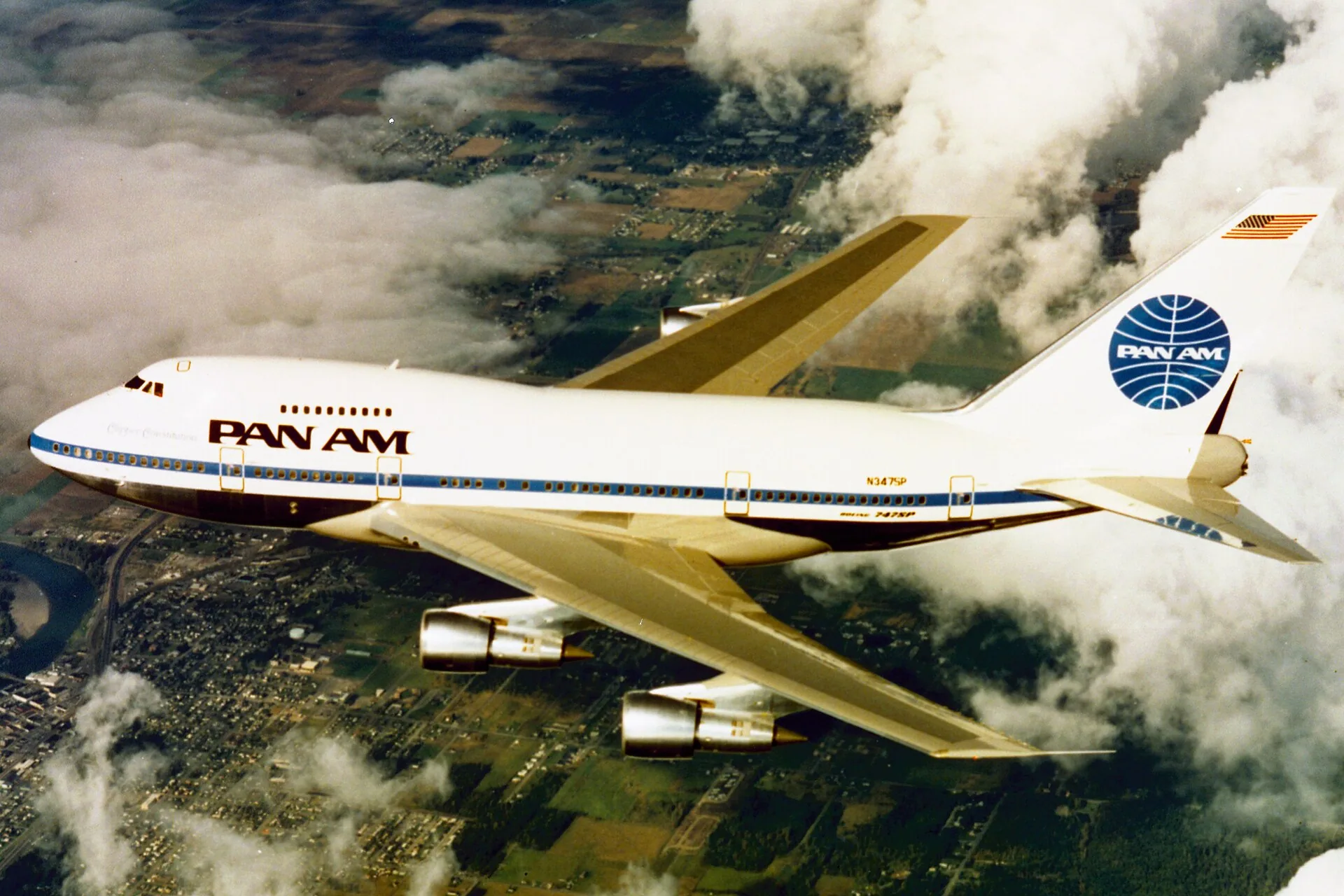
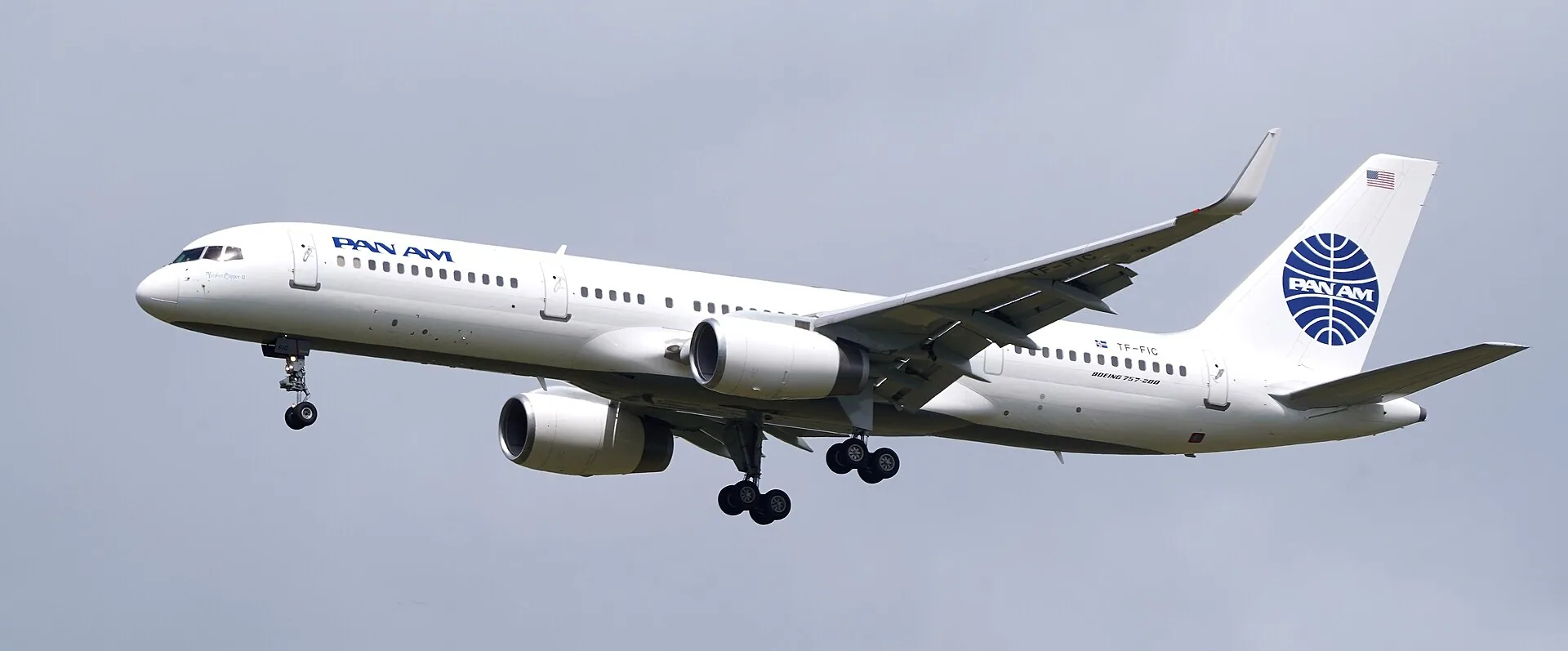
In June 2025, travelers paid at least 59,950 dollars each for a twelve-day trip on a jet painted in Pan Am colors. It was a tour — hotels and meals included, aboard a Boeing 757 operated by Icelandair, carrying fifty guests along the old transatlantic routes. The strange part is the date: the original Pan Am had been dead for thirty-four years. This is the story of the airline that taught the world to fly. It began in 1927 with a mail contract across ninety miles of water, invented the romance of the Clipper, launched both the 707 and the 747, and at its peak carried eleven million passengers a year to eighty-six countries. Then the world it had created — cheap fuel burned, borders deregulated, rivals unleashed — turned on it, and on a December morning in 1991 the most famous airline on Earth opened for business and shut down within hours. This account is drawn from the record: the airline's documented history, the official record of Flight 103, and contemporary reporting. One distinction is kept throughout, because everything after 1991 depends on it: the original airline is dead. The name is not — it survives as a license, a livery, and a comeback attempt still awaiting permission to fly.
A structured case history
Reading section 01
Watch: Dead Brands No. 3, the short — "What Happened to Pan Am?"
Reading section 02
The Rise of Pan Am
Pan American Airways was founded on 14 March 1927, by two United States Army Air Corps majors, Henry Arnold and Carl Spaatz. Washington feared a German-backed airline was positioning itself near the Panama Canal, and it wanted an American carrier in the Caribbean first. The prize was a mail contract: Key West, Florida, to Havana, Cuba — ninety miles of water. Pan Am won the contract, and then discovered it had no airplane, and no landing rights in Cuba. Days before the deadline, three rival companies pooled their efforts, chartered a floatplane, and on 19 October 1927 flew the first contract mail run to Havana. The merged company took shape in June 1928, and its operating chief was Juan Trippe. He would run Pan Am for forty years.
Washington treated the airline as its chosen instrument — America's flag carrier before America officially had one — and shielded it from competition. Trippe pushed south first: mail contracts, landing rights, and in 1929 a partnership with the Grace shipping line, Panagra, that opened the west coast of South America. Then came the flying boats. From 1931, Pan Am's Clippers island-hopped the Caribbean and Latin America out of Dinner Key, Miami. Every aircraft carried a Clipper name, and the crews wore naval-style uniforms: ocean travel, dressed for the sky.
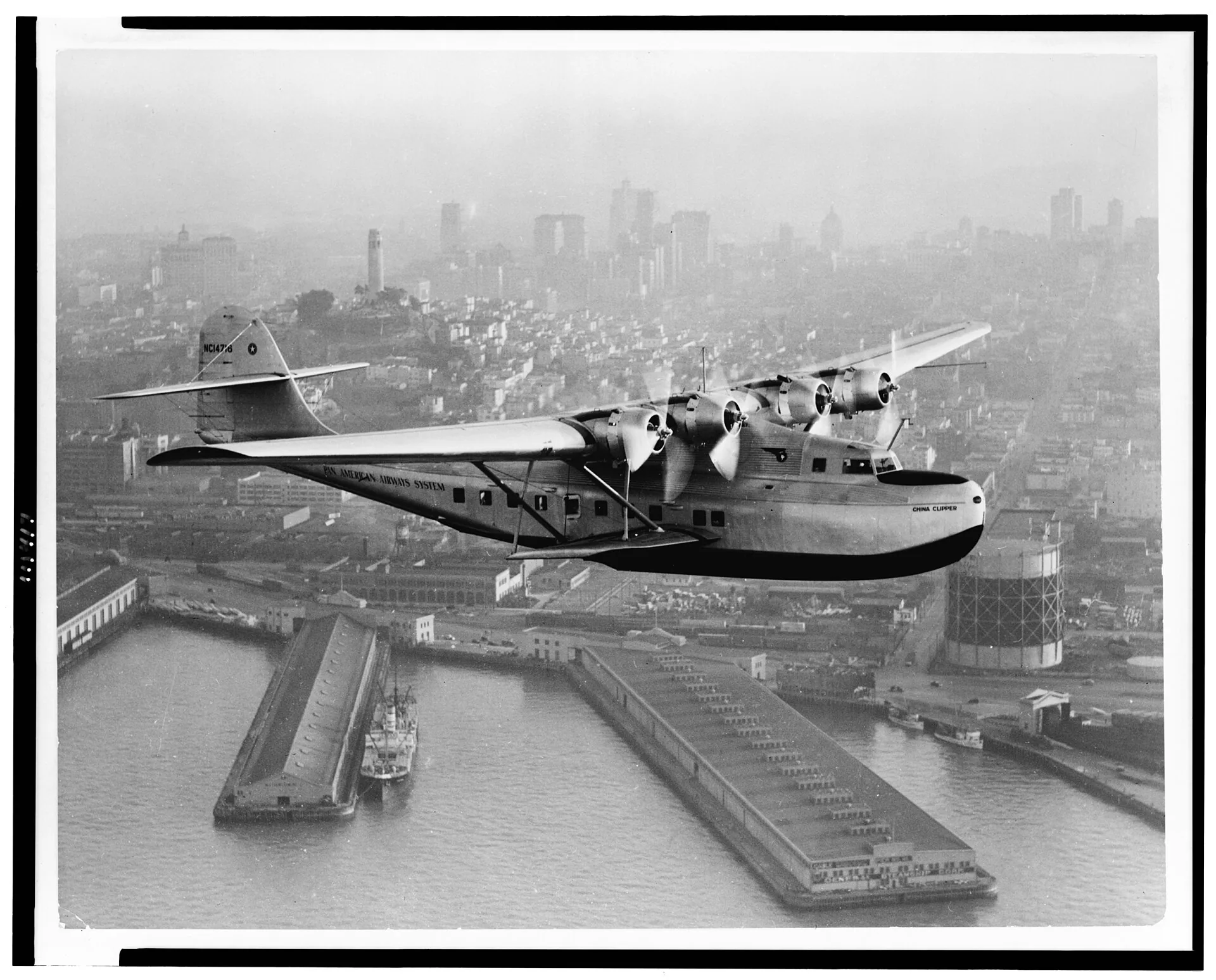
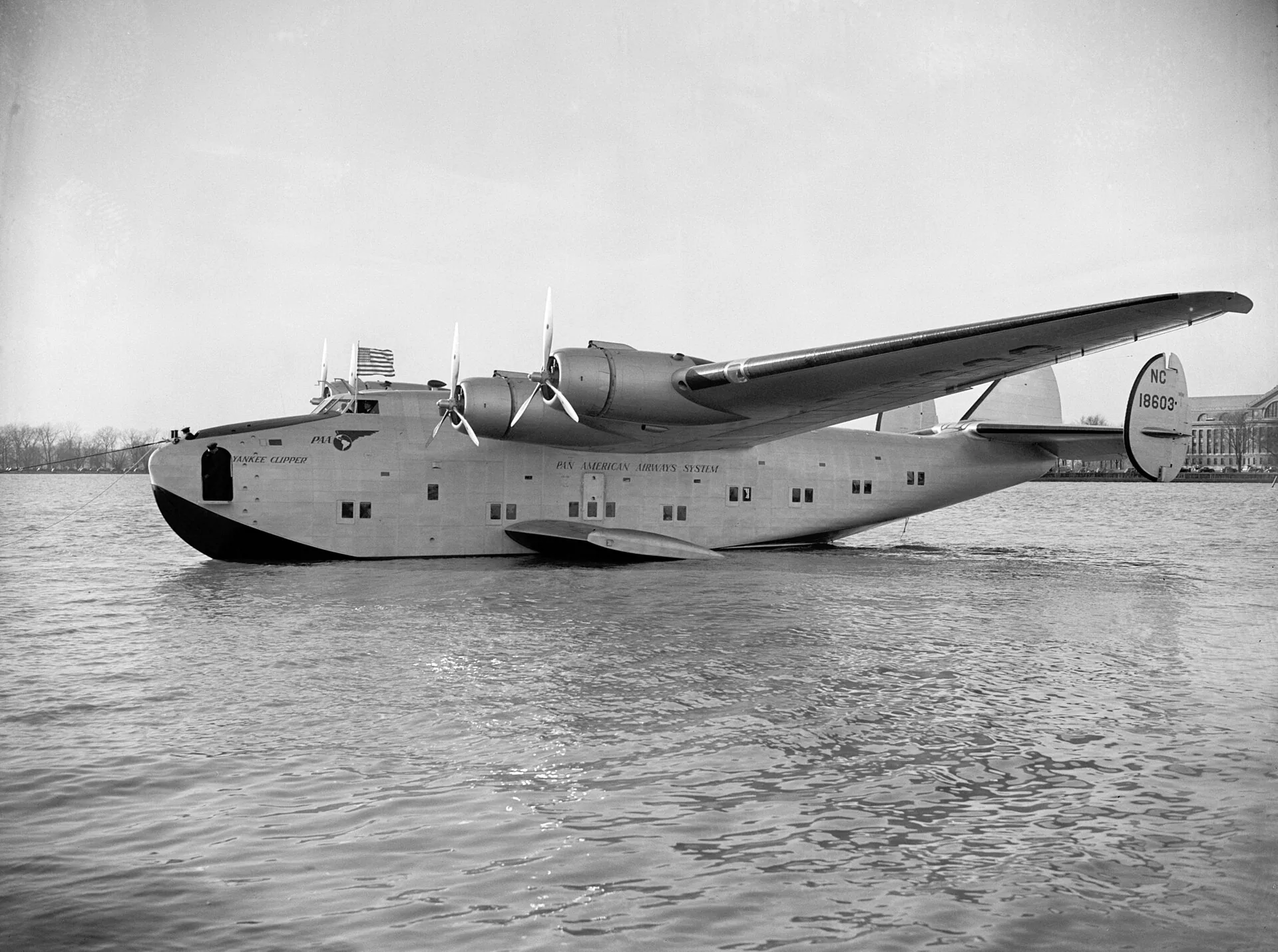
The Pacific was built speck by speck. In 1934 Trippe negotiated the landing rights — Pearl Harbor, Midway, Wake, Guam, Manila — and in March 1935 a chartered freighter carried five hundred thousand dollars in equipment and construction crews west, island by island, to clear coral, raise hotels and string radio beacons. On 22 November 1935, the flying boat China Clipper carried the first transpacific mail from California to Manila — eight thousand miles, in five hops. A crossing that had taken up to six weeks by steamship now took six days. Passengers followed in October 1936. In 1937, Pan Am's survey flights crossed the North Atlantic for the first time, and in 1939 the giant Boeing 314 Clippers opened passenger service across the Atlantic.
When war came, the Clippers went into military service; Pan Am flew more than ninety million miles in support of the war effort, and under a secret program its subsidiary built and improved airfields across Latin America and the Caribbean for Washington, disguised as the airline's own work. Weeks after Pearl Harbor, one Clipper, cut off by the fighting, flew home the long way around the world — the first circumnavigation of the globe by a commercial airliner, completed by accident. In January 1943, Franklin Roosevelt flew to Africa aboard a Pan Am Clipper — the first American president to fly abroad while in office.
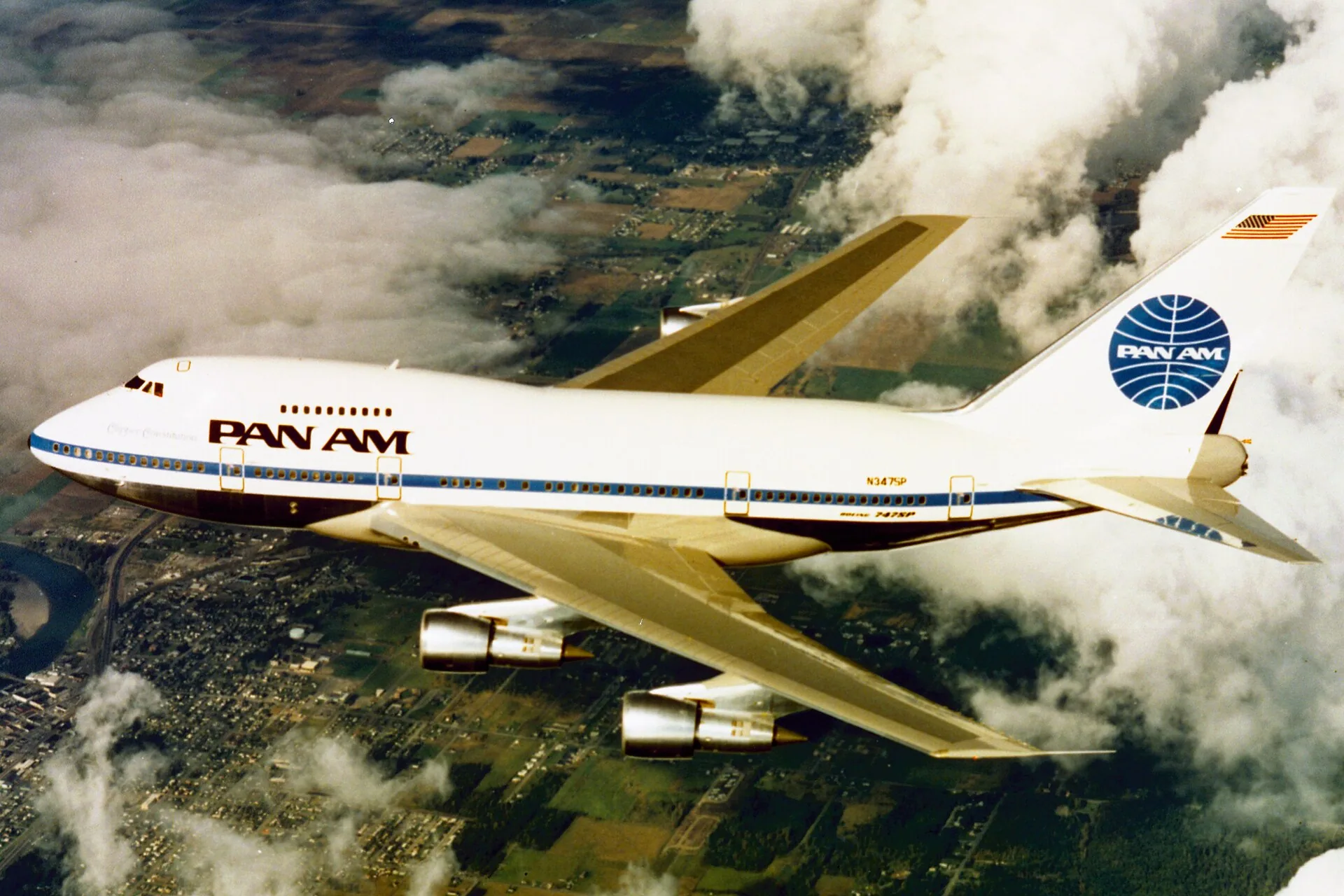
Peace made Pan Am bigger, but not safer: Washington began encouraging rivals, and the near-monopoly started to crack. In June 1947 it launched the first scheduled round-the-world airline service, and in 1950 the company took the name the world would know it by: Pan American World Airways. Its Stratocruisers had sleeping berths and a lower-deck lounge — flying was still an occasion, and Pan Am meant to keep it that way; in 1946 Trippe had even founded the InterContinental hotels, so that wherever a Pan Am flight landed, a Pan Am bed waited. Trippe bet on jets early: in 1955 Pan Am became the launch customer for Boeing's 707, and on 26 October 1958 it flew its first scheduled jet service, New York to Paris. In 1964 it switched on one of the first computerized reservation systems ever built. Then, in April 1966, Trippe ordered twenty-five Boeing 747s — a 525 million dollar wager on an airplane that did not yet fly. On 21 January 1970, after her sister ship broke down before departure, Clipper Victor opened the jumbo age, flying from New York to London. Pan Am built the temples of the jet age too: the Pan Am Building in Manhattan, then the largest office building of its kind in the world, and the Worldport at Kennedy Airport — a terminal under a four-acre roof, built so passengers could board without getting wet.
Visual interlude
Reading section 03
The Peak
At its peak, the numbers were unreal. In 1970, Pan Am carried eleven million passengers to eighty-six countries — every continent except Antarctica. At the end of the 1960s it held a billion dollars in cash reserves. Its cabin crews were multilingual, often college graduates; its dining was modeled on Maxim's of Paris. It called itself the world's most experienced airline — and for once, the slogan was simply true. For years, more passengers boarded Pan Am flights at Berlin's Tempelhof Airport than at any station it served: the airline was West Berlin's lifeline, as much as America's. In 1968, after forty-one years in command, Juan Trippe stepped down — gone before the 747 he had ordered ever carried a passenger.
Underneath, though, the map had a hole in it. Pan Am flew everywhere on Earth except the one place it needed most: the United States itself. For decades, regulators refused to let it build a domestic network, or merge with a domestic airline. Its passengers landed in New York or Miami, stepped off the most famous airline in the world — and continued their journeys on somebody else's.
Visual interlude
Reading section 04
The Fall of Pan Am
The nineteen seventies hit from every side. The 1973 oil crisis sent fuel prices soaring, just as Pan Am's giant new 747s arrived into a slowing economy — too many seats chasing too few passengers. By 1976, the airline had piled up 364 million dollars of accumulated losses, and close to a billion dollars of debt. Only a brutal round of cuts — routes, jobs, wages — pulled it back to profit by 1977.
Then, in 1978, deregulation rewrote the rules. The domestic giants were suddenly free to fly Pan Am's international routes — carrying the feeder networks Pan Am had always been denied. Pan Am needed an American network, fast. It fought a bidding war for National Airlines, and won — at a price. In January 1980 it paid 437 million dollars for National: an airline whose routes barely fed Pan Am's gateways, whose fleet barely matched, and whose crews had to be raised to Pan Am pay. Revenue jumped — up 62 percent in a year. Fuel costs jumped faster, up 157 percent. And the debt from the purchase never went away.
To pay for survival, Pan Am began selling the furniture. In November 1980 it sold the Pan Am Building itself — its own headquarters, its name in lights above Manhattan — to MetLife for 400 million dollars. The InterContinental hotel chain went the following year. And in April 1985 came the deepest cut of all: the entire Pacific division — a quarter of the whole route system, built over fifty years — sold to United Airlines for 750 million dollars. Each sale bought time. Each sale also made the airline smaller than the debt it was trying to outrun. In October 1986 Pan Am bought the Shuttle, flying the Boston–New York–Washington corridor for 100 million dollars; business travelers loved it, but a corridor could not replace a network. And by the third quarter of 1988, there were real signs of a turnaround: the most profitable quarter in the company's history.
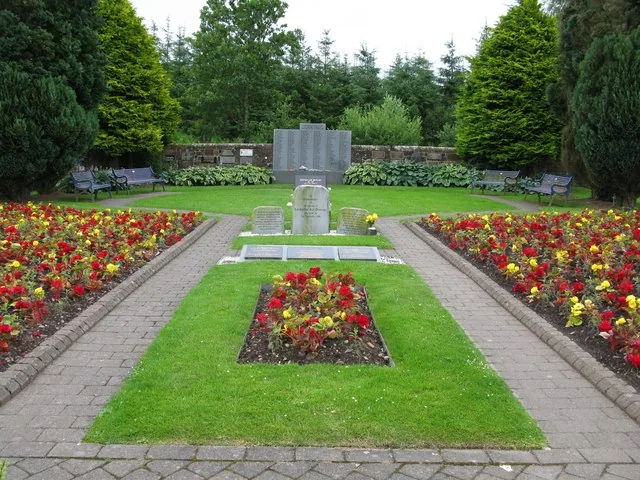
Then came the night that ended the argument. Flight 103 began that day, 21 December 1988, in Frankfurt — a feeder flight carrying passengers and baggage on to London, where the 747 Clipper Maid of the Seas waited. She left Heathrow at twenty-five past six. Thirty-eight minutes later, at thirty-one thousand feet, a bomb hidden in a radio cassette player in a suitcase in the forward hold exploded. Two hundred and fifty-nine people aboard, and eleven on the ground, were killed.
The bombing brought lawsuits — and official findings of security failures; in 1992, with the airline already gone, a U.S. federal court found Pan Am guilty of willful misconduct for never carrying out the baggage-matching program Washington had ordered. Bookings collapsed. The criminal trial came only in 2000, when a Scottish court sitting in the Netherlands convicted one Libyan officer and acquitted the other; in 2003 Libya paid over two billion dollars in compensation.
Even then, Pan Am tried one last fix: in June 1989, a 2.7 billion dollar bid for Northwest Airlines — one final attempt to buy the domestic network it had always needed. It was outbid. In 1990, war in the Gulf sent fuel prices climbing again, and emptied the transatlantic routes that were Pan Am's lifeline. Pan Am sold its London Heathrow routes to United — the London routes alone fetched 290 million dollars in cash — and its Berlin routes to Lufthansa: 1.2 billion dollars of its own map, sold in a single season to stay alive. On 8 January 1991, Pan Am filed for Chapter 11 bankruptcy protection.
Delta Air Lines stepped in as the rescuer. It bought the remaining European routes, the Shuttle, forty-five jets and the Worldport for 416 million dollars, and put 100 million dollars into a reorganized Pan Am for a 45 percent stake. The smaller airline relaunched from Miami that November — and lost money from its first day. To keep flying, it needed one final payment from Delta: 25 million dollars.
STAT CARD One billion dollars in cash → one unpaid 25 million dollars At the end of the 1960s Pan Am held a billion dollars in cash reserves. In December 1991 it died waiting for a final 25 million dollar payment that never came.
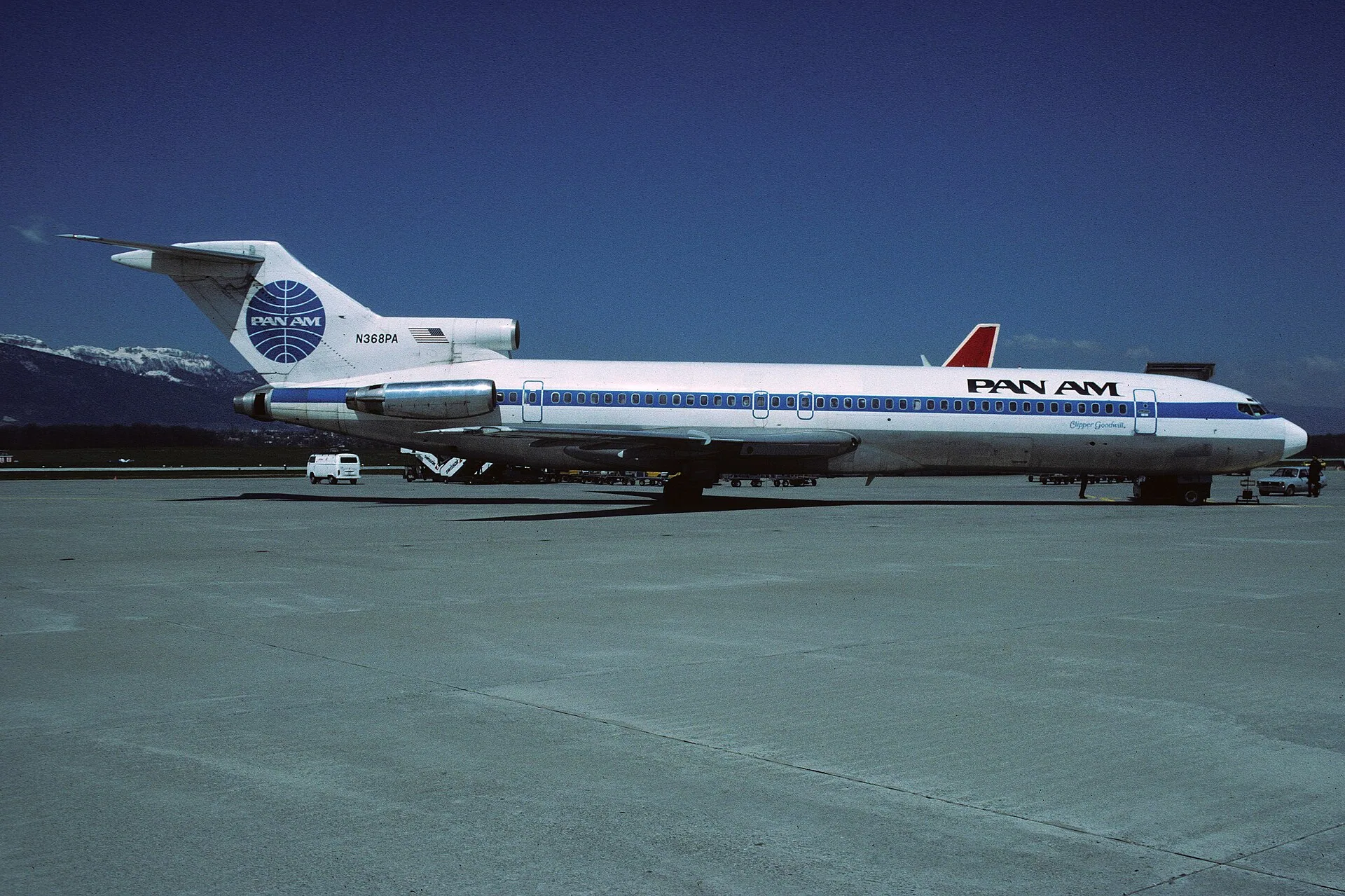
In the first week of December, Delta decided not to pay. On the morning of 4 December 1991, Pan Am opened for business — and shut down within hours. Some 7,500 employees lost their jobs. The last scheduled flight, Flight 436 from Bridgetown, Barbados, landed in Miami that afternoon, flown by the Boeing 727 Clipper Goodwill. When it closed, Pan Am's trademark was reported to be the second most recognized on Earth. The airline was gone anyway.
Visual interlude
Reading section 05
The Afterlife
The name was sold at a bankruptcy-court auction in December 1993, and the resurrections began. A new Pan Am flew from 1996 to 1998. Another, based in New Hampshire, flew from 1998 to 2004. A Texas attempt in 2010 failed. The name even spent years painted on freight trains, after a railway company bought the rights in 1998. Mostly, the name became a license: watches, bags, clothing — the blue globe, worn as fashion. The Worldport stood on for twenty-two years after its airline died; Delta used it, then emptied it, and in 2013 the flying saucer came down. One piece of the original company still operates: its flight academy in Miami, training pilots under the Pan Am name to this day — the only surviving division of the original airline.
In February 2024, an investor group led by Craig Carter bought the trademark, through Pan American Global Holdings. And in June 2025, the circle closed: the Icelandair 757 in Pan Am colors, fifty guests, twelve days — the tour this story began with. That October, Pan American Global Holdings and Avi8 Air Capital say they have begun seeking federal certification to fly Pan Am again, with a planned Miami base. No certificate, no routes and no launch date have been confirmed.
Visual interlude
Reading section 06
The Verdict
So — is Pan Am dead? The airline: yes, since 4 December 1991. Everything since has been the name, worn by smaller companies with smaller dreams. What killed it was not one villain. It was a structure: an airline allowed to fly everywhere except home — which bought its way into debt, sold its way into smallness, and then met a bomb and a war it could not survive. Pan Am taught the world to fly. It just could not survive the world it created.
Visual interlude
Reading section 07
Timeline
Visual interlude
Reading section 08
Sources & image credits
Sources. The airline's history, founding, Clipper era, jets, peak, decline and afterlife — Wikipedia, "Pan Am" (read in full for this production, 2026-11-07), including: the 1927 founding and first contract flight; Panagra (1929); the Pacific build of 1934–35 and the China Clipper's 22 November 1935 mail flight; the wartime Airport Development Program and the Pacific Clipper's accidental circumnavigation; the 1947 round-the-world service; the 1966 order of 25 Boeing 747s for 525 million dollars; the 1970 peak (11 million passengers, 86 countries); cash reserves of one billion dollars (late 1960s); the 1976 position (364 million dollars accumulated losses, debts approaching one billion dollars); the National Airlines acquisition (437 million dollars, completed January 1980; revenues +62 percent, fuel costs +157 percent); the Pan Am Building sale (November 1980, 400 million dollars, to MetLife); the Pacific division sale (April 1985, 750 million dollars, 25 percent of the route system); the third quarter of 1988 as the most profitable quarter in company history; the June 1989 Northwest bid (2.7 billion dollars); the 1991 asset disposals (1.2 billion dollars in total); the Delta transaction (416 million dollars for the remaining European routes, the Shuttle, 45 jets and the Worldport, plus 100 million dollars for 45 percent of the reorganized airline); the final 25 million dollar installment and the shutdown of 4 December 1991; Flight 436 as the last scheduled operation; and the reported second-most-recognized trademark at closure. The 2025 tour — Criterion Travel's "Tracing the Transatlantic" (June 2025), as reported by AirlineGeeks (17 June 2025) and FOX 5 NY and logged in the episode Fact Log: a 12-day tour, hotels and meals included, aboard an Icelandair-operated Boeing 757 in Pan Am livery, capped at 50 guests, 59,950 dollars per person double occupancy (65,500 dollars solo); no source confirms a sell-out, so none is claimed. The trademark purchase — CNN Travel (2025): in February 2024 a group of investors led by Craig Carter bought the Pan Am trademark and its related intellectual property; the licensing program runs through Pan American Global Holdings. The relaunch claim — Avi8 Air Capital / Pan American Global Holdings reporting (AirGuide, Simple Flying, FlightGlobal, ch-aviation, October 2025): an FAA Part 121 certification process is said by the companies to have been initiated; the FAA has not confirmed it, and no certificate, routes or launch date are confirmed. Lockerbie — AAIB Report 2/1990 and Wikipedia, "Pan Am Flight 103": Flight 103 (Boeing 747-121, Clipper Maid of the Seas), destroyed by a bomb in a radio cassette player in the forward hold, 21 December 1988; 243 passengers and 16 crew aboard, 259 killed aboard and 11 on the ground; the trial court's conclusions on the suitcase's route (Malta, Frankfurt feeder, loaded unaccompanied at Heathrow); the 1992 U.S. federal court finding of willful misconduct; the 2000 Camp Zeist trial (one convicted, one acquitted); Libya's compensation of over two billion dollars (2003). The London-routes price — Foreign Claims Settlement Commission decision, Abbott Group v. Libya (290 million dollars in cash for the London routes and other property sold to United), with the Bermuda II context (only Pan Am and TWA of U.S. carriers at Heathrow). Postwar airfield construction — U.S. Army AMEDD, History of the South Atlantic Area, and U.S. Department of State, FRUS 1946 vol. XI (the Airport Development Program, run through Pan Am and its subsidiaries "as a cloak").
Image credits (all via Wikimedia Commons; licenses as logged at download, November 2026):
Dates. Published: 2026-11-09 · Last verified: 2026-11-07 · Updated: 2026-11-09
Author: Ronin Naodhinsuk
Pan Am, Pan American Global Holdings, Avi8 Air Capital, and all other brand names and logos mentioned in this article are trademarks of their respective owners. The Record Institute is an independent archive and is not affiliated with, endorsed by, or connected with Pan Am, Pan American Global Holdings, or any successor owner of the brand.
Next episode → No. 4: What Happened to Sears?
Video Archive
What Happened to Pan Am?
Related Articles
- Borders — What Happened to Borders?
- Tower Records — What Happened to Tower Records?
- Compaq — What Happened to Compaq?