The Time Traveller’s Dossier: 1983 Delco-GM/Bose Music System Vintage Advertisement — The Anthropomorphic Architecture of Sound
The History
To fully comprehend the gravity of this advertisement, one must transport themselves to the automotive landscape of the early 1980s. For decades, the car radio was treated as an afterthought—a generic metallic box slotted into the dashboard, pushing a narrow band of frequencies through paper-cone speakers that were haphazardly mounted into the doors or rear deck. The resulting audio was entirely at the mercy of the car’s inherently hostile acoustic environment: glass windows that fiercely reflected high frequencies, and plush velour or leather upholstery that aggressively absorbed the low end.
The 1983 model year marked a geological shift in this paradigm, heralded by the unprecedented partnership between Delco Electronics (the technological arm of General Motors) and the Bose Corporation. Amar Bose, a professor at the Massachusetts Institute of Technology (M.I.T.), had built his company on the rigorous, mathematical study of psychoacoustics—the science of how the human brain perceives sound. The Delco-GM/Bose Music System was not merely an upgrade; it was a bespoke, factory-installed acoustic ecosystem.
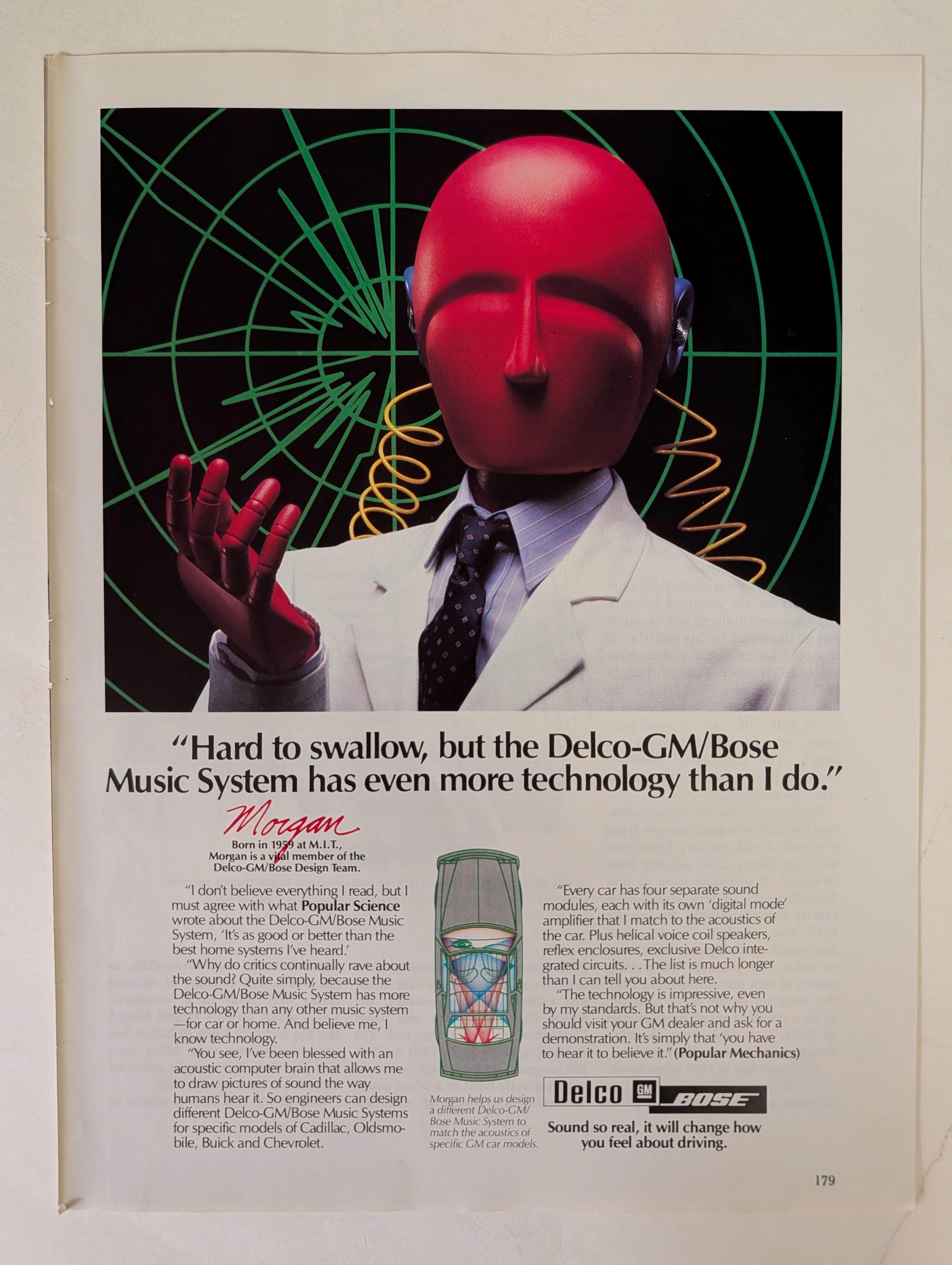
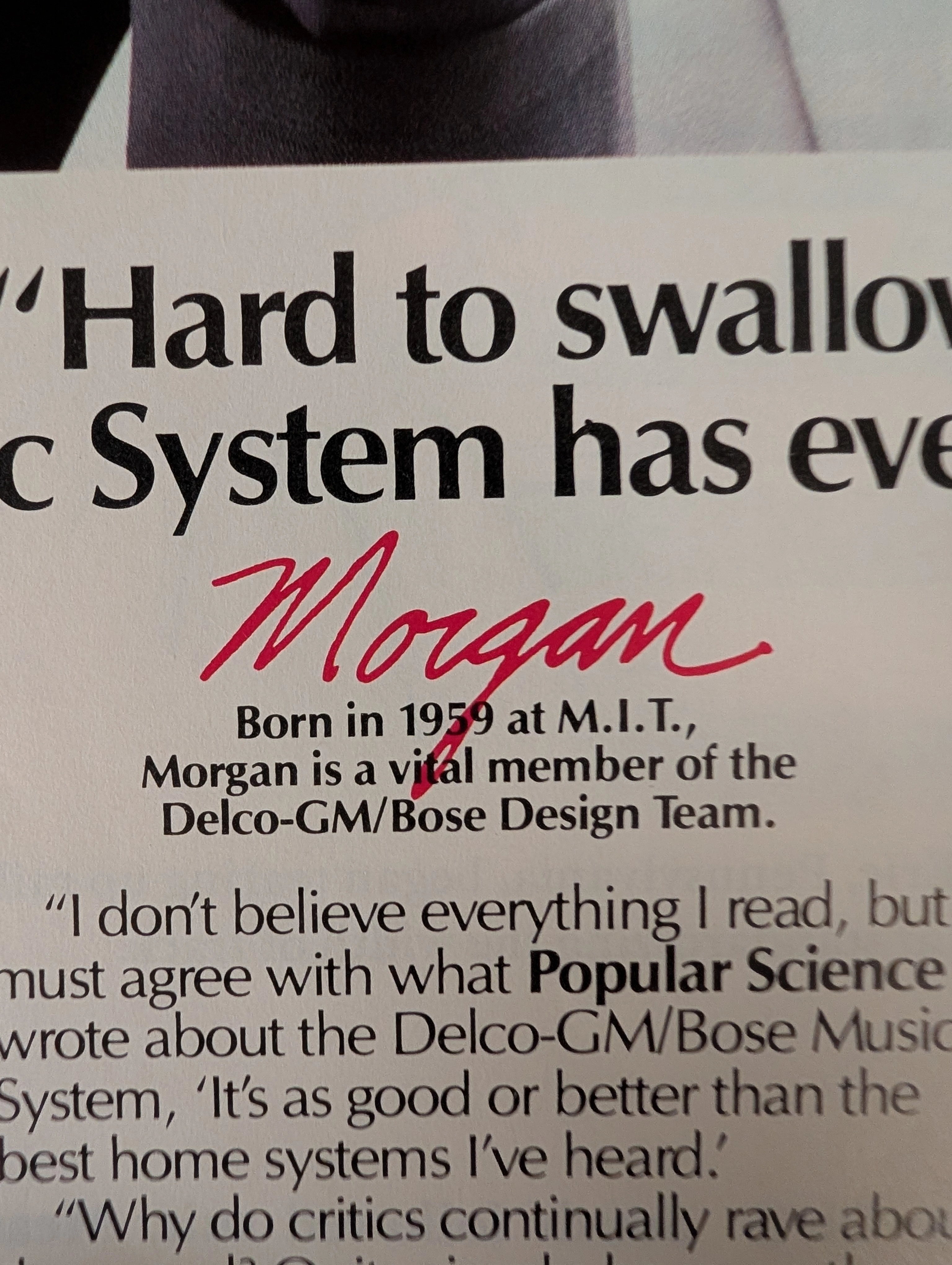
This advertisement introduces the public to "Morgan," an anthropomorphic representation of the intricate acoustic measurement systems utilized by the design team. The text proudly notes that Morgan was "Born in 1959 at M.I.T.," a direct nod to the foundational research years of Dr. Bose. In the real world, "Morgan" was essentially a highly sophisticated binaural recording dummy—a mechanical head outfitted with specialized microphones situated within artificial ear canals. By placing this dummy inside the pre-production cabins of specific General Motors vehicles—such as the Cadillac Seville, Oldsmobile Toronado, Buick Riviera, and Chevrolet Corvette—engineers could map the exact sonic reflections and absorptions of the interior.
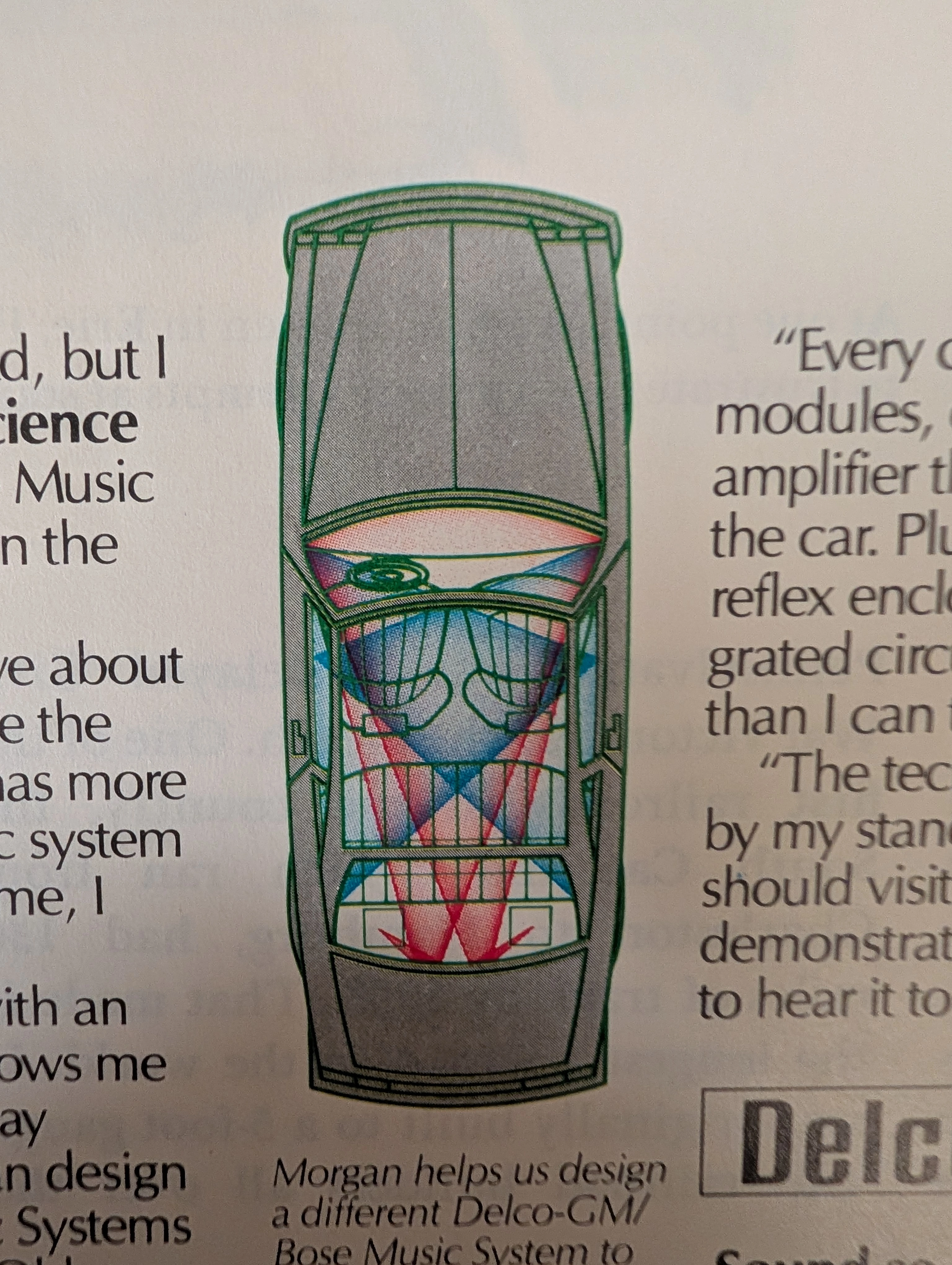
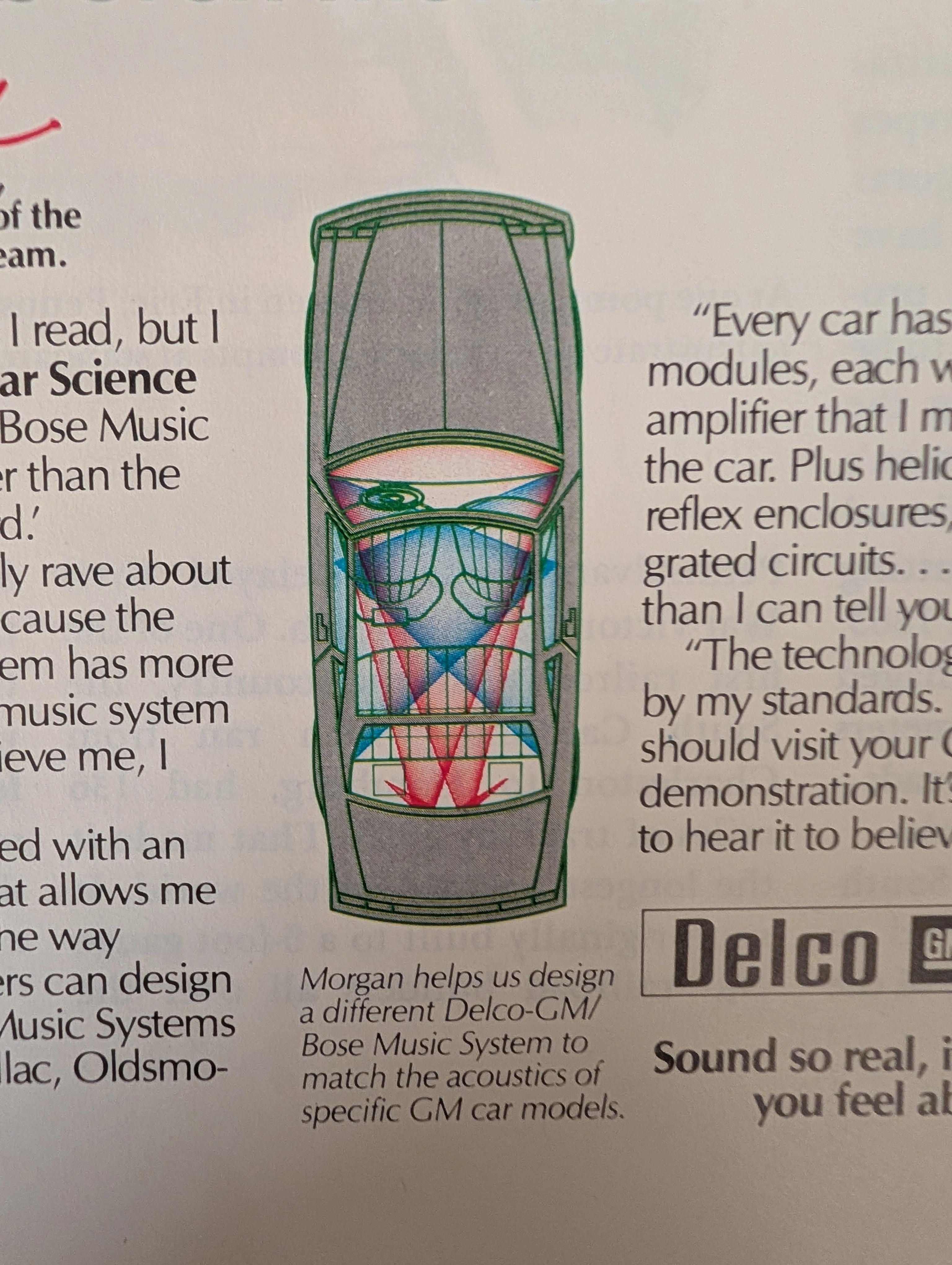
The resulting data allowed the team to construct a system where every car model received its own unique set of equalization parameters. As the ad copy technically details, the system utilized "four separate sound modules, each with its own 'digital mode' amplifier," paired with "helical voice coil speakers" and "reflex enclosures." This was a staggering level of technological integration for the era. The campaign was designed to educate an affluent consumer base, communicating that high-end, home-quality stereophonic reproduction was no longer confined to the living room. It was now available at 65 miles per hour.
The Paper
From an archival standpoint, examining the physical properties of this document reveals the specific print chronologies of 1980s mass-market periodicals, such as Popular Science and Popular Mechanics, where this ad prominently featured.
The artifact is printed on standard, mid-weight, clay-coated magazine stock typical of the era. The clay coating (kaolinite) was essential for achieving the high-gloss finish required to make the rich, saturated inks pop—a necessity for luxury automotive marketing. However, the underlying paper fibers were predominantly mechanical wood pulp, which inherently retains a high concentration of lignin. Over the decades, exposure to ultraviolet light and atmospheric oxygen initiates an oxidation process in the lignin, leading to the faint, warm yellowing visible at the extreme margins of the page. This subtle patina does not detract from the piece; rather, it authenticates its provenance.
The printing technique employed is four-color web offset lithography (CMYK). When viewed under an archival loupe, the halftone dot matrix becomes vividly apparent, particularly in the smooth, continuous tones of Morgan's white suit and the gradients of the green radar-grid background. The registration—the precise alignment of the cyan, magenta, yellow, and black printing plates—is exceptionally tight, an indicator of the high production budget GM allocated for this campaign. The most technically demanding element on the page is the deep, semi-translucent ruby red of Morgan’s face. Achieving this specific hue required a heavy, perfectly balanced laydown of magenta and yellow inks, contrasted sharply against the stark black background, without suffering from ink bleed or offset onto the facing page.
The Rarity
While the Delco-GM/Bose campaign ran extensively across major American publications in the early 1980s, locating pristine, unblemished, full-page examples of this specific "Morgan" variant has become increasingly difficult for archivists.
Magazine ephemera from this decade was inherently disposable. Furthermore, the cross-disciplinary appeal of this specific advertisement accelerates its scarcity. It is actively sought by three distinct collector demographics: automotive historians focusing on the peak era of General Motors' luxury divisions; audiophiles curating the early corporate history of Bose and the evolution of high-fidelity sound; and retro-technology enthusiasts fascinated by 1980s representations of computing and artificial intelligence.
Most surviving copies exhibit significant flaws—spine creases from tight magazine bindings, moisture rippling, or severe acid degradation from poor storage environments. A specimen maintaining the structural integrity and vibrant chromatic punch of this particular page holds commendable museum value. It represents not just a product, but the genesis of the OEM (Original Equipment Manufacturer) premium car audio industry—a multi-billion dollar sector today.
Visual Impact
The art direction of this piece is a masterclass in 1980s corporate surrealism, designed to arrest the reader's attention through visual dissonance.
The focal point is, undeniably, Morgan. The entity is styled with an uncanny blend of the sartorial and the synthetic. Clad in a crisp, slightly oversized white suit, a pale blue Oxford shirt, and a conservative, subtly patterned tie, from the neck down, Morgan is the quintessential, trustworthy 1980s corporate engineer. However, from the collar up, the humanity vanishes into sheer technological abstraction. The head is a featureless, aerodynamic dome of glossy red, devoid of eyes or a mouth, possessing only the suggestion of a brow ridge and a nose. Blue, highly mechanical "ears" protrude from the sides, with bright yellow coiled wires descending like arteries, further emphasizing his nature as an "acoustic computer brain."
This aesthetic taps brilliantly into the era's fascination with—and slight apprehension of—artificial intelligence and computer modeling. Morgan resembles an avant-garde sculpture or a member of a synth-pop band, rendering the complex mathematics of psychoacoustics into an approachable, yet entirely alien, mascot.
Behind him, a glowing green vector-graphic overlay resembling a radar screen or an early oscilloscope output creates a halo effect. This firmly roots the image in the realm of high technology and military-grade precision.
The layout balances this striking central portrait with rigorous, scientific grounding. The bottom center of the page features a meticulously drafted diagram of a car cabin seen from above. Transparent, overlapping cones of red and blue geometrically illustrate how sound waves are projected and reflected toward the passengers, validating the ad's claims with visual "proof" of spatial engineering. The typography choices—a sophisticated, highly legible serif font for the body copy, juxtaposed against the fluid, humanistic red script of Morgan’s "signature"—perfectly encapsulate the campaign's core message: the harmonious synthesis of cold, calculating technology and passionate, deeply human artistic expression.
Exhibition Halls
The Archive Continues
Continue the Exploration
GE · Technology
The Time Traveller's Dossier: Capturing the Outlaw – The General Electric Flashcube and the Democratization of Amateur Photography
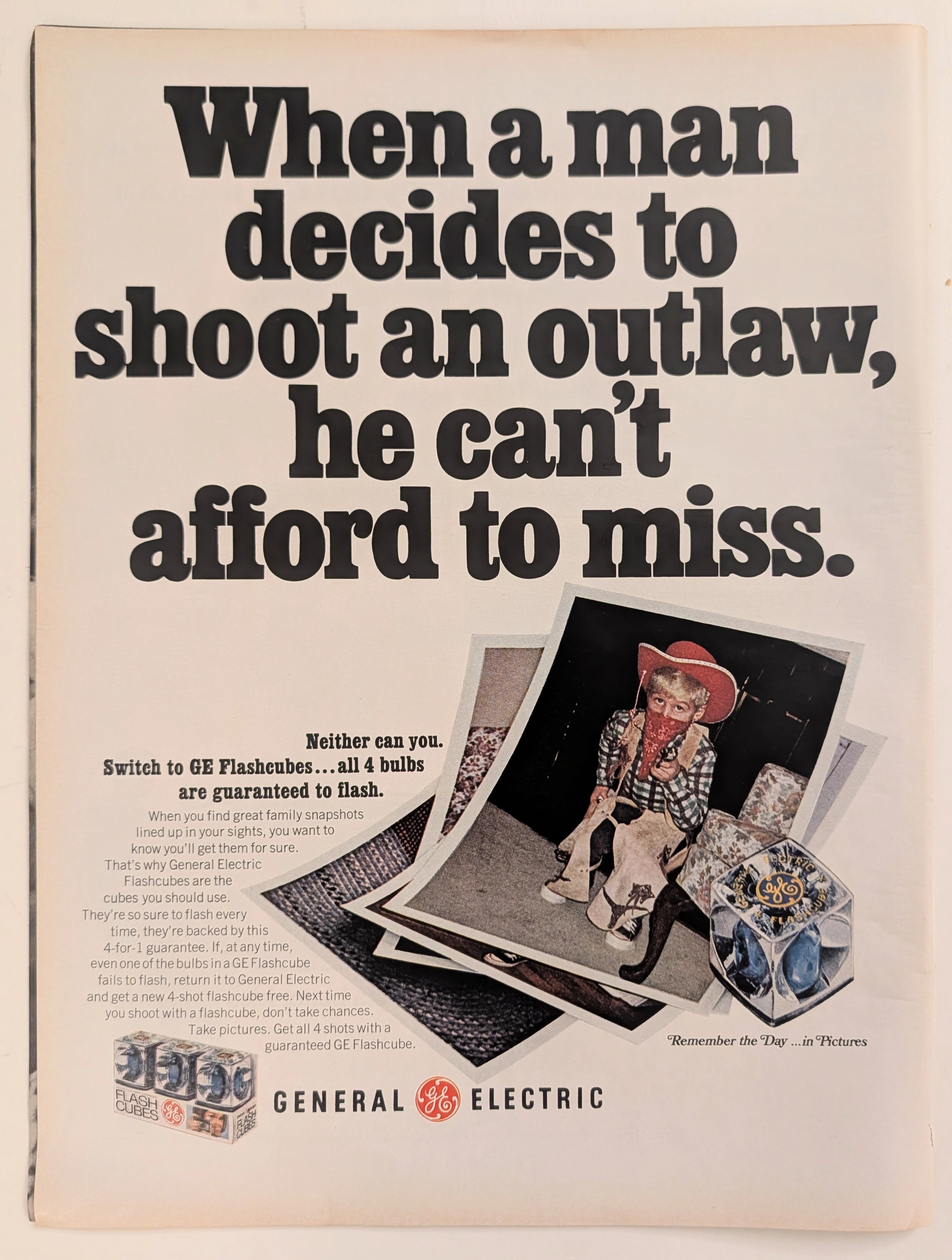
The evolution of twentieth-century domestic life and the archiving of the American family unit was fundamentally defined by the rapid, uncompromising advancement of accessible consumer photography. The historical artifact elegantly and securely positioned upon the analytical table of The Record Institute today is a striking, narrative-driven full-page print advertisement for General Electric (GE) Flashcubes. This document completely transcends the standard, utilitarian boundaries of photographic equipment marketing. It operates as a highly sophisticated, multi-layered cultural mirror, reflecting a precise era in consumer psychology where the anxiety of "missing the moment" was aggressively addressed by industrial innovation. By utilizing the playful, universally recognizable motif of childhood dress-up—a young boy costumed as an Old West "outlaw"—GE sought to reassure the mid-century parent that their technological consistency would never fail the spontaneous archiving of family history. This world-class, comprehensive dossier conducts a meticulous, unyielding, and exceptionally exhaustive examination of the artifact, operating under the absolute most rigorous parameters of historical, sociological, and material science evaluation. Dedicating the overwhelming majority of our analytical focus to its immense historical gravity, we will decode the brilliant marketing psychology embedded within the "shoot an outlaw" double entendre, analyze the profound sociopolitical impact of the Flashcube's invention on consumer behavior, and dissect the economic realities of the "4-for-1 guarantee." Furthermore, as we venture deeply into the chemical and physical foundations of this analog printed ephemera, we will reveal the precise mechanical fingerprints of the CMYK halftone rosettes captured in the stunning macro imagery of the GE logo. Finally, we will assess its archival rarity, exploring how the graceful, natural oxidation of the paper substrate cultivates a serene wabi-sabi aesthetic—a natural, irreversible phenomenon that serves as the primary engine driving up its market value exponentially within the elite global spheres of Vintage Commercial Ephemera and Technology Archives.
THE TIME TRAVELER'S DOSSIER: THE COMMODIFICATION OF STATUS AND THE ART OF THE ELEGANT ILLUSION
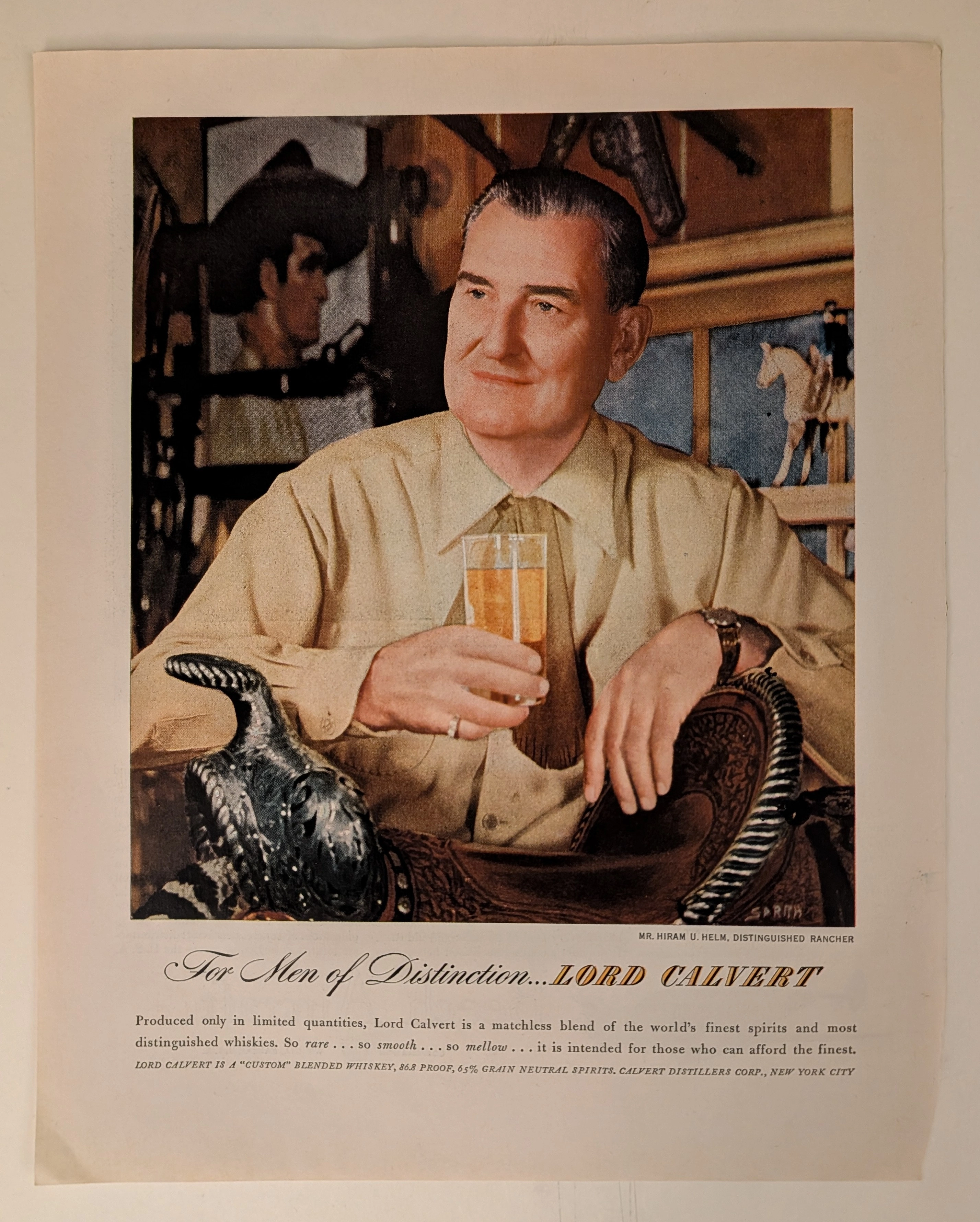
The artifact under exhaustive, uncompromising, and unprecedented museum-grade analysis is an exceptionally preserved Historical Relic originating from the absolute zenith of Madison Avenue's psychological marketing era (circa late 1940s to 1950s). This Primary Art Document is a monumental, full-page advertisement for LORD CALVERT, produced by the Calvert Distillers Corp., New York City. This piece represents the visual anchor for one of the most legendary, extensively studied, and phenomenally successful advertising campaigns in the history of American capitalism: "For Men of Distinction". It features a masterful, hyper-realistic portrait of Mr. Hiram U. Helm, Distinguished Rancher, deliberately painted/photographed to exude rugged sophistication, wealth, and aristocratic leisure. The artwork proudly bears the signature of SARRA (Valentino Sarra), a titan of mid-century commercial photography and illustration known for his cinematic lighting and profound character studies. This document is a profound "Sociological Blueprint of Aspirational Wealth." It masterfully utilized the psychology of exclusivity, marketing a blended whiskey composed of "65% Grain Neutral Spirits" as a "Custom" blend intended only "for those who can afford the finest". Rescued from the inevitable oblivion of disposable mass media, this mid-century analog artifact is a breathtaking embodiment of the Japanese aesthetic of wabi-sabi. Printed on inherently acidic wood-pulp paper, it exhibits a beautifully authentic, warm amber oxidation across its entire surface. This unstoppable molecular death transforms a piece of mass-produced corporate propaganda into an irreplaceable, ready-to-frame Primary Art Document of post-war sociological history.
THE TIME TRAVELER'S DOSSIER: THE AUTOMOTIVE ARISTOCRACY AND THE AESTHETICS OF RUIN
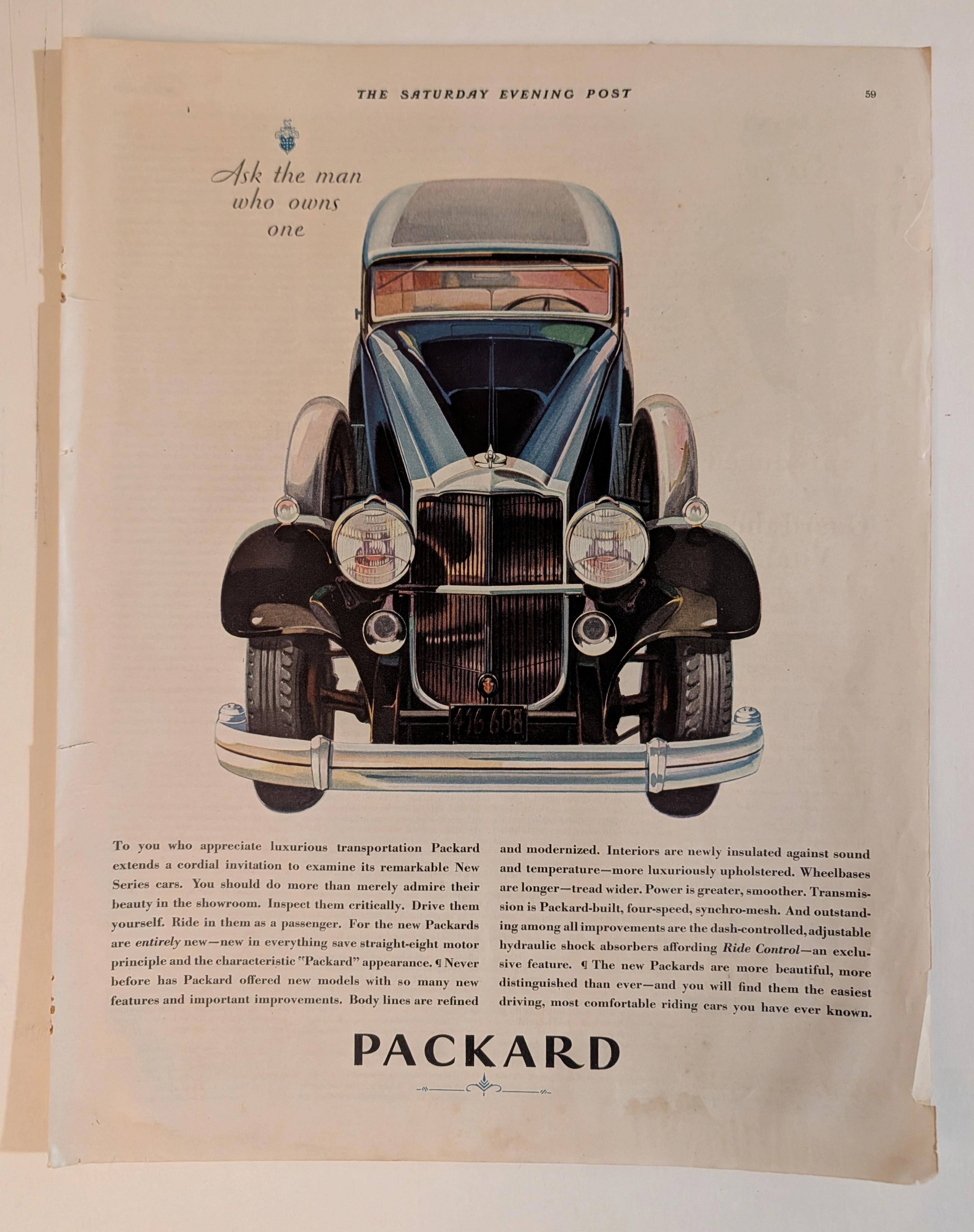
The artifact under rigorous, museum-grade analysis is an exceptionally preserved Historical Relic originating from the golden age of American automotive supremacy. Sourced from a vintage issue of The Saturday Evening Post, this Primary Art Document features a commanding, full-page advertisement for Packard, one of the most prestigious luxury automobile manufacturers in world history. Visually dominated by a striking, head-on illustration of a New Series Packard, the piece explicitly highlights the legendary corporate slogan: "Ask the man who owns one". Published during the turbulent economic landscape of the early 1930s Great Depression, this advertisement is a profound sociological marker. It boldly markets uncompromising luxury—boasting features like a four-speed synchro-mesh transmission and "Ride Control" shock absorbers—to an elite aristocracy largely insulated from the era's financial collapse. Physically, this pre-2000s analog artifact is a breathtaking embodiment of wabi-sabi. It exhibits a violently torn left binding edge, significant moisture blooming along the bottom margin, and deep amber lignin oxidation. This natural chemical and environmental degradation transforms a mass-produced commercial print into an irreplaceable, ready-to-frame Primary Art Document, forever capturing the magnificent mortality of the analog age.