The Time Traveller's Dossier : 1970 Dayton Quadra - The Radial Shift
The tire is a philosophical boundary. It is the exact physical location where human intention meets planetary resistance. Before the widespread adoption of the radial tire, this boundary was fraught with anxiety. Drivers were at the mercy of the changing seasons. The transition from dry asphalt to frozen sludge required an operational shift. It demanded a change of equipment. It demanded a change of mindset. Then came the synthesis. The all-season radial. The Dayton Quadra advertisement does not merely sell rubber. It documents a shift in the American psychological landscape. It captures the moment the driver demanded dominion over all four corners of the climate, wrapped in a single, unyielding contact patch. We moved from seasonal adaptation to year-round defiance. This is the record of that transition.
Category: Automotive
Brand: Dayton
The History
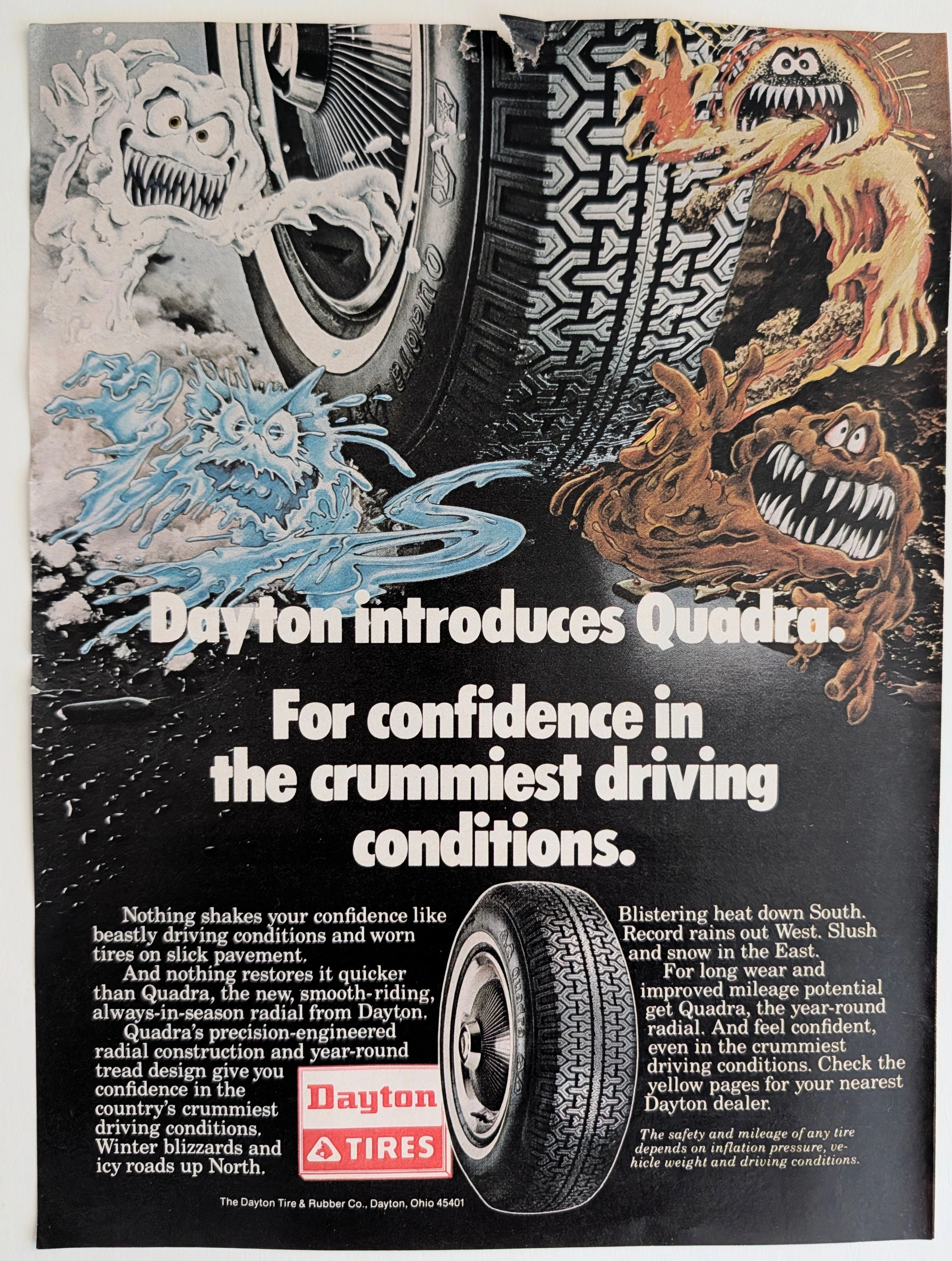
The Physics of the Contact Patch To understand the artifact, one must first understand the physics of locomotion. An automobile, regardless of its mass, its horsepower, or the complexity of its internal combustion, relies entirely on a few square inches of rubber touching the earth. This is the contact patch. It is the sole mediator of friction. In the mid-twentieth century, this mediator was fundamentally flawed. For decades, the automotive industry relied on bias-ply tire construction. The engineering was straightforward but compromised. Nylon or polyester cords were laid diagonally—on a bias—from one bead to the other. Subsequent layers were placed in a crisscross pattern. This created a uniform, rigid structure. The sidewall and the tread were structurally codependent. When the sidewall flexed under the weight of a cornering vehicle, the tread distorted. The contact patch lifted. Friction was lost. Furthermore, the crisscrossing plies rubbed against each other continuously during rotation. This friction generated immense internal heat. Heat is the enemy of vulcanized rubber. It accelerates wear. It precipitates catastrophic failure at high speeds. The bias-ply tire was a necessary step in industrial progress, but it was an imperfect tool for a nation building an interstate highway system designed for sustained, high-speed travel. The Radial Rupture The shift documented in the Dayton Quadra artifact is the American capitulation to the radial revolution. Invented and perfected in Europe decades prior, the radial tire was a structural paradigm shift. Instead of crisscrossing cords, the plies in a radial tire run perpendicular to the direction of travel—at a ninety-degree angle from bead to bead. Radiating outward. This simple geometric realignment changed everything. It decoupled the sidewall from the tread. The sidewall could flex independently to absorb the imperfections of the road, while the tread remained perfectly flat, maintaining maximum contact with the asphalt. To stabilize this flat tread, engineers wrapped rigid belts—usually constructed of steel—circumferentially around the tire, beneath the rubber blocks. The result was a tire that ran significantly cooler. It lasted thousands of miles longer. It provided drastically superior lateral grip. It reduced rolling resistance, thereby improving fuel efficiency. Yet, the American automotive industry resisted. Detroit’s suspension systems were tuned for the soft, dampening ride of bias-ply tires. Radials, with their stiff steel belts, transmitted more road noise and harshness into the cabin. It required a complete re-engineering of the vehicle's chassis to accommodate the superior tire. It took an economic crisis to force the issue. The 1973 oil embargo sent shockwaves through the American economy. Fuel prices soared. The efficiency gains of the radial tire could no longer be ignored by the consumer or the manufacturer. By the late 1970s, the era of this artifact, the radial tire was rapidly becoming the standard. The Dayton Quadra represents this technological triumph reaching the mainstream, accessible market. The Birth of the All-Season Compromise Technological shifts rarely happen in isolation. They are driven by compounding economic and social pressures. Before the era of the Quadra, drivers in variable climates faced a biannual ritual. In the autumn, the standard tires were removed and replaced with heavily lugged "snow tires." In the spring, the process was reversed. It was labor-intensive. It required storage space. It was an admission that technology was subservient to the calendar. The late 1970s introduced a new concept to the consumer market: the all-season tire. The all-season radial was an engineering compromise, but a brilliant one. It required rubber compounds that would not turn to glass in sub-zero temperatures, yet would not melt away on scorching summer highways. It required a tread pattern capable of evacuating water and biting into snow, without generating deafening acoustic resonance on dry pavement. The Dayton Quadra proudly announces itself as an "always-in-season radial." This is an economic proposition disguised as a technological one. In an era of rampant stagflation and economic uncertainty, offering a consumer the ability to buy one set of tires instead of two was a profound market advantage. It sold convenience. More importantly, as the copy states, it sold "confidence." The Geography of American Dread The United States is not a country; it is a continent. Its geography is vast, and its climates are deeply fractured. The artifact maps this geography through a lens of elemental dread. The copywriter explicitly segments the nation by its environmental hazards. "Winter blizzards and icy roads up North." "Blistering heat down South." "Record rains out West." "Slush and snow in the East." To a driver, the environment is fundamentally hostile. The road is a vector of potential tragedy. Slick pavement is a loss of control. Blistering heat is a blowout waiting to happen. Snow is paralysis. The visual representation of these threats is the artifact's most striking feature. The elements are not depicted as weather patterns; they are anthropomorphized into grotesque, aggressive monsters. This stylistic choice draws heavily from the "Weirdo" car culture art prevalent in the 1960s and 70s, popularized by artists like Ed "Big Daddy" Roth. These creatures—the ice phantom, the water gremlin, the mud brute, and the fire demon—are reaching out with claws and fangs, attempting to tear the tire apart. They represent the uncontrollable variables of nature. They are chaos. The Dayton Quadra, centered in the composition, is the monolith. It is the immovable object. It does not react to the monsters. It simply rolls forward, its steel-belted structure immune to the claws of the ice phantom, its deep tread channels shrugging off the liquid assault of the water gremlin. The message is deeply philosophical: Human engineering can outlast elemental fury. We can build a barrier between ourselves and the hostile earth. The Dayton Strategy Dayton Tire & Rubber Co. was not the largest manufacturer in Akron, Ohio—the undisputed rubber capital of the world at the time. They operated in the shadow of behemoths like Goodyear and Firestone. To compete, a subsidiary brand must differentiate its messaging. While the tier-one brands often focused on motorsport victories or absolute high-end performance, Dayton positioned itself as the pragmatic protector of the everyday driver. The phrasing "crummiest driving conditions" is highly deliberate. It eschews the polished, aspirational language of luxury advertising. "Crummy" is a blue-collar word. It speaks to the commuter fighting their way through an unplowed rust-belt city in February. It speaks to the traveling salesman navigating a torrential downpour on a neglected rural highway. The Dayton Quadra was positioned as the working man's armor. It promised the technological supremacy of the radial construction and the economic efficiency of an all-season tread, delivered without pretension. It is a masterclass in market positioning during a transitional era of automotive history.
The Paper
The artifact is printed on standard, mid-century magazine stock, likely a lightweight coated paper operating around 60 to 70 GSM. The printing method is a traditional four-color CMYK offset lithography. Upon macro inspection, the halftone rosette patterns are clearly visible, particularly in the gradients of the monsters' flesh. The technology of the era dictated a relatively coarse line screen, giving the illustrations an inherent grit that perfectly suits the subject matter. Time has interacted with the chemistry of the paper. There is a slight yellowing—acidic degradation—most visible at the edges of the clipped page. The blacks, particularly in the deep voids of the tire tread and the background, remain dense, heavily saturated with carbon-based ink. This physical substrate is a recording device. The slight offset of the cyan plate in the water monster’s splashes, the microscopic bleed of the magenta in the fire demon's aura—these are mechanical imperfections frozen in time. They prove the artifact's authenticity. They anchor this piece of psychological warfare against the weather firmly in the analog era.
The Rarity
Classification: Class A The artifact is not unique. It was mass-produced, likely inserted into hundreds of thousands of general interest and automotive publications across the United States. However, its contextual value elevates it to a Class A designation. Finding vintage advertisements in a state of preservation where the colors remain vibrant and the typography sharp is becoming increasingly difficult as the acidic paper self-destructs. Its true rarity lies in its conceptual execution. It perfectly encapsulates a highly specific window in time: the exact moment the American public was being educated on the necessity of the all-season radial tire. It is a primary document of a technological shift, disguised as consumer ephemera.
Cite this article
- MLA
- Naodhinsuk, Ronin. “The Time Traveller's Dossier : 1970 Dayton Quadra - The Radial Shift.” The Record Institute, 4 April 2026, https://therecord.institute/journal/the-time-travellers-dossier-1970-dayton-quadra-the-radial-shift.
- APA
- Naodhinsuk, R. (2026, April 4). The Time Traveller's Dossier : 1970 Dayton Quadra - The Radial Shift. The Record Institute. https://therecord.institute/journal/the-time-travellers-dossier-1970-dayton-quadra-the-radial-shift
- CHICAGO
- Naodhinsuk, Ronin. 2026. “The Time Traveller's Dossier : 1970 Dayton Quadra - The Radial Shift.” The Record Institute, April 4, 2026. https://therecord.institute/journal/the-time-travellers-dossier-1970-dayton-quadra-the-radial-shift.