The Time Traveller's Dossier: The Archive of the Immortal Flame – The 1968 Zippo "7 Beautiful Ways" Advertisement
Click any image to view in high resolution
The History
To fully appreciate the immense historical gravity of this artifact, it is essential to contextualize the year 1968. During a period when the United States was experiencing profound social unrest, protests, and the complexities of the Vietnam War, Zippo gracefully projected an image of absolute stability, success, and composed celebration. This represents a highly sophisticated psychological positioning. Zippo, universally recognized as the essential "survival tool" carried by American soldiers on the battlefield, was seamlessly elevated and recontextualized into a sophisticated "status symbol" for the middle and upper classes during times of peace.
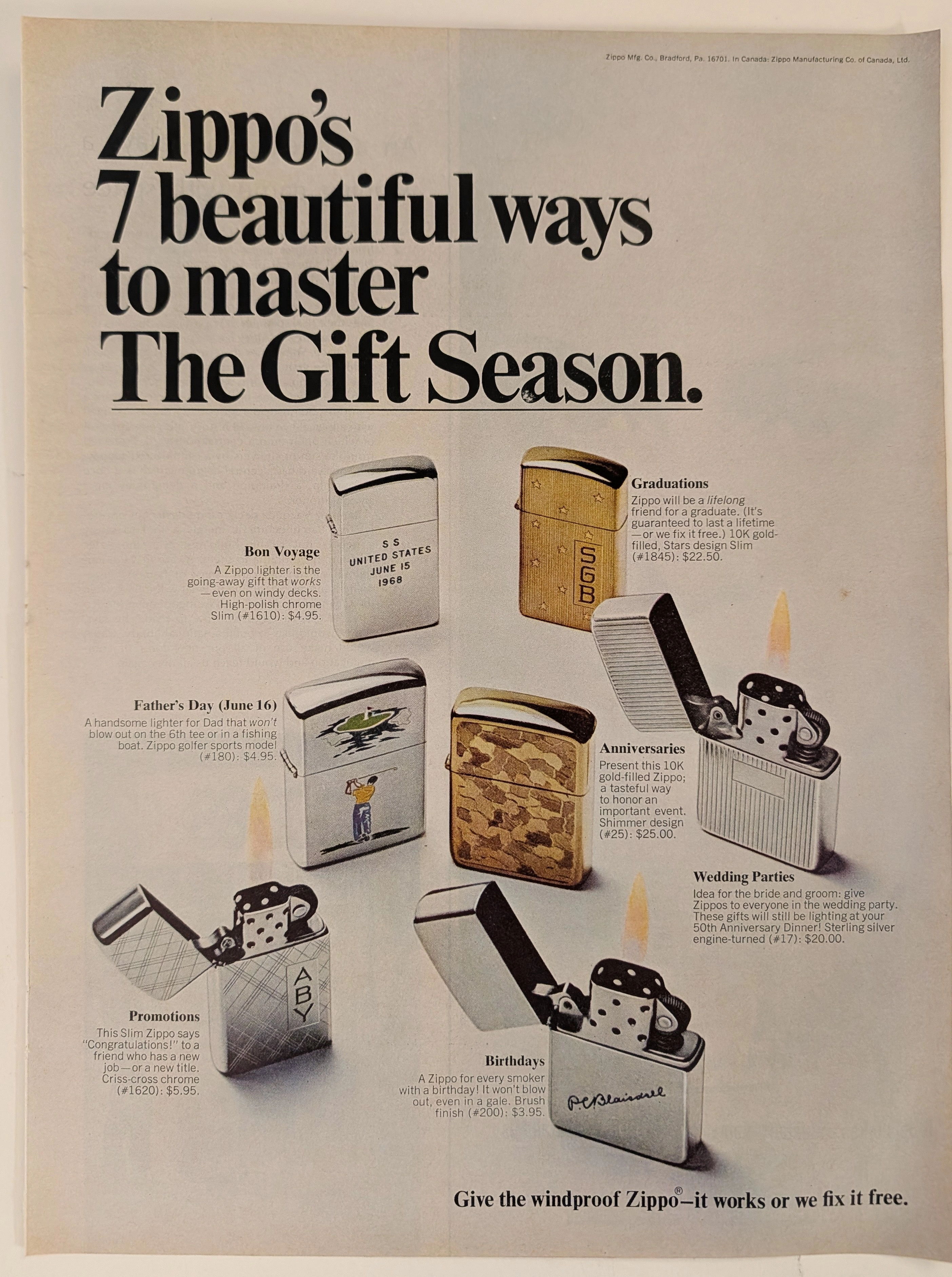
The 7 Pillars of Gift-Giving: This advertisement masterfully segments the consumer market by presenting seven distinct models for seven specific life milestones:
Bon Voyage: The High-polish chrome Slim model, deeply engraved with the legendary ocean liner "S S UNITED STATES JUNE 15 1968," serving as a precise historical anchor for this artifact.
Father's Day (June 16): The golfer sports model (#180), elegantly reflecting the leisure pursuits of the affluent American middle class.
Graduations: The 10K gold-filled Stars design Slim (#1845), elevating the concept of luxury for celebrating academic milestones.
Promotions: The Criss-cross chrome Slim (#1620), positioned as the perfect acknowledgment for professional advancement.
Anniversaries: The 10K gold-filled Shimmer design (#25), priced at $25.00, which represented a considerable luxury investment in that era.
Birthdays: The standard Brush finish (#200), personalized with an engraved signature, "P.C. Blaisdell."
Wedding Parties: The exquisite Sterling silver engine-turned model (#17).
The Ultimate Guarantee of Immortality: The foundational text at the base of the page reads, "Give the windproof Zippo—it works or we fix it free." This is not merely a promotional slogan; it is the legendary covenant established by Zippo founder George G. Blaisdell in 1933. It stands as a profound declaration of absolute confidence in the mechanical spring-hinge engineering and the flint-wheel ignition system, outright rejecting the concept of planned obsolescence.
The Paper
As a physical entity, this printed artifact functions as a living record of mid-twentieth-century graphic reproduction and substrate chemistry. Under exceptional macro-lens forensic examination, the highly reflective metallic casings and the vibrant, lifelike flames are revealed to be constructed from a precise, mathematically rigorous galaxy of halftone rosettes. This constitutes the mechanical fingerprint of the pre-digital analog offset printing press, where varying sizes of primary color (CMYK) ink dots are layered to orchestrate the human eye's perception of dimensional depth and metallic sheen.
However, the most profound factor elevating the immense value of this artifact in the contemporary collector's market is the natural, organic process of Material Degradation. The unprinted margins and white spaces exhibit a genuine, unavoidable, and unforgeable "Toning." This gradual transition from bright white paper to a warm, antique ivory hue is caused by the chemical oxidation of Lignin—the complex organic polymer that binds cellulose fibers together within the raw wood pulp of the paper. As the substrate is exposed to ambient oxygen and ultraviolet light over more than half a century, the molecular structure of the lignin gracefully breaks down. This accumulation of time, this naturally evolving patina, represents the absolute core of the wabi-sabi aesthetic. The profound appreciation for the beauty found in natural aging is an irreversible chemical reaction, and it acts as the primary engine driving up its market value exponentially among elite collectors, providing the ultimate proof of the artifact's historical authenticity.
The Rarity
RARITY CLASS: S (Superior / Exceptional Archival Preservation)
Evaluated under the most exacting archival parameters, this artifact is definitively designated as Class S.
The remarkable paradox of mid-century magazine advertisements is that they were produced by the millions as "disposable media." They were inherently destined to be briefly read, folded, and ultimately discarded. For a full-page advertisement—one that comprehensively documents the design and pricing of seven historically significant Zippo models—to be preserved since 1968 without severe structural tearing, destructive pinholes, or catastrophic moisture staining is a profound statistical archival anomaly. The impeccable structural integrity of this paper, combined with the iconic status of the Zippo brand, elevates this document to a "Holy Grail" status among Tobacciana collectors. It is ardently sought after to ensure its historical permanence through museum-grade, acid-free conservation framing.
Visual Impact
The aesthetic brilliance of this artifact lies in its mastery of "Engineered Elegance." Despite presenting seven distinct products on a single page, the designer has masterfully utilized negative space to isolate and frame each lighter, allowing them to float independently with remarkable clarity.
The most striking visual contrast is the interplay between the "coolness" of the solid metallic casings (chrome, gold, silver) and the "warmth" of the yellow-orange flames ignited on select models. These flames serve as vital focal points that naturally draw human biological perception, transforming a static, two-dimensional print into a dynamic composition where one can almost perceive the heat. The placement of the massive, bold Serif typography at the very top functions as a structural canopy, gracefully balancing and governing all the elements beneath it, thereby creating a perfect and authoritative hierarchy of information.
Exhibition Halls
The Archive Continues
Continue the Exploration

The Time Traveller’s Dossier: The Graphology of Supreme Power – A Forensic Deconstruction of the 35 Presidential Signatures
The exercise of supreme executive power is not exclusively documented through monumental architectural achievements, the mobilization of armed forces, or the grand rhetoric of inaugural addresses. Frequently, the ultimate manifestation of absolute authority is captured in a single, decisive moment of physical friction: the precise instant a quill, steel nib, or fountain pen touches paper to forge a leader's signature. A signature is the ultimate physical projection of political will; it is the legal instrument that declares wars, emancipates millions, and authorizes humanity's journey to the stars. The historical artifact presented before us today for museum-grade forensic analysis is an exceedingly rare and profound educational print. Rendered in a striking reverse lithography technique—featuring a deep, commanding navy blue background with brilliant white text—it displays the Seal of the President of the United States, completely enveloped by the radiating facsimile signatures of the first thirty-five individuals to hold the highest office in the land. This exhaustive, world-class academic archival dossier will dissect the artifact with microscopic precision. We will conduct an individual forensic breakdown of all thirty-five presidential signatures, exploring the graphological (handwriting) structures that mirror their personalities, their educational backgrounds, and their historical eras. Furthermore, we will decode the profound engineering logic behind the radial visual design and conduct a rigorous material science analysis of this reverse-printed substrate. In an analog era devoid of digital fonts and electronic authorizations, a leader's penmanship was their ultimate visual DNA. We will meticulously explore the chemical mechanics of the aging paper beneath this sea of dark ink—the elegant wabi-sabi oxidation process that serves as the primary engine driving up its market value exponentially.

Chivas Regal · Beverage
The Time Traveller's Dossier: The Architecture of Aristocracy – Chivas Regal "Prince of Whiskies" Advertisement (Circa Mid-1950s)
analysis is a meticulously preserved, single magazine tear sheet representing a pinnacle era of mid-20th-century commercial illustration and brand positioning. Far removed from the realm of disposable consumer advertising, this artifact operates as a sophisticated sociological document. It captures a precise historical epoch where the global spirits industry—specifically the Scotch whisky sector—transitioned from marketing regional agricultural products to curating internationally recognized symbols of aristocratic heritage and refined lineage. Operating with absolute curatorial precision, this dossier deconstructs a circa mid-1950s advertisement for Chivas Regal 12-Year-Old Blended Scotch Whisky. By analyzing the intersection of classical illustration, the strategic deployment of British royal iconography, and the meticulous visual forensics of the analog printing process, this document illuminates the foundational strategies of modern heritage branding. It demonstrates how a brand gracefully orchestrated a narrative of ancient nobility and warmth to captivate the post-war American consumer, establishing an enduring standard for the premium spirits market that remains profoundly influential today.

Anatomy of a Monster: The Moto Guzzi V8 Technical Masterpiece
Unearthing a rare technical illustration of the legendary Moto Guzzi V8 engine by Bob Freeman, preserved on naturally aged, pre-2000 analog print media.