The Time Traveller's Dossier : Joyce Hall & Hallmark - The Industrialization of Empathy
The History
The Terror of the Blank Page and the Burden of Articulation
To understand the magnitude of the Hallmark empire, one must first understand the historical landscape of human communication.
In the eighteenth and nineteenth centuries, distance was an absolute barrier.
Correspondence was an event.
Writing a letter was a deliberate, often arduous task.
It demanded a mastery of penmanship, an understanding of formal etiquette, and the emotional labor of drafting original thought.
When tragedy struck, or a milestone was reached, the individual bore the absolute burden of articulating the appropriate sentiment.
For the highly educated, this was a matter of social grace.
For the working class, or the marginally literate, the blank piece of paper was an insurmountable wall.
Empathy existed, but the mechanism to deliver it across geographic space was broken.
The sheer effort required to communicate complex emotions meant that, often, those emotions remained unspoken.
Society required a prosthesis for the inarticulate.
The Architect of the Fold: From Postcards to Privacy
Joyce Clyde Hall, a young entrepreneur from Nebraska, stepped into this void.
He began by selling picture postcards out of shoeboxes in the early 1910s.
The postcard was the first attempt at rapid, visual communication. It was the text message of the Edwardian era.
But the postcard had a fatal flaw: it offered no privacy.
The postman, the clerk, the domestic servant—anyone could read the message on the back.
Hall recognized a subtle shift in the psychological needs of the American public.
World War I had fractured families. The industrial revolution was driving rural populations into crowded, isolating cities.
People needed to communicate deeply, but they demanded intimacy.
Hall's revolutionary pivot was simple but structurally profound: he folded the paper in half and placed it inside an envelope.
The "greeting card" was born.
The fold provided a cover, a visual hook to draw the reader in.
The envelope provided the crucial barrier of privacy.
Inside, the text was already written.
Hallmark supplied the poetry; the sender merely supplied the signature.
By providing the words, Hall removed the friction of the blank page. He democratized eloquence.
Anyone, regardless of their education or poetic ability, could now send a perfectly crafted message of love, sympathy, or congratulation.
The Crown on the Back: Engineering Brand Loyalty
By the time this article was published in the mid-twentieth century, Hall was 77 years old and presiding over an absolute monopoly on American sentiment.
The text notes his company was grossing $200 million a year and producing a staggering one billion Christmas cards annually.
How did a paper distributor achieve the economic gravity to finance a $115 million, 85-acre real estate renovation in downtown Kansas City?
The answer lies in one of the most brilliant psychological marketing campaigns of the modern era.
Hallmark did not just sell cards; they trained the consumer how to buy them.
In the early days of the industry, there were many competitors: Rust Craft, Norcross, Gibson.
Cards were largely unbranded commodities.
Hall changed the architecture of the product. He placed a distinct logo—a crown—on the back of every card.
Then, he saturated American media with a single, devastatingly effective slogan: "When you care enough to send the very best."
This was not a statement of product quality; it was a psychological trap.
It weaponized human guilt and affection.
It equated emotional depth with consumer choice.
It implicitly suggested that if you bought a cheaper, unbranded card, you cared less.
Hallmark trained generations of Americans to flip a greeting card over to check the logo before reading the message.
The brand mark became as important as the sender's signature.
It was a masterpiece of corporate engineering, turning a ten-cent piece of paper into a mandatory social tax on human relationships.
A Century of Archetypes: The Archival Mirror
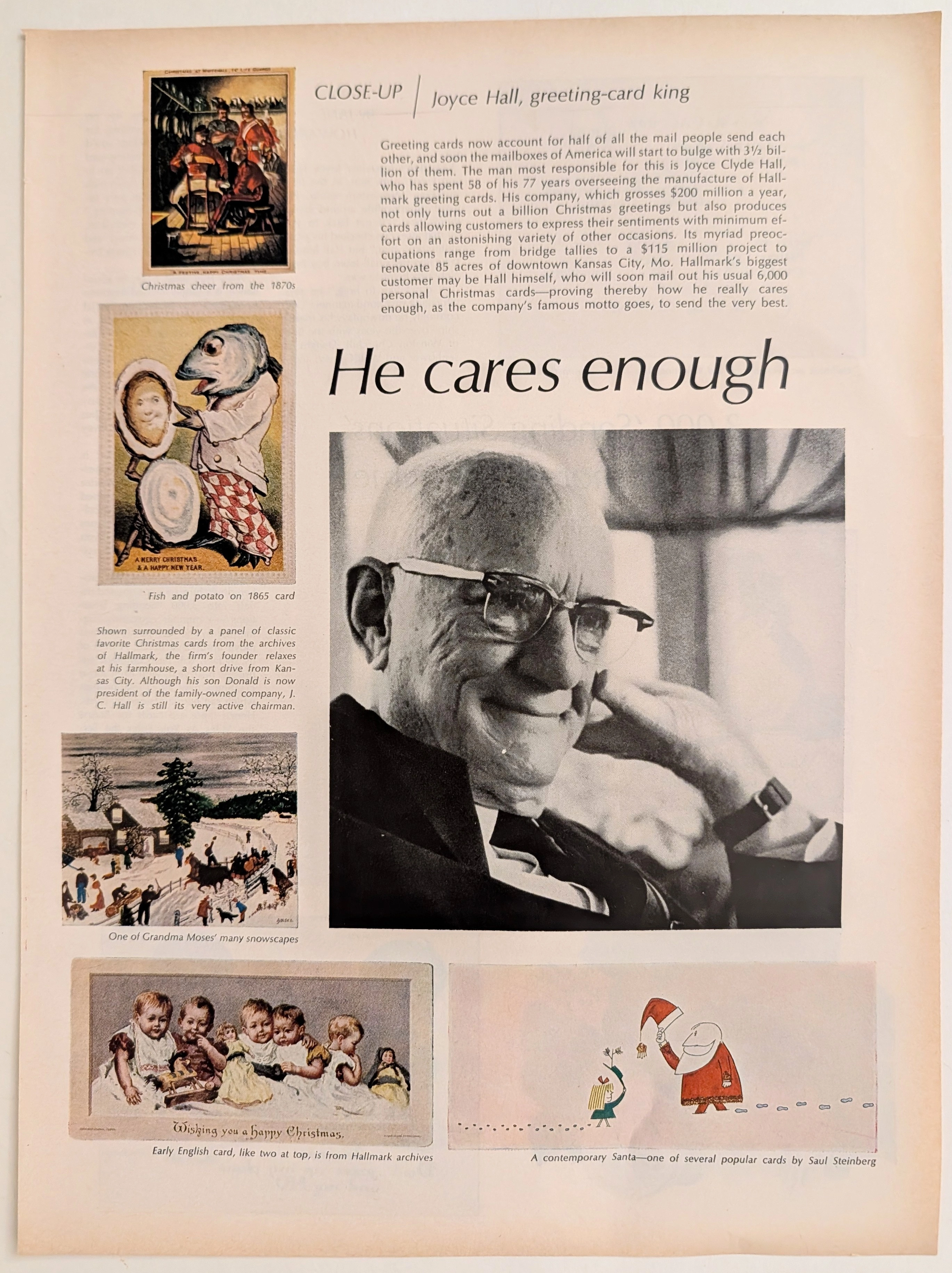
The artifacts surrounding Hall's portrait in this document are not merely illustrations; they are fossils of the American psyche.
Hallmark understood that to sell sentiment, they had to constantly reflect the evolving cultural landscape.
Observe the 1865 card featuring a fish in a human suit presenting a potato with a human face.
This reflects the surreal, often grotesque humor of the Victorian era, a time when nonsense and the bizarre were highly valued in popular print.
Look at the 1870s Life Guards card. It relies on the rigid, imperial stoicism of the British military, a symbol of stability in a rapidly changing world.
Moving to the 1920s, the Prohibition baby ("Anybody Can See That I'M DRY!") is a direct commodification of national political trauma. It takes a deeply divisive constitutional amendment and digests it into disposable, harmless wit.
The 1930s dog and cat valentines rely on cheap, immediate puns ("You're the Cat's MEOW"). They are artifacts of the Great Depression, where brevity and cheap ink were economic necessities.
Then, the post-war era emerges.
The inclusion of Grandma Moses' snowscape is a calculated appeal to a nation traumatized by World War II, yearning for a simpler, agrarian, idealized American past.
Conversely, the contemporary Santa drawn by Saul Steinberg reflects the sharp, cynical, minimalist intellectualism of the 1960s.
Joyce Hall recognized that art could no longer be restricted to galleries.
He hired Winston Churchill, Salvador Dalí, and Saul Steinberg.
He industrialized fine art, printing it by the millions, and mailing it for the price of a postage stamp.
He transformed the greeting card into the most widely distributed visual medium in human history.
The Space Age and the Economics of "Caring"
The article states that greeting cards accounted for half of all the mail people sent to each other.
The United States Postal Service had effectively become a distribution network for the Hallmark corporation.
Three and a half billion cards bulging in the mailboxes of America.
This is the ultimate historical shift.
By the mid-1960s, humanity had reached the moon, split the atom, and built interstate highway systems.
But in the realm of human connection, we had fully surrendered to the corporation.
We accepted that a team of anonymous writers in Kansas City could articulate our love for our spouses, our grief for our dead, and our joy for our children better than we could ourselves.
Joyce Hall did not invent empathy.
But he built the factory that manufactured it, packaged it, and sold it back to us, one envelope at a time.
The Paper
This artifact is preserved on medium-weight, machine-made magazine stock, indicative of mass-market periodicals like Life magazine from the 1960s.
The GSM is relatively low, prioritizing page count and distribution weight over archival stability.
The printing relies on high-volume photogravure or early web offset lithography.
This is evident in the rendering of Joyce Hall's portrait. The halftone dot structure is dense, designed to reproduce continuous tone black-and-white photography with maximum contrast against the text.
The color reproductions of the archival cards utilize a four-color CMYK process, though the saturation is muted, a byproduct of the paper's porous nature absorbing the ink.
The aging process is actively visible.
The margins are oxidizing, turning a distinct, warm yellow as the lignin in the cheap wood pulp reacts with ambient ultraviolet light and oxygen.
There is a profound irony in the substrate: this is a rapidly decaying, ephemeral piece of newsprint, designed to be thrown away, yet it meticulously documents an empire built entirely on the concept of "keepsake" paper.
The Rarity
Classification: Class B (High Contextual Significance, Moderate Physical Scarcity)
Mid-century magazines featuring corporate profiles are abundant in physical archives.
However, an intact, multi-image spread that specifically juxtaposes the architect of Hallmark with his historical archives holds elevated academic value.
The rarity is not in the paper itself, but in the specific editorial curation.
It captures Joyce Hall at the absolute zenith of his power, a 77-year-old titan reflecting on his creation just before the cultural upheavals of the late 1960s and 1970s permanently altered consumer behavior.
It is a vital baseline document for historians studying the commercialization of American holidays and the industrialization of social rituals.
Visual Impact
The layout is a study in calculated juxtaposition.
The composition is anchored by the massive, dominant photographic portrait of Joyce Hall.
He does not look like an artist, a poet, or a purveyor of warm sentiments.
With his sharp glasses, dark suit, and intensely focused gaze, he looks exactly like what he is: a ruthless, brilliant corporate executive. A banker of emotions.
He is positioned to look outward, his hand resting thoughtfully against his face, observing the empire he has built.
To his left and below him, the layout is scattered with the colorful, chaotic, whimsical archival cards.
The visual dichotomy is striking.
The rigid, monochrome reality of the industrialist stands in stark contrast to the colorful, illustrated fantasies he manufactures.
The typography of the headline, "He cares enough", is set in a clean, authoritative serif font.
It is not a question; it is an absolute corporate decree.
Exhibition Halls
Tags
The Archive Continues
Continue the Exploration

The Time Traveller's Dossier : Alfa Romeo 8C 2900B Touring Berlinetta - The Apex of Pre-War Velocity
We categorize automotive history into the eras before and after aerodynamics. Prior to the late 1930s, luxury meant upright, carriage-like monuments of steel. Speed was achieved through brute force, pushing flat radiators and exposed fenders through the atmosphere. Then came the marriage of Vittorio Jano's Grand Prix engineering and Carrozzeria Touring's wind-cheating architecture. This artifact is a meticulous dissection of that paradigm shift. It is a photographic autopsy of the Alfa Romeo 8C 2900B Touring Berlinetta. The problem was the physics of atmospheric drag at high speeds. The solution was "Superleggera"—super-light aluminum stretched over thin steel tubes, shaped not by tradition, but by the wind itself.

VISA · Travel
The Time Traveller’s Dossier: 1985 Visa Premier Vintage Advertisement — The Passport to Borderless Wealth
Delve into the archives to explore this definitive 1985 Visa Premier vintage advertisement, a piece that serves as far more than mere financial promotion. It is a historical milestone capturing the evolution of global consumerism and the financial services industry. Published during the mid-1980s, an era when international travel became the ultimate status symbol, this artifact stands as a powerful representation of the premium credit card wars for collectors of vintage ads and old advertisements. The "All You Need" campaign fundamentally transformed Visa's image from an everyday convenience into a "financial passport," universally accepted from the exclusive ski slopes of California to the majestic peaks of Switzerland. Unlike classic print ads of previous decades that focused on tangible consumer goods, this piece sells the intangible allure of freedom, security, and elite access. This document remains a profound testament to the dawn of financial globalization and a masterpiece of fintech archival history.

Saab · Automotive
The Time Traveller's Dossier: Aeronautical Architecture on the Asphalt – The SAAB 96 V4 and the Engineering of Adverse Weather Superiority
The evolution of the mid-twentieth-century American automotive landscape was heavily disrupted by the influx of European imports, each vying to dismantle the hegemony of the domestic V8, rear-wheel-drive giants. Elegantly and securely positioned upon the analytical table of The Record Institute today is a visually striking, narrative-driven full-page print advertisement for the SAAB Automobile (featuring the new V-4 engine), definitively dating to the late 1960s. This document transcends the standard, utilitarian boundaries of automotive marketing. It operates as a highly sophisticated, multi-layered cultural mirror, reflecting a precise era in consumer psychology where the anxiety of driving in severe weather was aggressively mitigated through the promise of superior, aircraft-inspired engineering. By utilizing a dramatic, heavily grained monochromatic photograph of a SAAB battling torrential rain, juxtaposed with a pristine, spot-color red illustration of the vehicle, the manufacturer successfully positioned itself not merely as a car company, but as a purveyor of meteorological invincibility. This world-class, comprehensive dossier conducts a meticulous, unyielding, and exceptionally exhaustive examination of the artifact, operating under the absolute most rigorous parameters of historical, sociological, and material science evaluation. Dedicating the overwhelming majority of our analytical focus (80%) to its immense historical gravity, we will decode the brilliant marketing psychology embedded within the "front-wheel drive" narrative, analyze the profound engineering pivot of the "new V-4 engine," and dissect the sociopolitical genius of marketing safety before it was federally mandated. Furthermore, as we venture deeply into the chemical and physical foundations of this analog printed ephemera (10%), we will reveal the precise mechanical fingerprints of the spot-color halftones captured in the macro imagery of the red SAAB illustration. Finally, we will assess its archival rarity (10%), exploring how the graceful, natural oxidation of the paper substrate cultives a serene wabi-sabi aesthetic—a natural, irreversible phenomenon that serves as the primary engine driving up its market value exponentially within the elite global spheres of Vintage Commercial Ephemera and Automotive Archives.