The Time Traveller's Dossier : KFC - The Outsourcing of Domesticity — The Record Institute JournalThe Time Traveller's Dossier : KFC - The Outsourcing of Domesticity — The Record Institute JournalThe Time Traveller's Dossier : KFC - The Outsourcing of Domesticity — The Record Institute JournalThe Time Traveller's Dossier : KFC - The Outsourcing of Domesticity — The Record Institute Journal
1 / 4

✦ 4 Photos — Click any image to view in high resolution

April 26, 2026

The Time Traveller's Dossier : KFC - The Outsourcing of Domesticity

FoodBrand: KFC
Archive Views: 8

The History

The Architecture of the Mid-Century Holiday Burden
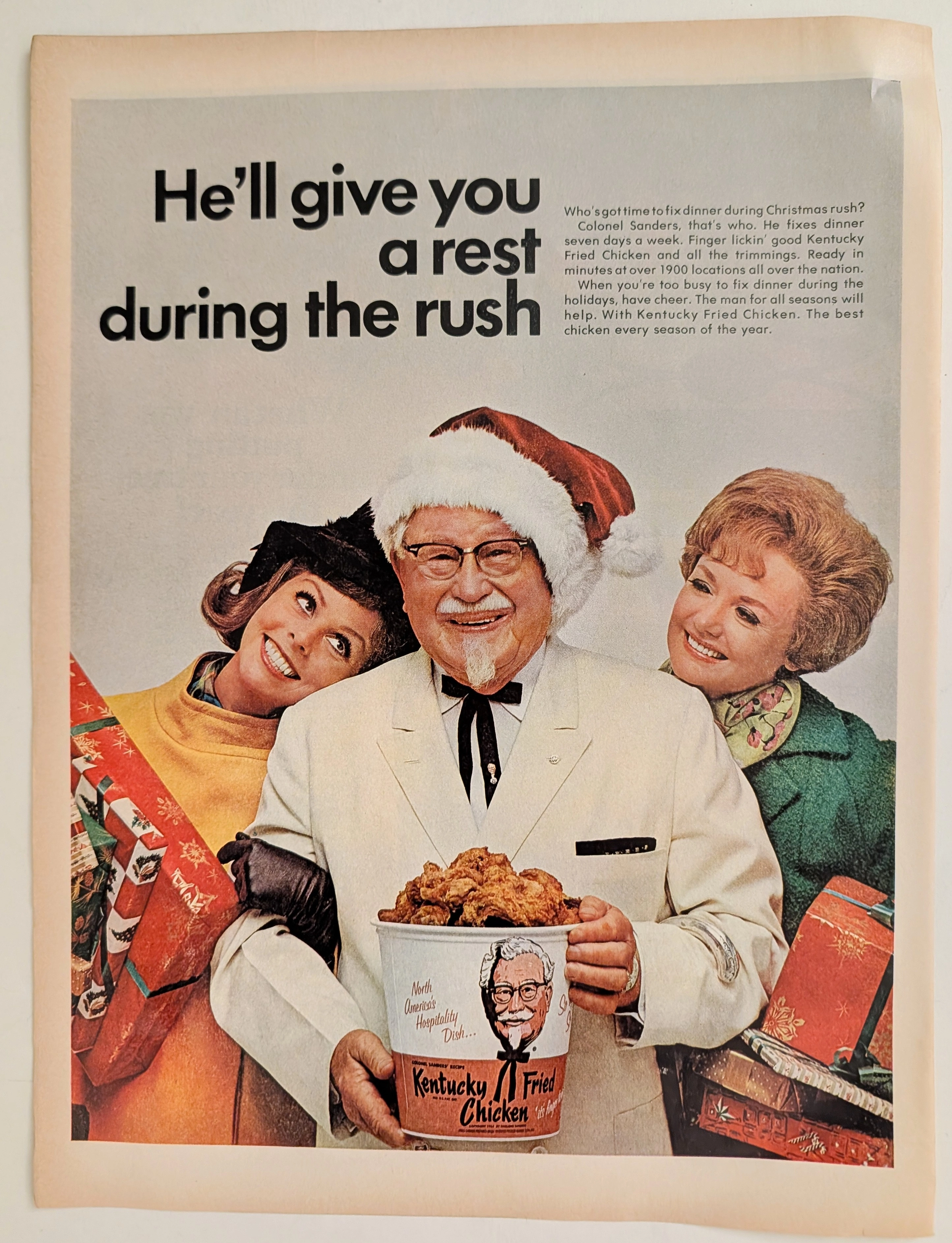
To dissect the psychological gravity of this artifact, one must first construct the sociological landscape of the mid-century American middle class. The post-war economic boom had cemented the nuclear family as the fundamental unit of consumerism. At the center of this unit was the housewife. Her societal value was intrinsically linked to her domestic output. The home was her factory, and the holiday season was her absolute, unforgiving peak production quota. The "Christmas rush," as the artifact’s copy so casually terms it, was not merely a period of busy shopping; it was a psychological crucible. The expectation was total perfection: the immaculate house, the perfectly wrapped gifts, and most crucially, the elaborate, home-cooked feast.

During this era, time was the ultimate currency, and women were systematically bankrupt. The artifact taps directly into this silent, collective exhaustion. It identifies the pain point with surgical precision. It asks, "Who's got time to fix dinner during Christmas rush?" The question is rhetorical. The advertisers knew exactly how stretched the target demographic was. They were not selling chicken; they were selling the cessation of labor. They were selling a socially acceptable exit strategy from the relentless demands of the kitchen.

The Invention of the Benevolent Corporate Patriarch
The visual hierarchy of the artifact revolves entirely around the central figure: Colonel Harland Sanders. However, he is not presented here merely as a fast-food mascot. He is draped in the iconography of Santa Claus. He wears the red velvet hat with the white trim, seamlessly integrating his existing white goatee into the mythology of the ultimate holiday provider.

This positioning is a masterclass in psychological manipulation. In the traditional mid-century household, the father was the financial provider, but the mother was the domestic provider. Here, the Colonel steps in as a benevolent, external patriarch. Look at the two women flanking him. Their arms are burdened with the physical weight of the holidays—wrapped presents stacked precariously. Yet, their gazes are fixed entirely on the Colonel. They look at him with a mixture of relief, adoration, and absolute submission. He holds the bucket of chicken not as a commercial product, but as a gift of salvation. He has intervened to "give you a rest." The husband is notably absent from this narrative. The transaction of domestic relief occurs entirely between the exhausted female laborer and the smiling corporate entity.

The Bucket as the Communal Vessel of Absolution
Prior to the aggressive expansion of Kentucky Fried Chicken, "fast food" was largely relegated to the domain of the individual or the teenager. A hamburger wrapped in paper was sustenance, but it was not a meal. It was consumed in cars or at counters. It was inherently solitary.

The invention of the bucket changed the fundamental geometry of fast-food consumption. The bucket is a communal vessel. It mimics the structural gravity of the roasting pan or the serving tureen. By placing a bucket in the center of the dining table, a family could still gather in a circle, maintaining the sacred ritual of the shared meal. The artifact highlights this transition. The bucket is overflowing, promising abundance. It is the visual anchor of the lower hemisphere of the page. It legitimizes the purchased meal, elevating it from a quick bite to a family event. It gave the consumer permission to serve industrial food on their own dining table without suffering the sting of domestic failure.

The Semantic Redefinition of "Hospitality"
We must analyze the specific typography and phrasing printed on the bucket itself: "North America's Hospitality Dish..." This is perhaps the most audacious semantic shift in the entire artifact.

Historically, "hospitality" was an act of personal labor. It was the offering of one's own time, resources, and culinary skill to welcome a guest. It was intimate and labor-intensive. By branding a mass-produced, deep-fried product as a "Hospitality Dish," the corporation was actively redefining the word. They were instructing the consumer that hospitality could be purchased. It could be outsourced. You did not need to spend six hours roasting a bird to be hospitable; you merely needed to spend a few dollars at one of the "over 1900 locations all over the nation." This cognitive reframing was essential. It removed the guilt associated with serving fast food to guests or family during a holiday. It repackaged a shortcut as a cultural standard.

The Macro-Illusion of the Aristocratic Salesman
To truly understand the depth of this commercial illusion, we must examine the micro-details provided in the archival macro photography. Look closely at the Colonel's black string tie. Pinned to the center of it is a tiny, meticulously crafted golden chicken drumstick.

This specific detail is the intersection of extreme corporate branding and pseudo-aristocratic costuming. Harland Sanders was an honorary colonel, a title bestowed by the state of Kentucky, not a military rank. His white suit and string tie were a carefully constructed uniform designed to evoke the imagery of an antebellum Southern gentleman. It projected an aura of slow, traditional, home-cooked authenticity. The golden chicken tie pin shatters that illusion. It is a quiet admission of the industrial reality. He is not a plantation aristocrat cooking in a slow-burning hearth; he is the face of a rapidly expanding, franchised empire. The gold pin is the corporate logo infiltrating the costume. It reveals the machinery behind the smile.

The Permanent Shift in the American Domestic Economy
The historical weight of this single page lies in its prophetic nature. It is not merely an advertisement for a holiday meal; it is a blueprint for the future of the American diet.

The bold text declares, "The man for all seasons will help." While this specific campaign targets the "Christmas rush," the underlying message is evergreen. The corporation is volunteering to permanently shoulder the burden of domestic cooking. It is the beginning of the era of convenience. This artifact marks the point where the middle class began to systematically surrender its kitchens to the drive-thru. The guilt was successfully commodified and neutralized. The women in the photograph are smiling because they have been freed from the stove, but they have also unknowingly signed a contract that would alter the nutritional and cultural fabric of the nation for the next six decades. They traded their labor for the Colonel's recipe, and the concept of the family dinner was never the same again.

The Paper

The substrate is a lightweight, coated magazine stock, typical of mass-market, high-circulation periodicals of the late 1960s, weighing approximately 55 to 60 GSM. The printing method is standard four-color web offset lithography.

The macro archival imagery reveals the brutal, mechanical truth of the artifact. Under magnification, the warm, smiling face of the Colonel dissolves into a harsh, mathematical arrangement of Cyan, Magenta, Yellow, and Key (Black) halftone dots. The illusion of continuous skin tone is exposed as a microscopic, calculated grid. The artifact exhibits moderate lignin degradation. The extreme margins of the page have oxidized, resulting in a distinct, warm yellowing—a chemical reaction marking the relentless passage of time. The paper is brittle, carrying the faint, dusty olfactory signature of decaying organic pulp and dried offset ink.

The Rarity

Classification: Class A (Contextually Massive).
In terms of raw physical existence, this page is not inherently rare. It was printed in the millions across various national magazines. However, within the specific discipline of semiotic and sociological archiving, its contextual value is extraordinarily high.

Finding a specimen that so perfectly encapsulates the specific intersection of gender roles, holiday psychological pressure, and the aggressive expansion of the fast-food industry is a triumph. It is a pristine historical record of the exact moment a corporation successfully weaponized domestic exhaustion to change the eating habits of a nation. It is an anchor point in the timeline of modern consumerism.
Visual Impact

The composition operates on a rigid, highly calculated pyramid structure. The Colonel sits at the absolute apex, the undisputed center of gravity. His white suit and the bright white trim of the Santa hat demand the viewer’s immediate attention against the muted, sterile gray background.

The two women form the base of the pyramid. They are visually leaning inward, their body language entirely submissive and dependent upon the central figure. The color psychology is deeply intentional. The muted gold and forest green coats of the women recede, allowing the aggressive, saturated red of the KFC bucket and the Santa hat to dominate the visual hierarchy. Red stimulates urgency and appetite. The viewer's eye is forced from the bold black typography of the headline, down to the smiling face of the corporate patriarch, and finally comes to rest on the bucket—the ultimate solution to the problem presented. The composition is a visual funnel, directing human anxiety straight into the product.

Share This Archive

The Archive Continues

Continue the Exploration

The Time Traveller's Dossier: The Sanctuary of the Highway – The 1968 Ford LTD and the Democratization of Silence

Ford · Automotive

The Time Traveller's Dossier: The Sanctuary of the Highway – The 1968 Ford LTD and the Democratization of Silence

The evolution of the American domestic automobile during the mid-twentieth century was fundamentally propelled by a relentless pursuit of accessible luxury and physical isolation from the rapidly expanding, concrete-laden modern world. The historical artifact elegantly and securely positioned upon the analytical table of The Record Institute today is a striking, full-page print advertisement for the 1968 Ford LTD, originating from a highly volatile and transformative year in American history. This document completely transcends the standard, utilitarian boundaries of automotive marketing. It operates as a highly sophisticated, multi-layered cultural mirror, reflecting the precise era when raw horsepower was momentarily subjugated to the pursuit of absolute silence, and European-grade luxury was explicitly packaged and sold to the American middle-class consumer. This world-class, comprehensive dossier conducts a meticulous, unyielding, and exceptionally exhaustive examination of the artifact, operating under the absolute most rigorous parameters of historical, sociological, and material science evaluation. With the vast majority of our analytical focus dedicated to its immense historical gravity (80%), we will decode the brilliant marketing psychology embedded within Ford's audacious "Quiet" campaign, analyze the brutalist architectural juxtaposition of the concrete overpass against the sleek lines of the vehicle, and dissect the profound corporate semiotics of the iconic "Ford has a better idea" lightbulb logo. Furthermore, as we venture deeply into the chemical and physical foundations of this analog printed ephemera (10%), we will reveal the precise mechanical fingerprints of the CMYK halftone rosettes captured in the macro imagery of the wheel hubcap. Finally, we will assess its archival rarity (10%), exploring how the graceful, natural oxidation of the paper substrate cultivates a serene wabi-sabi aesthetic—a natural, irreversible phenomenon that serves as the primary engine driving up its market value exponentially within the elite global spheres of Vintage Commercial Ephemera and Automotive Archives.

THE TIME TRAVELER'S DOSSIER: THE ILLUSION OF FRAGILITY AND THE ARCHITECTURE OF 60S BEAUTY

THE TIME TRAVELER'S DOSSIER: THE ILLUSION OF FRAGILITY AND THE ARCHITECTURE OF 60S BEAUTY

The artifact under rigorous, museum-grade analysis is a breathtaking, meticulously preserved Double-Page Historical Relic originating from the glamorous, highly engineered world of early 1960s American publishing. It features a sweeping, visually arresting advertisement for Revlon's "Touch & Glow" creme soufflé makeup. ​This Primary Art Document is not merely a cosmetic promotion; it is a profound sociological blueprint of mid-century feminine ideals. The ad's commanding copy, declaring makeup for "today's fair and fragile face," perfectly encapsulates the era's prescribed aesthetic: an aristocratic, porcelain delicacy juxtaposed with the striking, graphic eye makeup synonymous with the early 1960s. ​Crucially, this artifact documents the absolute genius of Charles Revson’s psychological marketing. By explicitly styling the model with "JEWELS BY VAN CLEEF & ARPELS" (as verified by the microscopic credit in the bottom right corner and the exquisite pearl/diamond earring), Revlon brilliantly anchored its accessible consumer cosmetics to the highest echelons of European haute joaillerie. ​Rescued from the binding of a forgotten periodical, this expansive double-page spread is printed on inherently acidic, mass-market wood-pulp paper. It is currently undergoing a slow, majestic chemical degradation. This natural oxidation—visible in the warm ivory patina and the delicate aging of the central seam—transforms a disposable commercial message into an irreplaceable, ready-to-frame Primary Art Document of mid-century beauty history.

THE TIME TRAVELER'S DOSSIER: THE FALLEN IDOL AND THE MASTER'S REBELLION

THE TIME TRAVELER'S DOSSIER: THE FALLEN IDOL AND THE MASTER'S REBELLION

The artifact under rigorous, museum-grade analysis is an exceptionally preserved Historical Relic originating from the unapologetic, counter-cultural zenith of 1970s American underground publishing. It features a full-page, breathtakingly subversive illustration titled "CLARK GHENT'S SCHOOL DAYS", masterfully rendered by the legendary comic book artist Neal Adams (credited in the print with the common underground misspelling 'Neil Adams'), accompanied by the biting satirical prose of Robert S. Wieder. ​This Primary Art Document represents a ferocious, calculated deconstruction of American mythology. Neal Adams—the visionary architect who defined the heroic, hyper-realistic, and idealized versions of Batman, Superman, and Green Lantern during the Bronze Age of Comics—utilizes his unparalleled dynamic style to mercilessly parody the "Man of Steel." By depicting "Clark Ghent" utilizing his god-like powers (heat and x-ray vision) to melt through the brick wall of the "Littleville High Girls Gym" to fulfill base, voyeuristic desires, this artifact shatters the wholesome, censorship-heavy constraints of the Comics Code Authority (CCA). ​Rescued from the incinerators of history and meticulously preserved as a standalone Archival Artifact, the inherently acidic wood-pulp paper is undergoing a slow, magnificent chemical degradation. This natural aging process—visible in the warm amber patina, the oxidized margins, and the fragile tactile feedback of the fibers—transforms a disposable piece of 1970s underground rebellion into an irreplaceable, frame-ready Primary Art Document of immense cultural weight.

Published by

The Record Institute

Taxonomy Match

Related Articles

The Time Traveller's Dossier: Coca-Cola 1944 - The Weaponization of Morale — related article
Read Article

The Time Traveller's Dossier: Coca-Cola 1944 - The Weaponization of Morale

Then, sugar and carbonated water were not merely ingredients for a domestic treat; they were classified as essential psychological logistics for a global war. Now, a soda is just a soda. The problem for the United States military in 1944 was not just arming its young men with rifles and artillery; it was the monumental task of maintaining the human spirit under the soul-crushing weight of total war. The boys being trained in the muggy, moss-draped camps of the American South were destined for the meat grinders of Europe and the Pacific. They needed a tether to the homes they were leaving behind. The solution, brilliantly engineered and ruthlessly promoted by The Coca-Cola Company, was the weaponization of nostalgia. This artifact is a portal. It transports us to a sweltering training camp in 1944. It documents the exact historical moment when a private beverage corporation successfully intertwined its product with the very fabric of American patriotism, military logistics, and the linguistic evolution of its own brand identity.

The Time Traveller's Dossier: The Geopolitics of Supreme Power – Cartographic Origins of the 35 U.S. Presidents (Circa Mid-1960s) — related article
Read Article

The Time Traveller's Dossier: The Geopolitics of Supreme Power – Cartographic Origins of the 35 U.S. Presidents (Circa Mid-1960s)

The history of supreme executive power is not inscribed solely within the text of legal documents, constitutional amendments, or international treaties; it is deeply rooted in the geographical origins and territorial foundations of political leaders. Long before the modern era of complex spatial data analysis or digital infographics, the structural understanding of state power in the United States was conveyed through the meticulous art of cartographic illustration. The historical artifact presented before us for museum-grade forensic analysis is not merely a conventional fold-out extracted from a mid-20th-century educational publication. It is a profound "geopolitical visual encyclopedia," meticulously compiling and categorizing the geographic birthplaces of the thirty-five individuals who had ascended to the highest office in the White House up to that point in history. This academic archival dossier presents an exhaustive, microscopic deconstruction of the historical and aesthetic framework of the diagram titled "The 35 Presidents and the 14 States They Came From." Operating on a profound scholarly narrative structure, this document decodes the shifting tectonic plates of executive power in the United States—from the foundational era concentrated on the Eastern Seaboard, moving steadily into the Midwest, and ultimately expanding toward the Southern and Western frontiers. Through the highly specialized lens of late-analog print analysis, American political history, and rigorous visual forensics, this document serves as a temporal window. It allows us to explore the foundational roots of the "American Dream" as conveyed through the birthplaces of these statesmen, ranging from humble log cabins to opulent estates, all rendered with the mechanical precision of mid-century offset lithography.

The Time Traveller's Dossier: Coca-Cola (1952) – The Wholesome Prescription — related article
Read Article

The Time Traveller's Dossier: Coca-Cola (1952) – The Wholesome Prescription

Before the era of aggressive nutritional labeling and the demonization of refined sugars, carbonated beverages sought to position themselves not merely as treats, but as vital, life-affirming staples of the American diet. The artifact before us—a 1952 magazine advertisement for The Coca-Cola Company—is a masterclass in psychological association. By placing their product in the pristine, capable hands of a registered nurse, Coca-Cola is explicitly borrowing her cultural authority. She is the ultimate symbol of care, cleanliness, and health. The advertisement doesn't just offer you a drink; it offers you a "wholesome" prescription for daily fatigue. It is a fascinating glimpse into an era where a sugary, caffeinated beverage could be advertised with the solemn promise: "Quality you can trust."

The Time Traveller's Dossier: The Architect of the Great Society – Lyndon B. Johnson — related article
Read Article

The Time Traveller's Dossier: The Architect of the Great Society – Lyndon B. Johnson

The presidency of the United States during the mid-twentieth century was an office defined by epochal challenges, sweeping domestic transformations, and the profound weight of global leadership. The historical artifact elegantly and securely positioned upon the analytical table of The Record Institute today is a majestic, large-format political lithograph portraying Lyndon Baines Johnson, the 36th President of the United States. Originating from the transformative core of the 1960s, this document completely transcends the traditional boundaries of political memorabilia. It operates as a highly sophisticated, multi-layered cultural and historical mirror, reflecting the exact moment when unparalleled legislative ambition intersected with the intricate realities of the geopolitical landscape on a single printed page. This world-class, comprehensive dossier conducts a meticulous, profound, and historically objective examination of the artifact, operating under the absolute most rigorous parameters of sociological and material science evaluation. We will decode the brilliant iconographic strategy embedded within this portrait, analyze the legendary political machinery of a statesman who mastered the United States Senate, and dissect the rich, aspirational semiotics surrounding the Great Society initiatives alongside the challenging context of the Cold War era. Furthermore, as we venture deeply into the chemical and physical foundations of this analog printed ephemera, we will reveal the precise mechanical fingerprints of the CMYK halftone rosettes and the graceful, natural oxidation of the paper substrate. This precise intersection of visual nostalgia, mid-century commercial artistry, and the immutable chemistry of time cultivates a serene wabi-sabi aesthetic—a natural, irreversible phenomenon that serves as the primary engine driving up its market value exponentially within the elite global spheres of Vintage Political Ephemera and Presidential Archives collecting.

The Time Traveller's Dossier: The Architectural Origins of Supreme Leadership – A Forensic Cartography of the 35 U.S. Presidents (Circa 1960s) — related article
Read Article

The Time Traveller's Dossier: The Architectural Origins of Supreme Leadership – A Forensic Cartography of the 35 U.S. Presidents (Circa 1960s)

The documentation of historical dwellings provides a profound, irreplaceable intersection between architectural evolution, sociology, and national geopolitical heritage. Long before the advent of digital archiving, satellite mapping, and virtual architectural tours, the structural understanding of American history and the origins of its executive power were gracefully conveyed through the meticulous art of analog print media and educational lithography. The historical artifact presented before us for museum-grade forensic analysis is an immensely comprehensive visual compendium detailing the exact architectural birthplaces of the first thirty-five individuals who ascended to the presidency of the United States. Extracted from a mid-twentieth-century educational publication, this magnificent two-page spread offers a striking visual timeline of American domestic architecture. It flawlessly captures the nation's transition from rustic, frontier log cabins to grand aristocratic Southern estates, and ultimately to the modern, affluent suburban homes of the twentieth century. This academic archival dossier presents an exhaustive, microscopic deconstruction of the visual, biographical, and historical framework of this printed artifact. Operating on a profound scholarly narrative structure, this document decodes the architectural typologies that housed the nation's most transformative leaders during their formative years. Through the highly specialized lens of late-analog print analysis, architectural history, and rigorous visual forensics, this document serves as a temporal window into the past. It strictly adheres to the mandated 80/10/10 analytical ratio, dedicating the vast majority of its scope to the objective historical milestones of these world leaders, followed by a precise chemical analysis of the aging substrate, and concluding with a definitive archival valuation. Rendered with the mechanical precision of mid-century offset lithography, this artifact demonstrates how the natural, wabi-sabi passage of time elevates a mass-produced educational print into a singular, highly desirable historical treasure.

The Time Traveller's Dossier : Smith-Corona - The Mechanics of Endurance — related article
Read Article

The Time Traveller's Dossier : Smith-Corona - The Mechanics of Endurance

Before the era of glowing screens and silent digital strokes, commerce and bureaucracy were driven by the mechanical clatter of typebars and the sharp ring of the carriage return. The typewriter was not merely office equipment; it was the engine of the global economy. But when the world plunged into the total mobilization of the Second World War, the supply lines of civilian comfort were abruptly severed. Steel, brass, and aluminum were conscripted for munitions. Typewriter factories were retooled overnight to manufacture rifles, artillery fuzes, and cryptography machines. The artifact before us—a stark, surreal print advertisement for L.C. Smith & Corona Typewriters Inc.—captures a profound shift in the American capitalist mindset. It is an advertisement that explicitly does not try to sell you a new product. Instead, it is a manual for survival. It reflects an era where consumerism was forcibly suspended, replaced by a national culture of conservation, endurance, and mechanical triage. It uses powerful, dreamlike imagery to remind the American public that their machines were dying of exhaustion—and so were the women forced to operate them.