THE RECORD · ARCHIVE PLAYER
MP4
■ PAUSED
1960s Helbros Date-King Vintage AdvertisementANALOG ARCHIVE
1960s Helbros Date-King Vintage Advertisement (1960) — Class A vintage Luxury Brands
CLASS A
1 of 3

1960s Helbros Date-King Vintage Advertisement

Category|Luxury Brands
Year|1960
Rarity Class|CLASS A
Archive Views|42

Last updated: 07 May 2026

Historical Context

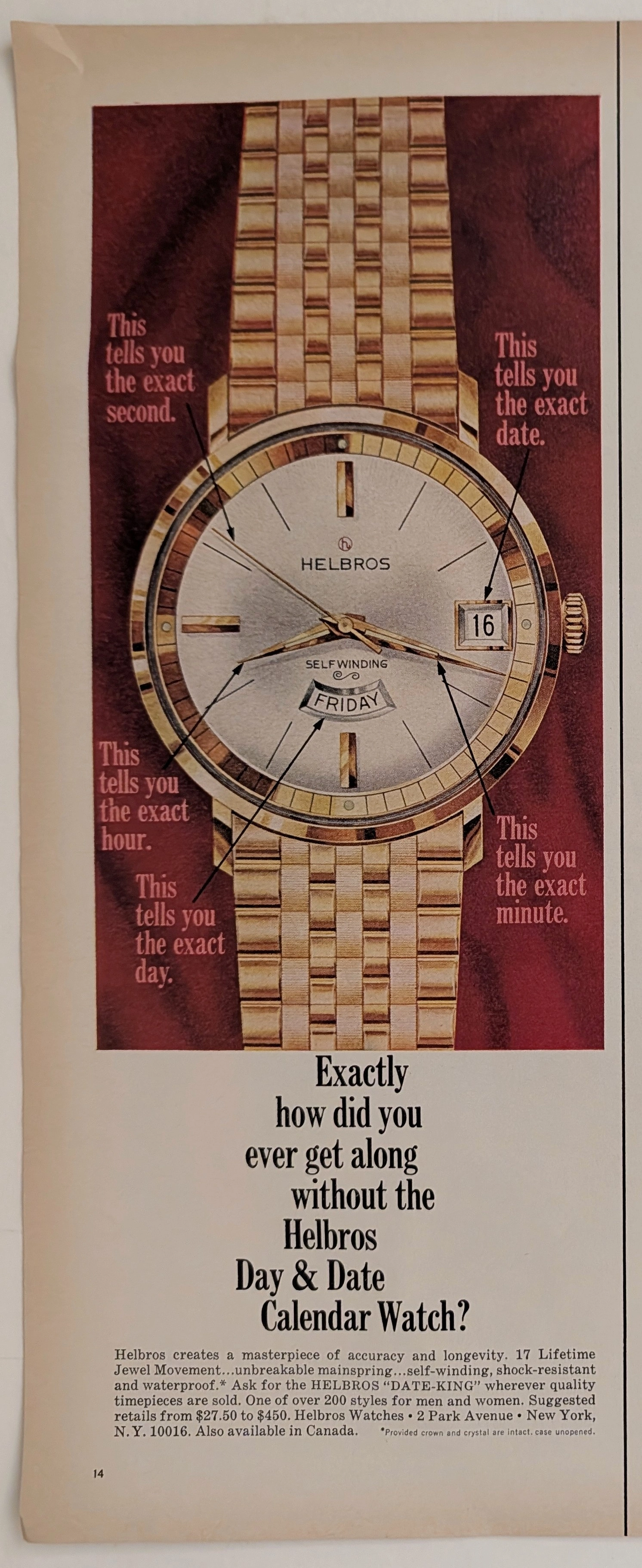
1960s Helbros Date-King Day & Date Calendar Watch Vintage Advertisement The post-World War II economic boom in the United States ushered in a golden age of consumerism, wherein functional tools were increasingly marketed as lifestyle accessories. Within the horological sector, technological advancements that were once reserved for elite luxury models began to democratize. This Helbros advertisement, likely published in a mainstream American magazine in the 1960s, perfectly captures this shift by spotlighting the "Date-King" model. The advertisement employs a highly didactic, almost instructional design philosophy. By utilizing literal pointers that direct the reader's eye to specific elements of the dial—"This tells you the exact second," "This tells you the exact date," "This tells you the exact day"—the agency breaks down the mechanical complexity of the watch into easily digestible, pragmatic benefits. This straightforward approach was highly effective for a middle-class demographic that valued both utility and modern convenience. Furthermore, the copy leans heavily into durability and precision. The mention of a "17 Lifetime Jewel Movement," an "unbreakable mainspring," and "self-winding, shock-resistant and waterproof" characteristics reflects the mid-century consumer's desire for "buy-it-for-life" dependability. Helbros, originally founded in 1913 by the Helbein Brothers, was renowned for assembling watches in the United States using reliable imported Swiss movements. This allowed them to offer exceptional quality at a lower price point than purely Swiss counterparts. Remarkably, the advertisement lists a suggested retail price range from $27.50 to $450.00. This massive spread indicates that the "Date-King" line encompassed everything from basic, gold-plated stainless steel models up to solid gold, premium-tier iterations. Through this single piece of marketing material, Helbros effectively communicated a brand identity that was simultaneously aspirational and grounded in mass-market accessibility.

Paper & Print Condition

The artifact exhibits excellent preservation of its original color palette, characterized by the warm, rich gold tones of the watch contrasted against a deep crimson background. There is minor, uniform yellowing characteristic of magazine stock from the mid-20th century, which does not detract from the clarity of the typography or the central graphic.

Provenance & Rarity

Extracted from a prominent mid-century American lifestyle or general-interest periodical—likely a high-circulation publication akin to Life or The Saturday Evening Post—this advertisement represents a specific era of post-war horological mass marketing. The provenance traces back to a time when print media was the undisputed medium for consumer influence. While originally produced in the millions as commercial ephemera, the survival rate of such pieces is exceedingly low. The inherent fragility of mid-20th-century wood-pulp paper, which is highly acidic, means that most examples have long since deteriorated, been discarded, or suffered from severe foxing, moisture damage, and UV fading. Finding a meticulously preserved, untorn specimen that retains its original structural integrity, crisp typography, and vivid color saturation is becoming increasingly uncommon. This piece is not merely an advertisement; it is a scarce surviving artifact of mid-century commercial art that bridges the gap between mechanical watchmaking and everyday American consumerism just prior to the impending quartz crisis.

Rarity & Condition Summary

This artifact represents a remarkable convergence of common mass-market ephemera and exceptional physical preservation. While the Helbros "Date-King" advertisement was originally printed in vast quantities for mid-century periodicals, its survival in this pristine, structurally sound condition elevates it from a mere commercial clipping to a museum-grade archival document. The vivid retention of the metallic gold inks against the deep crimson background, coupled with the sharp, legible typography, provides an uncompromised look at early informational graphic techniques. Ultimately, this piece stands as a highly desirable and increasingly rare chronological benchmark in the study of 1960s horological marketing and American consumer culture.

Share This Archive

From the Journal

Related Articles

The Time Traveller's Dossier: The Anatomy of Autonomy – The 1966 Bulova Commander Collection and the American System of Watchmaking — related article
Read Article

The Time Traveller's Dossier: The Anatomy of Autonomy – The 1966 Bulova Commander Collection and the American System of Watchmaking

The evolution of the mid-twentieth-century luxury consumer market was fundamentally propelled by an intense post-war desire for unwavering reliability and transparent corporate accountability. The historical artifact elegantly and securely positioned upon the analytical table of The Record Institute today is a striking, full-page print advertisement for the 1966 Bulova Commander Collection, originating from a highly transformative era in global horology. This document completely transcends the standard, utilitarian boundaries of jewelry marketing. It operates as a highly sophisticated, multi-layered cultural mirror, reflecting the precise era when American industrial might directly challenged the fragmented traditions of European watchmaking, explicitly packaging and selling the concept of total mechanical autonomy to the American middle-class consumer. This world-class, comprehensive dossier conducts a meticulous, unyielding, and exceptionally exhaustive examination of the artifact, operating under the absolute most rigorous parameters of historical, sociological, and material science evaluation. With the vast majority of our analytical focus dedicated to its immense historical gravity, we will decode the brilliant marketing psychology embedded within the "If you want something done right, do it yourself" campaign, analyze the sociopolitical impact of the "American System of Watchmaking," and dissect the profound visual semiotics of the exploded mechanical view. Furthermore, as we venture deeply into the chemical and physical foundations of this analog printed ephemera, we will reveal the precise mechanical fingerprints of the CMYK halftone rosettes captured in the macro imagery of the watch dial and alligator strap. Finally, we will assess its archival rarity, exploring how the graceful, natural oxidation of the paper substrate cultivates a serene wabi-sabi aesthetic—a natural, irreversible phenomenon that serves as the primary engine driving up its market value exponentially within the elite global spheres of Vintage Commercial Ephemera and Horological Archives.

Ahead of Its Time: The 1978 Heuer Chronosplit Manhattan GMT — related article
Read Article

Ahead of Its Time: The 1978 Heuer Chronosplit Manhattan GMT

Rediscover the ultimate analog-digital hybrid timepiece through a rare 1978 vintage magazine advertisement, meticulously preserved as a single sheet cut-out.

Rolex "Perpetually Yours" — related article
Read Article

Rolex "Perpetually Yours"

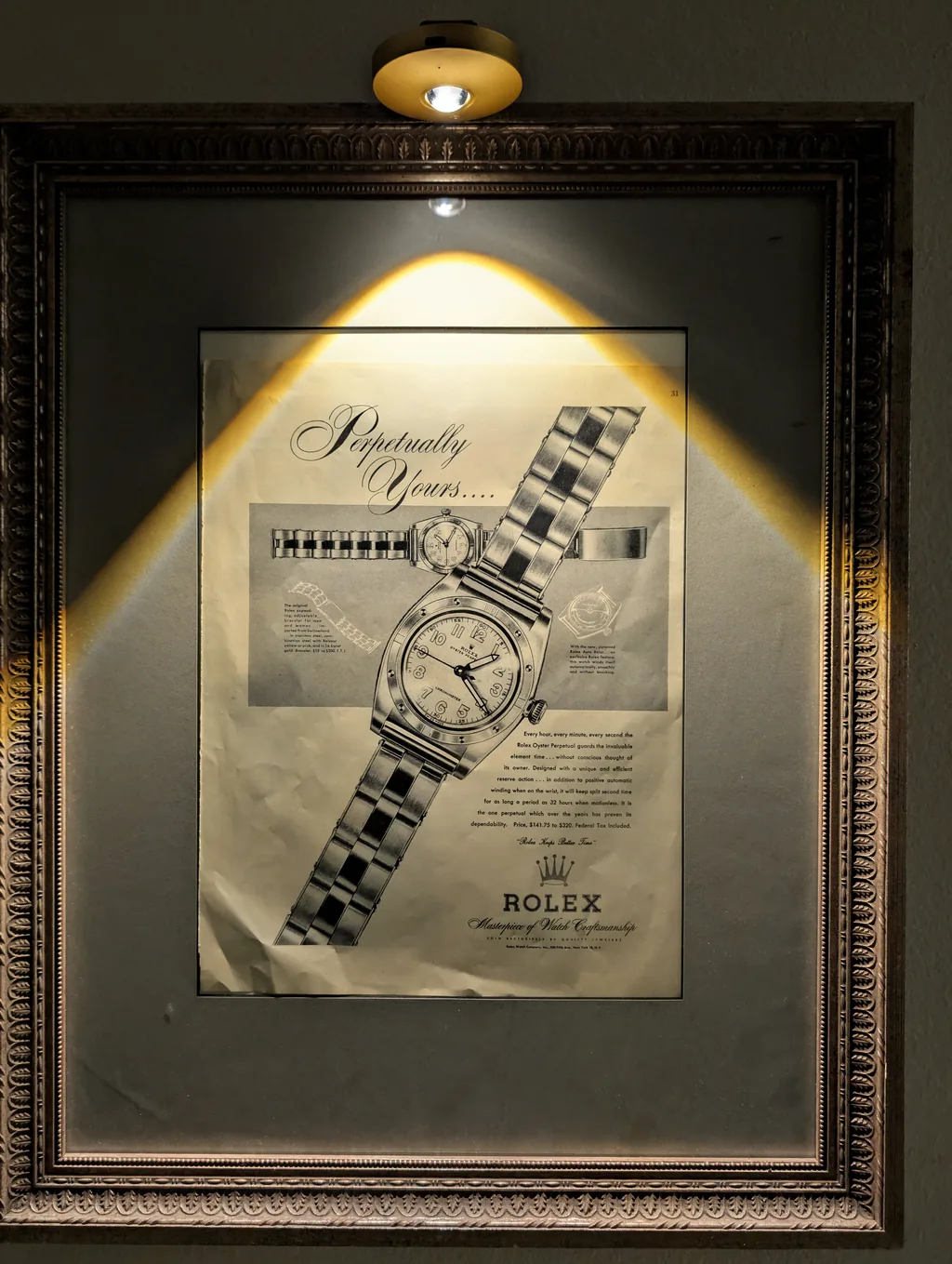
This rare mid-century Rolex "Perpetually Yours" advertisement captures the genesis of the modern Rolex empire. Featuring the legendary Oyster Perpetual, it celebrates the historic union of the world's first waterproof 'Oyster' case (1926) and the revolutionary self-winding 'Perpetual' rotor (1931). A true museum-grade horological archive, this piece represents the ultimate mechanical blueprint that defined Rolex's eternal supremacy.

The Time Traveller's Dossier: The Ultimate Horological Supremacy – A Museum-Grade Forensic Deconstruction of the 1968 Longines Ultra-Chron — related article
Read Article

The Time Traveller's Dossier: The Ultimate Horological Supremacy – A Museum-Grade Forensic Deconstruction of the 1968 Longines Ultra-Chron

The evolution of human timekeeping is not merely a passive record of hands rotating in concentric circles; it is a brutal, centuries-long engineering war waged against the absolute, unforgiving laws of physics—specifically gravity, temperature fluctuation, and physical friction. The historical artifact placed upon The Record Institute’s forensic examination table today is a monumental full-page print advertisement for the 1968 Longines Ultra-Chron, extracted from a mid-twentieth-century publication. Released precisely on the precipice of the "Quartz Crisis"—a technological tsunami that would soon decimate the traditional Swiss watch industry—this document represents the absolute pinnacle, the zenith, and the glorious final, defiant stand of analog mechanical engineering. This exhaustive, world-class academic archival dossier will ruthlessly dissect the artifact with microscopic precision, operating under the most rigorous parameters of historical and physical evaluation. We will decode the arrogant yet mathematically backed copywriting that boldly claims "A Minute A Month" accuracy, the profound mechanical significance of the 36,000 vibrations per hour (vph) high-beat movement, and the five specific medallions of honor that permanently anchor the brand’s bloodline to legendary aviation pioneers such as Charles Lindbergh and Howard Hughes. Furthermore, we will subject the heavy, dark-field offset lithography to a rigorous material science analysis, exposing the mechanical fingerprints of the analog halftone rosettes and the inevitable, profoundly beautiful wabi-sabi oxidation of the paper substrate. It is this exact intersection of horological mastery and chemical degradation that acts as the primary engine driving the artifact's market value exponentially upward among serious global collectors.