THE RECORD · ARCHIVE PLAYER
MP4
■ PAUSED
1990s Dunhill Two-Tone Watch & Cufflinks Vintage Print AdvertisementANALOG ARCHIVE
1990s Dunhill Two-Tone Watch & Cufflinks Vintage Print Advertisement (1990) — Class A vintage Luxury Brands
CLASS A
1 of 6

1990s Dunhill Two-Tone Watch & Cufflinks Vintage Print Advertisement

Category|Luxury Brands
Year|1990
Rarity Class|CLASS A
Archive Views|7

Last updated: 03 May 2026

Historical Context

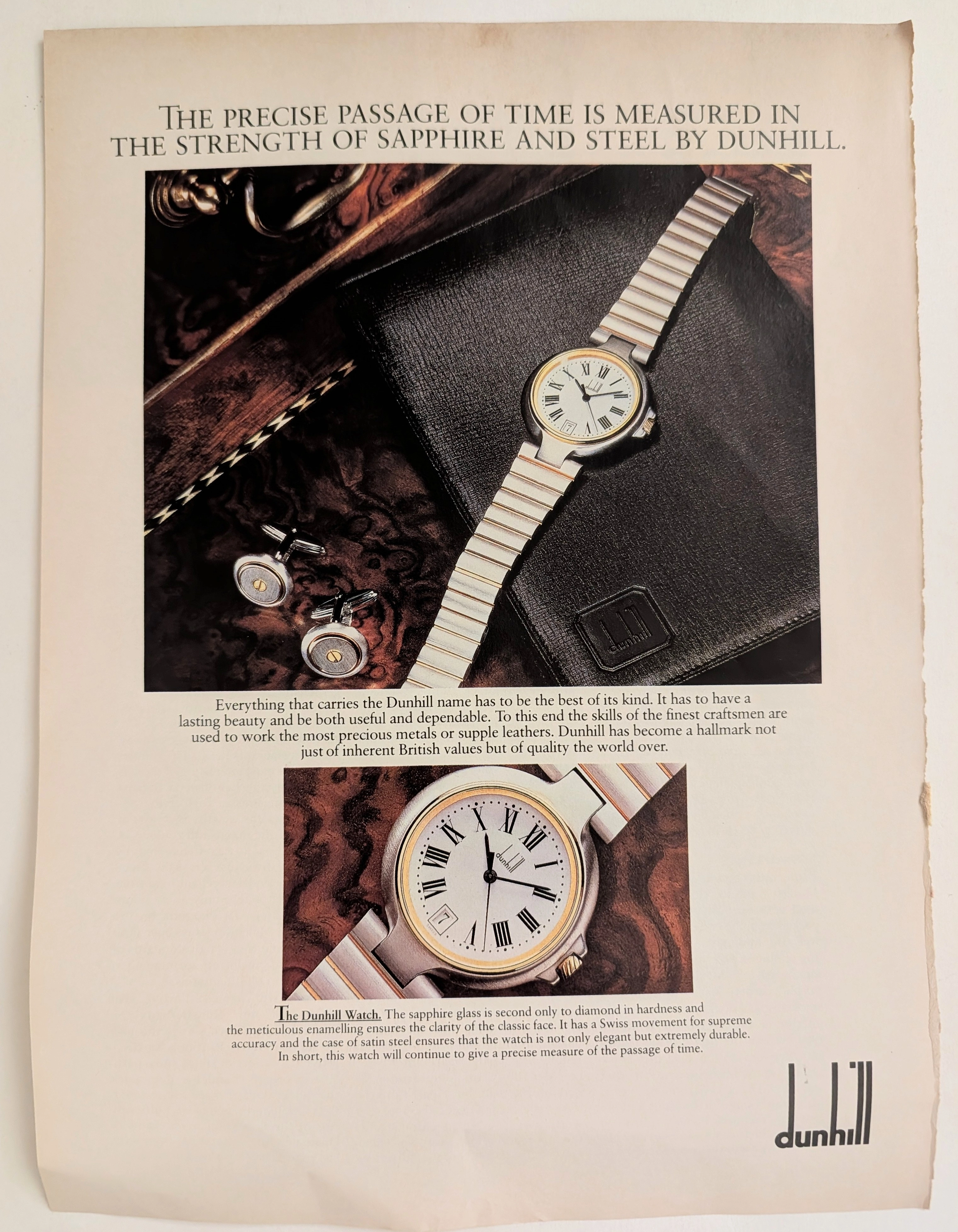
During the late 20th century, Alfred Dunhill solidified its reputation as a purveyor of quintessential British luxury and executive lifestyle goods. This vintage advertisement highlights "The Dunhill Watch," showcasing the brand's dedication to combining inherent British aesthetic values with world-renowned Swiss watchmaking precision. The campaign elegantly frames the timepiece alongside other hallmark men's accessories, emphasizing enduring quality through the use of sapphire glass and satin steel. In the late 1980s and throughout the 1990s, the landscape of men's luxury experienced a renaissance of traditionalism. Moving away from the experimental designs of the 1970s, established houses like Alfred Dunhill returned to core classical aesthetics, heavily emphasizing heritage, durability, and refined masculinity. This advertisement serves as a perfect capsule of that era's prevailing executive style, defined by rich textures and understated elegance. The visual composition of the advertisement is a masterclass in luxury staging. Set against a backdrop of highly polished burl wood—a material deeply associated with classic British automotive interiors and gentleman's clubs—the products are presented not merely as accessories, but as artifacts of a distinguished lifestyle. A textured black leather wallet serves as a stark, elegant podium for the central focus: The Dunhill Watch. Beside it rest a pair of sophisticated circular cufflinks, mirroring the watch's two-tone steel and gold aesthetic. The copy is equally deliberate, opening with the striking headline: "THE PRECISE PASSAGE OF TIME IS MEASURED IN THE STRENGTH OF SAPPHIRE AND STEEL BY DUNHILL." This immediately grounds the product in a narrative of permanence and resilience. During this period, the integration of scratch-resistant sapphire crystal ("second only to diamond in hardness") was a significant technical selling point for luxury timepieces, clearly distinguishing them from mass-market alternatives. Furthermore, the advertisement highlights the synergy between British design and Swiss engineering. While Dunhill leveraged its London heritage to sell the concept of the watch—elegant, dependable, classic—it correctly outsourced the mechanics to Switzerland. The "meticulous enamelling" of the classic Roman numeral face and the "satin steel" case speak to the era's massive demand for two-tone, everyday-luxury sports watches that could seamlessly transition from the boardroom to weekend leisure. Ultimately, this piece of print media represents Dunhill’s successful evolution from a traditional tobacconist and leather goods maker into a comprehensive, global men's lifestyle empire.

Paper & Print Condition

Printed on standard glossy magazine stock of the era. The color fidelity remains exceptionally high, particularly in the rich, warm browns of the burl wood background and the crisp metallic contrasts of the gold and steel components. There is minimal yellowing or degradation to the core image area.

Provenance & Rarity

This piece was carefully sourced from a premier international men’s lifestyle or executive business publication circulated during the early to mid-1990s. While the original print runs for these high-tier magazines were relatively substantial at the time, the inherently ephemeral nature of periodical publishing means that surviving examples in true, display-worthy condition have become remarkably scarce. Most copies from this era were subjected to the inevitable degradation of environmental exposure, improper storage, or routine disposal. Consequently, finding an impeccably preserved page that retains the structural integrity, sharp typography, and high color fidelity seen here is an increasingly rare occurrence. For horological archivists, brand historians, and collectors of vintage luxury ephemera, this piece holds significant curatorial value. It acts as a primary source document, capturing a pivotal era in luxury menswear where heritage brands like Dunhill solidified their global standing through highly calculated print campaigns. It is not merely a commercial advertisement, but a verified historical record of late 20th-century consumer culture and executive taste.

Rarity & Condition Summary

This vintage advertisement is a remarkably well-preserved artifact of late 20th-century luxury brand marketing, possessing a condition grade rarely encountered in periodical ephemera of this era. The inherent fragility of commercial magazine stock from the 1990s typically results in severe oxidative yellowing (foxing), micro-tears, or significant ink degradation over the decades. However, this specific specimen demonstrates an exceptional degree of structural and visual integrity. The color saturation, particularly within the warm, organic tones of the burl wood and the sharp metallic sheen of the horological subjects, remains deeply vibrant and true to the original press run. While there are microscopic edge imperfections and slight marginal wear consistent with careful extraction from a bound volume, these negligible flaws do not intrude upon the main visual composition or the typography. Ultimately, the combination of its pristine presentation and its status as a tangible piece of Alfred Dunhill's corporate heritage renders it a highly desirable, museum-quality acquisition for institutional archives and dedicated horological collections alike.

Share This Archive

From the Journal

Related Articles

Ahead of Its Time: The 1978 Heuer Chronosplit Manhattan GMT — related article
Read Article

Ahead of Its Time: The 1978 Heuer Chronosplit Manhattan GMT

Rediscover the ultimate analog-digital hybrid timepiece through a rare 1978 vintage magazine advertisement, meticulously preserved as a single sheet cut-out.

The Time Traveller's Dossier: The Anatomy of Autonomy – The 1966 Bulova Commander Collection and the American System of Watchmaking — related article
Read Article

The Time Traveller's Dossier: The Anatomy of Autonomy – The 1966 Bulova Commander Collection and the American System of Watchmaking

The evolution of the mid-twentieth-century luxury consumer market was fundamentally propelled by an intense post-war desire for unwavering reliability and transparent corporate accountability. The historical artifact elegantly and securely positioned upon the analytical table of The Record Institute today is a striking, full-page print advertisement for the 1966 Bulova Commander Collection, originating from a highly transformative era in global horology. This document completely transcends the standard, utilitarian boundaries of jewelry marketing. It operates as a highly sophisticated, multi-layered cultural mirror, reflecting the precise era when American industrial might directly challenged the fragmented traditions of European watchmaking, explicitly packaging and selling the concept of total mechanical autonomy to the American middle-class consumer. This world-class, comprehensive dossier conducts a meticulous, unyielding, and exceptionally exhaustive examination of the artifact, operating under the absolute most rigorous parameters of historical, sociological, and material science evaluation. With the vast majority of our analytical focus dedicated to its immense historical gravity, we will decode the brilliant marketing psychology embedded within the "If you want something done right, do it yourself" campaign, analyze the sociopolitical impact of the "American System of Watchmaking," and dissect the profound visual semiotics of the exploded mechanical view. Furthermore, as we venture deeply into the chemical and physical foundations of this analog printed ephemera, we will reveal the precise mechanical fingerprints of the CMYK halftone rosettes captured in the macro imagery of the watch dial and alligator strap. Finally, we will assess its archival rarity, exploring how the graceful, natural oxidation of the paper substrate cultivates a serene wabi-sabi aesthetic—a natural, irreversible phenomenon that serves as the primary engine driving up its market value exponentially within the elite global spheres of Vintage Commercial Ephemera and Horological Archives.

The Time Traveller's Dossier: The Ultimate Horological Supremacy – A Museum-Grade Forensic Deconstruction of the 1968 Longines Ultra-Chron — related article
Read Article

The Time Traveller's Dossier: The Ultimate Horological Supremacy – A Museum-Grade Forensic Deconstruction of the 1968 Longines Ultra-Chron

The evolution of human timekeeping is not merely a passive record of hands rotating in concentric circles; it is a brutal, centuries-long engineering war waged against the absolute, unforgiving laws of physics—specifically gravity, temperature fluctuation, and physical friction. The historical artifact placed upon The Record Institute’s forensic examination table today is a monumental full-page print advertisement for the 1968 Longines Ultra-Chron, extracted from a mid-twentieth-century publication. Released precisely on the precipice of the "Quartz Crisis"—a technological tsunami that would soon decimate the traditional Swiss watch industry—this document represents the absolute pinnacle, the zenith, and the glorious final, defiant stand of analog mechanical engineering. This exhaustive, world-class academic archival dossier will ruthlessly dissect the artifact with microscopic precision, operating under the most rigorous parameters of historical and physical evaluation. We will decode the arrogant yet mathematically backed copywriting that boldly claims "A Minute A Month" accuracy, the profound mechanical significance of the 36,000 vibrations per hour (vph) high-beat movement, and the five specific medallions of honor that permanently anchor the brand’s bloodline to legendary aviation pioneers such as Charles Lindbergh and Howard Hughes. Furthermore, we will subject the heavy, dark-field offset lithography to a rigorous material science analysis, exposing the mechanical fingerprints of the analog halftone rosettes and the inevitable, profoundly beautiful wabi-sabi oxidation of the paper substrate. It is this exact intersection of horological mastery and chemical degradation that acts as the primary engine driving the artifact's market value exponentially upward among serious global collectors.

Rolex "Perpetually Yours" — related article
Read Article

Rolex "Perpetually Yours"

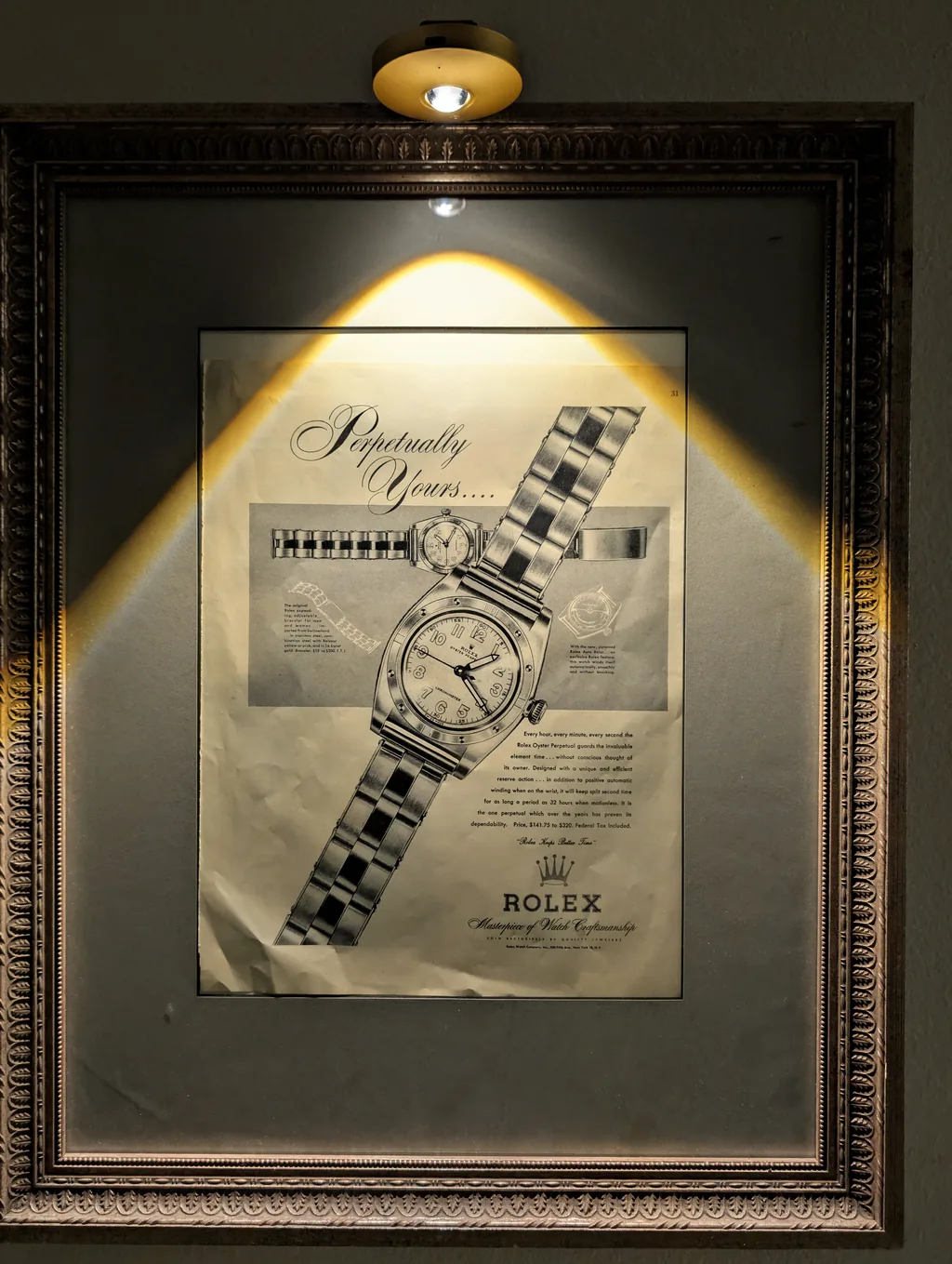
This rare mid-century Rolex "Perpetually Yours" advertisement captures the genesis of the modern Rolex empire. Featuring the legendary Oyster Perpetual, it celebrates the historic union of the world's first waterproof 'Oyster' case (1926) and the revolutionary self-winding 'Perpetual' rotor (1931). A true museum-grade horological archive, this piece represents the ultimate mechanical blueprint that defined Rolex's eternal supremacy.