THE RECORD · ARCHIVE PLAYER
MP4
■ PAUSED
1968 De Beers "Changing World" Portrait-Tableau Vintage AdvertisementANALOG ARCHIVE
1968 De Beers "Changing World" Portrait-Tableau Vintage Advertisement (1960) — Class A vintage Luxury Brands
CLASS A
1 of 4

1968 De Beers "Changing World" Portrait-Tableau Vintage Advertisement

Category|Luxury Brands
Year|1960
Rarity Class|CLASS A
Archive Views|14

Last updated: 30 Apr 2026

Historical Context

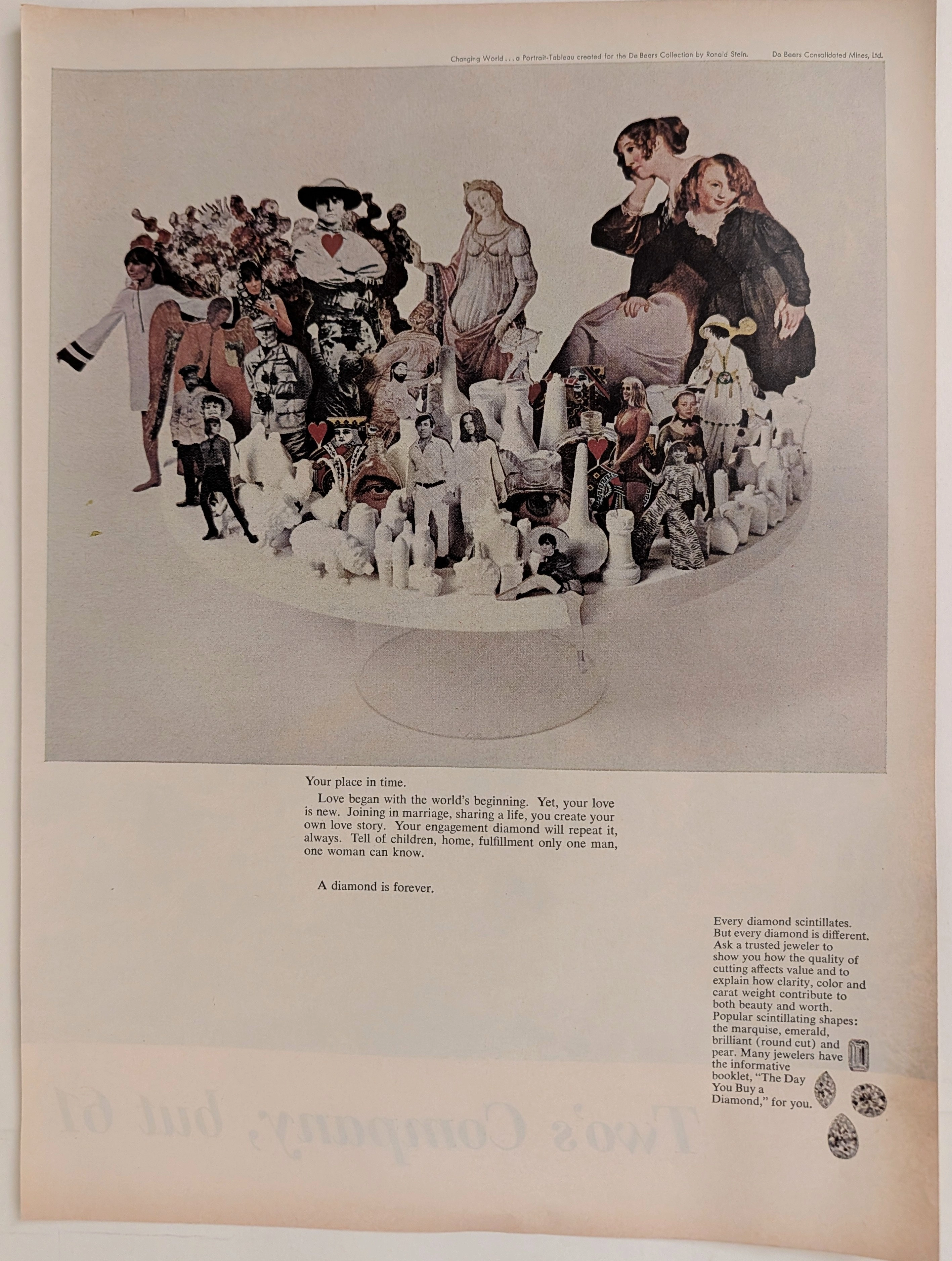
Circa 1968 De Beers "Changing World" Portrait-Tableau Vintage Advertisement The late 1960s was an era defined by rapid social, political, and cultural upheaval. In response to this shifting landscape, De Beers—guided by the N.W. Ayer & Son advertising agency—commissioned fine artists to create works that positioned the diamond as an anchor of eternal stability. Ronald Stein’s Changing World acts as a visual metaphor for this concept. The tableau is a dense, collage-like assembly of historical epochs, royal figures, 1960s youth, and classical statuary. By explicitly stating, "Love began with the world's beginning... Yet, your love is new," De Beers masterfully reframes the ancient tradition of marriage to appeal to a modern generation seeking individuality within a chaotic era. Furthermore, the advertisement serves a dual purpose: emotional resonance and consumer education. The lower quadrant transitions from philosophical musings into practical gemological advice, illustrating four popular diamond cuts (marquise, emerald, brilliant, and pear) and encouraging buyers to consult a jeweler about clarity, color, and carat weight. This educational approach was instrumental in standardizing the modern diamond market and reinforcing De Beers' authority.

Paper & Print Condition

Printed on standard mid-century magazine stock. The piece shows mild, uniform age-toning. The complex photomontage retains excellent contrast and color fidelity, essential for reading the intricate details of Stein's collage.

Provenance & Rarity

Sourced from a major American periodical of the late 1960s. While the magazine was mass-circulated, De Beers' commissioned art pieces are highly sought after by advertising archivists.

Rarity & Condition Summary

A compelling cultural artifact that captures a transitional moment in luxury advertising. It beautifully preserves the intersection of fine art commissions and mass-market consumer education in the mid-twentieth century.
Share This Archive

From the Journal

Related Articles

The Time Traveller's Dossier : Lindé Star - The Engineered Asterism — related article
Read Article

The Time Traveller's Dossier : Lindé Star - The Engineered Asterism

Nature is fundamentally inefficient. It requires chaotic heat, random mineral deposits, and geologic timescales. It relies on blind, subterranean luck to forge a gemstone. For thousands of years, humans accepted this scarcity. A star sapphire was an anomaly of dirt and pressure. It was reserved for royalty. It was a geological lottery ticket. Then came the twentieth century. Then came industrial ambition. This advertisement is not simply selling jewelry. It is selling a profound historical shift. It is documenting the exact moment humanity stopped mining the earth for miracles, and started manufacturing them in a laboratory. The Lindé Star represents the conquest of natural magic by chemical engineering. It is the democratization of the cosmos, packaged in a mid-century magazine spread. The problem was rarity. The solution was mass-produced perfection.

The Time Traveller's Dossier: The Architecture of Eternity – De Beers "Glory of Bells" Advertisement (Circa early 1940s) — related article
Read Article

The Time Traveller's Dossier: The Architecture of Eternity – De Beers "Glory of Bells" Advertisement (Circa early 1940s)

History is not shaped by chance; it is engineered by those who control the narrative and own the resources. Long before the digital age fragmented human attention, the ultimate manifestations of social engineering and psychological manipulation were executed through the calculated precision of the four-color offset printing press and the masterful strokes of commercial fine art. The historical artifact presented before us is not merely a page from a vintage magazine. It is a perfectly weaponized blueprint of corporate capitalism, a masterpiece of emotional extortion, and a foundational document in the creation of one of the most successful, universally accepted illusions in the history of human commerce: the diamond engagement ring. This museum-grade, academic archival dossier presents an exhaustive, microscopic deconstruction of a World War II-era print advertisement for De Beers Consolidated Mines, Limited, executed by the legendary advertising agency N.W. Ayer & Son. Operating on a profound and ruthless binary structure, this document records a calculated paradigm shift within the global luxury and gemstone industry. It captures the precise historical fracture where a monopolized carbon allotrope was conceptually transmuted from a rare gemstone into an absolute, non-negotiable sacrament of love, faith, and matrimony. Through the highly specialized lens of late-analog commercial artistry and stringent visual forensics, this document serves as a masterclass in psychological marketing. It established the foundational archetype for linking extreme financial expenditure with spiritual and emotional devotion—an archetype that unconditionally dictates the visual and strategic totems of the modern diamond industry today.

The Time Traveller’s Dossier: 1980 Imperial Treasury Golden Reliquary Vintage Advertisement — The Weight of Divine Right — related article
Read Article

The Time Traveller’s Dossier: 1980 Imperial Treasury Golden Reliquary Vintage Advertisement — The Weight of Divine Right

Explore the meticulous craftsmanship captured in this 1980 Imperial Treasury Golden Reliquary vintage advertisement, a stunning testament to both medieval goldsmithing and late 20th-century print reproduction. Among vintage ads, pieces that successfully bridge the gap between historical artifact and commercial art hold a unique, exalted position in curatorial archives. This comprehensive dossier examines the exquisite details of the reliquary’s goldwork, the prominent step-cut emeralds, and the intricate enamel eagle, all rendered through the distinct halftone dot matrix characteristic of classic print ads from the era. By analyzing the deep visual chiaroscuro and the material preservation of this specific lithograph, we uncover why old advertisements featuring such opulent antiquities remain highly sought after by archivists, art historians, and dedicated collectors alike. It is not merely a promotional print; it is a paper-bound exhibition of divine right, royal heritage, and institutional prestige, perfectly preserved in the annals of print history and curatorial excellence.

THE TIME TRAVELER'S DOSSIER: THE DAWN OF ELEGANCE AND THE EXTINCT $1,500 HOLY GRAIL — related article
Read Article

THE TIME TRAVELER'S DOSSIER: THE DAWN OF ELEGANCE AND THE EXTINCT $1,500 HOLY GRAIL

The artifact under museum-grade analysis is an exceptionally preserved Historical Relic originating from the golden age of analog publishing—a vintage issue of PLAYBOY magazine (circa late 1960s to 1970s). It features a striking, deeply sophisticated advertisement for one of the most revolutionary men's fragrances in modern human history: EAU SAUVAGE by Christian Dior. ​This Primary Art Document does not merely advertise a grooming product; it serves as a tangible historical marker of a monumental cultural paradigm shift. Prior to its introduction in 1966, men's fragrances were exclusively heavy, musky, and brutally spiced. Eau Sauvage, formulated by the legendary Master Perfumer Edmond Roudnitska, shattered this archaic mold by introducing Hedione (an airy, luminous synthetic jasmine compound) to men's perfumery, forever altering the trajectory of the global fragrance industry. ​Crucially, the original mid-century formulation and the specific ribbed-glass bottle design depicted in this artifact are permanently discontinued and lost to time. Modern reformulations driven by strict chemical regulations (such as the banning of natural oakmoss) have forever altered Roudnitska's original masterpiece. Consequently, surviving vintage bottles of this exact era have achieved mythical "Holy Grail" status, currently commanding astronomical prices of up to $1,500 USD in the global collector's market. This transforms the preserved advertisement from a commercial print into an invaluable piece of historical provenance—a birth certificate for an extinct luxury. ​Rescued from destruction and preserved as a standalone Archival Artifact, the inherently acidic, glossy paper stock of the mid-century era is undergoing a slow, breathtaking chemical degradation. This natural aging process (oxidation and lignin breakdown) transforms the mass-produced print into an irreplaceable, ready-to-frame Primary Art Document, embodying the ultimate aesthetic of analog impermanence.