The Time Traveller's Dossier : Lindé Star - The Engineered Asterism — The Record Institute JournalThe Time Traveller's Dossier : Lindé Star - The Engineered Asterism — The Record Institute JournalThe Time Traveller's Dossier : Lindé Star - The Engineered Asterism — The Record Institute JournalThe Time Traveller's Dossier : Lindé Star - The Engineered Asterism — The Record Institute JournalThe Time Traveller's Dossier : Lindé Star - The Engineered Asterism — The Record Institute JournalThe Time Traveller's Dossier : Lindé Star - The Engineered Asterism — The Record Institute JournalThe Time Traveller's Dossier : Lindé Star - The Engineered Asterism — The Record Institute JournalThe Time Traveller's Dossier : Lindé Star - The Engineered Asterism — The Record Institute JournalThe Time Traveller's Dossier : Lindé Star - The Engineered Asterism — The Record Institute Journal
1 / 9

✦ 9 Photos — Click any image to view in high resolution

April 28, 2026

The Time Traveller's Dossier : Lindé Star - The Engineered Asterism

FashionBrand: Linde Star
Archive Views: 44

The History

The Geological Lottery and the Burden of Nature

To understand the artifact, one must first understand the stone.
A natural star sapphire is a prison of light.
It begins as corundum, an incredibly hard aluminum oxide.
Deep within the earth, over millions of years, impurities infiltrate the matrix.
Titanium dioxide bleeds into the cooling crystal.
It forms microscopic, needle-like inclusions known as rutile.
Under immense pressure, these needles align themselves.
They intersect at precise sixty-degree angles.

When raw corundum is extracted from the earth, it is jagged and dull.
A lapidary must cut it into a smooth, domed shape called a cabochon.
When light strikes this curved surface, it pierces the stone.
It hits the microscopic lattice of rutile needles.
The light bends. It fractures. It reflects.
The result is asterism.
A six-rayed star appears, floating like a ghost beneath the surface.
It moves as the stone moves.

For centuries, this phenomenon was considered magical.
It was a flaw in the stone, yet it was a perfect flaw.
Because nature is chaotic, natural star sapphires are rarely perfect.
The star is often crooked. The rays are broken. The color is muddy.
Perfection was an astronomical improbability.
It was priced accordingly.
Only the absolute apex of the economic hierarchy could afford to wear a star.

The Alchemist’s Furnace: Union Carbide and the Flame

The mid-twentieth century brought a shift in the human ego.
We split the atom. We engineered plastics. We prepared to leave the atmosphere.
Humanity decided it no longer needed to wait for geological accidents.

The foundational technology was not new.
In 1902, a French chemist named Auguste Verneuil invented flame fusion.
He dropped finely powdered aluminum oxide through an incredibly hot oxyhydrogen flame.
The powder melted instantly.
It fell onto a rotating pedestal.
Drop by drop, it built a cylindrical, synthetic crystal called a boule.
Verneuil had created artificial corundum. He had made sapphires.

But a clear sapphire is just a stone.
A star sapphire is a performance.

It took decades to decipher the physics of the star.
In the late 1940s, the Linde Air Products Company, a division of the industrial giant Union Carbide, solved the equation.
They learned how to introduce titanium dioxide into the Verneuil process.
They learned how to heat-treat the resulting boule to force the rutile needles to crystallize in the exact, necessary geometry.
They patented the process in 1947.

Union Carbide was a chemical behemoth.
They manufactured industrial gases, synthetic rubber, and uranium components for the atomic bomb.
They were engineers of the highest order.
And yet, here they were, manufacturing romance.
They had bypassed a billion years of geology in a matter of hours.
They created the Lindé Star.
It was not a fake gem. It was chemically, physically, and optically identical to a natural sapphire.
It was simply born in a furnace instead of a mountain.

The Mid-Century Modern Mindset: Better Living Through Chemistry

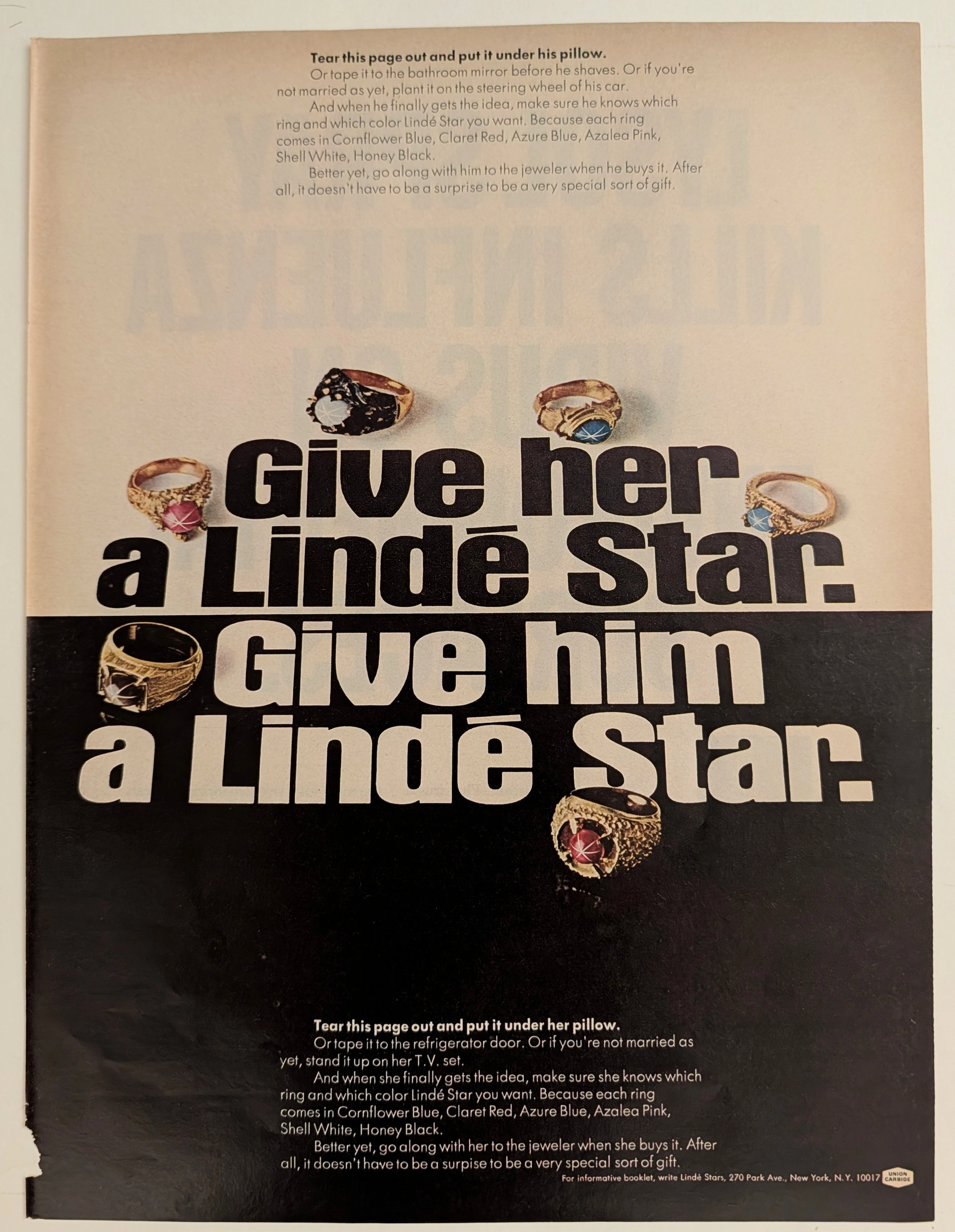
This advertisement originates from the late 1960s to early 1970s.
The zip code "10017" places it firmly after 1963.
The typographic choices and societal implications point to the apex of the Space Age.

In this era, "synthetic" was not a derogatory term.
Today, the modern consumer seeks "organic" and "natural" products.
We possess a deep skepticism of the laboratory.
In the mid-century mindset, the opposite was true.
Nature was viewed as primitive. Science was the ultimate luxury.
Nylon, polyester, fiberglass, and synthetic gems were symbols of progress.

Union Carbide did not hide the origins of the Lindé Star.
They branded it. They named the colors with calculated, evocative precision.
Cornflower Blue. Claret Red. Azure Blue. Azalea Pink. Shell White. Honey Black.
These were not geological classifications. These were consumer choices.
The Lindé Star was marketed as a triumph of American industry.
It offered middle-class citizens the opportunity to wear a stone that, a century prior, would have cost a fortune.
It was the ultimate democratization of luxury.
Perfection was no longer a matter of luck. It was a matter of retail.

The Psychology of the Pitch: Subverting Romance and Gender

The copy of this artifact is a masterclass in mid-century domestic psychology.
It is aggressively pragmatic.
It strips away the mystique of the surprise gift.

"Tear this page out and put it under his pillow."
"Or tape it to the bathroom mirror before he shaves."

The advertisement acknowledges the reality of the middle-class marriage.
It recognizes the female consumer as the director of domestic purchasing, even if the male holds the capital.
It advises women to "plant" the advertisement.
To leave it on the steering wheel of his car.
It is a calculated, humorous endorsement of domestic manipulation.
It removes the anxiety of the male buyer. It dictates exactly what to purchase.

"Better yet, go along with him to the jeweler when he buys it. After all, it doesn't have to be a surprise to be a very special sort of gift."

This is a stark departure from the traditional, romanticized jewelry narrative.
It treats the transaction as a joint economic decision.

Furthermore, the artifact aggressively targets both genders.
"Give her a Lindé Star. Give him a Lindé Star."
The visual real estate is split perfectly in half.
In the 1960s and 70s, male jewelry was experiencing a resurgence.
Bold, heavy gold rings with prominent stones were acceptable markers of male success.
The Honey Black and Claret Red stars, set in thick, textured gold, were designed specifically for the male hand.
The artifact captures a brief window in time where a synthetic gem was considered a highly desirable, masculine status symbol.

The Inevitable Shift: The Return to the Dirt

Nothing remains cutting-edge forever.
The Lindé Star enjoyed immense popularity for three decades.
But as the 1970s bled into the 1980s, the cultural pendulum swung back.
The environmental movement gained traction.
The charm of "Better Living Through Chemistry" fractured under the weight of industrial pollution and chemical disasters.

Consumers began to reject laboratory perfection.
A new premium was placed on natural flaws.
A natural stone, even with a crooked star, became infinitely more valuable than a chemically perfect synthetic.
The word "synthetic" became synonymous with "imitation."
Union Carbide eventually ceased production of the Lindé Star.
The furnaces cooled. The patents expired.

This advertisement is an artifact of a closed chapter.
It represents a specific, isolated period where humanity believed that absolute, engineered perfection was superior to the chaotic beauty of the earth.

The Paper

This artifact is suspended on medium-weight, coated magazine stock.
It sits at approximately 70 GSM.
The paper is engineered for mass distribution, not for archival longevity.

The printing utilizes a four-color CMYK process, standard for high-circulation periodicals of the era.
Close inspection of the macro photographs reveals the distinctive halftone dot patterns.
The rich blacks of the background are not solid ink; they are dense clusters of pigment, prone to saturation limits.

The passage of time is evident in the substrate.
The edges show the slow burn of acidic decay.
The lignin within the wood pulp is reacting with oxygen and ambient light.
The crisp white of the paper is shifting toward a dull, muted cream.
The physical artifact is degrading, even as the synthetic stones it advertises remain chemically immune to time.
It is a fragile record of an indestructible product.

The Rarity

Classification: Class B (High Contextual Significance, Moderate Physical Scarcity)

Physical copies of mid-century magazines are relatively abundant in the broader archival market.
However, intact, high-contrast, undamaged spreads specific to the Lindé Star campaign are decreasing in circulation.
The true rarity of this artifact lies not in its physical scarcity, but in its contextual weight.

It is a prime documentary specimen of the industrial shift in gemology.
It encapsulates the specific marketing vernacular of Union Carbide.
Its value is academic, sociological, and psychological.
It is an essential baseline document for understanding the history of synthetic luxury.
Visual Impact

The layout is a study in brutalist symmetry and bold contrasts.
The page is bifurcated horizontally. A strict horizon line divides light from dark.
The top half is an expansive, warm cream void. The bottom is an impenetrable, dense black.

This visual dichotomy serves a dual purpose.
First, it immediately segregates the gendered messaging. Light for her, dark for him.
Second, it forces the eye directly to the product.
The rings do not rest on a surface. They float in a vacuum.
This removes all real-world context.
It isolates the stones, forcing the viewer to confront the engineered asterism.

The typography is dense, heavy, and tightly tracked.
It utilizes a bold, robust sans-serif for the primary hook, projecting authority and corporate confidence.
The visual language is not delicate or romantic; it is an industrial command.

Exhibition Halls

Share This Archive

The Archive Continues

Continue the Exploration

THE TIME TRAVELER'S DOSSIER: THE STRATOSPHERIC MANSION AND THE AESTHETICS OF DECAY

THE TIME TRAVELER'S DOSSIER: THE STRATOSPHERIC MANSION AND THE AESTHETICS OF DECAY

The artifact under exhaustive, museum-grade analysis is a flawlessly preserved Historical Relic originating from the absolute dawn of the commercial Jet Age (circa late 1950s to early 1960s). This Primary Art Document is a magnificent full-page advertisement for the Douglas DC-8, the aerospace leviathan engineered to rival the Boeing 707 and conquer the global skies. ​Visually anchored by an elegant, sweeping illustration of the aircraft's exterior and a highly detailed, evocative rendering of its opulent passenger lounge, the piece represents the zenith of mid-century aspirational marketing. Signed by an elusive mid-century commercial artist, the illustration captures the "Palomar Lounge"—a private club in the stratosphere where the elite played cards, smoked, and drank champagne beneath a Space-Age celestial diagram. By utilizing the ultimate authority of the era—the airline stewardess—to validate its luxury ("Stewardesses call it... The world's most luxurious jetliner!"), Douglas masterfully sold the illusion of exclusive, aristocratic segregation at 600 miles per hour. ​Rescued from the binding of a forgotten periodical, this pre-2000s analog artifact is an unforgeable testament to the aesthetic of wabi-sabi. Printed on inherently acidic wood-pulp paper, it exhibits a beautifully frayed right margin and a deep, warm ivory oxidation. This majestic chemical degradation transforms a mass-produced corporate propaganda piece into an irreplaceable, ready-to-frame Primary Art Document of aerospace history.

Viceroy: Al Unser and the "Taste of Excitement"

Viceroy: Al Unser and the "Taste of Excitement"

A legendary artifact linking Al Unser's racing dominance to the golden age of tobacco advertising, a style now permanently banned. The value of this original page will appreciate significantly as pre-2000 analog media naturally decays and vanishes forever.

The Time Traveller's Dossier: BBS Wheels 1986 - The Golden Age of IMSA GTP

BBS · Automotive

The Time Traveller's Dossier: BBS Wheels 1986 - The Golden Age of IMSA GTP

Then, sports car racing was an unrestricted, high-speed arms race. It was an era where manufacturers threw massive budgets at experimental aerodynamics and terrifying turbocharged horsepower, resulting in 200-mph ground-effect monsters that rattled the teeth of spectators. Now, top-tier endurance racing is strictly governed by "Balance of Performance" regulations to ensure parity, and the cars are heavily restricted by standardized hybrid systems. The problem for an automotive enthusiast in 1986 was how to capture a piece of this cutting-edge, million-dollar racing technology for their own street car. The solution, masterfully presented in this advertisement, was BBS. If the fastest, most advanced cars on earth relied on their modular wheels to survive 24 hours of grueling abuse, surely they were good enough for your driveway. This artifact is a portal. It transports us to the paddock of the Daytona International Speedway or Road Atlanta in the mid-1980s. It documents the absolute zenith of the IMSA GTP (Grand Touring Prototype) era, serving as a visual "Who's Who" of legendary race cars, all united by a single, golden component.

Published by

The Record Institute

Taxonomy Match

Related Articles

The Time Traveller's Dossier: Tools of the Void - Engineering Against Newton's Third Law — related article
Read Article

The Time Traveller's Dossier: Tools of the Void - Engineering Against Newton's Third Law

When we look back at the golden age of the Apollo and Gemini programs, we often fixate on the massive Saturn V rockets, the explosive launches, and the triumph of the lunar landings. We rarely think about the mundane act of turning a wrench. Yet, in the brutal, frictionless vacuum of space, the most basic acts of manual labor become lethal puzzles. This collection of highly specialized tool photographs is not just a catalogue of vintage hardware. It is a visual record of humanity realizing that the fundamental mechanics of Earth do not apply in orbit. In microgravity, without friction to anchor your boots to the floor, Sir Isaac Newton’s Third Law (F A ​ =−F B ​ , for every action, there is an equal and opposite reaction) transforms a simple mechanic's wrench into a centrifuge. This dossier dissects a fascinating, mid-1960s print artifact detailing the "Zero Reaction" toolset. These tools were engineered specifically to allow astronauts to build, repair, and survive in the void without spinning uncontrollably into the abyss. It is a masterclass in aerospace engineering, ergonomic survival design, and the aesthetics of the Space Race.

The Time Traveller's Dossier: The Alchemy of Royal Rebellion – Drambuie "Bonnie Prince Charlie" Advertisement (Circa Mid-20th Century) — related article
Read Article

The Time Traveller's Dossier: The Alchemy of Royal Rebellion – Drambuie "Bonnie Prince Charlie" Advertisement (Circa Mid-20th Century)

History is rarely an objective chronicle of facts; it is a malleable narrative, continually rewritten, romanticized, and ultimately weaponized by those seeking to legitimize their power or, in the modern era, their products. Long before digital algorithms could synthesize artificial heritage, the supreme manifestation of corporate alchemy was executed through the calculated precision of the four-color offset press and the appropriation of historical iconography. The artifact presented before us is not merely a vintage magazine tear sheet selling a Scottish liqueur. It is a masterclass in the commodification of myth, a visual distillation of romantic rebellion, and a foundational blueprint for what is now known as "Heritage Branding." This museum-grade, academic archival dossier presents an exhaustive, microscopic deconstruction of a mid-20th-century print advertisement for Drambuie Liqueur. Operating on a profound binary structure, this document records a calculated paradigm shift within the global spirits industry. It captures the precise historical fracture where a highly specific, geographically isolated alcoholic beverage was conceptually transmuted into a literal draught of royal rebellion and aristocratic romance. Through the highly specialized lens of late-analog commercial artistry and stringent visual forensics, this document serves as a masterclass in psychological marketing. It established the foundational archetype for linking the consumption of a physical product with the ingestion of an epic, historical fantasy—an archetype that unconditionally dictates the visual and strategic totems of the modern luxury spirits industry today.

The Time Traveller's Dossier : 1968 Pepsi-Cola - The Thermodynamics of Youth — related article
Read Article

The Time Traveller's Dossier : 1968 Pepsi-Cola - The Thermodynamics of Youth

The year is 1968. The globe is fracturing under the weight of profound social and political upheaval. Then, carbonated beverages were marketed on the gentle merits of family gatherings and nostalgic heritage. Now, the commercial battlefield demands a new, aggressive demographic loyalty. This artifact is a masterclass in the weaponization of temperature and identity. It documents the precise escalation of the Cola Wars, shifting the focus from the liquid itself to the psychographic profile of the consumer. It is the architectural blueprint of the "Pepsi Generation." A manufactured, sun-drenched sanctuary of youth, action, and athletic leisure. It rejects the warm nostalgia of the establishment. It demands a visceral, freezing shock to the system. It is a declaration of absolute thermodynamic supremacy. Taste that beats the others cold.

THE TIME TRAVELER'S DOSSIER :THE BIRTH OF THE WIDE-TRACK — related article
Read Article

THE TIME TRAVELER'S DOSSIER :THE BIRTH OF THE WIDE-TRACK

The artifact currently subjected to our uncompromising, museum-grade analysis is a profoundly preserved Historical Relic excavated from the turning point of Detroit's "horsepower and handling" wars. This Primary Art Document is a full-page magazine advertisement for the 1959 Pontiac, explicitly introducing the brand's revolutionary "Wide-Track" engineering. Functioning as a "Forensic Blueprint of Automotive Rebranding," the document masterfully weaponizes the peerless artistic talents of Fitz and Van to transform Pontiac from a conservative, aging brand into America's most aggressive performance marque. Its historical context is irrefutably anchored by the extreme macro details of its proprietary engineering claims and the highly coveted "Body by Fisher" corporate hallmark. Grounded by these physical timestamps, the microscopic artist signature, and its breathtaking wabi-sabi chemical degradation, this artifact commands an irreplaceable status, cementing its Rarity Class A designation.

The Time Traveller's Dossier: The Semantics of Arrogance – JOY de Jean Patou Advertisement (Circa 1980s) — related article
Read Article

The Time Traveller's Dossier: The Semantics of Arrogance – JOY de Jean Patou Advertisement (Circa 1980s)

History is not written by the victors; it is printed by the industrialists. Long before digital algorithms began to sterilely dictate human consumption and virtual reality stripped away authentic tactile sensation, societal engineering and consumer psychology were executed through the calculated, mathematical geometry of the four-color offset press and the absolute mastery of analog darkroom photography. The historical artifact before us is not merely a disposable magazine tear sheet meant to peddle a fragrance. It is a perfectly weaponized blueprint of absolute capitalist supremacy, a visual declaration of class warfare, and an unwavering testament to an era of uncompromising, unapologetic ultra-luxury. This museum-grade, academic archival dossier presents an exhaustive deconstruction of a late-analog print advertisement for the legendary fragrance "JOY de Jean Patou," dating from the late 1970s to the early 1980s. Operating on a profound and ruthless binary structure, this document records a calculated paradigm shift within the global luxury goods industry. It captures the precise historical fracture where luxury transitioned conceptually from being a mere indicator of high-quality craftsmanship into a blatant, arrogant weapon of socioeconomic exclusion. Through the highly specialized lens of late-analog commercial artistry and stringent visual forensics, this document serves as a masterclass in psychological marketing. It established the foundational archetype for selling astronomically priced, exclusionary items—an archetype that unconditionally dictates the visual and strategic totems of modern ultra-luxury brands today.

The Time Traveller's Dossier: Coca-Cola & The "Sprite Boy" - The Carbonated Utopia of Post-War America — related article
Read Article

The Time Traveller's Dossier: Coca-Cola & The "Sprite Boy" - The Carbonated Utopia of Post-War America

Then, a beverage was simply a flavored liquid used to quench thirst. In 1950s America, it was packaged as a scientifically formulated "lift," a socially sanctioned psychological "pause" in the roaring machinery of the post-war economy. This artifact is a portal. It transports us back to the mid-1950s, an era defined by blind optimism, explosive mass consumerism, and the absolute dawn of television media. Here, we encounter a now-forgotten phantom of pop culture: the Coca-Cola "Sprite Boy." It is a vintage print advertisement, yes. But deeper than that, it is an early blueprint for cross-media corporate synergy. It perfectly captures how Coca-Cola weaponized the sensory metaphors of print (sparks, energy, tang) to herd consumers toward a nascent media format: the corporately sponsored television program. It documents how a carbonated syrup inextricably bound itself to the leisure time of the American middle class.