The Time Traveller's Dossier : 1968 Pepsi-Cola - The Thermodynamics of Youth — The Record Institute JournalThe Time Traveller's Dossier : 1968 Pepsi-Cola - The Thermodynamics of Youth — The Record Institute JournalThe Time Traveller's Dossier : 1968 Pepsi-Cola - The Thermodynamics of Youth — The Record Institute JournalThe Time Traveller's Dossier : 1968 Pepsi-Cola - The Thermodynamics of Youth — The Record Institute JournalThe Time Traveller's Dossier : 1968 Pepsi-Cola - The Thermodynamics of Youth — The Record Institute JournalThe Time Traveller's Dossier : 1968 Pepsi-Cola - The Thermodynamics of Youth — The Record Institute JournalThe Time Traveller's Dossier : 1968 Pepsi-Cola - The Thermodynamics of Youth — The Record Institute Journal
1 / 7

✦ 7 Photos — Click any image to view in high resolution

April 26, 2026

The Time Traveller's Dossier : 1968 Pepsi-Cola - The Thermodynamics of Youth

BeverageBrand: Pepsi-Cola
Archive Views: 9

The History

The Epoch of Fracture and the Illusion of the Sunlit Dock
To fully comprehend the psychological gravity of this artifact, one must first construct the severe sociological reality of the year it was printed. The year is 1968. It is arguably the most volatile, blood-stained, and chaotic twelve months of the 20th-century American experience. The Tet Offensive ravages Vietnam. The assassinations of Martin Luther King Jr. and Robert F. Kennedy shatter the national psyche. Protests erupt on university campuses from Paris to Berkeley. The world is quite literally burning.

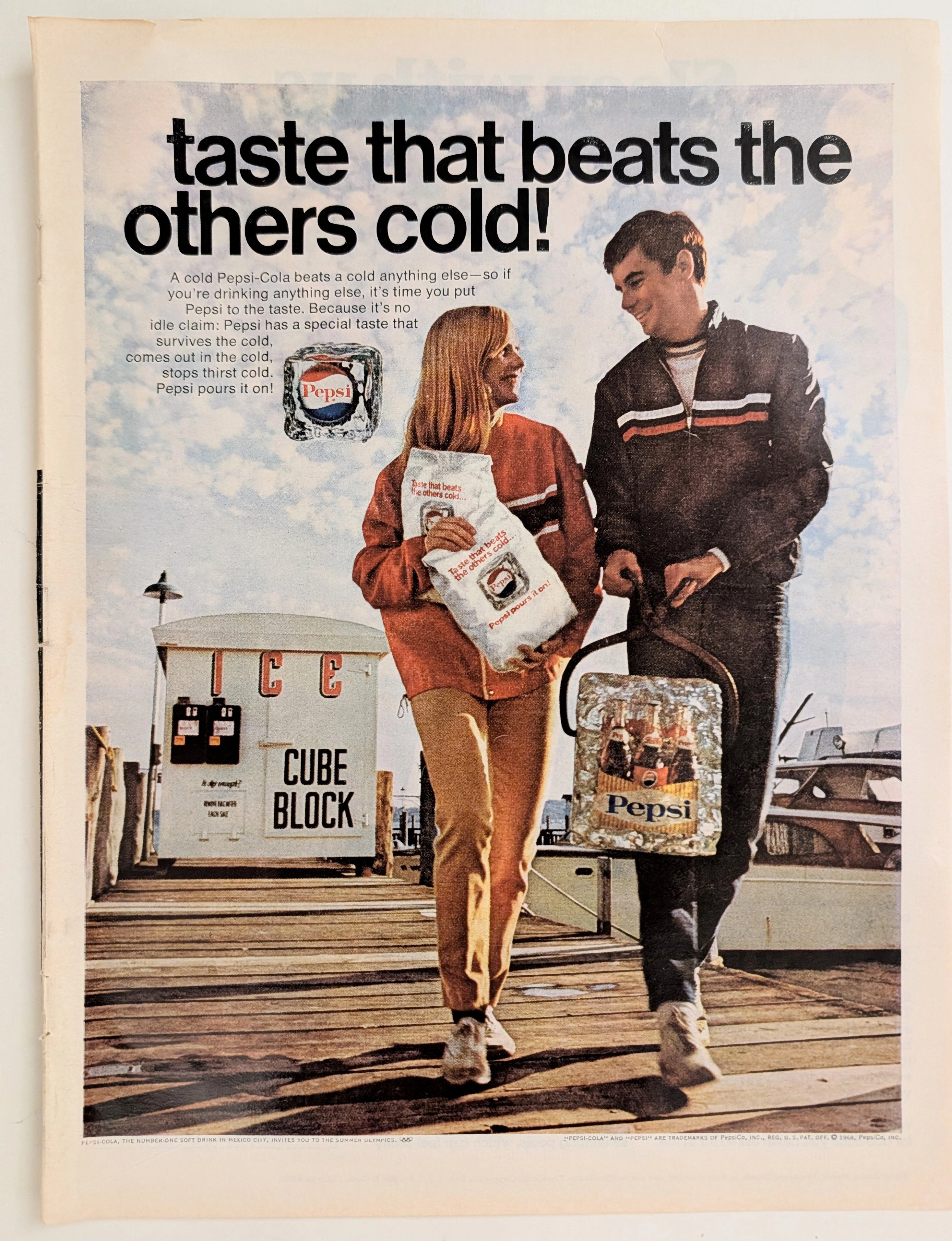
Yet, looking at this artifact, one sees an alternate dimension. It presents a pristine, sun-drenched wooden dock. A young, attractive, unbothered couple strides forward with casual athleticism. The sky is a brilliant, optimistic blue, scattered with soft clouds. This is not a reflection of 1968; it is an aggressive, calculated escape from it. Pepsi-Cola was not selling a beverage; they were constructing an ideological sanctuary. They recognized that the youth of America were overwhelmed by the reality of their era. In response, the corporation offered them the "Pepsi Generation"—a manufactured demographic identity defined by endless summers, affluent leisure, and total detachment from political anxiety. This artifact is a ticket to that artificial paradise. It promises that if you consume the product, you belong to the dock, not the riot.

The Thermodynamics of the Cola Wars
The core textual weaponry of this artifact is centralized in its massive, bold headline: "taste that beats the others cold!"
This is a profound escalation in corporate warfare. The "others" is an unnamed, yet universally understood, specter. It is Coca-Cola. For decades, Coca-Cola dominated the market through the sheer force of historical heritage. Coke was Santa Claus. Coke was World War II. Coke was the warm, nostalgic heartbeat of traditional America.

Pepsi realized they could never defeat Coke on the battlefield of the past. They had to claim the future. To do so, they weaponized the concept of temperature. Warmth is associated with comfort, age, and stagnation. Cold is associated with shock, vitality, awakening, and youth. The copywriter leans into this concept with a brutal, rhythmic repetition. "A cold Pepsi-Cola beats a cold anything else... Pepsi has a special taste that survives the cold, comes out in the cold, stops thirst cold."

This is not a description of a flavor profile. It is a declaration of thermodynamic dominance. Pepsi is framing its product as an extreme physical experience. It suggests that their chemical formula is inherently superior at low temperatures, designed specifically to shock the palate and invigorate the body. It positions the competitor’s product as weak, unable to survive the freezing extremes demanded by the active youth.

The Surreal Geometry of the Harvest
We must analyze the physical objects the subjects are carrying. They are not simply holding bottles; they are engaged in a labor of leisure. They are harvesting the cold.

The man, clad in a modern, athletic track jacket, carries a heavy metal tong. Clamped within it is a surreal, impossible object: a solid, perfect cube of ice containing a suspended six-pack of Pepsi glass bottles. This is a visual metaphor rendered as a literal object. It represents the absolute, impenetrable freezing power of the brand. Beside him, the woman holds two white paper bags, printed with the campaign's aggressive slogans. They are returning from a hunt.

Behind them stands the source of their bounty: a stark white, utilitarian ice bunker sitting on the wooden pier. The bold red letters "ICE" and the black stenciled text "CUBE BLOCK" give the structure the appearance of a military refueling station. In the context of 1968, where technology and industry were advancing at breakneck speeds, this ice machine represents the infrastructure required to maintain the "Pepsi Generation." The couple has tapped into this grid. They are actively transporting the fuel necessary to sustain their sunlit, youthful motion. The artifact elevates the simple act of buying a soda into an athletic, communal achievement.

The Democratization of Athletic Leisure
Observe the wardrobe of the subjects. The man is wearing a dark track jacket with horizontal white and orange racing stripes. The woman wears a casual, zip-up athletic sweater and tailored slacks. Today, "athleisure" is the standard global uniform. In 1968, it was a distinct socio-economic signal.

Prior to the 1960s, athletic wear was strictly reserved for the gymnasium or the track. Casual sportswear as a public fashion statement signaled a specific type of affluent, active lifestyle. It implied that the wearer had both the free time and the physical vitality to engage in continuous recreation. By dressing their models in track jackets and placing them on a boat dock, Pepsi was cementing the association between their sugar water and cardiovascular health. They were not selling to the sedentary consumer watching television; they were selling to the consumer who had just finished sailing, running, or playing tennis. The product is positioned not as a sugary indulgence, but as a necessary, hydrating fuel for a life in perpetual, affluent motion.

The Olympic Geopolitics of Sugar Water
To uncover the global ambition of this specific campaign, one must examine the microscopic typography running along the absolute bottom margin of the page. It reads: "PEPSI-COLA, THE NUMBER-ONE SOFT DRINK IN MEXICO CITY, INVITES YOU TO THE SUMMER OLYMPICS." It is accompanied by the iconic five interlaced Olympic rings.

This single sentence elevates the artifact from a domestic advertisement to an instrument of geopolitical corporate strategy. The 1968 Summer Olympics in Mexico City were a monumental global event, fraught with high-altitude records, intense international rivalries, and profound political demonstrations (most notably the Black Power salute by Tommie Smith and John Carlos).

By acquiring the rights to associate with the Olympics, and by explicitly declaring dominance in the host city, Pepsi was executing a strategic strike against Coca-Cola's global empire. Coca-Cola's global headquarters is located in Atlanta, Georgia. By claiming Mexico City as Pepsi territory on the eve of the world's largest athletic gathering, Pepsi was projecting an image of international supremacy. They were aligning their brand with the absolute pinnacle of human physical achievement. If the greatest athletes in the world were gathering in a city that preferred Pepsi, the implication was clear: Pepsi is the choice of champions. The chilling thermodynamic properties of the drink were now officially linked to Olympic-level performance.

The Evolution from Product to Persona
Ultimately, the historical weight of this document lies in its role as a transitional fossil in the evolution of modern advertising. Look at the faces of the couple. They are not looking at the camera. They are not looking at the product. They are looking at each other. They are sharing a private, joyful, intimate moment.

The product—the surreal ice block and the paper bags—is merely the facilitator of their happiness. It is a prop in the theater of their lifestyle. This marks the definitive shift from product-centric marketing to persona-centric marketing. The advertisement does not need to explain the ingredients of the cola, its price, or its history. It only needs to show the consumer who they will become if they drink it. They will become young. They will become active. They will become insulated from the horrors of the late 1960s. They will step onto the sunlit dock, immune to the heat of the world, protected by the freezing, absolute power of the brand. They will beat the others cold.

The Paper

The substrate is a lightweight, coated magazine stock, typical of high-circulation American periodicals of the late 1960s. It weighs approximately 60 GSM. The paper was engineered to absorb the high-speed ink transfer of the era without catastrophic bleed-through, sacrificing long-term archival stability for immediate mass distribution.

The printing method is a high-volume, four-color web offset lithography. Under extreme magnification, the artifact reveals the brutal, mechanical truth of its construction. The brilliant blue of the sky and the sharp red of the Pepsi logo are not solid colors, but complex, overlapping grids of Cyan, Magenta, Yellow, and Key (Black) halftone dots. The isolated graphic of the Pepsi bottle cap trapped inside the ice cube (Image 2) is a fascinating display of lithographic manipulation. The printer used dense clusters of cyan and black dots to simulate the refraction and depth of frozen water. The extreme margins of the page exhibit a distinct, warm yellowing—a chemical oxidation of the paper’s lignin. This physical degradation stands in stark, ironic contrast to the advertisement's promise of eternal, freezing youth.

The Rarity

Classification: Class A (Cultural Node).
In terms of raw physical existence, this page is not inherently scarce. It was printed in the millions across national magazines like LIFE, Look, and The Saturday Evening Post. However, within the specific discipline of corporate archival analysis, its contextual value elevates its status.

Finding a pristine specimen that captures the specific intersection of the 1968 Cola Wars, the invention of the "Pepsi Generation" identity, and the Mexico City Olympics tie-in is an archival triumph. It is a definitive cornerstone document charting the exact moment a corporation successfully transitioned from selling a flavor to selling a psychographic lifestyle. It is an anchor point in the timeline of modern consumerism.
Visual Impact

The composition operates on a dynamic, asymmetrical vector of movement. The subjects are positioned on the right side of the frame, but they are walking forward, moving from left to right. In Western visual literacy, moving left to right implies moving forward in time—progressing into the future.

The left hemisphere is anchored by the stark, geometric white mass of the "ICE CUBE BLOCK" machine. This provides a heavy visual counterweight to the moving couple. The horizon line of the wooden dock is deliberately placed low in the frame, allowing the brilliant, textured blue sky to consume nearly sixty percent of the composition. This vast expanse of blue creates a psychological sensation of open air, freedom, and deep inhalation. Against this wash of blue and the neutral tones of the dock, the aggressive red, white, and blue of the Pepsi logos act as high-contrast visual targets. The viewer's eye is pulled from the heavy, black, declarative headline down into the intricate, surreal ice block held by the man, seamlessly guiding human attention directly into the center of the brand's thermodynamic promise.

Share This Archive

The Archive Continues

Continue the Exploration

The Time Traveller's Dossier : 1943 Interwoven Socks - The Fabric of Wartime Endurance

Interwoven Sock · Fashion

The Time Traveller's Dossier : 1943 Interwoven Socks - The Fabric of Wartime Endurance

Then, apparel was a matter of aristocratic vanity. Now, it is a calculus of survival. The problem in 1943 was not the pursuit of fashion; it was the absolute degradation of the human body in the brutal, unforgiving theaters of global war. Trench foot. Jungle rot. The relentless, humid friction of the Pacific front. The solution, as framed by the Interwoven Stocking Company, was not merely a woven textile. It was engineered morale. It was endurance. This artifact is a portal. It transports us to a specific socio-economic and psychological pivot: the exact moment consumer goods were weaponized as tools of patriotic resilience. It is an advertisement, yes. But deeper than that, it is a strategic blueprint of how a society in total war convinced itself that ordinary comforts could conquer extraordinary horrors.

Vintage Chivas Regal x Charles Saxon Ad: The Vanishing Playboy Art | The Record

Vintage Chivas Regal x Charles Saxon Ad: The Vanishing Playboy Art | The Record

An in-depth look at the Chivas Regal ad from Playboy magazine, illustrated by legendary artist Charles Saxon. A magazine-sized piece of authentic analog art on degrading vintage paper, driving up its value as an alternative asset.

The Time Traveller’s Dossier: 1978 Camel Lights Vintage Advertisement — The Golden Illusion of Diminished Harm

Camel · Tobacco

The Time Traveller’s Dossier: 1978 Camel Lights Vintage Advertisement — The Golden Illusion of Diminished Harm

This archival dossier provides a comprehensive examination of the 1978 Camel Lights vintage advertisement, a defining artifact from an era when the global tobacco industry fiercely pivoted toward "low tar" alternatives in response to escalating public health mandates. As medical consensus shifted consumer habits in the late twentieth century, R.J. Reynolds introduced Camel Lights as "the solution" to the purported low tar and low taste dilemma. This document stands as a masterful exemplar of classic print ads, leveraging high-contrast macro photography and rugged, masculine aesthetics to retain fierce brand loyalty while navigating an increasingly regulated landscape. For archivists, cultural historians, and collectors of vintage ads and old advertisements, this artifact offers profound insight into the psychological marketing tactics of the 1970s. The visual centerpiece—a glowing golden camel illuminated by a struck match—demonstrates exceptional commercial print execution and art direction, cementing its status as a vital cultural document within the broader taxonomy of commercial advertising history.

Published by

The Record Institute

Taxonomy Match

Related Articles

The Time Traveller's Dossier: Coca-Cola 1944 - The Weaponization of Morale — related article
Read Article

The Time Traveller's Dossier: Coca-Cola 1944 - The Weaponization of Morale

Then, sugar and carbonated water were not merely ingredients for a domestic treat; they were classified as essential psychological logistics for a global war. Now, a soda is just a soda. The problem for the United States military in 1944 was not just arming its young men with rifles and artillery; it was the monumental task of maintaining the human spirit under the soul-crushing weight of total war. The boys being trained in the muggy, moss-draped camps of the American South were destined for the meat grinders of Europe and the Pacific. They needed a tether to the homes they were leaving behind. The solution, brilliantly engineered and ruthlessly promoted by The Coca-Cola Company, was the weaponization of nostalgia. This artifact is a portal. It transports us to a sweltering training camp in 1944. It documents the exact historical moment when a private beverage corporation successfully intertwined its product with the very fabric of American patriotism, military logistics, and the linguistic evolution of its own brand identity.

The Time Traveller's Dossier: Coca-Cola (1952) – The Wholesome Prescription — related article
Read Article

The Time Traveller's Dossier: Coca-Cola (1952) – The Wholesome Prescription

Before the era of aggressive nutritional labeling and the demonization of refined sugars, carbonated beverages sought to position themselves not merely as treats, but as vital, life-affirming staples of the American diet. The artifact before us—a 1952 magazine advertisement for The Coca-Cola Company—is a masterclass in psychological association. By placing their product in the pristine, capable hands of a registered nurse, Coca-Cola is explicitly borrowing her cultural authority. She is the ultimate symbol of care, cleanliness, and health. The advertisement doesn't just offer you a drink; it offers you a "wholesome" prescription for daily fatigue. It is a fascinating glimpse into an era where a sugary, caffeinated beverage could be advertised with the solemn promise: "Quality you can trust."

The Time Traveller's Dossier: Coca-Cola & The "Sprite Boy" - The Carbonated Utopia of Post-War America — related article
Read Article

The Time Traveller's Dossier: Coca-Cola & The "Sprite Boy" - The Carbonated Utopia of Post-War America

Then, a beverage was simply a flavored liquid used to quench thirst. In 1950s America, it was packaged as a scientifically formulated "lift," a socially sanctioned psychological "pause" in the roaring machinery of the post-war economy. This artifact is a portal. It transports us back to the mid-1950s, an era defined by blind optimism, explosive mass consumerism, and the absolute dawn of television media. Here, we encounter a now-forgotten phantom of pop culture: the Coca-Cola "Sprite Boy." It is a vintage print advertisement, yes. But deeper than that, it is an early blueprint for cross-media corporate synergy. It perfectly captures how Coca-Cola weaponized the sensory metaphors of print (sparks, energy, tang) to herd consumers toward a nascent media format: the corporately sponsored television program. It documents how a carbonated syrup inextricably bound itself to the leisure time of the American middle class.

The Time Traveller's Dossier : WWII War Bonds - Corporate Conscription — related article
Read Article

The Time Traveller's Dossier : WWII War Bonds - Corporate Conscription

A nation does not wage war with steel alone. It wages war with capital. It fights with belief. Before 1941, the American consumer was a creature of comfort, trained by an emerging advertising industry to desire soda, automobiles, and modern conveniences. Then came the sudden violence of global conflict. The factories pivoted. The supply chains froze. The consumer economy ground to a sudden, devastating halt. Yet, the advertising machinery did not sleep. It was conscripted. The artifacts presented here—fragments of print from 1943, embedded within the commercial messaging of companies like The Seven-Up Co. and Autocar Trucks—represent a monumental shift in human behavior. This was the moment the public was asked to purchase the future instead of the present. The strategy was unprecedented. Convert the civilian into a shareholder of the state. Transform the act of saving into the ultimate act of aggression against an unseen enemy. This is not merely a collection of vintage advertisements. It is the exact inflection point where corporate marketing was weaponized for national survival.

THE TIME TRAVELER'S DOSSIER: THE FLAVOR OF AUTHENTICITY AND THE PROPHET OF CAPITALISM — related article
Read Article

THE TIME TRAVELER'S DOSSIER: THE FLAVOR OF AUTHENTICITY AND THE PROPHET OF CAPITALISM

The artifact under uncompromising, museum-grade analysis is a flawlessly preserved Historical Relic originating from the cultural epicenter of 1970. This Primary Art Document is a monumental, full-page advertisement for Coca-Cola, officially copyrighted in 1970. It serves as the definitive visual anchor for one of the most legendary and heavily studied marketing campaigns in human history: "It's the real thing." ​This is not a mere beverage promotion; it is a profound sociological masterstroke. Emerging at the dawn of the 1970s—an era defined by counter-culture, political disillusionment, and a search for genuine meaning—Coca-Cola aggressively positioned its product as the ultimate, unassailable anchor of authenticity. The commanding copywriting, "Real life calls for real taste... When you ask for it, be sure you get it", is a psychological directive urging consumers to reject artificiality. Visually, the artifact is a triumph of mid-century hyper-realism. The towering glass, weeping with visceral, tactile condensation, and the monolithic block typography elevate a 15-cent soda to the status of an absolute cultural leviathan. ​Rescued from the inevitable oblivion of disposable mass media and preserved as a standalone Archival Artifact, the inherently acidic analog paper is undergoing a majestic chemical degradation. It exhibits a beautiful, warm patina, with natural biological oxidation softening the iconic red "Enjoy Coca-Cola" emblem. This unstoppable molecular death transforms a piece of mass-produced corporate propaganda into an irreplaceable, ready-to-frame Primary Art Document of American pop-art history.

THE TIME TRAVELER'S DOSSIER: THE ARCHITECTURE OF POWER AND THE BIRTH OF THE DIGITAL WORLD IN THE 50S — related article
Read Article

THE TIME TRAVELER'S DOSSIER: THE ARCHITECTURE OF POWER AND THE BIRTH OF THE DIGITAL WORLD IN THE 50S

The artifact under exhaustive, uncompromising museum-grade analysis is a remarkably preserved Historical Relic originating from the absolute zenith of the post-war American economic boom. This Primary Art Document is a sweeping, monumental full-page advertisement for the Sheraton Hotels empire, forensically dated to circa 1958–1959 via the explicitly illustrated Pittsburgh Bicentennial (1758-1958) stamp embedded within the artwork. This document is not merely a travel advertisement; it is a profound "Sociological Blueprint of the American Corporate Ascendancy." Visually anchored by four hyper-stylized, architectural illustrations of Sheraton's flagship properties—New York, Cleveland, Pittsburgh, and Detroit—the piece captures the era's unbridled optimism. Each panel is a masterpiece of mid-century commercial illustration, particularly the Detroit panel featuring ethereal, floating tail-fin automobiles symbolizing the Motor City's dominance. Furthermore, this artifact documents critical milestones in global business history. It proudly advertises the acceptance of the Diners' Club card, marking the revolutionary dawn of the modern credit card era. It also boasts of Sheraton's "Reservatron" electronic system—one of the earliest commercial applications of computing in the hospitality industry—and proudly declares its listing on the New York Stock Exchange. Rescued from the binding of a forgotten, heavy-stock periodical, this pre-2000s analog artifact is an unforgeable testament to the Japanese aesthetic of wabi-sabi. Printed on inherently acidic wood-pulp paper, it exhibits a beautifully violent, jagged right margin and a deep, warm amber oxidation across its surface. This majestic, unstoppable chemical degradation transforms a mass-produced corporate propaganda piece into an irreplaceable, ready-to-frame Primary Art Document of mid-century architectural and economic history.