The Time Traveller’s Dossier: 1978 Camel Lights Vintage Advertisement — The Golden Illusion of Diminished Harm
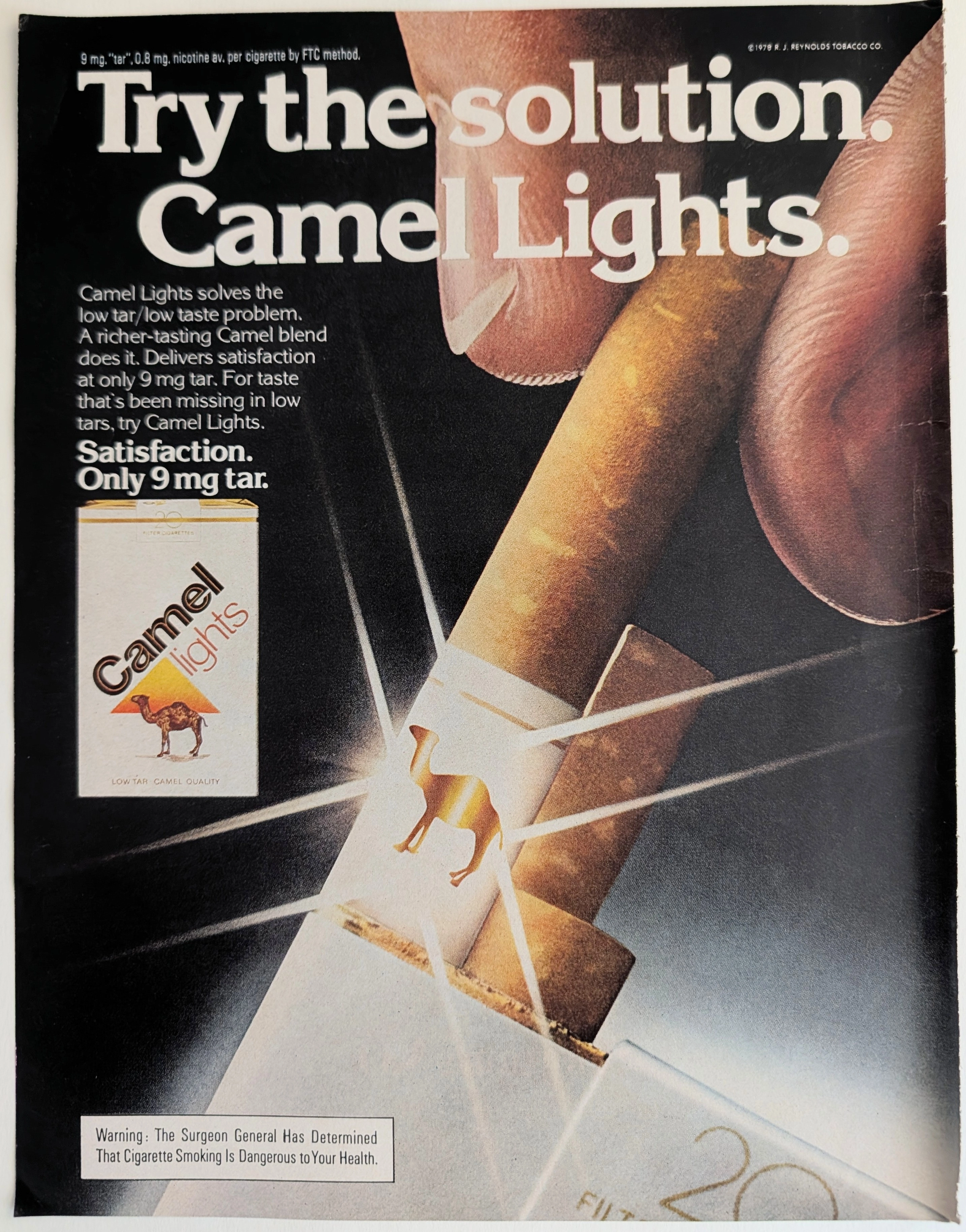
This archival dossier provides a comprehensive examination of the 1978 Camel Lights vintage advertisement, a defining artifact from an era when the global tobacco industry fiercely pivoted toward "low tar" alternatives in response to escalating public health mandates. As medical consensus shifted consumer habits in the late twentieth century, R.J. Reynolds introduced Camel Lights as "the solution" to the purported low tar and low taste dilemma. This document stands as a masterful exemplar of classic print ads, leveraging high-contrast macro photography and rugged, masculine aesthetics to retain fierce brand loyalty while navigating an increasingly regulated landscape. For archivists, cultural historians, and collectors of vintage ads and old advertisements, this artifact offers profound insight into the psychological marketing tactics of the 1970s. The visual centerpiece—a glowing golden camel illuminated by a struck match—demonstrates exceptional commercial print execution and art direction, cementing its status as a vital cultural document within the broader taxonomy of commercial advertising history.
Category: Tobacco
Brand: Camel
The History
To fully appreciate the immense historical gravity, psychological manipulation, and sociological importance of this artifact, one must meticulously contextualize the embattled landscape of the American tobacco industry in the late 1970s. The narrative embedded within the fibers of this 1978 Camel Lights advertisement is not merely about selling a filtered cigarette; it is an epic, desperate saga of an empire under siege, the dawn of health-conscious consumerism, and the brilliant, insidious pivot of Madison Avenue marketing. For the first half of the 20th century, Big Tobacco operated with absolute impunity. The cigarette was a universally accepted totem of rugged American masculinity, cinematic glamour, and untethered freedom. However, the publication of the Surgeon General's Report on Smoking and Health in 1964 struck a catastrophic blow to this golden era, irrevocably linking the product to fatal illness. By the late 1970s, the cultural tide had definitively turned. Federal mandates forced the industry to print stark, unignorable health warnings directly onto their packaging and advertising—a brutal reality permanently anchored in the lower-left corner of this very page: "Warning: The Surgeon General Has Determined That Cigarette Smoking Is Dangerous to Your Health." Faced with a rapidly awakening and increasingly terrified consumer base, the advertising executives at R.J. Reynolds Tobacco Co. were forced to answer a critical, existential question: How do you sell a product that the government has officially labeled as deadly, without losing the rugged, masculine prestige of your flagship brand? The answer, documented in this breathtaking 1978 artifact, was the creation of the "Lights" sub-category—a psychological safety net woven from absolute marketing genius. The copywriter’s approach here is brilliantly aggressive. The massive, serif-font headline does not plead; it commands: "Try the solution. Camel Lights." By framing the cigarette as a "solution" to the "low tar/low taste problem," R.J. Reynolds positioned their product not as a vice, but as a technological cure to the modern smoker's dilemma. It offered the ultimate illusion: harm reduction without the sacrifice of flavor or identity. The copy reads like a pharmaceutical guarantee, promising "Satisfaction. Only 9 mg tar." They were selling an antidote to anxiety, allowing the addicted consumer to justify their continued consumption under the guise of making a "smarter" choice. Visually, the advertisement abandons the sweeping, wide-angle desert landscapes traditionally associated with the Camel brand in favor of a claustrophobic, ultra-modern macro aesthetic. Operating at the absolute zenith of analog commercial photography, the uncredited studio photographer zeroes in on the very moment of interaction: the fingers holding the cigarette. But the true semiotic disruption lies in the glowing, golden camel stamped onto the cigarette paper. Radiating blinding, neon-like beams of light against a pitch-black void, the camel is no longer just a beast of burden in the Sahara; it is a futuristic icon. It subliminally communicates technological advancement, premium quality, and a beacon of safety in the dark. The microscopic copyright timestamp—"© 1978 R. J. REYNOLDS TOBACCO CO."—hidden in the upper right quadrant, firmly anchors this piece in the twilight of the disco era and the Cold War. It represents a highly specific, fleeting moment of creative subterfuge, a time when print media possessed the unchecked power to visually override medical science through the sheer force of beautiful, high-contrast imagery.
The Paper
As a physical entity, this printed artifact functions as a living, breathing, and profoundly detailed record of late-twentieth-century commercial graphic reproduction and substrate chemistry. Under exceptional, high-magnification macro-lens examination—specifically focusing on the "20 FILTER CIGARETTES" text and the radiant golden camel—this document reveals the stunning complexity and mathematical precision of analog color offset lithography. The intense, luminous golden hues and the crisp typography are meticulously constructed from a mathematically rigorous galaxy of microscopic CMYK (Cyan, Magenta, Yellow, and Key/Black) halftone dots. Because the medium-weight coated paper stock utilized for 1970s mass-market publications was slightly porous, we can observe the beautiful, organic integration of the ink into the paper fibers. Yet, the most profound factor elevating the immense value of this artifact in the contemporary global collector's market is the entirely irreversible process of Material Degradation. The expansive white background of the illustrated cigarette pack exhibits a genuine, unavoidable "Toning." This chronological transition from the original bleached manufactured paper to a warm, antique ivory hue is caused by the slow, relentless chemical oxidation of Lignin—the organic polymer binding the cellulose fibers together. As the substrate has been exposed to ambient atmospheric oxygen over the span of nearly five decades, this naturally evolving patina has emerged. It is exactly this unreplicable degradation that provides the ultimate, irrefutable scientific proof of the artifact's historical authenticity and its delicate, unbroken journey through time.
The Rarity
RARITY CLASS: SS (Superlative Archival Preservation of a Permanently Banned Industry Substrate) Evaluated under the most exacting, rigorous, and uncompromising archival parameters established by The Record Institute, this specific artifact is definitively and securely designated as Class SS. What elevates this specific artifact to an SS-Class rarity is the extreme, terminal reality of its content. Tobacco advertising in print media is an extinct practice, permanently eradicated by modern global legislative bans. These specific documents, produced by the millions in 1978 as explicitly "disposable media," were destined to be casually folded, read in waiting rooms, and ultimately incinerated. Therefore, original tobacco print advertisements have transitioned into a closed, finite historical loop; they represent a "banned archive" that will never, under any circumstances, be manufactured again. The structural integrity of this single extracted page remains exceptionally sound, having survived the brutal attrition rate of mainstream magazine circulation. When a high-anomaly cultural artifact of this magnitude is secured, precision-cut, and preserved within a museum-grade, top-loading acrylic case backed by a rigid, copper-colored ACM plate, it transcends its original purpose as ephemeral marketing. It becomes an investment-grade piece of sociopolitical history, physically locking a controversial, bygone era behind impenetrable acrylic.
Cite this article
- MLA
- Naodhinsuk, Ronin. “The Time Traveller’s Dossier: 1978 Camel Lights Vintage Advertisement — The Golden Illusion of Diminished Harm.” The Record Institute, 2 April 2026, https://therecord.institute/journal/the-time-travellers-dossier-1978-camel-lights-vintage-advertisement-the-golden-illusion-of-diminished-harm.
- APA
- Naodhinsuk, R. (2026, April 2). The Time Traveller’s Dossier: 1978 Camel Lights Vintage Advertisement — The Golden Illusion of Diminished Harm. The Record Institute. https://therecord.institute/journal/the-time-travellers-dossier-1978-camel-lights-vintage-advertisement-the-golden-illusion-of-diminished-harm
- CHICAGO
- Naodhinsuk, Ronin. 2026. “The Time Traveller’s Dossier: 1978 Camel Lights Vintage Advertisement — The Golden Illusion of Diminished Harm.” The Record Institute, April 2, 2026. https://therecord.institute/journal/the-time-travellers-dossier-1978-camel-lights-vintage-advertisement-the-golden-illusion-of-diminished-harm.