1968 Pepsi-Cola Mexico City Olympics Vintage Advertisement (1968) — Class A vintage Lifestyle & Vice
CLASS A
1 of 7

1968 Pepsi-Cola Mexico City Olympics Vintage Advertisement

Category|Lifestyle & Vice
Year|1968
Rarity Class|CLASS A
Archive Views|2
Heritage AdvertisementsFood & BeverageBeverages
Ad Content TypeBrand Building

Last updated: 26 Apr 2026

Historical Context

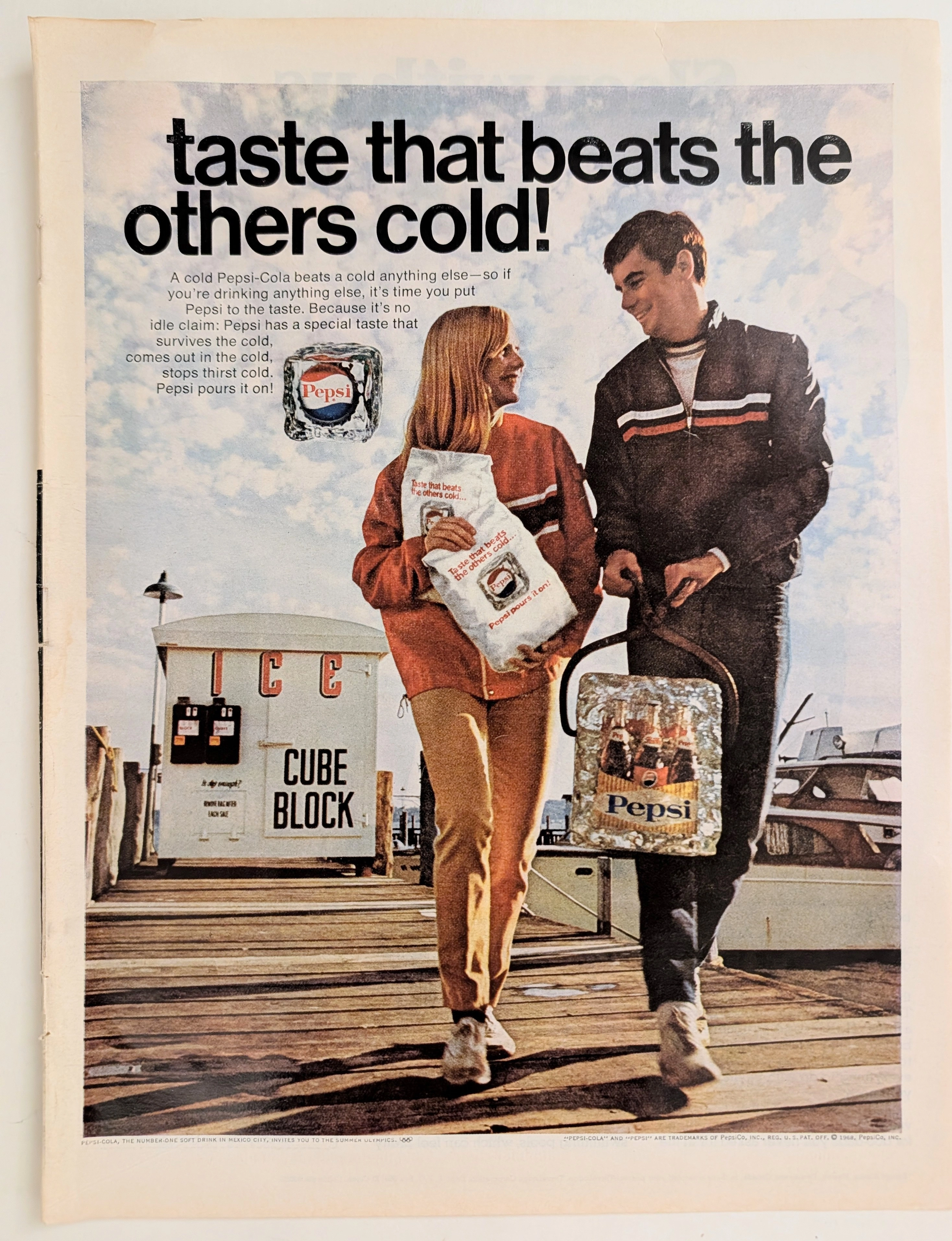
1968 Pepsi-Cola Mexico City Olympics Vintage Print Advertisement Published during a transformative era of global sports and youth culture, this 1968 Pepsi-Cola advertisement perfectly captures the vibrant energy of the late sixties. Featuring the bold "taste that beats the others cold!" headline, the piece acts as both a clever beverage promotion and a direct marketing tie-in to the 1968 Summer Olympics in Mexico City. It stands as a prime example of mid-century lifestyle marketing targeting the energetic and ever-moving "Pepsi Generation." During the 1960s, PepsiCo revolutionized beverage marketing by shifting the focus from the product itself to the lifestyle of the consumer—a strategy that birthed the legendary "Pepsi Generation." This 1968 advertisement brilliantly exemplifies this approach. The youthful, active couple featured strolling down a sunlit wooden pier embodies the vitality and casual leisure that Pepsi wanted inextricably linked to its brand. The visual hyperbole is particularly striking: the man is carrying an entire six-pack of Pepsi frozen solid inside a block of ice, hoisted with heavy-duty ice tongs. This clever artistic exaggeration visually reinforces the bold headline, "taste that beats the others cold!" and promises the ultimate refreshment. Furthermore, 1968 was a monumental year for global events, notably the Summer Olympics held in Mexico City. The bottom margin of the advertisement proudly proclaims Pepsi-Cola as the "number-one soft drink in Mexico City," utilizing the official Olympic rings to invite consumers to the games. This strategic corporate sponsorship highlights the era's accelerating globalization of American brands and the emerging power of international sports marketing. The casual sportswear, the robust typographic treatment, and the energetic copy ("Pepsi pours it on!") collectively capture the optimistic, forward-looking zeitgeist of late-1960s America.

Paper & Print Condition

Printed on standard mid-century magazine stock. The paper shows mild, natural toning characteristic of the era. The color registration of the halftone lithography is excellent, preserving the bright outdoor lighting, the crisp blues and reds of the Pepsi logo embedded in the ice, and the sharp contrast of the bold, sans-serif typography.

Provenance & Rarity

Sourced from a mainstream North American publication in 1968. While consumer soda advertisements from the late 1960s are abundant, pieces specifically featuring official tie-ins and trademark integration with the historic 1968 Mexico City Olympics are highly sought after by both beverage advertising collectors and Olympic historians.

Rarity & Condition Summary

A superbly preserved example of late-1960s lifestyle advertising. Its historical significance lies in the dynamic intersection of the iconic "Pepsi Generation" branding and the nascent era of massive international Olympic sports marketing.
Share This Archive

From the Journal

Related Articles

THE TINY TEXT THAT AUTHENTICATES HISTORY Why Fine Print in Magazine Advertisements Matters More Than You Think — related article
Read Article

THE TINY TEXT THAT AUTHENTICATES HISTORY Why Fine Print in Magazine Advertisements Matters More Than You Think

Tiny copyright notices in magazine ads originated from mandatory US copyright law (1909 Act) and sector-specific regulations (BATF for alcohol). They function as layered authentication evidence: typographic era-consistency, regulatory language accuracy, ink/paper forensics, and contextual integrity — paralleling vintage band tee authentication methods. Collaboration credits (Pierre Cardin × Tiffany & Co.) and creative credits (photography, calligraphy, fashion) document commercial relationships lost to no other record.

The Treaty of Two Empires: Deconstructing the 1982 Bacardi & Coca-Cola Vintage Ad (Class S) — related article
Read Article

The Treaty of Two Empires: Deconstructing the 1982 Bacardi & Coca-Cola Vintage Ad (Class S)

Dive into the history of American consumerism with this museum-grade analysis of the iconic 1982 Bacardi and Coca-Cola co-branding advertisement. This Class S archival piece captures the definitive shift from the Golden Age of Illustration to 1980s commercial studio photography. Explore the geopolitical legacy of the "Cuba Libre" and the analog practical effects behind the immortal condensation on the Coca-Cola contour bottle.

THE TIME TRAVELER'S DOSSIER: THE HOME FRONT SMILE AND THE 1944 PSYCHOLOGICAL WAR — related article
Read Article

THE TIME TRAVELER'S DOSSIER: THE HOME FRONT SMILE AND THE 1944 PSYCHOLOGICAL WAR

This original 1944 7-Up advertisement cut page from The Saturday Evening Post is a vital piece of WWII Home Front ephemera. Beneath the wholesome mid-century illustrations lies a patriotic directive to support the war effort by adhering to rationing laws. The massive water stain and natural oxidation of the 80-year-old acidic paper highlight the beautiful aesthetic of decay, elevating this to a Class A primary art print.

The Time Traveller's Dossier : WWII War Bonds - Corporate Conscription — related article
Read Article

The Time Traveller's Dossier : WWII War Bonds - Corporate Conscription

A nation does not wage war with steel alone. It wages war with capital. It fights with belief. Before 1941, the American consumer was a creature of comfort, trained by an emerging advertising industry to desire soda, automobiles, and modern conveniences. Then came the sudden violence of global conflict. The factories pivoted. The supply chains froze. The consumer economy ground to a sudden, devastating halt. Yet, the advertising machinery did not sleep. It was conscripted. The artifacts presented here—fragments of print from 1943, embedded within the commercial messaging of companies like The Seven-Up Co. and Autocar Trucks—represent a monumental shift in human behavior. This was the moment the public was asked to purchase the future instead of the present. The strategy was unprecedented. Convert the civilian into a shareholder of the state. Transform the act of saving into the ultimate act of aggression against an unseen enemy. This is not merely a collection of vintage advertisements. It is the exact inflection point where corporate marketing was weaponized for national survival.