1959 Friskies Cat Food Kittens Vintage Advertisement (1950) — Class B vintage Lifestyle & Vice
CLASS B
1 of 5

1959 Friskies Cat Food Kittens Vintage Advertisement

Category|Lifestyle & Vice
Year|1950
Rarity Class|CLASS B
Archive Views|12

Last updated: 25 Apr 2026

Historical Context

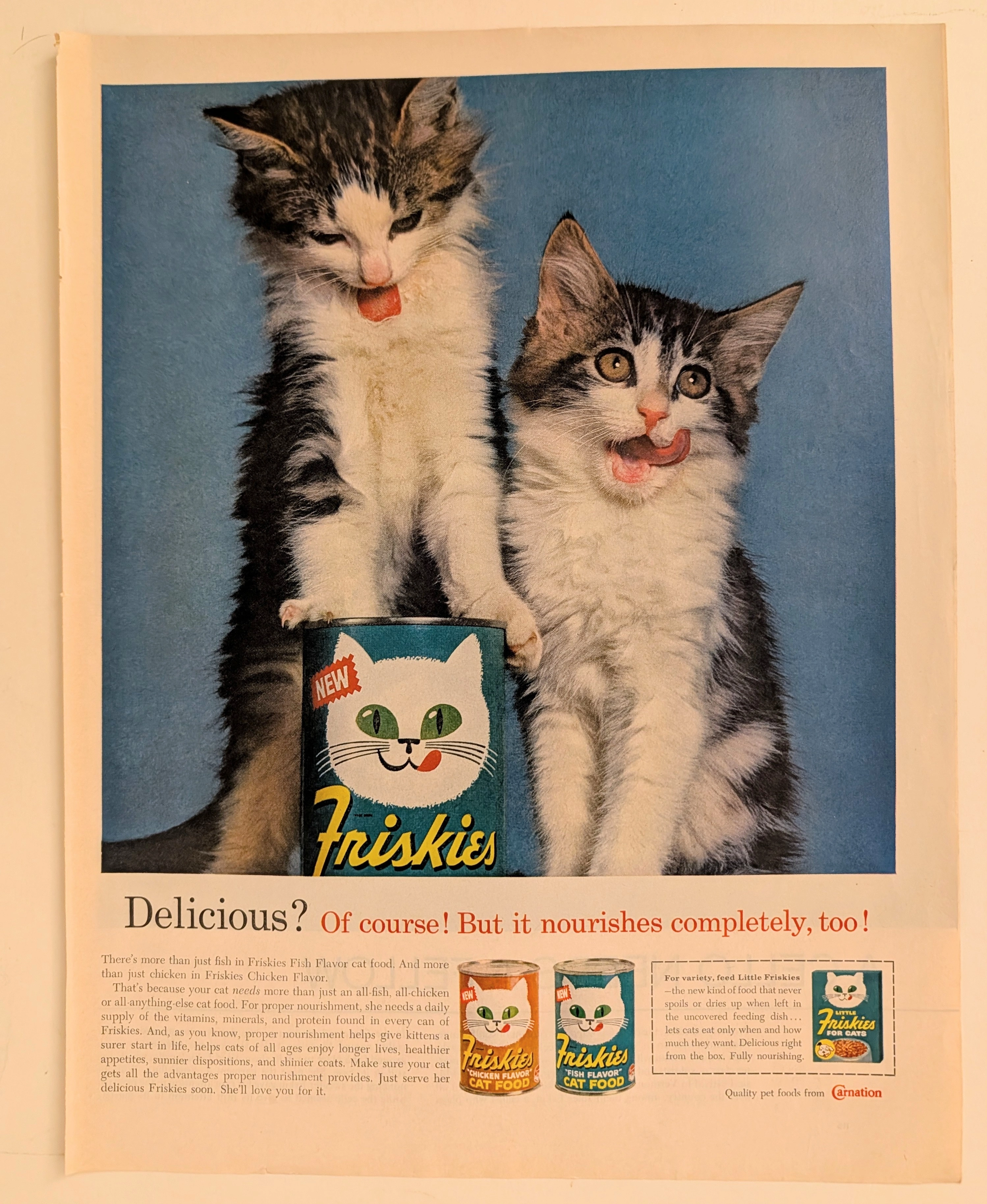
Circa 1959 Friskies Cat Food Kittens Vintage Print Advertisement Published during the booming post-war pet care market, this circa 1959 advertisement for Friskies Cat Food captures the era's shift toward scientifically formulated animal nutrition. Featuring two endearing kittens alongside the brand's iconic feline mascot, the piece highlights the Carnation Company's expansion into convenient, specialized pet diets, marking a definitive moment in the commercialization of domestic animal care. During the late 1950s, the American pet care industry underwent a significant transformation. As the middle class expanded and suburban living became the norm, cats transitioned from outdoor mousers to pampered indoor companions. This circa 1959 Friskies advertisement by the Carnation Company brilliantly captures this cultural shift. Rather than relying on table scraps, pet owners were increasingly educated on the importance of scientifically formulated diets. The ad's primary copy, "Delicious? Of course! But it nourishes completely, too!" directly addresses this new consumer demand for balanced animal nutrition, emphasizing the inclusion of essential vitamins, minerals, and proteins. Furthermore, the advertisement serves as a historical marker for product diversification in the Fast-Moving Consumer Goods (FMCG) sector. It showcases both the "New" canned flavors (Chicken and Fish) and introduces "Little Friskies," a dry food innovation designed for ultimate convenience. The dry food is marketed as a product that "never spoils or dries up," catering specifically to the modern, busy mid-century household. Visually, the advertisement utilizes a highly effective combination of endearing photography—two exceptionally fluffy kittens interacting with the product—and bold, graphic mid-century modern illustration. This is embodied by the stylized white cat face logo with its distinctive green eyes and licking red tongue. This juxtaposition of charming realism and sharp commercial art cemented Friskies as a trusted household name in mid-century America, leveraging the overarching authority of the "Carnation" parent brand.

Paper & Print Condition

Printed on standard mid-century magazine stock. The paper exhibits mild, natural toning along the outer edges. The color registration is excellent, preserving the vibrant teal background, the rich amber/yellow of the typography, and the detailed fur texture of the photographed kittens without significant fading.

Provenance & Rarity

Sourced from a mainstream American lifestyle magazine. While advertisements for Friskies are relatively common, specimens that perfectly balance the photographic transition of the era with the introduction of dry kibble ("Little Friskies") alongside the iconic mid-century graphic mascot are highly valued by advertising and pet industry historians.

Rarity & Condition Summary

A pristine example of 1950s FMCG marketing. It serves as an excellent visual record of the Carnation Company's successful strategy to elevate commercial pet food from a novelty to a household necessity.
Share This Archive

From the Journal

Related Articles

The Time Traveller's Dossier: The Anatomy of a Commodity – Chiquita's "How to read a banana" and the Invention of Produce Branding — related article
Read Article

The Time Traveller's Dossier: The Anatomy of a Commodity – Chiquita's "How to read a banana" and the Invention of Produce Branding

The evolution of the mid-twentieth-century American supermarket was defined by the rapid transition from bulk, unbranded agricultural goods to highly packaged, fiercely differentiated consumer brands. The historical artifact elegantly and securely positioned upon the analytical table of The Record Institute today is a striking, full-page print advertisement for Chiquita Brand Bananas, originating from the late 1960s. This document completely transcends the standard boundaries of grocery marketing. It operates as a highly sophisticated, multi-layered cultural mirror, reflecting the precise era when the United Fruit Company utilized educational infographics to train the American housewife to perceive natural biological traits as engineered markers of exclusive quality. This world-class, comprehensive dossier conducts a meticulous, unyielding, and exceptionally exhaustive examination of the artifact, operating under the absolute most rigorous parameters of historical, sociological, and material science evaluation. Dedicating the overwhelming majority of our analytical focus to its immense historical gravity, we will decode the brilliant marketing psychology embedded within the "How to read a banana" campaign, analyze the immense sociopolitical weight of the United Fruit Company, and dissect the profound visual semiotics of the blue Chiquita sticker. Furthermore, as we venture deeply into the chemical and physical foundations of this analog printed ephemera, we will reveal the precise mechanical fingerprints of the CMYK halftone rosettes captured in the macro imagery of the fruit's peel. Finally, we will assess its archival rarity, exploring how the graceful, natural oxidation of the paper substrate cultivates a serene wabi-sabi aesthetic—a natural, irreversible phenomenon that serves as the primary engine driving up its market value exponentially within the elite global spheres of Vintage Commercial Ephemera and Advertising Archives.

The Time Traveller's Dossier: The Architecture of Slumber – The 1967 Simmons Golden Value — related article
Read Article

The Time Traveller's Dossier: The Architecture of Slumber – The 1967 Simmons Golden Value

The evolution of the American domestic interior during the mid-twentieth century was heavily influenced by the golden age of travel and the rapid expansion of the luxury hospitality industry. The historical artifact elegantly secured upon the analytical table of The Record Institute today is a large-format, two-page centerfold print advertisement for the Simmons Mattress Company, copyrighted in 1967. This document transcends standard consumer goods marketing; it operates as a sophisticated sociological mirror, reflecting a highly specific moment when industrial sleep engineering and the aspirational luxury of the modern hotel were explicitly packaged and sold to the suburban American household. This world-class, comprehensive dossier conducts a meticulous, profound, and historically objective examination of the artifact, operating under the absolute most rigorous parameters of sociological and material science evaluation. We will decode the brilliant marketing psychology embedded within the "First Public Sale" messaging, analyze the iconic "Good Housekeeping" endorsement, and dissect the rich semiotics of the heraldic quilt patterns alongside the modernist architectural illustrations. Furthermore, as we venture deeply into the chemical and physical foundations of this analog printed ephemera, we will reveal the precise mechanical fingerprints of the CMYK halftone rosettes and the graceful, natural oxidation of the paper substrate. This precise intersection of visual nostalgia, mid-century commercial artistry, and the immutable chemistry of time cultivates a serene wabi-sabi aesthetic—a natural, irreversible phenomenon that serves as the primary engine driving up its market value exponentially within the elite global spheres of Vintage Commercial Ephemera and Mid-Century Lifestyle Archives collecting.

The Time Traveller's Dossier: The Masquerade of Quality – Nabisco's 1968 Ritz "Can't Disguise" Campaign and the Golden Age of Snack Branding — related article
Read Article

The Time Traveller's Dossier: The Masquerade of Quality – Nabisco's 1968 Ritz "Can't Disguise" Campaign and the Golden Age of Snack Branding

The evolution of the twentieth-century American pantry was fundamentally defined by the rise of standardized, nationally recognized "anchor" brands. The historical artifact elegantly positioned upon the analytical table of The Record Institute today is a striking full-page advertisement for Ritz Crackers, originating from 1968. This document represents a pivotal era in consumer psychology where snack foods were repositioned from simple staples to creative culinary canvases. By utilizing playful, anthropomorphic food art—crackers "disguised" as whimsical faces—Nabisco sought to reassure a burgeoning suburban middle class of the cracker's unmistakable "buttery" identity regardless of how it was "dressed up" for social gatherings. This comprehensive dossier conducts a meticulous examination of the artifact, operating under the absolute most rigorous parameters of historical and material science evaluation. We will decode the brilliant marketing psychology of the "Quality in Our Corner" slogan, analyze the profound sociopolitical impact of standardized grocery branding in the late 1960s, and dissect the mechanical fingerprints of the CMYK halftone rosettes captured in macro imagery. Finally, we will assess its archival rarity, exploring how the graceful, natural oxidation of the paper substrate serves as the primary engine driving up its market value exponentially within elite collection circles.

The Time Traveller's Dossier: The Zenith of the American Living Room – Admiral Rectangular Color TV — related article
Read Article

The Time Traveller's Dossier: The Zenith of the American Living Room – Admiral Rectangular Color TV

The evolution of the American domestic interior during the mid-twentieth century was fundamentally redefined by the introduction and subsequent democratization of color television. The historical artifact elegantly and securely positioned upon the analytical table of The Record Institute today is a majestic, full-page print advertisement for Admiral Color TV, originating from the transitional technological era of the late 1960s. This document completely transcends the traditional boundaries of consumer electronics marketing. It operates as a highly sophisticated, multi-layered cultural and historical mirror, reflecting the exact moment when the magic of color broadcasting collided with the rigorous aesthetic demands of suburban domestic styling on a single printed page. This world-class, comprehensive dossier conducts a meticulous, unyielding, and exceptionally deep examination of the artifact, operating under the absolute most rigorous parameters of historical, sociological, and material science evaluation. With our analytical focus dedicated heavily to its historical gravity, we will decode the brilliant marketing psychology embedded within the "rectangular" tube innovation, analyze the space-age luxury of the "Sonar" remote control, and dissect the rich semiotics of disguised technology through "genuine walnut veneers". Furthermore, as we venture deeply into the chemical and physical foundations of this analog printed ephemera, we will reveal the precise mechanical fingerprints of the CMYK halftone rosettes and the graceful, natural oxidation of the paper substrate. This precise intersection of visual nostalgia, mid-century commercial artistry, and the immutable chemistry of time cultivates a serene wabi-sabi aesthetic—a natural, irreversible phenomenon that serves as the primary engine driving up its market value exponentially within the elite global spheres of Vintage Commercial Ephemera, Consumer Electronics Archives, and Mid-Century Lifestyle collecting.