THE RECORD · ARCHIVE PLAYER
MP4
■ PAUSED
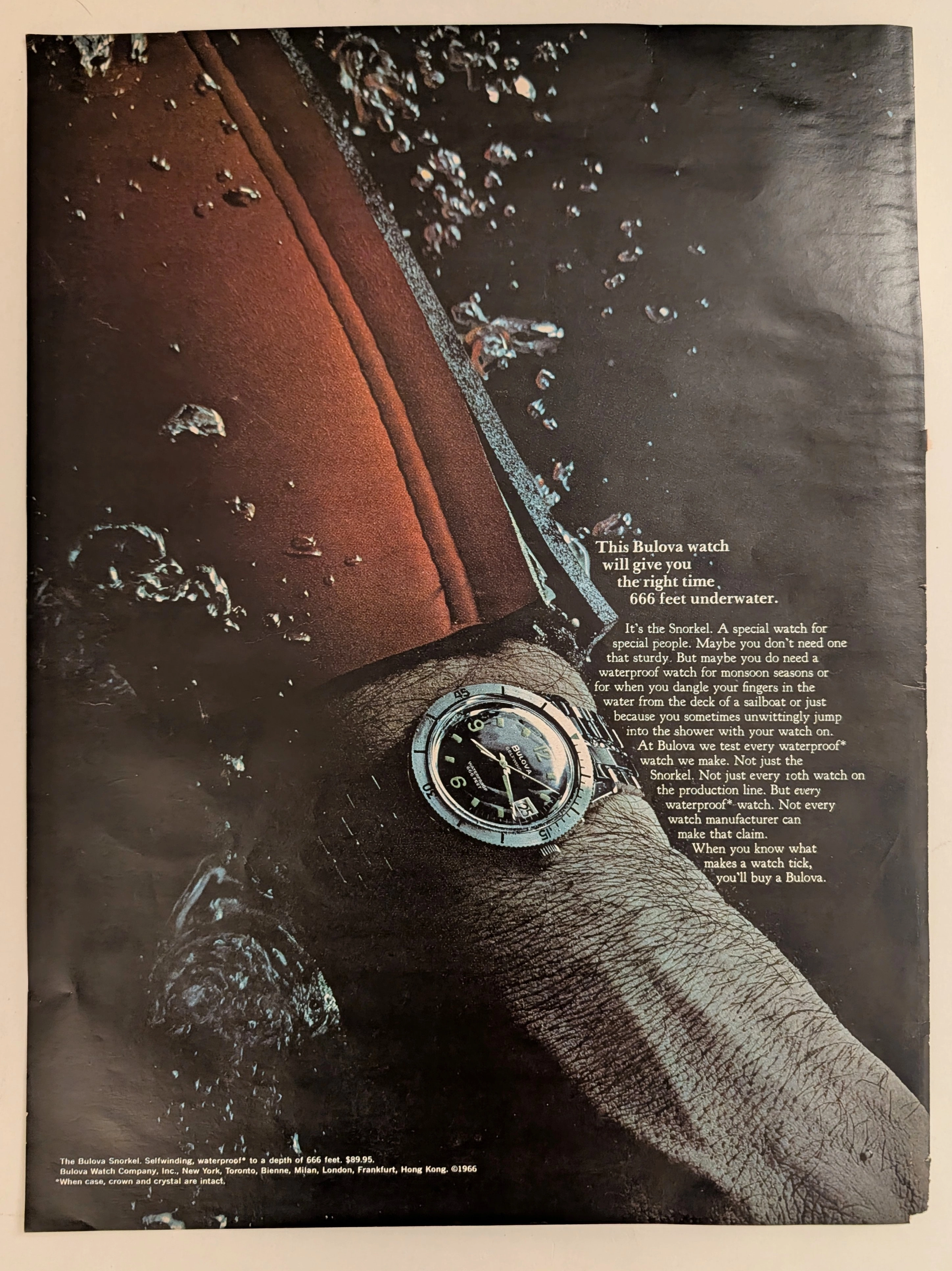
1966 Bulova Snorkel Vintage AdvertisementANALOG ARCHIVE
1966 Bulova Snorkel Vintage Advertisement (1966) — Class B vintage Luxury Brands
CLASS B
1 of 3

1966 Bulova Snorkel Vintage Advertisement

Category|Luxury Brands
Subcategory|Watches
Year|1966
Rarity Class|CLASS B
Archive Views|19

Last updated: 02 May 2026

Historical Context

The 1960s represented a zenith for mechanical dive watches, driven by the surging popularity of recreational scuba diving and high-profile underwater exploration. As consumers increasingly sought out robust "tool watches" that could transition seamlessly from the ocean floor to the office, the horological industry responded with intense innovation and competitive marketing. Bulova, a dominant force in American watchmaking, positioned its Snorkel line not merely as a piece of jewelry, but as an indispensable instrument of survival and reliability. This 1966 advertisement is a masterful example of mid-century atmospheric marketing. Visually, it plunges the reader immediately into the product's element. The intense close-up of a diver's submerged arm, framed against the dark, bubbling water, communicates a visceral sense of depth, pressure, and adventure. The lighting emphasizes the luminescence of the dial and the sturdy stainless steel construction of the bezel, subtly reinforcing the watch's utilitarian purpose. The ad copy is equally deliberate, anchoring the romance of the visual with hard, technical claims. The bold assertion that the watch "will give you the right time 666 feet underwater" highlights the exact specifications that would eventually earn this lineage of Bulova watches the affectionate collector's nickname: the "Devil Diver." Furthermore, Bulova leverages this piece to educate the consumer on their exceptional quality control. By stating, "At Bulova we test every waterproof watch we make. Not just the Snorkel. Not just every 10th watch on the production line," the brand contrasts its rigorous standards against those of its competitors. Priced at $89.95, the Bulova Snorkel represented a significant, yet accessible, investment for the middle-class consumer of 1966. The fine print—"*When case, crown and crystal are intact"—serves as a fascinating historical marker of early advertising regulations regarding "waterproof" terminology, a term that would later be phased out in favor of "water-resistant" under updated Federal Trade Commission guidelines. Today, this advertisement remains a critical artifact, illustrating how mid-century brands blended technical bravado with lifestyle aspiration.

Paper & Print Condition

This authentic 1966 horological artifact is printed on standard mid-weight glossy publication stock, a hallmark of mass-circulation American periodicals from the mid-20th century. Over the decades, the paper has aged gracefully, exhibiting only marginal oxidation or 'age-toning' near the far margins, which does not encroach upon the primary visual field. The print quality is exceptional, showcasing the robust color halftone printing techniques of the era. It demonstrates extraordinary color retention and chemical stability; the deep, atmospheric cyan and navy hues of the aquatic background remain richly saturated without significant fading. Furthermore, the striking contrast between the organic, textured skin tones of the diver's arm and the sharp, bright white serif typography highlights the precise registration of the original printing press. Minor edge wear and faint micro-abrasions are present along the bindery edge, entirely consistent with careful, manual archival extraction from a bound volume. Overall, the structural integrity of the paper remains highly supple, making it an exemplary specimen for museum-grade display and horological study.

Provenance & Rarity

Sourced directly from a primary American publication of 1966, this advertisement possesses a verifiable and direct provenance back to the golden era of mid-century print media. While original print runs for prominent magazines of the 1960s were vast, the ephemeral nature of these periodicals means that the survival rate of individual pages in such pristine condition is exceptionally low. Magazines were routinely discarded, recycled, or subjected to detrimental environmental factors such as humidity, UV light, and acidic paper degradation over the past six decades. Consequently, finding a surviving example that retains its structural integrity and vibrant color fidelity is increasingly uncommon. Furthermore, this specific advertisement holds profound horological significance. It serves as a primary historical document confirming the genesis of the famous "Devil Diver" nomenclature, explicitly highlighting the exact 666-foot depth rating that collectors covet today. For archivists and vintage Bulova enthusiasts, this print is not merely a marketing piece, but a critical reference point that authenticates original dial configurations, mid-century advertising regulations regarding the term "waterproof," and the $89.95 retail pricing of the period. Its combination of pristine preservation and deep horological lore elevates it from a common vintage clipping to a highly prized collector's artifact.

Rarity & Condition Summary

This 1966 Bulova Snorkel advertisement stands as a premier museum-grade artifact, distinguished by both its remarkable physical preservation and its profound horological significance. In terms of condition, it entirely defies the expected degradation of mid-century ephemera. The piece exhibits extraordinary chromatic fidelity, retaining the deep, immersive aquatic blues and the sharp contrast of its stark white typography without the fading, brittleness, or foxing (age-related spotting) typically associated with paper approaching sixty years of age. Structurally, it remains remarkably supple and stable. Regarding rarity, its true institutional value lies in its historical content. As a primary source document capturing the exact era the "666 feet" depth specification was cemented into the public consciousness—subsequently birthing the legendary "Devil Diver" moniker among collectors—this advertisement is not merely a surviving vintage page, but a crucial chapter of watchmaking history. Finding an example that perfectly intersects this specific historical milestone with such immaculate physical presentation is an exceedingly rare occurrence, making it a cornerstone acquisition for any serious horological archive.

Share This Archive

From the Journal

Related Articles

The Time Traveller's Dossier: The Anatomy of Autonomy – The 1966 Bulova Commander Collection and the American System of Watchmaking — related article
Read Article

The Time Traveller's Dossier: The Anatomy of Autonomy – The 1966 Bulova Commander Collection and the American System of Watchmaking

The evolution of the mid-twentieth-century luxury consumer market was fundamentally propelled by an intense post-war desire for unwavering reliability and transparent corporate accountability. The historical artifact elegantly and securely positioned upon the analytical table of The Record Institute today is a striking, full-page print advertisement for the 1966 Bulova Commander Collection, originating from a highly transformative era in global horology. This document completely transcends the standard, utilitarian boundaries of jewelry marketing. It operates as a highly sophisticated, multi-layered cultural mirror, reflecting the precise era when American industrial might directly challenged the fragmented traditions of European watchmaking, explicitly packaging and selling the concept of total mechanical autonomy to the American middle-class consumer. This world-class, comprehensive dossier conducts a meticulous, unyielding, and exceptionally exhaustive examination of the artifact, operating under the absolute most rigorous parameters of historical, sociological, and material science evaluation. With the vast majority of our analytical focus dedicated to its immense historical gravity, we will decode the brilliant marketing psychology embedded within the "If you want something done right, do it yourself" campaign, analyze the sociopolitical impact of the "American System of Watchmaking," and dissect the profound visual semiotics of the exploded mechanical view. Furthermore, as we venture deeply into the chemical and physical foundations of this analog printed ephemera, we will reveal the precise mechanical fingerprints of the CMYK halftone rosettes captured in the macro imagery of the watch dial and alligator strap. Finally, we will assess its archival rarity, exploring how the graceful, natural oxidation of the paper substrate cultivates a serene wabi-sabi aesthetic—a natural, irreversible phenomenon that serves as the primary engine driving up its market value exponentially within the elite global spheres of Vintage Commercial Ephemera and Horological Archives.

Ahead of Its Time: The 1978 Heuer Chronosplit Manhattan GMT — related article
Read Article

Ahead of Its Time: The 1978 Heuer Chronosplit Manhattan GMT

Rediscover the ultimate analog-digital hybrid timepiece through a rare 1978 vintage magazine advertisement, meticulously preserved as a single sheet cut-out.

Rolex "Perpetually Yours" — related article
Read Article

Rolex "Perpetually Yours"

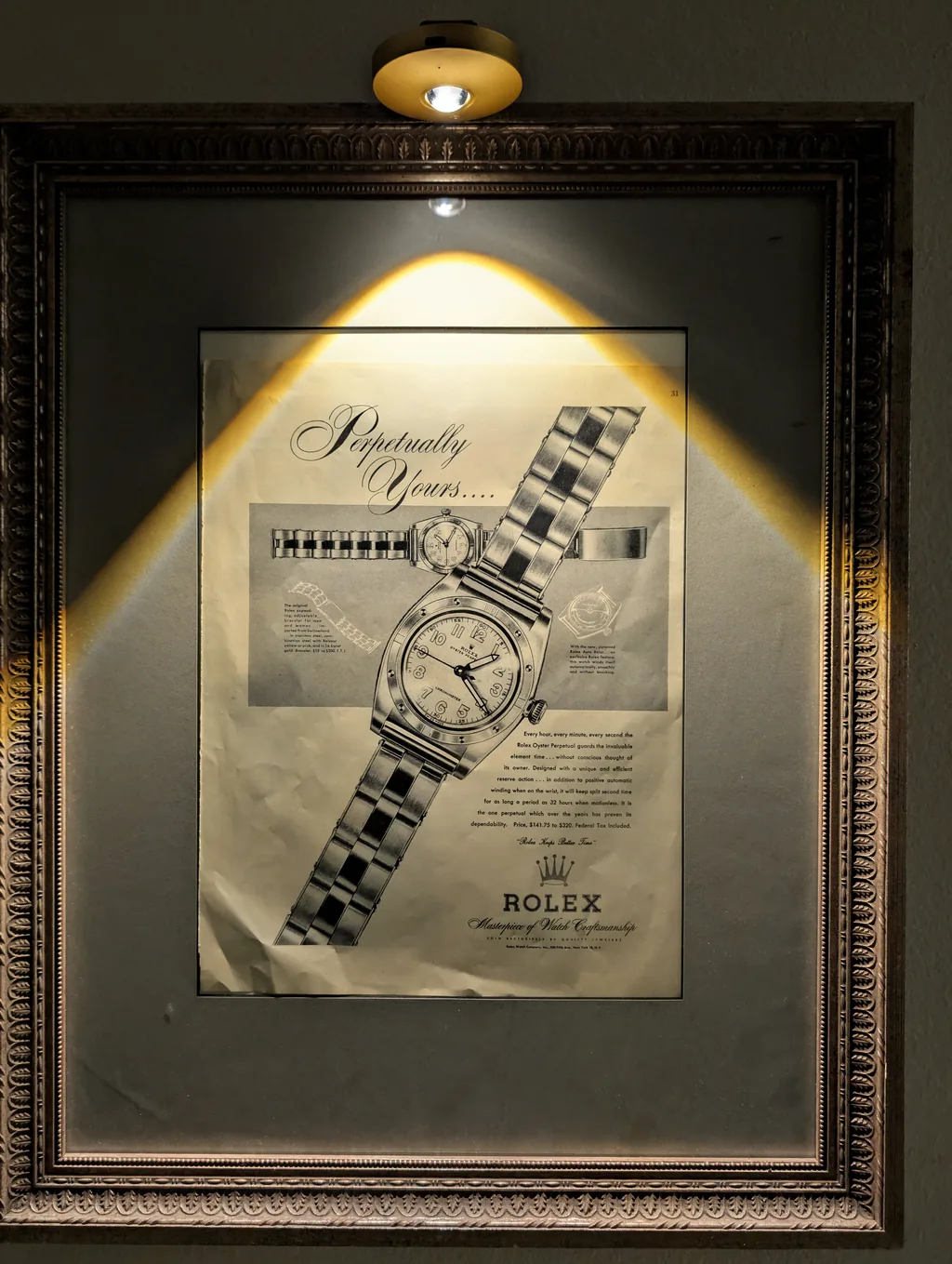
This rare mid-century Rolex "Perpetually Yours" advertisement captures the genesis of the modern Rolex empire. Featuring the legendary Oyster Perpetual, it celebrates the historic union of the world's first waterproof 'Oyster' case (1926) and the revolutionary self-winding 'Perpetual' rotor (1931). A true museum-grade horological archive, this piece represents the ultimate mechanical blueprint that defined Rolex's eternal supremacy.

The Time Traveller's Dossier: The Ultimate Horological Supremacy – A Museum-Grade Forensic Deconstruction of the 1968 Longines Ultra-Chron — related article
Read Article

The Time Traveller's Dossier: The Ultimate Horological Supremacy – A Museum-Grade Forensic Deconstruction of the 1968 Longines Ultra-Chron

The evolution of human timekeeping is not merely a passive record of hands rotating in concentric circles; it is a brutal, centuries-long engineering war waged against the absolute, unforgiving laws of physics—specifically gravity, temperature fluctuation, and physical friction. The historical artifact placed upon The Record Institute’s forensic examination table today is a monumental full-page print advertisement for the 1968 Longines Ultra-Chron, extracted from a mid-twentieth-century publication. Released precisely on the precipice of the "Quartz Crisis"—a technological tsunami that would soon decimate the traditional Swiss watch industry—this document represents the absolute pinnacle, the zenith, and the glorious final, defiant stand of analog mechanical engineering. This exhaustive, world-class academic archival dossier will ruthlessly dissect the artifact with microscopic precision, operating under the most rigorous parameters of historical and physical evaluation. We will decode the arrogant yet mathematically backed copywriting that boldly claims "A Minute A Month" accuracy, the profound mechanical significance of the 36,000 vibrations per hour (vph) high-beat movement, and the five specific medallions of honor that permanently anchor the brand’s bloodline to legendary aviation pioneers such as Charles Lindbergh and Howard Hughes. Furthermore, we will subject the heavy, dark-field offset lithography to a rigorous material science analysis, exposing the mechanical fingerprints of the analog halftone rosettes and the inevitable, profoundly beautiful wabi-sabi oxidation of the paper substrate. It is this exact intersection of horological mastery and chemical degradation that acts as the primary engine driving the artifact's market value exponentially upward among serious global collectors.