THE RECORD · ARCHIVE PLAYER
MP4
■ PAUSED
1968 Campbell's Tomato Soup "Hang-Up" Poster Vintage AdvertisementANALOG ARCHIVE
1968 Campbell's Tomato Soup "Hang-Up" Poster Vintage Advertisement (1968) — Class B vintage Lifestyle & Vice
CLASS B
1 of 4

1968 Campbell's Tomato Soup "Hang-Up" Poster Vintage Advertisement

Category|Lifestyle & Vice
Year|1968
Rarity Class|CLASS B
Archive Views|9

Last updated: 30 Apr 2026

Historical Context

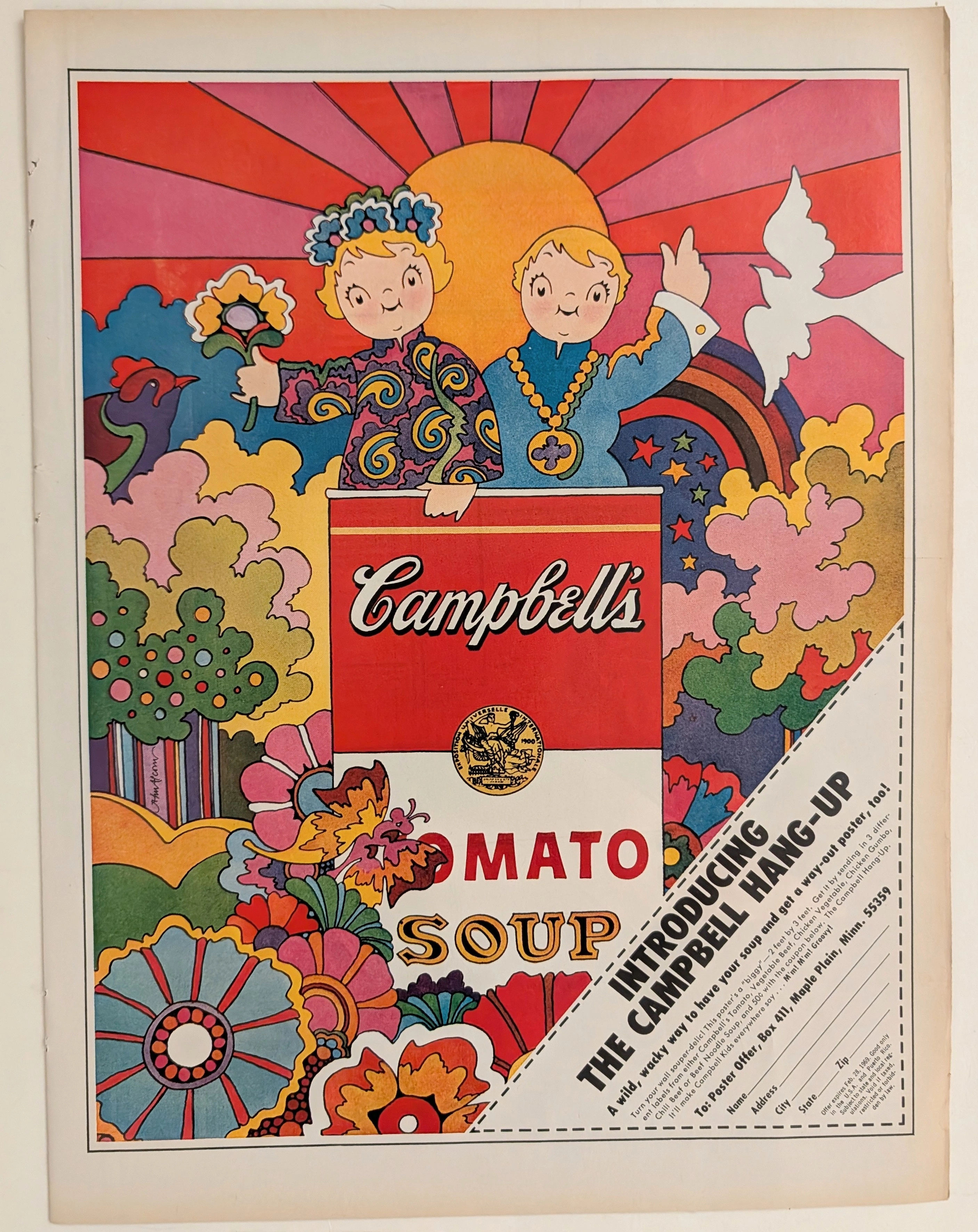
By the late 1960s, the Campbell Soup can had already been elevated from a humble pantry staple to a global icon of Pop Art, thanks to Andy Warhol's revolutionary 1962 silkscreens. Riding the cultural wave of this newfound artistic relevance, Campbell's advertising department sought to connect with a younger, trend-conscious demographic. The result was the "Campbell Hang-Up" campaign, which offered consumers a "souper-delic" 2×3 foot wall poster in exchange for soup labels and fifty cents. This specific advertisement is a masterful example of late-60s psychedelic commercial art. It was illustrated by John Alcorn, a highly influential designer associated with Push Pin Studios, known for his fluid, organic linework, flat expanses of vibrant color, and revival of Art Nouveau aesthetics. Alcorn transforms the iconic Campbell Kids—originally created by Grace Drayton in 1904—into quintessential 1968 mod figures. They are adorned in paisley and geometric patterns, wearing oversized medallions, holding a stylized flower, and flashing a peace sign. The composition is heavily layered with the iconography of the era: a peace dove in flight, a technicolor rainbow, and blooming "flower power" flora, all framing the central, rigid geometry of the classic Campbell's Tomato Soup can. The stark contrast between the traditional, unchanged label—complete with the 1900 Paris Exposition gold medal—and the swirling, "way-out" graphics surrounding it highlights the brand's attempt to bridge generations. The copywriting further anchors the piece in its era, utilizing the vernacular of the counterculture with phrases like "wild, wacky," "souper-delic," "way-out," and concluding with the enthusiastic "M'm! M'm! Groovy!" As an archival piece, this advertisement transcends simple marketing; it is a vivid sociological record of how mainstream corporate institutions adapted to and commodified the aesthetics of the 1960s counterculture movement.

Paper & Print Condition

Printed on standard, semi-gloss consumer magazine stock. The CMYK color separation remains exceptionally vivid, showcasing the high-saturation magenta, cyan, and yellow inks characteristic of mid-century psychedelic printing. Edge wear is minimal.

Provenance & Rarity

Sourced from a mainstream American publication distributed during the cultural apex of late 1968. Ephemeral artifacts containing original mail-in order forms from this specific campaign are increasingly scarce. They hold significant provenance and are highly coveted on the secondary collector's market due to their dual appeal: capturing the interest of corporate advertising historians as well as dedicated collectors of John Alcorn’s pioneering psychedelic illustration work.

Rarity & Condition Summary

A beautifully preserved, museum-quality example documenting corporate America's strategic co-option of 1960s counterculture aesthetics. The remarkable retention of vibrant chromaticity, coupled with the pristine legibility of John Alcorn's signature, elevates this print from mere advertising ephemera to a premier archival exhibition piece.

Share This Archive

From the Journal

Related Articles

The Time Traveller's Dossier: The Architecture of Slumber – The 1967 Simmons Golden Value — related article
Read Article

The Time Traveller's Dossier: The Architecture of Slumber – The 1967 Simmons Golden Value

The evolution of the American domestic interior during the mid-twentieth century was heavily influenced by the golden age of travel and the rapid expansion of the luxury hospitality industry. The historical artifact elegantly secured upon the analytical table of The Record Institute today is a large-format, two-page centerfold print advertisement for the Simmons Mattress Company, copyrighted in 1967. This document transcends standard consumer goods marketing; it operates as a sophisticated sociological mirror, reflecting a highly specific moment when industrial sleep engineering and the aspirational luxury of the modern hotel were explicitly packaged and sold to the suburban American household. This world-class, comprehensive dossier conducts a meticulous, profound, and historically objective examination of the artifact, operating under the absolute most rigorous parameters of sociological and material science evaluation. We will decode the brilliant marketing psychology embedded within the "First Public Sale" messaging, analyze the iconic "Good Housekeeping" endorsement, and dissect the rich semiotics of the heraldic quilt patterns alongside the modernist architectural illustrations. Furthermore, as we venture deeply into the chemical and physical foundations of this analog printed ephemera, we will reveal the precise mechanical fingerprints of the CMYK halftone rosettes and the graceful, natural oxidation of the paper substrate. This precise intersection of visual nostalgia, mid-century commercial artistry, and the immutable chemistry of time cultivates a serene wabi-sabi aesthetic—a natural, irreversible phenomenon that serves as the primary engine driving up its market value exponentially within the elite global spheres of Vintage Commercial Ephemera and Mid-Century Lifestyle Archives collecting.

The Time Traveller's Dossier: The Zenith of the American Living Room – Admiral Rectangular Color TV — related article
Read Article

The Time Traveller's Dossier: The Zenith of the American Living Room – Admiral Rectangular Color TV

The evolution of the American domestic interior during the mid-twentieth century was fundamentally redefined by the introduction and subsequent democratization of color television. The historical artifact elegantly and securely positioned upon the analytical table of The Record Institute today is a majestic, full-page print advertisement for Admiral Color TV, originating from the transitional technological era of the late 1960s. This document completely transcends the traditional boundaries of consumer electronics marketing. It operates as a highly sophisticated, multi-layered cultural and historical mirror, reflecting the exact moment when the magic of color broadcasting collided with the rigorous aesthetic demands of suburban domestic styling on a single printed page. This world-class, comprehensive dossier conducts a meticulous, unyielding, and exceptionally deep examination of the artifact, operating under the absolute most rigorous parameters of historical, sociological, and material science evaluation. With our analytical focus dedicated heavily to its historical gravity, we will decode the brilliant marketing psychology embedded within the "rectangular" tube innovation, analyze the space-age luxury of the "Sonar" remote control, and dissect the rich semiotics of disguised technology through "genuine walnut veneers". Furthermore, as we venture deeply into the chemical and physical foundations of this analog printed ephemera, we will reveal the precise mechanical fingerprints of the CMYK halftone rosettes and the graceful, natural oxidation of the paper substrate. This precise intersection of visual nostalgia, mid-century commercial artistry, and the immutable chemistry of time cultivates a serene wabi-sabi aesthetic—a natural, irreversible phenomenon that serves as the primary engine driving up its market value exponentially within the elite global spheres of Vintage Commercial Ephemera, Consumer Electronics Archives, and Mid-Century Lifestyle collecting.

The Time Traveller's Dossier : 1980 The Architecture of Leisure and the Golden Age of the American Regional Department Store — related article
Read Article

The Time Traveller's Dossier : 1980 The Architecture of Leisure and the Golden Age of the American Regional Department Store

Before the algorithmic precision of digital feeds stripped the tactility from consumer longing, and long before the homogenization of global e-commerce, print media served as the grand architectural blueprint for the American lifestyle. Captured within the glossy confines of a late-20th-century publication—specifically indicated by the vertical marginalia of Playboy magazine—this Boston Traders advertisement stands as a pristine, museum-grade artifact. It masterfully encapsulates the ‘preppy-outdoor’ synthesis that dominated the sartorial landscape of the early 1980s. However, its true value extends far beyond its depiction of robust color-blocking and heritage-driven knitwear. This archival piece serves as a critical historical ledger of America’s evolving retail infrastructure. By permanently anchoring its brand legacy to iconic, and now profoundly defunct, regional department store giants, this document offers a rare, tightly datable window into the zenith of physical retail and the psychological marketing of the affluent weekend gentleman. It is a masterpiece of commercial archaeology.

The Time Traveller's Dossier : KFC - The Outsourcing of Domesticity — related article
Read Article

The Time Traveller's Dossier : KFC - The Outsourcing of Domesticity

The year is obscured, yet the era is violently clear. It is the late 1960s. The American domestic sphere is a theater of impossible expectations. Then, the holiday season was a crucible of female domestic labor. The mother was the sole, unassisted architect of the festive feast. Now, a corporate entity offers absolution. This artifact documents the precise moment the sacred holiday dining table was breached by industrial fast food. It is the commercialization of domestic relief, printed on coated paper. It captures the transition of the weary housewife surrendering her pan to the benevolent, manufactured patriarch. It is an invitation to buy time. To reject the crushing weight of the "Christmas rush." To accept the paper bucket as a legitimate vessel of hospitality.