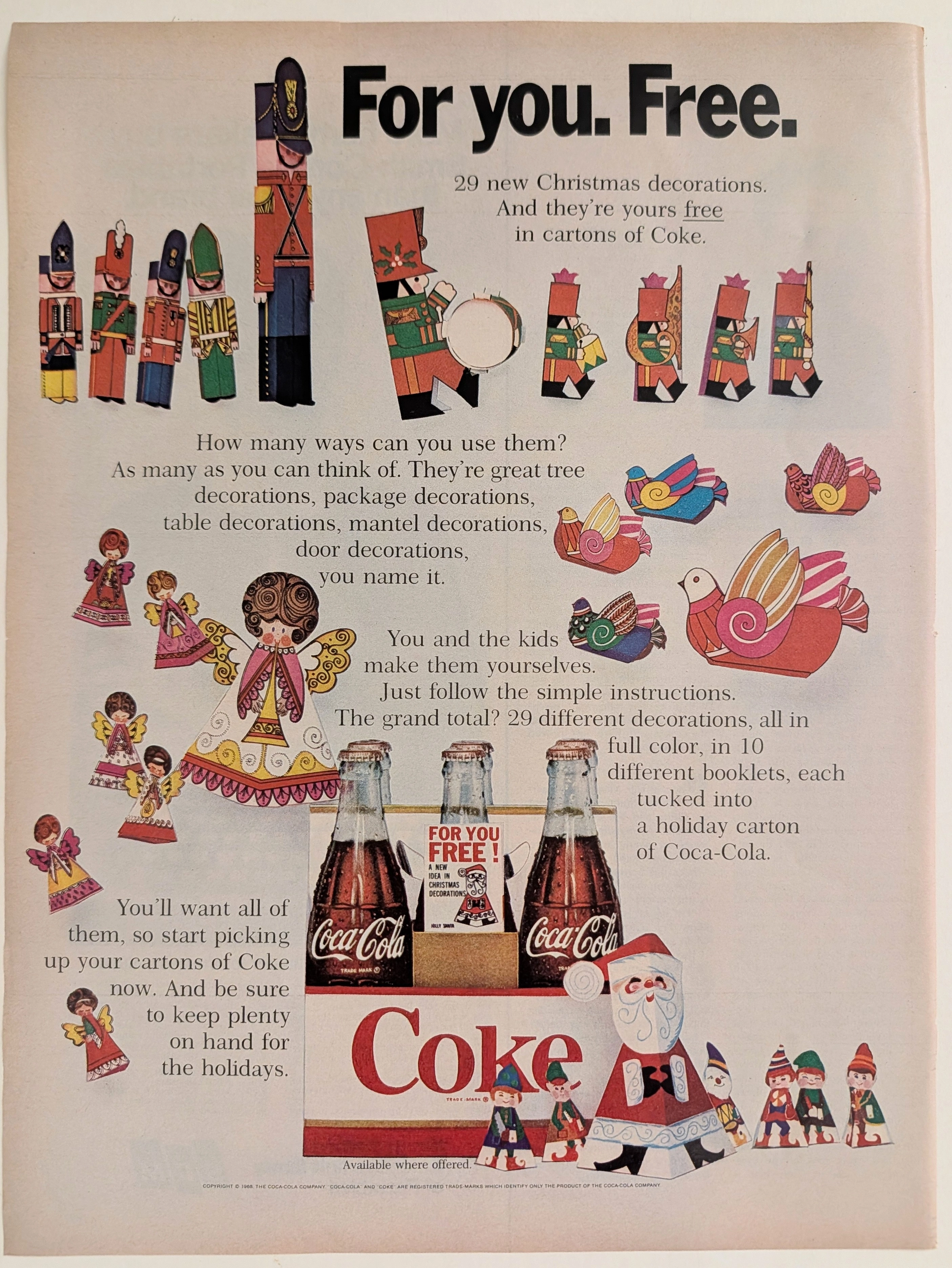
1968 Coca-Cola "For You. Free." DIY Christmas Decorations Vintage Print Advertisement (1968) — Class B vintage Lifestyle & Vice
CLASS B
1 of 3

1968 Coca-Cola "For You. Free." DIY Christmas Decorations Vintage Print Advertisement

Category|Lifestyle & Vice
Year|1968
Rarity Class|CLASS B
Archive Views|11

Last updated: 29 Apr 2026

Historical Context

By the late 1960s, The Coca-Cola Company had long established itself as a cornerstone of American Christmas iconography, largely due to the enduring legacy of Haddon Sundblom’s Santa Claus illustrations commissioned in the 1930s. However, this 1968 advertisement represents a brilliant pivot in promotional strategy: moving from passive visual association to active, interactive consumer engagement. The "For you. Free." campaign offered unprecedented value to the consumer by including 29 distinct, full-color papercraft Christmas decorations distributed across 10 different booklets. These booklets were strategically "tucked into a holiday carton of Coca-Cola." This was a masterclass in point-of-sale marketing. By hiding the DIY ornaments inside the packaging, the brand successfully incentivized the purchase of multi-bottle cartons over individual bottles, driving higher-volume sales during the crucial fourth quarter. Visually, the advertisement captures the charming, slightly geometric illustration style popular in late-1960s commercial art. The featured papercrafts—which include marching nutcrackers, stylized turtle doves, delicate angels, and a "Jolly Santa" designed to fit directly over a Coca-Cola bottle—reflect a wholesome, family-centric ethos. The ad copy explicitly speaks to this, suggesting, "You and the kids make them yourselves." In a year defined by profound global and domestic turbulence, Coca-Cola offered an accessible, domestic comfort: crafting around the living room table. Furthermore, this artifact highlights the era's reliance on print media for complex promotional delivery. The vibrant colors, clear instructional tone, and integration of the product itself into the holiday display (using the bottles as stands for the paper figures) demonstrate a highly cohesive marketing vision, blending product packaging seamlessly with seasonal festivity.

Paper & Print Condition

This piece exhibits excellent color retention, with the vibrant reds of the Coca-Cola branding and the varied hues of the papercrafts remaining highly saturated. There is a slight, natural oxidation (yellowing) consistent with mid-century consumer magazine stock, but no significant foxing or degradation.

Provenance & Rarity

Sourced from a mainstream American publication dated late 1968 (Copyright 1968, The Coca-Cola Company). Advertisements that specifically catalogue ephemeral promotional items—like these DIY booklets—serve as critical reference points for brand historians and Coca-Cola collectors.

Rarity & Condition Summary

A well-preserved and culturally significant artifact of 1960s interactive consumer marketing, displaying both typographic clarity and illustrative charm indicative of late mid-century commercial design.
Share This Archive

From the Journal

Related Articles

The Time Traveller's Dossier : 1963 Coca-Cola - The Culinary Symbiosis — related article
Read Article

The Time Traveller's Dossier : 1963 Coca-Cola - The Culinary Symbiosis

The year is 1963. The American middle class is experiencing an unprecedented post-war economic boom. The commercial landscape is shifting from selling standalone products to selling integrated lifestyles. This artifact documents a masterclass in culinary anchoring. It captures the precise era when Coca-Cola aggressively positioned itself not just as a beverage, but as the mandatory companion to the American diet. It is a monument to the sensory contrast of hot and cold. It is the dawn of modern multimedia cross-promotion, tethering a soft drink to the golden age of television syndication. It is a visual decree: you cannot consume the hamburger without the Cola. Things go better with Coke.

The Time Traveller's Dossier: Coca-Cola (1952) – The Wholesome Prescription — related article
Read Article

The Time Traveller's Dossier: Coca-Cola (1952) – The Wholesome Prescription

Before the era of aggressive nutritional labeling and the demonization of refined sugars, carbonated beverages sought to position themselves not merely as treats, but as vital, life-affirming staples of the American diet. The artifact before us—a 1952 magazine advertisement for The Coca-Cola Company—is a masterclass in psychological association. By placing their product in the pristine, capable hands of a registered nurse, Coca-Cola is explicitly borrowing her cultural authority. She is the ultimate symbol of care, cleanliness, and health. The advertisement doesn't just offer you a drink; it offers you a "wholesome" prescription for daily fatigue. It is a fascinating glimpse into an era where a sugary, caffeinated beverage could be advertised with the solemn promise: "Quality you can trust."

The Time Traveller's Dossier: Coca-Cola 1944 - The Weaponization of Morale — related article
Read Article

The Time Traveller's Dossier: Coca-Cola 1944 - The Weaponization of Morale

Then, sugar and carbonated water were not merely ingredients for a domestic treat; they were classified as essential psychological logistics for a global war. Now, a soda is just a soda. The problem for the United States military in 1944 was not just arming its young men with rifles and artillery; it was the monumental task of maintaining the human spirit under the soul-crushing weight of total war. The boys being trained in the muggy, moss-draped camps of the American South were destined for the meat grinders of Europe and the Pacific. They needed a tether to the homes they were leaving behind. The solution, brilliantly engineered and ruthlessly promoted by The Coca-Cola Company, was the weaponization of nostalgia. This artifact is a portal. It transports us to a sweltering training camp in 1944. It documents the exact historical moment when a private beverage corporation successfully intertwined its product with the very fabric of American patriotism, military logistics, and the linguistic evolution of its own brand identity.

The Time Traveller's Dossier: The Zenith of the American Living Room – Admiral Rectangular Color TV — related article
Read Article

The Time Traveller's Dossier: The Zenith of the American Living Room – Admiral Rectangular Color TV

The evolution of the American domestic interior during the mid-twentieth century was fundamentally redefined by the introduction and subsequent democratization of color television. The historical artifact elegantly and securely positioned upon the analytical table of The Record Institute today is a majestic, full-page print advertisement for Admiral Color TV, originating from the transitional technological era of the late 1960s. This document completely transcends the traditional boundaries of consumer electronics marketing. It operates as a highly sophisticated, multi-layered cultural and historical mirror, reflecting the exact moment when the magic of color broadcasting collided with the rigorous aesthetic demands of suburban domestic styling on a single printed page. This world-class, comprehensive dossier conducts a meticulous, unyielding, and exceptionally deep examination of the artifact, operating under the absolute most rigorous parameters of historical, sociological, and material science evaluation. With our analytical focus dedicated heavily to its historical gravity, we will decode the brilliant marketing psychology embedded within the "rectangular" tube innovation, analyze the space-age luxury of the "Sonar" remote control, and dissect the rich semiotics of disguised technology through "genuine walnut veneers". Furthermore, as we venture deeply into the chemical and physical foundations of this analog printed ephemera, we will reveal the precise mechanical fingerprints of the CMYK halftone rosettes and the graceful, natural oxidation of the paper substrate. This precise intersection of visual nostalgia, mid-century commercial artistry, and the immutable chemistry of time cultivates a serene wabi-sabi aesthetic—a natural, irreversible phenomenon that serves as the primary engine driving up its market value exponentially within the elite global spheres of Vintage Commercial Ephemera, Consumer Electronics Archives, and Mid-Century Lifestyle collecting.