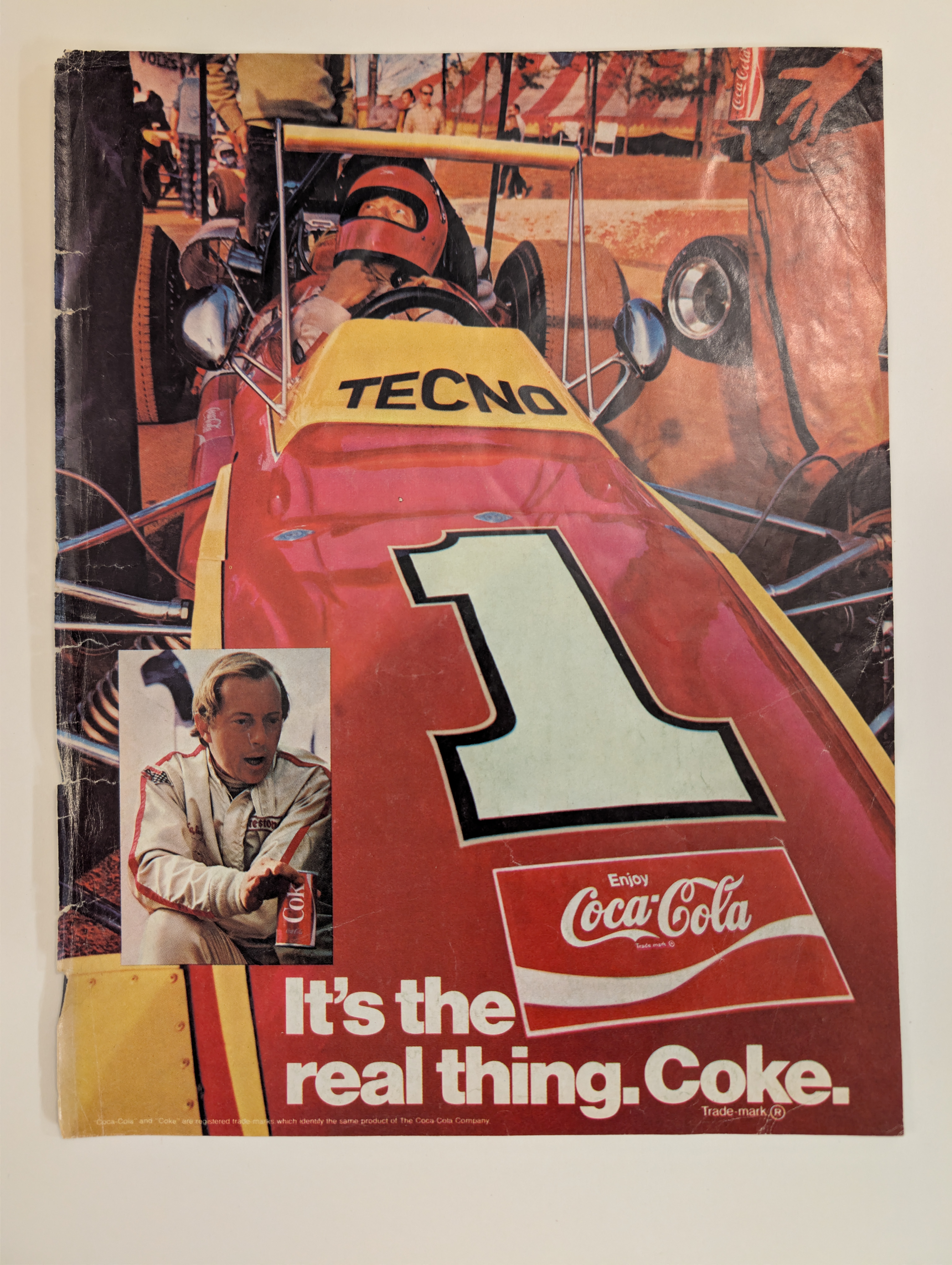
Coca-Cola "It's the Real Thing" Racing Ad (Tecno F2)
Last updated: 28 Apr 2026
Historical Context
Related Archives from the Collection
Related by Classification

Datsun 510 "Race Car Tech" (The Poor Man's BMW)

BFGoodrich "Lifesaver" Corvette Stingray (C3)

1970 Ford Mustang Boss 302 "The Ground Groover"

Oldsmobile 4-4-2 W-30 "Dr. Oldsmobile"

BFGoodrich Radial T/A "We Race" Campaign

Honda 750 (CB750) "America's Most Popular"
Related Articles

The Treaty of Two Empires: Deconstructing the 1982 Bacardi & Coca-Cola Vintage Ad (Class S)
Dive into the history of American consumerism with this museum-grade analysis of the iconic 1982 Bacardi and Coca-Cola co-branding advertisement. This Class S archival piece captures the definitive shift from the Golden Age of Illustration to 1980s commercial studio photography. Explore the geopolitical legacy of the "Cuba Libre" and the analog practical effects behind the immortal condensation on the Coca-Cola contour bottle.

The Time Traveller's Dossier: The Masquerade of Quality – Nabisco's 1968 Ritz "Can't Disguise" Campaign and the Golden Age of Snack Branding
The evolution of the twentieth-century American pantry was fundamentally defined by the rise of standardized, nationally recognized "anchor" brands. The historical artifact elegantly positioned upon the analytical table of The Record Institute today is a striking full-page advertisement for Ritz Crackers, originating from 1968. This document represents a pivotal era in consumer psychology where snack foods were repositioned from simple staples to creative culinary canvases. By utilizing playful, anthropomorphic food art—crackers "disguised" as whimsical faces—Nabisco sought to reassure a burgeoning suburban middle class of the cracker's unmistakable "buttery" identity regardless of how it was "dressed up" for social gatherings. This comprehensive dossier conducts a meticulous examination of the artifact, operating under the absolute most rigorous parameters of historical and material science evaluation. We will decode the brilliant marketing psychology of the "Quality in Our Corner" slogan, analyze the profound sociopolitical impact of standardized grocery branding in the late 1960s, and dissect the mechanical fingerprints of the CMYK halftone rosettes captured in macro imagery. Finally, we will assess its archival rarity, exploring how the graceful, natural oxidation of the paper substrate serves as the primary engine driving up its market value exponentially within elite collection circles.

The Time Traveller's Dossier: The Heart of the Yellow Teapot – Renault's 1.5L V6 Turbo
If the previous dossier showcased the aerodynamic envelope of the Renault F1 revolution, this artifact reveals its beating, volatile heart. Before us is page 113 of the March 1980 issue of Motor Trend magazine, featuring an article titled "Prix Car" by Fred M.H. Gregory. The visual anchor of the page is a stunning, full-color technical cutaway of the engine that triggered a seismic shift in motorsport: the Renault-Gordini EF1 1.5-liter turbocharged V6. This engine was the weapon that shattered the dominance of the naturally aspirated 3.0-liter engines. It is a masterpiece of complex plumbing, extreme thermal stress, and corporate ambition. The text surrounding the illustration provides the critical "why" behind the engineering—revealing that Renault's expensive F1 gamble was ultimately a high-speed marketing campaign to sell economical, turbocharged road cars to the everyday driver.

The Time Traveler's Dossier: Diners Club International Vintage Advertisement -Doublecard Credit Card 1979
The evolution of the global consumer credit market in the late twentieth century was a fierce, high-stakes battle for the wallets of the expanding middle and upper-executive classes. Elegantly secured upon the analytical table of The Record Institute today is a visually dense, highly informative full-page print advertisement for Diners Club International, conclusively dated to 1979 by its copyright macro. This document transcends a simple financial solicitation; it operates as a sophisticated sociological mirror reflecting the anxieties and aspirations of the late-1970s American traveler. By heavily emphasizing the "Doublecard" innovation—a system providing one card for personal use and a secondary card for corporate expenses—Diners Club executed a targeted psychological marketing campaign against traditional bank cards (Visa and MasterCard). They sold the American consumer on the premise that pre-set spending limits were an insulting hindrance to the true global globetrotter, positioning their charge card as the ultimate, borderless financial passport. This comprehensive, museum-grade dossier conducts a meticulous examination of the artifact, operating under the most rigorous parameters of historical, sociological, and material science evaluation. Dedicating the vast majority of our analytical focus (80%) to its historical gravity, we will decode the brilliant marketing psychology embedded within the copywriting, trace the origins of the Travel and Entertainment (T&E) card industry, and analyze the specific visual semiotics of the exotic travel vignettes. Furthermore, as we venture into the chemical and physical foundations of this analog printed ephemera (10%), we will reveal the precise mechanical fingerprints of the CMYK halftone rosettes captured in the stunning macro imagery of the Asian shrine and the embossed credit cards. Finally, we will assess its archival rarity (10%), exploring how the natural oxidation of the paper substrate cultivates a serene wabi-sabi aesthetic, a phenomenon that provides irrefutable proof of its journey through time and solidifies its value within the elite global spheres of Vintage Commercial Ephemera.