The Time Traveller's Dossier: The Heart of the Yellow Teapot – Renault's 1.5L V6 Turbo — The Record Institute JournalThe Time Traveller's Dossier: The Heart of the Yellow Teapot – Renault's 1.5L V6 Turbo — The Record Institute JournalThe Time Traveller's Dossier: The Heart of the Yellow Teapot – Renault's 1.5L V6 Turbo — The Record Institute JournalThe Time Traveller's Dossier: The Heart of the Yellow Teapot – Renault's 1.5L V6 Turbo — The Record Institute Journal
1 / 4

✦ 4 Photos — Click any image to view in high resolution

April 23, 2026

The Time Traveller's Dossier: The Heart of the Yellow Teapot – Renault's 1.5L V6 Turbo

AutomotiveBrand: Renault
Archive Views: 10

The History

The Roots of the Revolution
The text provides vital context for how this mechanical marvel came to be. Renault didn't build this engine out of thin air. As Francois Castaing (then technical director of Renault Sport) recalls in the article, the foundation was laid earlier in the 1970s. Renault commissioned Gordini to build a 2-liter 90-degree V6 for sports car racing (winning the European championship in 1974).

When Renault set its sights on F1, they took that architecture, reduced the displacement to the regulation 1.5 liters, and bolted on a massive turbocharger. It was a brutal, forced evolution of an existing block, creating an engine that produced staggering horsepower but generated temperatures that routinely melted its own internals during its early development.

Win on Sunday, Sell on Monday (The French Way)
Why endure the humiliation of the early, explosive engine failures? The text quotes Renault President Bernard Hanon directly, explaining the corporate strategy: "Because we believe that turbocharging has potential also for passenger cars, and we wanted to acquire the technology and do something original with smaller engines."

Hanon connects the dots between the screaming 200mph F1 beast and consumer showrooms. F1 was their laboratory to solve the problem of fuel consumption. By proving that a tiny 1.5-liter engine could beat massive 3.0-liter V8s and flat-12s, Renault was preparing the public for a future of smaller, highly efficient, turbocharged passenger cars. It was a brilliant, albeit massively expensive, long-term brand strategy.

Anatomy of the Beast
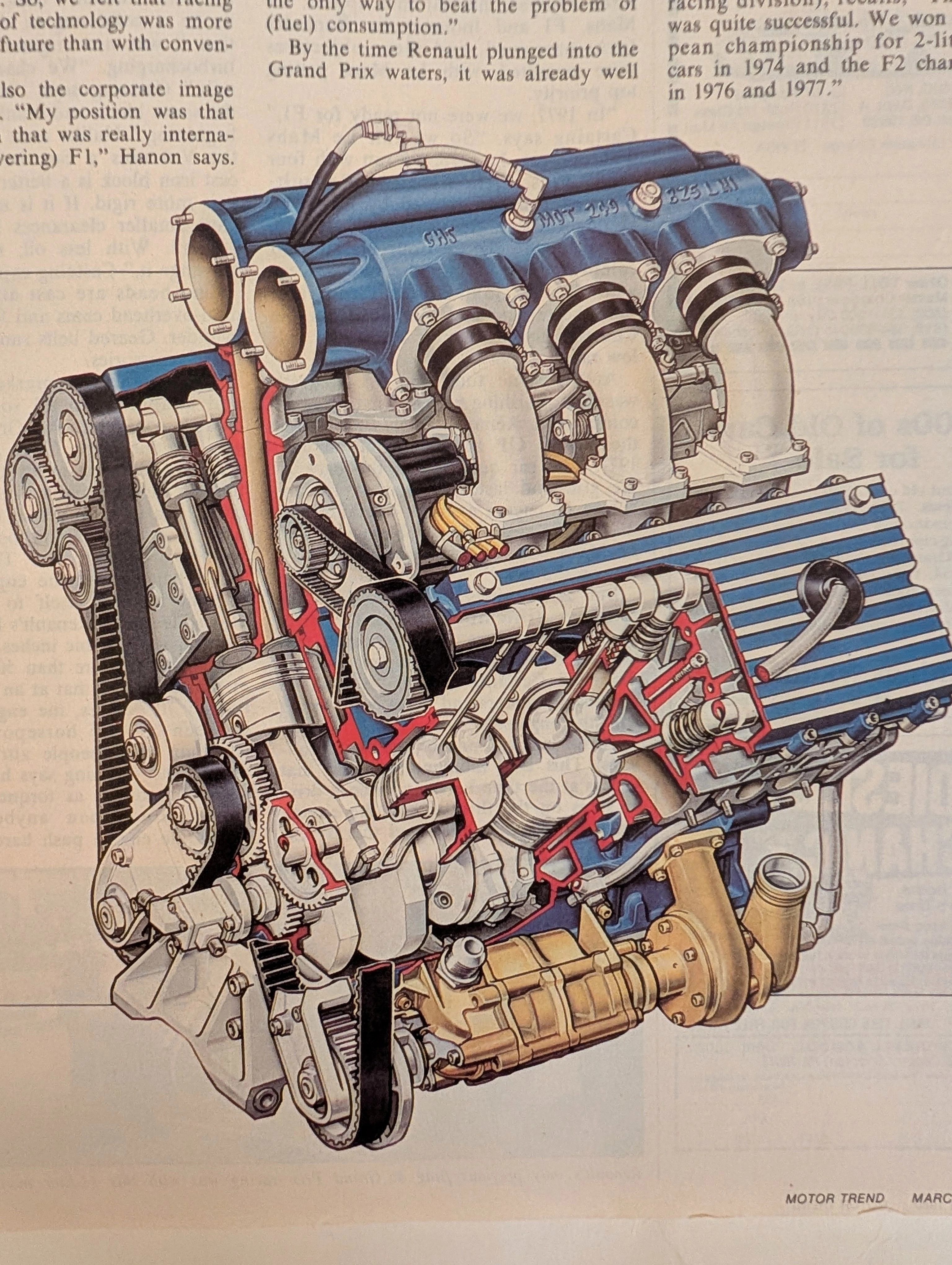
The illustration beautifully exposes the violent mechanics of forced induction. You can clearly see the bronze-colored turbocharger casing at the bottom right. Exhaust gases from the cylinders would spin the turbine within this casing at over 100,000 RPM, forcing compressed air back up into the blue intake plenums atop the engine. The cutaway also highlights the intricate routing of the toothed timing belts on the front of the block, driving the dual overhead camshafts for each cylinder bank.

The Paper

This page represents a leap from the black-and-white line art of the previous page into the realm of color magazine printing of the early 1980s.

Printed on standard, slightly porous magazine stock, the CMYK halftone process is on full display. The macro shot of the blue intake plenum reveals how the rich, glossy blue is constructed from a dense matrix of cyan and magenta dots. Interestingly, we can clearly read the casting marks on the blue plenum: "GHS MOT 249" and "825 LMI" (though the exact letters are slightly distorted by the hand-drawn nature of the art).

The paper has oxidized around the edges, typical of mass-produced publications containing lignin, resulting in a warm, vintage patina that contrasts beautifully with the stark blues, reds, and golds of the engine illustration.

The Rarity

Classification: Class B (High Technical & Archival Value)

As a single page from a widely circulated magazine like Motor Trend, it is not physically rare. However, its archival value is exceptional. Finding this specific color cutaway, paired with Fred M.H. Gregory’s contemporary interview with Bernard Hanon, creates a perfect historical capsule. It captures the exact moment the automotive press and the public began to understand that the "turbo era" wasn't just a racing fad, but the future of the automotive industry.
Visual Impact

The illustration is a triumph of technical communication and commercial art. The artist utilizes color not just for realism, but for mechanical clarity.

Blue is used for the cool intake air paths (the large plenums).

Red is used strategically to highlight cross-sections, indicating where metal has been "cut away" for the viewer's benefit, particularly around the combustion chambers and water jackets.

Gold/Bronze highlights the turbocharger assembly, drawing the eye immediately to the component that makes this engine special.

Silver/Grey grounds the heavy mechanical components—the block, pistons, and gears.

It is a chaotic yet highly organized visual that conveys heat, motion, and extreme pressure even while completely static on the page.

Share This Archive

The Archive Continues

Continue the Exploration

The Time Traveller's Dossier: The Aesthetics of Gifting and Consumer Hypnosis – Skyway Luggage Advertisement (Circa 1950s)

Sky Way · Travel

The Time Traveller's Dossier: The Aesthetics of Gifting and Consumer Hypnosis – Skyway Luggage Advertisement (Circa 1950s)

The history of commercial marketing is rarely driven by cold, rational logic; it is forged, molded, and dictated through the weaponization of emotion, manufactured desire, and the carefully engineered magic of the holiday season. Long before digital algorithms were deployed to predict and manipulate our purchasing behaviors, social engineering and consumer psychology were executed with devastating precision through the tip of a master illustrator’s brush on the pages of glossy magazines. The historical artifact standing before us is not merely a run-of-the-mill mid-century holiday campaign for a luggage brand. It is an absolute visual "Trojan Horse"—one of the most cunningly designed blueprints ever utilized to bypass the consumer's psychological defenses. It serves as an unwavering testament to an era when the stark, industrial rigidity of manufactured goods was brilliantly concealed beneath the irresistible wrapping paper of festive innocence. ​This museum-grade academic archival dossier presents an exhaustive, uncompromising deconstruction of a late-analog print advertisement from Skyway Luggage. Operating on a ruthlessly calculated, gender-segregated binary narrative structure, this campaign captures a critical paradigm shift: the exact historical moment when luggage transcended its utilitarian status as a mere "storage box" and was conceptually elevated into a highly coveted "dream Christmas gift." Through the highly specialized lens of mid-century commercial artistry and stringent visual forensics, this document serves as a masterclass in the psychological marketing of manufactured desire. It established the foundational archetype for the holiday retail economy—an archetype that unconditionally dictates the global lifestyle merchandising strategies of today.

THE TIME TRAVELER'S DOSSIER:THE SMILE IN THE TRENCHES AND THE HOME FRONT BRAINWASHING

Chesterfield · Tobacco

THE TIME TRAVELER'S DOSSIER:THE SMILE IN THE TRENCHES AND THE HOME FRONT BRAINWASHING

The artifact under exhaustive, uncompromising museum-grade analysis is a profoundly battle-scarred Historical Relic originating from the absolute climax of World War II. This Primary Art Document is a monumental advertisement for Chesterfield Cigarettes, forensically dated to 1943 (verified by the copyright text: "Copyright 1943, LIGGETT & MYERS TOBACCO CO."). ​This document transcends mere tobacco marketing; it is a profound "Sociological Blueprint of Wartime Psychological Comfort." The visual architecture targets the Home Front by depicting a wholesome American G.I. writing a letter home on a military cot. The headline, "WHERE A CIGARETTE COUNTS MOST", positions the product as a vital psychological lifeline. Furthermore, it explicitly functions as state-aligned propaganda, featuring a patriotic shield commanding citizens to "BUY U.S. BONDS STAMPS". ​Printed on highly acidic wood-pulp paper, it exhibits severe edge trauma, heavy oxidation, and the calcified residue of ancient cellophane tape applied by a desperate owner decades ago. This unstoppable molecular death transforms a mass-produced piece of wartime propaganda into an irreplaceable Primary Art Document of Rarity Class S.

THE TIME TRAVELER'S DOSSIER: THE HOME FRONT SMILE AND THE 1944 PSYCHOLOGICAL WAR

THE TIME TRAVELER'S DOSSIER: THE HOME FRONT SMILE AND THE 1944 PSYCHOLOGICAL WAR

This original 1944 7-Up advertisement cut page from The Saturday Evening Post is a vital piece of WWII Home Front ephemera. Beneath the wholesome mid-century illustrations lies a patriotic directive to support the war effort by adhering to rationing laws. The massive water stain and natural oxidation of the 80-year-old acidic paper highlight the beautiful aesthetic of decay, elevating this to a Class A primary art print.

Published by

The Record Institute

Taxonomy Match

Related Articles

The Time Traveller's Dossier : Renault's Turbo Gamble - Anatomy of a Revolution — related article
Read Article

The Time Traveller's Dossier : Renault's Turbo Gamble - Anatomy of a Revolution

In the annals of motorsport, true revolutions are rarely born from immediate success. They are usually forged in the fires of public humiliation, mechanical failure, and stubborn, visionary persistence. Before the modern era of ultra-efficient hybrid power units, Formula One was dominated by a single, reliable philosophy: the 3.0-liter naturally aspirated engine (most notably the ubiquitous Ford Cosworth DFV). Then came Renault. In 1977, the French manufacturer did not enter F1 to conform; they entered to disrupt. They chose a loophole in the rulebook that allowed for 1.5-liter forced-induction engines—a path so complex and fraught with reliability issues that the established British teams dismissed it entirely. The artifact before us—a page from the March 1980 issue of Motor Trend magazine—captures the precise historical moment when the laughter stopped. It documents the vindication of the turbocharged V6. This magnificent technical cutaway illustrates not just a car, but the blueprint of a paradigm shift that would permanently alter the trajectory of global motorsport.

The Time Traveller's Dossier : Ferrari 312 F1 - The Aerodynamic Subjugation  Summary — related article
Read Article

The Time Traveller's Dossier : Ferrari 312 F1 - The Aerodynamic Subjugation Summary

Then, speed was a brute-force equation of pushing a cigar-shaped fuselage blindly through the resisting atmosphere. Now, speed is the absolute subjugation of the invisible air, weaponizing the wind to crush the machine into the asphalt. The problem in the late 1960s and early 1970s Formula 1 was not merely generating more horsepower; the internal combustion engine had already reached terrifying heights of output. The existential crisis for manufacturers was keeping the tires connected to the earth. The cars were literally taking flight. The pursuit of pure, unadulterated mechanical grip had reached its physical, terrifying limit. The solution, as meticulously documented in this 1976 Road & Track retrospective by Werner Bührer, was a violent paradigm shift. It was the painful, reluctant birth of modern aerodynamics. This artifact is a portal. It transports us to the exact historical, psychological, and engineering pivot where Enzo Ferrari—a man who famously proclaimed that aerodynamics were for people who could not build engines—was forced to surrender to the wind. It is an automotive magazine spread, yes. But deeper than that, it is a beautifully illustrated autopsy of a legacy manufacturer desperately evolving its DNA. It captures the frantic mutation of the Ferrari 312 from a traditional tube-framed missile into a winged, deformed, downforce-generating weapon. It is the visual documentation of motorsport losing its romantic innocence and embracing the cold, hard laws of fluid dynamics.

The Time Traveller's Dossier: BBS Wheels 1986 - The Golden Age of IMSA GTP — related article
Read Article

The Time Traveller's Dossier: BBS Wheels 1986 - The Golden Age of IMSA GTP

Then, sports car racing was an unrestricted, high-speed arms race. It was an era where manufacturers threw massive budgets at experimental aerodynamics and terrifying turbocharged horsepower, resulting in 200-mph ground-effect monsters that rattled the teeth of spectators. Now, top-tier endurance racing is strictly governed by "Balance of Performance" regulations to ensure parity, and the cars are heavily restricted by standardized hybrid systems. The problem for an automotive enthusiast in 1986 was how to capture a piece of this cutting-edge, million-dollar racing technology for their own street car. The solution, masterfully presented in this advertisement, was BBS. If the fastest, most advanced cars on earth relied on their modular wheels to survive 24 hours of grueling abuse, surely they were good enough for your driveway. This artifact is a portal. It transports us to the paddock of the Daytona International Speedway or Road Atlanta in the mid-1980s. It documents the absolute zenith of the IMSA GTP (Grand Touring Prototype) era, serving as a visual "Who's Who" of legendary race cars, all united by a single, golden component.

The Time Traveller's Dossier : Datsun 280-ZX - The GT Shift — related article
Read Article

The Time Traveller's Dossier : Datsun 280-ZX - The GT Shift

Then. The sports car was a visceral punishment. A machine of raw mechanical feedback. Loud. Uncomfortable. Temperamental. It demanded physical sacrifice in exchange for kinetic velocity. It was a weekend indulgence, entirely divorced from daily comfort. Now. The sports car is an isolated, luxurious capsule. It is a computational network rolling on synthetic rubber. It prioritizes atmospheric control, acoustic perfection, and passenger comfort alongside acceleration. It is a sanctuary of speed. The artifact before us documents the precise architectural bridge between these two eras. The year is 1980. The vehicle is the Datsun 280-ZX 10th Anniversary "Black Gold" edition. This is not merely a piece of automotive marketing collateral. It is the obituary of the raw, analog sports car. It is the birth certificate of the modern Personal Luxury Grand Tourer. It is the definitive moment Japanese manufacturing stopped apologizing and claimed absolute supremacy over the American highway.

The Time Traveller's Dossier: Aeronautical Architecture on the Asphalt – The SAAB 96 V4 and the Engineering of Adverse Weather Superiority — related article
Read Article

The Time Traveller's Dossier: Aeronautical Architecture on the Asphalt – The SAAB 96 V4 and the Engineering of Adverse Weather Superiority

The evolution of the mid-twentieth-century American automotive landscape was heavily disrupted by the influx of European imports, each vying to dismantle the hegemony of the domestic V8, rear-wheel-drive giants. Elegantly and securely positioned upon the analytical table of The Record Institute today is a visually striking, narrative-driven full-page print advertisement for the SAAB Automobile (featuring the new V-4 engine), definitively dating to the late 1960s. This document transcends the standard, utilitarian boundaries of automotive marketing. It operates as a highly sophisticated, multi-layered cultural mirror, reflecting a precise era in consumer psychology where the anxiety of driving in severe weather was aggressively mitigated through the promise of superior, aircraft-inspired engineering. By utilizing a dramatic, heavily grained monochromatic photograph of a SAAB battling torrential rain, juxtaposed with a pristine, spot-color red illustration of the vehicle, the manufacturer successfully positioned itself not merely as a car company, but as a purveyor of meteorological invincibility. This world-class, comprehensive dossier conducts a meticulous, unyielding, and exceptionally exhaustive examination of the artifact, operating under the absolute most rigorous parameters of historical, sociological, and material science evaluation. Dedicating the overwhelming majority of our analytical focus (80%) to its immense historical gravity, we will decode the brilliant marketing psychology embedded within the "front-wheel drive" narrative, analyze the profound engineering pivot of the "new V-4 engine," and dissect the sociopolitical genius of marketing safety before it was federally mandated. Furthermore, as we venture deeply into the chemical and physical foundations of this analog printed ephemera (10%), we will reveal the precise mechanical fingerprints of the spot-color halftones captured in the macro imagery of the red SAAB illustration. Finally, we will assess its archival rarity (10%), exploring how the graceful, natural oxidation of the paper substrate cultives a serene wabi-sabi aesthetic—a natural, irreversible phenomenon that serves as the primary engine driving up its market value exponentially within the elite global spheres of Vintage Commercial Ephemera and Automotive Archives.

The Time Traveller's Dossier: The Ten-Dollar Titan – The Autolite Ford Indianapolis 500 Exhibition — related article
Read Article

The Time Traveller's Dossier: The Ten-Dollar Titan – The Autolite Ford Indianapolis 500 Exhibition

The synthesis of high-stakes motorsport engineering and everyday consumer accessibility represents a pinnacle achievement in mid-twentieth-century American commercial strategy. The historical artifact elegantly secured upon the analytical table of The Record Institute today is a majestic full-page print advertisement for Autolite Ford Ignition Coils, originating from the golden era of 1960s automobile racing. This document completely transcends the traditional boundaries of automotive parts marketing. It operates as a profound, sophisticated declaration of how cutting-edge technological innovation on the racetrack was democratized and delivered directly into the hands of the American middle class, transforming the daily commute into an extension of the Indianapolis 500. ​This world-class, comprehensive dossier conducts a meticulous and deep examination of the artifact, operating under the absolute most rigorous parameters of historical, sociological, and material science evaluation. We will decode the brilliant, kinetic pit-stop scene capturing an open-wheel race car, and analyze the dramatic visual juxtaposition of this high-speed chaos against the highly structured, calculated copywriting of the Ford Motor Company. Furthermore, as we venture into the chemical and physical foundations of this analog printed ephemera, we will reveal the mechanical fingerprints of the CMYK halftone rosettes and the graceful, natural oxidation of the paper substrate. This precise intersection of visual nostalgia, motorsport heritage, and the chemistry of time cultivates a serene wabi-sabi aesthetic—a natural, irreversible phenomenon that serves as the primary engine driving up its market value exponentially within the elite global spheres of Vintage Automotive Ephemera and Motorsports Archives collecting.