THE RECORD · ARCHIVE PLAYER
MP4
■ PAUSED
1960s Hormel Cure 81 Registered Ham Vintage AdvertisementANALOG ARCHIVE
1960s Hormel Cure 81 Registered Ham Vintage Advertisement (1963) — Class B vintage Lifestyle & Vice
CLASS B
1 of 5

1960s Hormel Cure 81 Registered Ham Vintage Advertisement

Category|Lifestyle & Vice
Year|1963
Rarity Class|CLASS B
Archive Views|8
Theme/SubjectFamilyDomestic Life
Heritage AdvertisementsFood & Beverage

Last updated: 27 Apr 2026

Historical Context

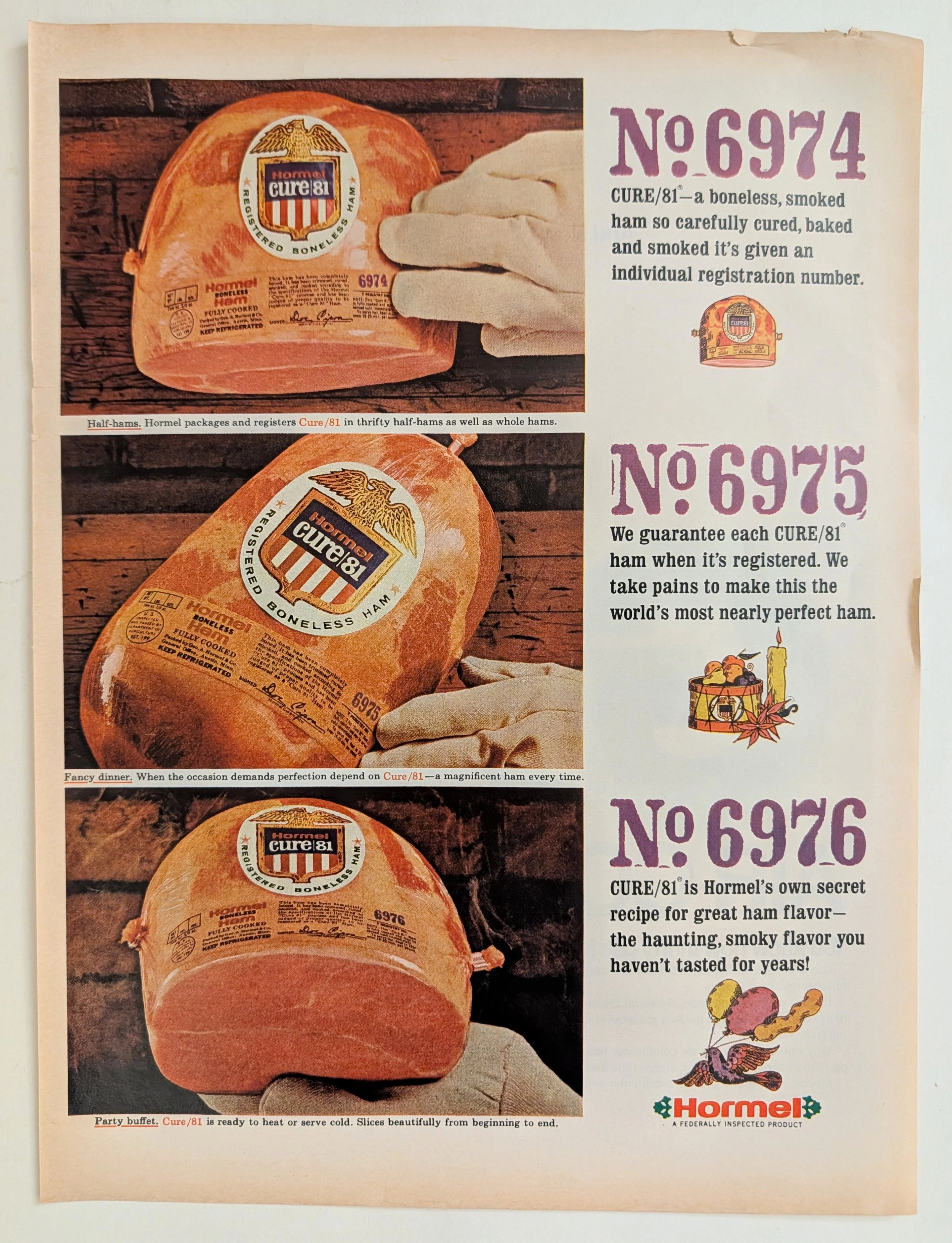
Circa 1960s Hormel Cure 81 Registered Ham Vintage Print Advertisement Published during the mid-century culinary boom, this vintage advertisement for Hormel Cure/81 introduces a novel concept in mass-market food production: the individually registered, premium ham. Emphasizing meticulous craftsmanship and guaranteed quality, the campaign elevated a standard dinner staple into a luxury dining experience, complete with white-glove treatment. Introduced in 1963, the Hormel Cure/81 ham represented a revolutionary step in the American meatpacking industry. During an era when post-war convenience foods were rapidly expanding and the middle class was heavily focused on domestic entertaining, Hormel sought to carve out a highly specific, premium niche. This advertisement brilliantly communicates the brand's unique selling proposition: treating a mass-produced packaged ham with the meticulous reverence of a bespoke, artisanal product. The striking visual of the ham being handled by pristine, white-gloved hands instantly conveys premium quality, rigorous inspection, and utmost care. The structural core of the campaign is the "registration number" (prominently highlighted as No. 6974, 6975, and 6976). By assigning an individual registry number to every ham and including the printed signature of the "Curemaster" (Don Cipra), Hormel created a powerful aura of exclusivity. The ad copy explicitly states, "We guarantee each CURE/81 ham when it's registered. We take pains to make this the world's most nearly perfect ham." This messaging directly targeted the mid-century American hostess who desired reliability and prestige for "fancy dinners" and "party buffets," ensuring her culinary efforts would not be undermined by an inferior centerpiece. Visually, the advertisement employs a warm, rustic color palette, contrasting the rich, glazed orange-reds of the smoked meat against a dark, textured brick background. The typography cleverly blends modern, clean sans-serif fonts with decorative, woodtype-style antique numerals. This typographical choice visually bridges the gap between modern mid-century convenience (boneless, fully cooked, thrifty half-hams) and old-world, traditional smoking recipes. By blending these elements, Hormel successfully transformed the Cure/81 from a simple grocery commodity into a coveted status symbol of domestic success.

Paper & Print Condition

Printed on standard mid-century magazine stock. The paper shows mild, natural toning along the perimeter, indicative of its age. The color registration of the halftone lithography is excellent, accurately capturing the glistening texture of the ham, the stark white of the gloves, and the deep, contrasting tones of the brick background without noticeable fading.

Provenance & Rarity

Recovered from a mainstream American lifestyle or women's interest magazine from the 1960s. While vintage food advertisements are plentiful, campaigns that utilize "registration" and serial numbers as a marketing gimmick for grocery items are highly distinct and sought after by culinary historians analyzing mid-century consumer psychology.

Rarity & Condition Summary

A perfectly preserved culinary artifact. This advertisement serves as a prime example of mid-century corporate efforts to introduce luxury positioning into everyday supermarket staples.
Share This Archive

From the Journal

Related Articles

The Time Traveller's Dossier: The Anatomy of a Commodity – Chiquita's "How to read a banana" and the Invention of Produce Branding — related article
Read Article

The Time Traveller's Dossier: The Anatomy of a Commodity – Chiquita's "How to read a banana" and the Invention of Produce Branding

The evolution of the mid-twentieth-century American supermarket was defined by the rapid transition from bulk, unbranded agricultural goods to highly packaged, fiercely differentiated consumer brands. The historical artifact elegantly and securely positioned upon the analytical table of The Record Institute today is a striking, full-page print advertisement for Chiquita Brand Bananas, originating from the late 1960s. This document completely transcends the standard boundaries of grocery marketing. It operates as a highly sophisticated, multi-layered cultural mirror, reflecting the precise era when the United Fruit Company utilized educational infographics to train the American housewife to perceive natural biological traits as engineered markers of exclusive quality. This world-class, comprehensive dossier conducts a meticulous, unyielding, and exceptionally exhaustive examination of the artifact, operating under the absolute most rigorous parameters of historical, sociological, and material science evaluation. Dedicating the overwhelming majority of our analytical focus to its immense historical gravity, we will decode the brilliant marketing psychology embedded within the "How to read a banana" campaign, analyze the immense sociopolitical weight of the United Fruit Company, and dissect the profound visual semiotics of the blue Chiquita sticker. Furthermore, as we venture deeply into the chemical and physical foundations of this analog printed ephemera, we will reveal the precise mechanical fingerprints of the CMYK halftone rosettes captured in the macro imagery of the fruit's peel. Finally, we will assess its archival rarity, exploring how the graceful, natural oxidation of the paper substrate cultivates a serene wabi-sabi aesthetic—a natural, irreversible phenomenon that serves as the primary engine driving up its market value exponentially within the elite global spheres of Vintage Commercial Ephemera and Advertising Archives.

The Time Traveller's Dossier: The Masquerade of Quality – Nabisco's 1968 Ritz "Can't Disguise" Campaign and the Golden Age of Snack Branding — related article
Read Article

The Time Traveller's Dossier: The Masquerade of Quality – Nabisco's 1968 Ritz "Can't Disguise" Campaign and the Golden Age of Snack Branding

The evolution of the twentieth-century American pantry was fundamentally defined by the rise of standardized, nationally recognized "anchor" brands. The historical artifact elegantly positioned upon the analytical table of The Record Institute today is a striking full-page advertisement for Ritz Crackers, originating from 1968. This document represents a pivotal era in consumer psychology where snack foods were repositioned from simple staples to creative culinary canvases. By utilizing playful, anthropomorphic food art—crackers "disguised" as whimsical faces—Nabisco sought to reassure a burgeoning suburban middle class of the cracker's unmistakable "buttery" identity regardless of how it was "dressed up" for social gatherings. This comprehensive dossier conducts a meticulous examination of the artifact, operating under the absolute most rigorous parameters of historical and material science evaluation. We will decode the brilliant marketing psychology of the "Quality in Our Corner" slogan, analyze the profound sociopolitical impact of standardized grocery branding in the late 1960s, and dissect the mechanical fingerprints of the CMYK halftone rosettes captured in macro imagery. Finally, we will assess its archival rarity, exploring how the graceful, natural oxidation of the paper substrate serves as the primary engine driving up its market value exponentially within elite collection circles.

The Time Traveller's Dossier: The Architecture of Slumber – The 1967 Simmons Golden Value — related article
Read Article

The Time Traveller's Dossier: The Architecture of Slumber – The 1967 Simmons Golden Value

The evolution of the American domestic interior during the mid-twentieth century was heavily influenced by the golden age of travel and the rapid expansion of the luxury hospitality industry. The historical artifact elegantly secured upon the analytical table of The Record Institute today is a large-format, two-page centerfold print advertisement for the Simmons Mattress Company, copyrighted in 1967. This document transcends standard consumer goods marketing; it operates as a sophisticated sociological mirror, reflecting a highly specific moment when industrial sleep engineering and the aspirational luxury of the modern hotel were explicitly packaged and sold to the suburban American household. This world-class, comprehensive dossier conducts a meticulous, profound, and historically objective examination of the artifact, operating under the absolute most rigorous parameters of sociological and material science evaluation. We will decode the brilliant marketing psychology embedded within the "First Public Sale" messaging, analyze the iconic "Good Housekeeping" endorsement, and dissect the rich semiotics of the heraldic quilt patterns alongside the modernist architectural illustrations. Furthermore, as we venture deeply into the chemical and physical foundations of this analog printed ephemera, we will reveal the precise mechanical fingerprints of the CMYK halftone rosettes and the graceful, natural oxidation of the paper substrate. This precise intersection of visual nostalgia, mid-century commercial artistry, and the immutable chemistry of time cultivates a serene wabi-sabi aesthetic—a natural, irreversible phenomenon that serves as the primary engine driving up its market value exponentially within the elite global spheres of Vintage Commercial Ephemera and Mid-Century Lifestyle Archives collecting.

The Time Traveller's Dossier: The Zenith of the American Living Room – Admiral Rectangular Color TV — related article
Read Article

The Time Traveller's Dossier: The Zenith of the American Living Room – Admiral Rectangular Color TV

The evolution of the American domestic interior during the mid-twentieth century was fundamentally redefined by the introduction and subsequent democratization of color television. The historical artifact elegantly and securely positioned upon the analytical table of The Record Institute today is a majestic, full-page print advertisement for Admiral Color TV, originating from the transitional technological era of the late 1960s. This document completely transcends the traditional boundaries of consumer electronics marketing. It operates as a highly sophisticated, multi-layered cultural and historical mirror, reflecting the exact moment when the magic of color broadcasting collided with the rigorous aesthetic demands of suburban domestic styling on a single printed page. This world-class, comprehensive dossier conducts a meticulous, unyielding, and exceptionally deep examination of the artifact, operating under the absolute most rigorous parameters of historical, sociological, and material science evaluation. With our analytical focus dedicated heavily to its historical gravity, we will decode the brilliant marketing psychology embedded within the "rectangular" tube innovation, analyze the space-age luxury of the "Sonar" remote control, and dissect the rich semiotics of disguised technology through "genuine walnut veneers". Furthermore, as we venture deeply into the chemical and physical foundations of this analog printed ephemera, we will reveal the precise mechanical fingerprints of the CMYK halftone rosettes and the graceful, natural oxidation of the paper substrate. This precise intersection of visual nostalgia, mid-century commercial artistry, and the immutable chemistry of time cultivates a serene wabi-sabi aesthetic—a natural, irreversible phenomenon that serves as the primary engine driving up its market value exponentially within the elite global spheres of Vintage Commercial Ephemera, Consumer Electronics Archives, and Mid-Century Lifestyle collecting.