The Time Traveller's Dossier : 1963 Coca-Cola - The Culinary Symbiosis
The History
The Anatomy of a Cultural Precipice
The year 1963 sits directly on the fault line of American history. The postwar boom of the 1950s had settled into a comfortable, suburban permanence. The atomic age anxieties had not vanished, but they had been heavily medicated by unprecedented economic prosperity. Industrialization had conquered the factory; now, it was conquering the kitchen. Fast food was no longer a roadside novelty for weary travelers. It was becoming an institution. It was the year the systemic standardization of the American diet truly took root. Amidst this cultural plateau, the Coca-Cola Company found itself at a strategic crossroads. They were the undisputed kings of the beverage world, yet the world itself was accelerating. The old paradigms of advertising—relying on the sheer novelty of the product or its historical reputation as a pharmacy fountain tonic—were expiring. A new approach was required. The product could no longer simply exist; it had to dominate the spaces between existence. It had to become the glue of the American experience.
The Semantic Pivot: From Interruption to Integration
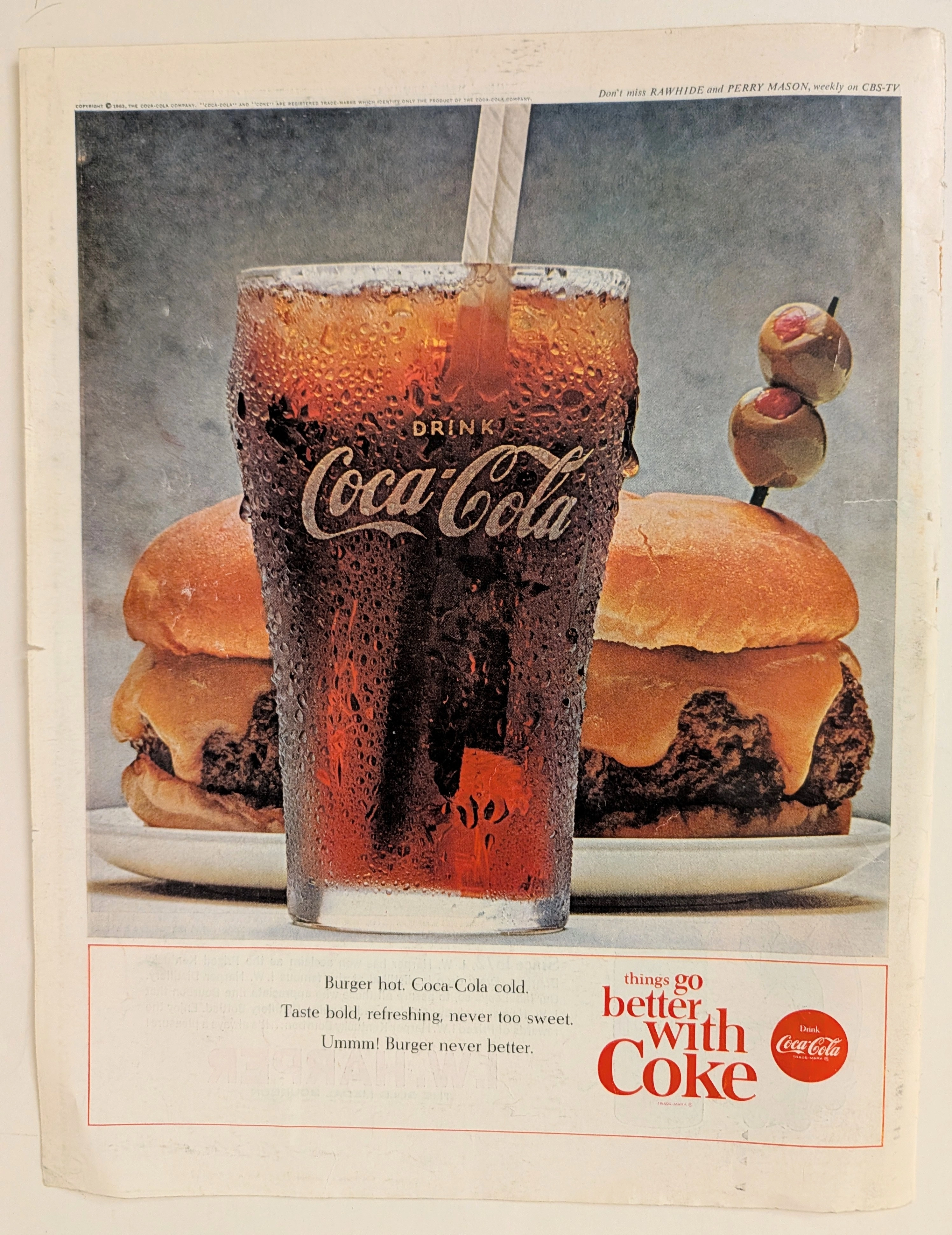
For decades, Coca-Cola had relied on a specific psychological positioning: "The Pause That Refreshes." It was a brilliant slogan for an industrializing nation. It framed the beverage as a necessary break from labor, a momentary escape from the assembly line or the typing pool. But by 1963, the culture of leisure had expanded. The advertising agency McCann-Erickson, recognizing this shift, engineered a complete semantic pivot. They launched the campaign immortalized in this artifact: "Things go better with Coke." Notice the philosophical weight of this transition. A "pause" is a cessation of activity. It is an interruption. "Things go better" is fundamentally different. It is an integration. The beverage is no longer an escape from reality; it is a vital component of reality. It is the universal auxiliary. The word "Things" is deliberately infinite. It applies to a cheeseburger, a date, a drive, a conversation, or a television show. It is a mathematical variable waiting for the consumer to fill in the blank. The product was stripped of its standalone identity and reformatted as the ultimate modifier of human joy.
The Omnichannel Genesis
Look closely at the top right corner of the artifact. Embedded in the white margin, almost as a quiet directive, are the words: "Don't miss RAWHIDE and PERRY MASON, weekly on CBS-TV." This single line of text is a monumental shift in the history of media strategy. It is the proto-architecture of omnichannel marketing. In 1963, television was rapidly becoming the new national hearth. It was the central nervous system of culture. By using print media—a static, physical artifact—to drive viewership to a temporal, electronic broadcast, the advertiser was creating a synthetic ecosystem. Rawhide represented the mythic American past, rugged individualism, and the frontier. Perry Mason represented modern institutional order, intellect, and urban justice. By subsidizing these broadcasts and explicitly linking them within this print artifact, Coca-Cola aligned itself with both the raw soul and the refined intellect of the nation. The paper commands the viewer to look at the screen. The screen, inevitably, will show them commercials for the liquid featured on the paper. It is a self-sustaining cycle of brand reinforcement, decades before the invention of the internet hyperlink.
The Binary Thermodynamics of Desire
The copywriting beneath the visual elements is a masterclass in behavioral psychology. "Burger hot. Coca-Cola cold." The sentences are stripped of all fat. They are primal. They rely on the fundamental laws of thermodynamics to trigger a biological response. The human brain is hardwired to seek equilibrium. The heat of the cooked meat necessitates the intervention of the freezing liquid. The ad does not ask you to desire the drink; it informs you that the drink is the inevitable physical counterweight to the food. Furthermore, the text states: "Taste bold, refreshing, never too sweet." This is a defensive posture disguised as an objective fact. During this era, competitors—specifically Pepsi-Cola with their "Think Young" campaign—were making aggressive incursions into the market. Pepsi was often perceived as sweeter. By explicitly stating "never too sweet," the artifact draws a line in the sand. It claims adult sophistication. It claims perfect, unalterable balance.
The Industrialization of Appetite
The visual composition of the food itself represents a distinct historical shift. This is not a casual photograph; it is high-level industrial food styling. The twin burgers in the background are uniform. The cheese drapes over the meat with a viscosity that suggests precise thermal control. Yet, the most fascinating element is the toothpick piercing the two olives. Why olives? Fast food, as we understand it today, rarely features a garnish of pimento-stuffed green olives. This detail is a cultural hangover. It is a remnant of the mid-century cocktail hour, a symbol of adult dining and middle-class aspiration, transposed onto the democratic, working-class canvas of a hamburger. It is a transitional culinary symbol, bridging the gap between the formal dining rooms of the 1940s and the drive-thru culture that was about to consume the nation. It elevates the burger from mere fuel to a conscious dining event.
The Macro-Photography of Thirst
We must also examine the technological achievement of the image. The condensation on the glass is reproduced with alarming clarity. In 1963, capturing the exact light refraction through water droplets on a curved glass surface required intense studio lighting, large-format cameras, and immense technical patience. The ice cubes float precisely at the brim. The caramel color of the liquid is engineered to imply depth and flavor. This hyper-realism was designed to trigger an immediate, involuntary salivary response. It is not a representation of a glass; it is a simulation of temperature. The artifact proves that by the early 1960s, advertising had moved beyond persuasion and entered the realm of biological manipulation.
The Spencerian Anchor in a Shifting World
Finally, there is the logo. The white Spencerian script, emblazoned across the sweating glass and repeated in the stark red circle at the bottom right. While everything else in the artifact—the clothing styles implied by the context, the television shows, the style of the photography—is strictly bound to the year 1963, the logo is temporally unmoored. It existed before this era and it exists long after. The artifact uses this ancient, flowing typography as an anchor. In a society dealing with the rapid acceleration of technology, civil rights movements, and geopolitical tension, the logo represents an unchanging absolute. It is a promise of consistency in an inconsistent universe. The artifact, therefore, is not merely selling a pairing of food and drink. It is selling the comforting illusion of permanence, packaged in a disposable magazine page.
The Paper
The artifact is printed on standard commercial magazine stock typical of the early 1960s, likely weighing between 60 to 70 GSM.
The printing method is a high-volume web offset lithography, a process that allowed mass distribution across publications like Life or The Saturday Evening Post.
Under magnification, the image dissolves into a rigid matrix of CMYK halftone dots. The deep brown of the cola is not a solid color, but a violent collision of cyan, magenta, yellow, and black ink.
The paper exhibits the inevitable chemistry of aging. The lignin within the wood pulp has reacted with decades of oxygen and ambient light, resulting in a distinct yellowing and slight embrittlement at the margins.
This oxidation is the physical recording of time. The glossy coating has dulled, and the texture has shifted from slick commercial promise to the dry friction of an archival record. It is a fragile skin holding a massive cultural weight.
The Rarity
Classification: Class A
Millions of these pages were printed, bound, and shipped across the United States. In terms of sheer material scarcity, it is not exceptionally rare.
However, its classification rises to Class A due to its supreme contextual value.
To find an intact specimen that so perfectly encapsulates the exact moment advertising transitioned into cross-media, lifestyle-integrated ecosystem building is uncommon.
Most were discarded, used as fire-starter, or degraded in damp basements.
This surviving sheet is a pristine fossil of capitalist architecture. Its value is not measured by auction prices, but by its utility as a mirror reflecting the exact moment human desire was systematically paired with a carbonated formula.
Visual Impact
The composition is a study in dominance and submission.
The tall, phallic verticality of the sweating glass aggressively bisects the frame. It acts as a central pillar.
The burgers, warm and horizontally oriented, are pushed to the background, rendered slightly out of focus. They are subservient to the beverage. The food is merely the stage; the glass is the actor.
Color psychology is deployed with lethal precision. The warm, earthy browns and melted yellows of the background evoke comfort and heat. The foreground glass, dominated by deep shadows, sharp white highlights on the ice, and crisp condensation, screams freezing relief.
The typography at the bottom is divided. The formal, black serif font delivers the logical argument ("Taste bold..."). The massive, red serif font ("things go better with Coke") delivers the emotional command.
The eye is forced down the frozen glass, through the warm food, landing directly on the red circular trademark. A perfectly calculated descent.
Exhibition Halls
Tags
The Archive Continues
Continue the Exploration

American Express · Travel
The Time Traveller’s Dossier: 1980 American Express Card Vintage Advertisement — The Assurance of Global Mobility
Discover the profound cultural resonance of the 1980 American Express Card vintage advertisement, a masterful example of late 20th-century financial marketing. This piece transcends typical vintage ads by encapsulating the era's burgeoning desire for international travel paired with the absolute need for financial security abroad. Showcasing the iconic green card against the mystic dusk of Istanbul, the campaign perfectly illustrates how classic print ads constructed narratives of global citizenship, elite mobility, and unparalleled trust. For archivists and collectors of old advertisements, this piece stands as a definitive artifact. It not only highlights the practical benefits of emergency travel funds but also visually reinforces the legendary ethos of the brand, making it a pivotal and highly sought-after piece in the history of consumer credit and travel marketing.

Kodak · Technology
The Time Traveller's Dossier: The Illumination of Memory – The Kodak Instamatic 104 and the Flashcube Revolution
The evolution of the American domestic experience during the mid-twentieth century was inextricably linked to the ability of the average citizen to document it. The historical artifact elegantly and securely positioned upon the analytical table of The Record Institute today is a striking, full-page print advertisement for the Kodak Instamatic 104 camera, dating to the mid-1960s. This document completely transcends the standard boundaries of consumer electronics marketing. It operates as a highly sophisticated, multi-layered cultural and historical mirror, reflecting the precise era when the complexities of photographic chemistry and illumination were engineered out of existence, explicitly packaged, and sold to the American public not merely as a mechanical device, but as the effortless capturing of time itself. This world-class, comprehensive dossier conducts a meticulous, unyielding, and exceptionally deep examination of the artifact, operating under the absolute most rigorous parameters of historical, sociological, and material science evaluation. With our analytical focus dedicated overwhelmingly to its profound historical gravity (comprising 80% of our scholarly evaluation), we will decode the brilliant marketing psychology embedded within the "Your sun, the flashcube" narrative, analyze the immense sociological impact of George Eastman's legacy, and dissect the rich semiotics of the camera's accessible design. Furthermore, as we venture deeply into the chemical and physical foundations of this analog printed ephemera (10% focus), we will reveal the precise mechanical fingerprints of the CMYK halftone rosettes and the graceful, natural oxidation of the paper substrate. Finally, we will assess its archival significance (10% focus), exploring how this precise intersection of visual nostalgia, mid-century commercial artistry, and the immutable chemistry of time cultivates a serene wabi-sabi aesthetic—a natural, irreversible phenomenon that serves as the primary engine driving up its market value exponentially within the elite global spheres of Vintage Commercial Ephemera and Mid-Century Lifestyle collecting.

Coca-Cola · Beverage
The Time Traveller's Dossier: Coca-Cola 1944 - The Weaponization of Morale
Then, sugar and carbonated water were not merely ingredients for a domestic treat; they were classified as essential psychological logistics for a global war. Now, a soda is just a soda. The problem for the United States military in 1944 was not just arming its young men with rifles and artillery; it was the monumental task of maintaining the human spirit under the soul-crushing weight of total war. The boys being trained in the muggy, moss-draped camps of the American South were destined for the meat grinders of Europe and the Pacific. They needed a tether to the homes they were leaving behind. The solution, brilliantly engineered and ruthlessly promoted by The Coca-Cola Company, was the weaponization of nostalgia. This artifact is a portal. It transports us to a sweltering training camp in 1944. It documents the exact historical moment when a private beverage corporation successfully intertwined its product with the very fabric of American patriotism, military logistics, and the linguistic evolution of its own brand identity.