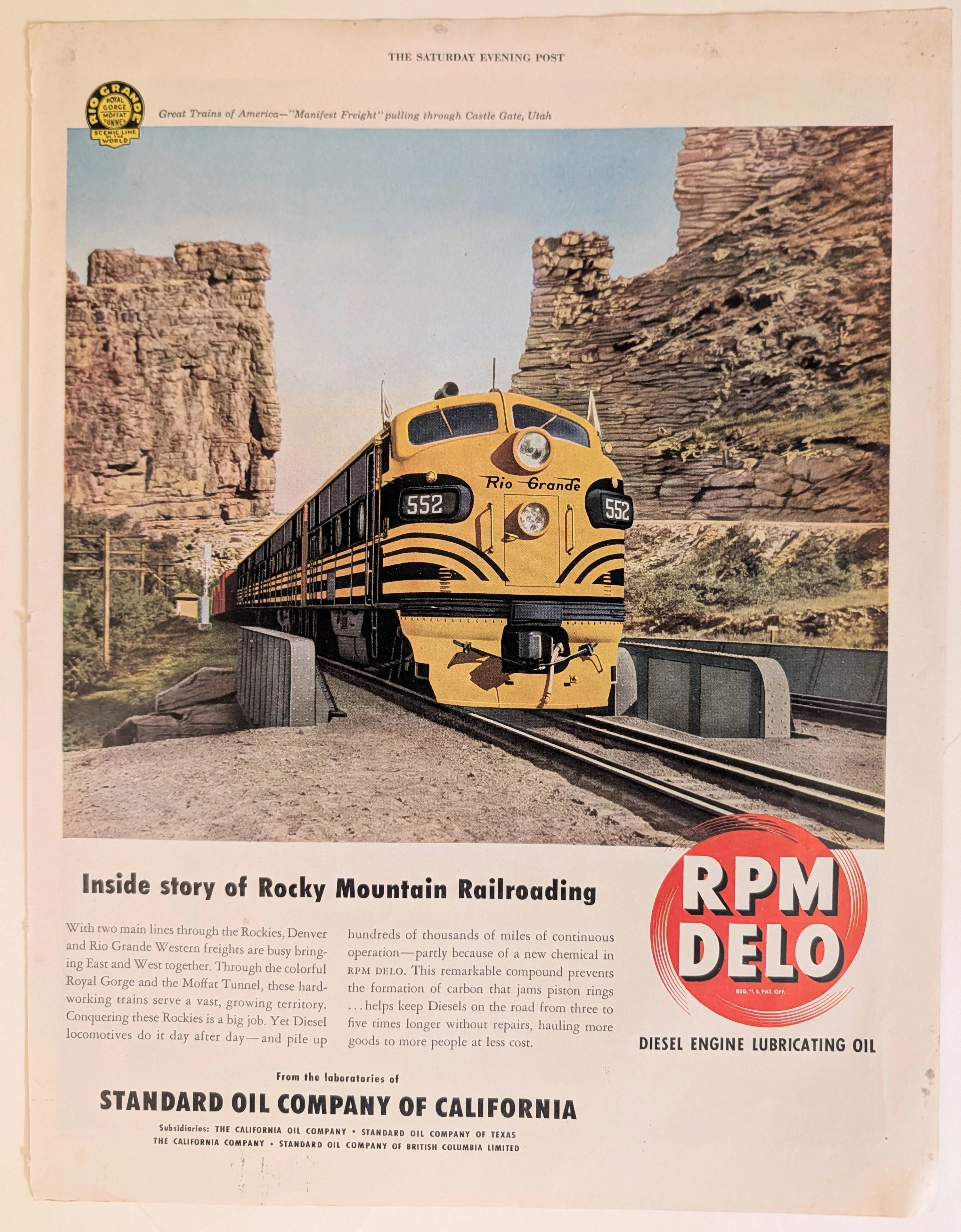
1949 Rio Grande Train & RPM DELO Oil Vintage Advertisement
1949 Rio Grande Train & RPM DELO Oil Vintage Advertisement In the decade immediately following World War II, a profound technological revolution reshaped American heavy industry: the dieselization of national railroad networks. This transition, moving away from the iconic but inefficient steam locomotive, was essential for the rapid industrial expansion of post-war America. This color advertisement for RPM DELO, a product of the Standard Oil Company of California, directly addresses this critical moment. It positions lubrication chemistry not as an afterthought, but as the essential enabler of this industrial modernization. The Rio Grande railroad, particularly its routes through the Rocky Mountains (the "Scenic Line of the World"), presented unique and brutal operational challenges. High-altitude mountain grades and extreme temperatures demanded lubricants that could withstand immense thermal and physical stress. The ad copy makes this distinction clear, explaining the "inside story of Rocky Mountain Railroading" and contrasting the performance required for massive freight haulers against passenger service. RPM DELO is touted as the "remarkable compound that prevents formation of carbon that jams piston rings" and "helps keep Diesels on the road from three to five times longer without repairs." Standard Oil's marketing is highly sophisticated. They present the product through a stunning, color-photolithographic illustration that leverages the allure of powerful diesel locomotives and awe-inspiring natural scenery. Yet, the text remains grounded in engineering and chemical science, directly appealing to industrial purchasers. By featuring a Rio Grande train—a railway known for its demanding terrain—the ad provides a gold-standard endorsement. Standard Oil wasn't just selling oil; they were selling "reliability and massive-tonnage hauling capacity" for the heavy industrial future.
Category: Automotive Parts
Year: 1949
Rarity Class: B
Paper & Print Condition
Printed on standard mid-century magazine stock. The paper exhibits a mild, warm toning consistent with the natural aging of late-1940s publications. The full-color lithographic ink remains vibrant and structurally sound, particularly the striking yellow of the locomotive and the bold red RPM DELO emblem, offering excellent contrast against the canyon backdrop.
Provenance & Rarity
Originally removed from an edition of The Saturday Evening Post. While consumer-facing ads from this era are common, highly detailed, full-page B2B (business-to-business) industrial advertisements featuring specific railroad lines are significantly scarcer and highly prized by railway historians and petroleum industry collectors.
Rarity & Condition Summary
A beautifully preserved specimen of post-war industrial advertising. It holds immense archival value by visually documenting the historic partnership between the demanding Rio Grande railway network and Standard Oil's lubrication technology.