The Time Traveller’s Dossier: 1980 American Express Card Vintage Advertisement — The Assurance of Global Mobility — The Record Institute JournalThe Time Traveller’s Dossier: 1980 American Express Card Vintage Advertisement — The Assurance of Global Mobility — The Record Institute JournalThe Time Traveller’s Dossier: 1980 American Express Card Vintage Advertisement — The Assurance of Global Mobility — The Record Institute Journal
1 / 3

✦ 3 Photos — Click any image to view in high resolution

March 28, 2026

The Time Traveller’s Dossier: 1980 American Express Card Vintage Advertisement — The Assurance of Global Mobility

TravelBrand: American Express
Archive Views: 3
Heritage AdvertisementsTravel & Tourism

The History

The Dawn of Democratized Global Travel and the Psychology of Displacement
To fully grasp the cultural weight of this 1980 American Express campaign, one must examine the socio-economic landscape of the late 1970s and early 1980s. Following the Airline Deregulation Act of 1978 in the United States, the aviation industry experienced a seismic shift. International travel, once the exclusive domain of diplomats, the ultra-wealthy, and jet-set elites, became increasingly accessible to the upper-middle class and the traveling corporate executive. The skies opened up, and exotic destinations that previously existed only in the pages of National Geographic became viable vacation spots.

However, this newfound global mobility carried an inherent psychological tax: the profound anxiety of displacement. In an era decades before the advent of the internet, smartphones, instantaneous digital banking, and global cellular networks, traveling abroad meant untethering oneself from all local safety nets. To lose your wallet in a foreign city in 1980 was not merely an inconvenience; it was an existential crisis. It meant navigating language barriers, complex and often predatory currency exchange markets, and the terrifying prospect of being stranded without recourse.

American Express understood this psychological undercurrent with clinical precision. The headline of the advertisement, "All you need to get emergency funds where they don't know you," taps directly into the primal fear of anonymity and helplessness in a foreign land. It does not sell credit; it sells the promise of institutional salvation.

American Express as a Sovereign Financial Entity
During this period, American Express was actively distancing itself from being perceived merely as a bank or a credit facility. Instead, the brand positioned itself as a global infrastructure—a quasi-sovereign entity whose power superseded local borders. The advertisement's body copy reveals the mechanics of this infrastructure, highlighting the network of "more than 1,000 Travel Service Offices."

For the American traveler, these offices functioned as commercial embassies. If catastrophe struck, the traveler could find sanctuary within these walls. The ad details the exact mechanics of this salvation: the ability to acquire up to "$1,000, with $200 of it in cash, and the balance in Travelers Cheques." This specific financial breakdown is a fascinating artifact of 1980s economic reality. Two hundred dollars in physical cash provided the immediate liquidity required for taxis, meals, and local tipping in developing economies, while the eight hundred dollars in Travelers Cheques provided a secure, universally accepted medium of exchange to settle hotel bills or purchase emergency return flights. American Express was marketing an entire ecosystem of survival.

The Semiotics of the Exotic: Istanbul at Dusk
The visual genius of this advertisement lies in its background plate—a deeply atmospheric, low-light photograph of Istanbul. From a semiotic perspective, the choice of Istanbul is masterfully calculated. To the Western consumer of 1980, Istanbul represented the ultimate intersection of the exotic, the historic, and the unknown. As the literal bridge between Europe and Asia, it is a city of profound beauty and staggering complexity.

The photograph captures the city at dusk, likely showing the silhouettes of the grand Ottoman-era mosques (such as the Yeni Cami or Süleymaniye) and the bustling waterways of the Golden Horn or the Bosphorus. The lighting is crucial: it is cast in moody, mysterious blues and purples, punctuated by the warm, glittering reflections of city lights bleeding into the water. This represents the "unknown" mentioned in the headline. It is breathtakingly beautiful, yet inherently intimidating. The dusk setting implies the approach of night, a time when vulnerability increases and the familiar becomes foreign. It is the perfect visual representation of "where they don't know you."

The Talismans of Western Affluence in the Foreground
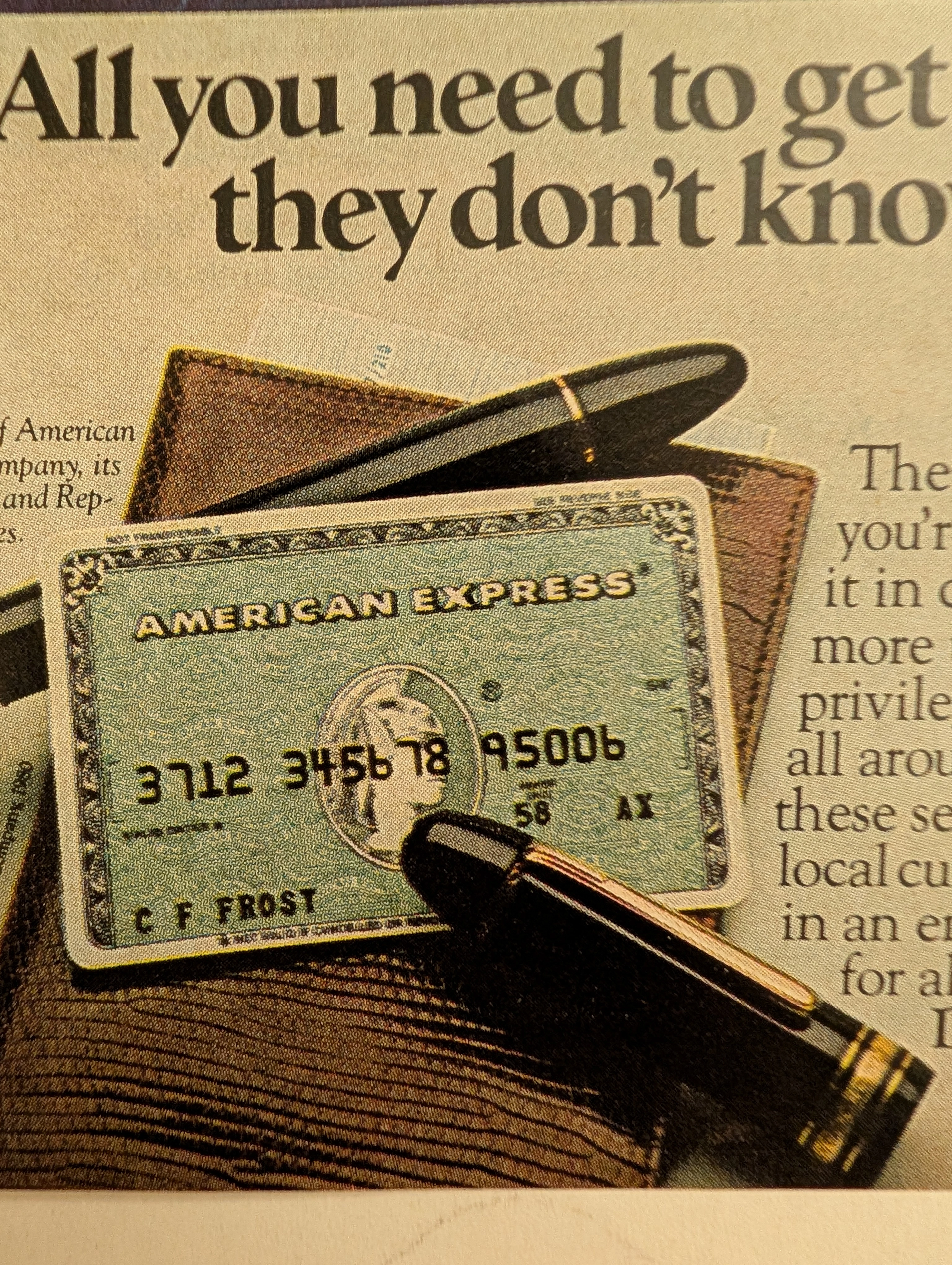
In violent, deliberate contrast to the mysterious and slightly chaotic backdrop of the foreign metropolis, the foreground of the advertisement is brightly lit, razor-sharp, and meticulously ordered. Here, resting on the textured leather of a premium wallet, lies the American Express Green Card (bearing the legendary placeholder name, C. F. Frost) alongside a high-end, gold-nibbed fountain pen.

These objects are not merely props; they are talismans of Western capitalism and affluence. The fountain pen suggests business, contracts, and authority. The leather wallet implies wealth and organization. And at the center of it all is the Green Card. The art direction uses a shallow depth of field to ensure the card remains the absolute focal point. It bridges the gap between the beautiful chaos of the foreign city and the structured safety of the traveler's home reality. The card is presented as an anchor—a singular piece of embossed plastic that commands respect and guarantees safety across the globe.

The Evolution of "Don't Leave Home Without It"
Finally, this advertisement serves as a vital chapter in the evolution of one of the most successful advertising slogans in history: "Don't leave home without it." Conceived in 1975 by the Ogilvy & Mather agency, the slogan was initially driven by television commercials featuring actor Karl Malden, who sternly warned viewers of the perils of traveling without American Express Travelers Cheques.

By 1980, as seen in this print campaign, the brand had evolved the narrative. They no longer needed a celebrity spokesperson to instill a sense of urgency. The imagery and the concept did the heavy lifting. The slogan, quietly placed at the bottom right corner alongside the corporate logo, had transitioned from a warning into a fundamental truth of international travel. This advertisement represents the maturation of the campaign, moving from direct television admonishments to sophisticated, cinematic print storytelling that appealed directly to the aspirations and anxieties of the global citizen.

The Paper

From an archival conservation standpoint, the physical artifact of this advertisement provides a textbook example of late-20th-century mass-market periodical printing.

Substrate Chemistry: The piece is printed on standard, lightweight coated magazine stock typical of 1980. This paper blend heavily utilized mechanical wood pulp, which inherently contains high levels of lignin. Over four decades, the exposure to ultraviolet light and atmospheric oxygen has triggered lignin oxidation. This is distinctly visible along the extreme margins of the page, where the paper has developed a warm, sepia-toned yellowing, commonly referred to in archival circles as "foxing" or acid burn.

Print Technology: The artifact utilizes four-color (CMYK) offset lithography. The most remarkable aspect of this specific print is its ink density and retention. To achieve the deep, brooding atmospheric blues and purples of the Istanbul skyline, the printers had to lay down significant amounts of cyan and key (black) ink. Despite the degradation of the paper's edges, the core image retains its saturation beautifully.

Halftone Precision: Furthermore, the registration of the halftone dots remains impeccably tight. This is most evident in the foreground elements; the iconic "Signature Green" of the American Express card, the gold foil stamping of the logo, and the sharp, legible embossing of the "3712" account number and the name "C F FROST" demonstrate the high tolerances maintained by premium magazine publishers of the era.

The Rarity

While millions of magazines were printed in 1980, locating financial ephemera from this exact period in museum-grade, display-worthy condition presents a significant challenge to archivists and collectors.

Survival Rates of Financial Marketing: The scarcity is largely driven by consumer behavior. Historically, collectors of vintage paper have prioritized aesthetic or hobbyist subjects—classic automotive advertisements, high fashion spreads, or iconic movie memorabilia. Advertisements concerning credit facilities, banking, or travel insurance were overwhelmingly viewed as utilitarian clutter and were consequently discarded.

A Transitional Economic Artifact: This specific piece commands a premium due to its historical context. It captures a fleeting, transitional moment in global finance: the era where paper-based Travelers Cheques were still heavily relied upon (as explicitly detailed in the ad copy's $800 cheque breakdown), yet the plastic Charge Card was rapidly ascending as the primary symbol of financial identity.

Institutional Value: In today's antiquarian market, this advertisement transcends mere nostalgia. It is highly valued by institutions focusing on economic history, the evolution of global tourism, and graphic design archives studying the legendary Ogilvy & Mather campaigns. It is a pristine record of how trust and credit were commodified and marketed at the dawn of the modern globalized economy.
Visual Impact

The visual impact is rooted in a masterful application of high-contrast semiotics. The composition deliberately splits the viewer's psychological state. The background—a sweeping, low-light, grainy photograph of an exotic city—induces a sense of awe mixed with mild trepidation. It is vast and uncontrollable. Conversely, the foreground is intensely sharp, brilliantly lit, and perfectly ordered, focusing on the tactile textures of leather, gold, and embossed plastic. This visual dichotomy effortlessly guides the viewer to the intended emotional conclusion: the world is wildly unpredictable, but the American Express card is an absolute certainty. The classic serif typography further grounds the imagery, lending an authoritative, institutional voice to the brand's promise.

Share This Archive

The Archive Continues

Continue the Exploration

The Time Traveller's Dossier: The Aesthetics of Gifting and Consumer Hypnosis – Skyway Luggage Advertisement (Circa 1950s)

Sky Way · Travel

The Time Traveller's Dossier: The Aesthetics of Gifting and Consumer Hypnosis – Skyway Luggage Advertisement (Circa 1950s)

The history of commercial marketing is rarely driven by cold, rational logic; it is forged, molded, and dictated through the weaponization of emotion, manufactured desire, and the carefully engineered magic of the holiday season. Long before digital algorithms were deployed to predict and manipulate our purchasing behaviors, social engineering and consumer psychology were executed with devastating precision through the tip of a master illustrator’s brush on the pages of glossy magazines. The historical artifact standing before us is not merely a run-of-the-mill mid-century holiday campaign for a luggage brand. It is an absolute visual "Trojan Horse"—one of the most cunningly designed blueprints ever utilized to bypass the consumer's psychological defenses. It serves as an unwavering testament to an era when the stark, industrial rigidity of manufactured goods was brilliantly concealed beneath the irresistible wrapping paper of festive innocence. ​This museum-grade academic archival dossier presents an exhaustive, uncompromising deconstruction of a late-analog print advertisement from Skyway Luggage. Operating on a ruthlessly calculated, gender-segregated binary narrative structure, this campaign captures a critical paradigm shift: the exact historical moment when luggage transcended its utilitarian status as a mere "storage box" and was conceptually elevated into a highly coveted "dream Christmas gift." Through the highly specialized lens of mid-century commercial artistry and stringent visual forensics, this document serves as a masterclass in the psychological marketing of manufactured desire. It established the foundational archetype for the holiday retail economy—an archetype that unconditionally dictates the global lifestyle merchandising strategies of today.

The Final Glimpse of a Legend: The History Behind Marilyn Monroe's Last Nude

The Final Glimpse of a Legend: The History Behind Marilyn Monroe's Last Nude

Uncover the profound historical significance of the ultimate photograph of the 20th century's greatest pop culture icon, captured by Leif-Erik Nygårds just weeks before her tragic death.

THE TIME TRAVELER'S DOSSIER: THE ILLUSION OF FRAGILITY AND THE ARCHITECTURE OF 60S BEAUTY

THE TIME TRAVELER'S DOSSIER: THE ILLUSION OF FRAGILITY AND THE ARCHITECTURE OF 60S BEAUTY

The artifact under rigorous, museum-grade analysis is a breathtaking, meticulously preserved Double-Page Historical Relic originating from the glamorous, highly engineered world of early 1960s American publishing. It features a sweeping, visually arresting advertisement for Revlon's "Touch & Glow" creme soufflé makeup. ​This Primary Art Document is not merely a cosmetic promotion; it is a profound sociological blueprint of mid-century feminine ideals. The ad's commanding copy, declaring makeup for "today's fair and fragile face," perfectly encapsulates the era's prescribed aesthetic: an aristocratic, porcelain delicacy juxtaposed with the striking, graphic eye makeup synonymous with the early 1960s. ​Crucially, this artifact documents the absolute genius of Charles Revson’s psychological marketing. By explicitly styling the model with "JEWELS BY VAN CLEEF & ARPELS" (as verified by the microscopic credit in the bottom right corner and the exquisite pearl/diamond earring), Revlon brilliantly anchored its accessible consumer cosmetics to the highest echelons of European haute joaillerie. ​Rescued from the binding of a forgotten periodical, this expansive double-page spread is printed on inherently acidic, mass-market wood-pulp paper. It is currently undergoing a slow, majestic chemical degradation. This natural oxidation—visible in the warm ivory patina and the delicate aging of the central seam—transforms a disposable commercial message into an irreplaceable, ready-to-frame Primary Art Document of mid-century beauty history.

Published by

The Record Institute

Taxonomy Match

Related Articles

The Time Traveller's Dossier: The Ten-Dollar Titan – The Autolite Ford Indianapolis 500 Exhibition — related article
Read Article

The Time Traveller's Dossier: The Ten-Dollar Titan – The Autolite Ford Indianapolis 500 Exhibition

The synthesis of high-stakes motorsport engineering and everyday consumer accessibility represents a pinnacle achievement in mid-twentieth-century American commercial strategy. The historical artifact elegantly secured upon the analytical table of The Record Institute today is a majestic full-page print advertisement for Autolite Ford Ignition Coils, originating from the golden era of 1960s automobile racing. This document completely transcends the traditional boundaries of automotive parts marketing. It operates as a profound, sophisticated declaration of how cutting-edge technological innovation on the racetrack was democratized and delivered directly into the hands of the American middle class, transforming the daily commute into an extension of the Indianapolis 500. ​This world-class, comprehensive dossier conducts a meticulous and deep examination of the artifact, operating under the absolute most rigorous parameters of historical, sociological, and material science evaluation. We will decode the brilliant, kinetic pit-stop scene capturing an open-wheel race car, and analyze the dramatic visual juxtaposition of this high-speed chaos against the highly structured, calculated copywriting of the Ford Motor Company. Furthermore, as we venture into the chemical and physical foundations of this analog printed ephemera, we will reveal the mechanical fingerprints of the CMYK halftone rosettes and the graceful, natural oxidation of the paper substrate. This precise intersection of visual nostalgia, motorsport heritage, and the chemistry of time cultivates a serene wabi-sabi aesthetic—a natural, irreversible phenomenon that serves as the primary engine driving up its market value exponentially within the elite global spheres of Vintage Automotive Ephemera and Motorsports Archives collecting.

THE TIME TRAVELER'S DOSSIER: HOLLYWOOD PROPAGANDA AND THE DAWN OF MULTIMEDIA SYNERGY — related article
Read Article

THE TIME TRAVELER'S DOSSIER: HOLLYWOOD PROPAGANDA AND THE DAWN OF MULTIMEDIA SYNERGY

The artifact under exhaustive, uncompromising, and unprecedented museum-grade analysis is a remarkably preserved Historical Relic originating from the zenith of Hollywood's post-war epic era. This Primary Art Document is a monumental, full-page theatrical advertisement for the 1959 biographical epic "John Paul Jones", produced by the legendary independent film mogul Samuel Bronston and distributed by Warner Bros.. ​This is not merely a movie poster; it is a "Forensic Blueprint of Cold War American Nationalism and Multimedia Synergy." Released in 1959, at the height of the Cold War, the advertisement aggressively weaponizes the foundational mythos of the United States Navy. The commanding, blood-red headline, "I have not yet begun to fight!", serves as a psychological anchor, projecting unyielding American defiance to both domestic audiences and global adversaries. Visually dominated by the rugged, heroic portrait of Robert Stack, the ad expertly balances masculine wartime aggression with romantic subplots and diplomatic intrigue featuring Charles Coburn as Benjamin Franklin. Furthermore, it showcases elite Hollywood casting power by explicitly highlighting a "Special Appearance by Bette Davis as Catherine the Great" in a striking red cameo vignette. ​Crucially, this artifact documents an early, masterful execution of cross-platform corporate synergy. The bottom corner explicitly markets the original Max Steiner soundtrack on Warner Bros. Records, proving that the commercialization of the "Original Motion Picture Soundtrack" was already highly codified. ​Rescued from the inevitable oblivion of disposable entertainment media, this pre-2000s analog artifact is a breathtaking embodiment of the Japanese aesthetic of wabi-sabi. Printed on inherently acidic mid-century wood-pulp paper, it exhibits beautifully authentic edge wear and a profound, warm amber oxidation across its surface. This unstoppable molecular death transforms a mass-produced piece of Hollywood propaganda into an irreplaceable, ready-to-frame Primary Art Document of cinematic and sociological history.

THE TIME TRAVELER'S DOSSIER :THE BIRTH OF THE WIDE-TRACK — related article
Read Article

THE TIME TRAVELER'S DOSSIER :THE BIRTH OF THE WIDE-TRACK

The artifact currently subjected to our uncompromising, museum-grade analysis is a profoundly preserved Historical Relic excavated from the turning point of Detroit's "horsepower and handling" wars. This Primary Art Document is a full-page magazine advertisement for the 1959 Pontiac, explicitly introducing the brand's revolutionary "Wide-Track" engineering. Functioning as a "Forensic Blueprint of Automotive Rebranding," the document masterfully weaponizes the peerless artistic talents of Fitz and Van to transform Pontiac from a conservative, aging brand into America's most aggressive performance marque. Its historical context is irrefutably anchored by the extreme macro details of its proprietary engineering claims and the highly coveted "Body by Fisher" corporate hallmark. Grounded by these physical timestamps, the microscopic artist signature, and its breathtaking wabi-sabi chemical degradation, this artifact commands an irreplaceable status, cementing its Rarity Class A designation.

The Time Traveller's Dossier: The Stroke of Seduction – 1970s Christian Dior "Dioressence" Advertisement — related article
Read Article

The Time Traveller's Dossier: The Stroke of Seduction – 1970s Christian Dior "Dioressence" Advertisement

History is not written; it is printed. Before digital algorithms dictated consumer desires, societal engineering was executed through the calculated geometry of the four-color offset press and the masterful stroke of an illustrator's brush. The historical artifact before us is not merely a fragrance advertisement; it is a weaponized blueprint of unapologetic female sensuality and a testament to the absolute zenith of French haute couture marketing. This museum-grade archival dossier presents an academic deconstruction of a vintage 1970s print advertisement for Christian Dior's "Dioressence" perfume. Operating on a profound binary structure, it documents a calculated paradigm shift within the global luxury fragrance industry. It illustrates the precise historical fracture where the polite, restrained elegance of post-war fashion transitioned into the bold, liberated, and sexually assertive era of the 1970s. Through the lens of late-analog commercial artistry—specifically the genius of René Gruau—and precise visual forensics, this document serves as a masterclass in psychological semiotics, establishing the visual tropes of the empowered, enigmatic woman that unconditionally dominate modern luxury branding.

The Time Traveller's Dossier: The Architecture of Eternity – De Beers "Glory of Bells" Advertisement (Circa early 1940s) — related article
Read Article

The Time Traveller's Dossier: The Architecture of Eternity – De Beers "Glory of Bells" Advertisement (Circa early 1940s)

History is not shaped by chance; it is engineered by those who control the narrative and own the resources. Long before the digital age fragmented human attention, the ultimate manifestations of social engineering and psychological manipulation were executed through the calculated precision of the four-color offset printing press and the masterful strokes of commercial fine art. The historical artifact presented before us is not merely a page from a vintage magazine. It is a perfectly weaponized blueprint of corporate capitalism, a masterpiece of emotional extortion, and a foundational document in the creation of one of the most successful, universally accepted illusions in the history of human commerce: the diamond engagement ring. This museum-grade, academic archival dossier presents an exhaustive, microscopic deconstruction of a World War II-era print advertisement for De Beers Consolidated Mines, Limited, executed by the legendary advertising agency N.W. Ayer & Son. Operating on a profound and ruthless binary structure, this document records a calculated paradigm shift within the global luxury and gemstone industry. It captures the precise historical fracture where a monopolized carbon allotrope was conceptually transmuted from a rare gemstone into an absolute, non-negotiable sacrament of love, faith, and matrimony. Through the highly specialized lens of late-analog commercial artistry and stringent visual forensics, this document serves as a masterclass in psychological marketing. It established the foundational archetype for linking extreme financial expenditure with spiritual and emotional devotion—an archetype that unconditionally dictates the visual and strategic totems of the modern diamond industry today.

The Time Traveller's Dossier: The Architecture of Desire – Guerlain "Shalimar" Advertisement (Circa Mid-20th Century) — related article
Read Article

The Time Traveller's Dossier: The Architecture of Desire – Guerlain "Shalimar" Advertisement (Circa Mid-20th Century)

History is not an accidental sequence of events; it is a meticulously engineered illusion crafted by those who command the aesthetic and cultural narratives of their time. Long before digital algorithms could sterilely dictate consumer preferences, the ultimate manifestation of psychological manipulation and corporate alchemy was executed through the calculated precision of the halftone printing press and the absolute mastery of analog darkroom photography. The historical artifact before us is not merely a disposable page torn from a vintage magazine. It is a perfectly weaponized blueprint of exoticism, a visual declaration of extreme luxury, and an unwavering testament to an era where fragrance was sold not as a cosmetic, but as an immortal "Love Song." ​This museum-grade, academic archival dossier presents an exhaustive, microscopic deconstruction of a mid-20th-century print advertisement for the legendary Guerlain "Shalimar" perfume. Operating on a profound and ruthless binary structure, this document records a calculated paradigm shift within the global luxury industry. It captures the precise historical fracture where a concoction of botanical extracts and synthetic molecules was conceptually transmuted into a literal, physical embodiment of a mythical Eastern romance. Through the highly specialized lens of late-analog commercial artistry and stringent visual forensics, this document serves as a masterclass in psychological marketing. It established the foundational archetype for selling intangible emotions at astronomical markups—an archetype that unconditionally dictates the visual and strategic totems of the modern haute parfumerie industry today.