THE RECORD · ARCHIVE PLAYER
MP4
■ PAUSED
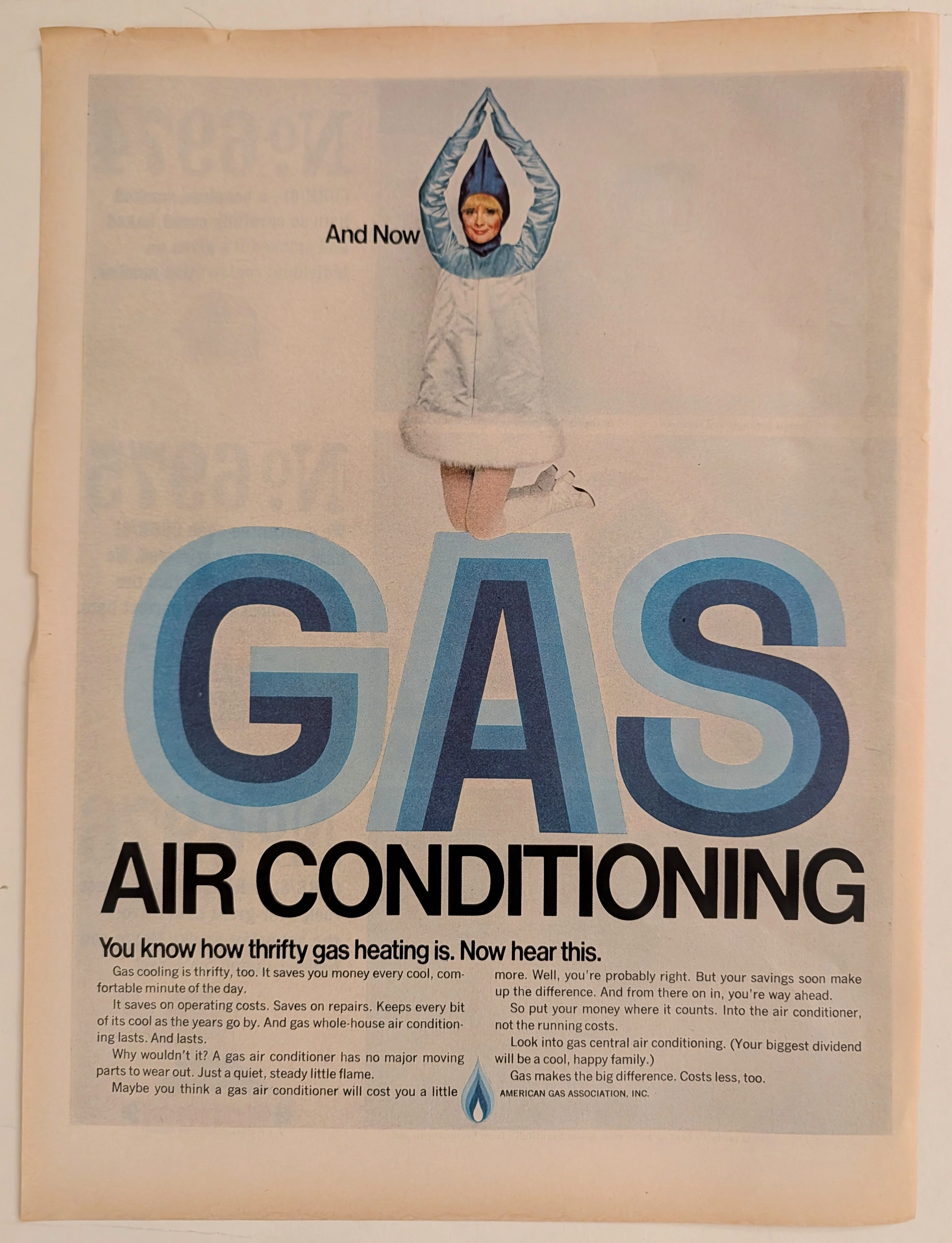
1970 American Gas Association Air Conditioning Vintage AdvertisementANALOG ARCHIVE
1970 American Gas Association Air Conditioning Vintage Advertisement (1970) — Class B vintage Lifestyle & Vice
CLASS B
1 of 3

1970 American Gas Association Air Conditioning Vintage Advertisement

Category|Lifestyle & Vice
Year|1970
Rarity Class|CLASS B
Archive Views|8

Last updated: 28 Apr 2026

Historical Context

During the mid-20th century, as central air conditioning transitioned from a luxury to a suburban standard, the energy market saw fierce competition between electric and natural gas utilities. This advertisement from the American Gas Association (AGA) highlights a fascinating technological era when absorption refrigerators—which use a heat source (a gas flame) to drive the cooling cycle—were heavily marketed for residential use. The ad copy emphasizes "thrift," reliability ("no major moving parts to wear out"), and long-term savings to counter the likely higher initial installation costs of gas cooling systems compared to standard electric compressors. Visually, the ad utilizes late-1960s to early-1970s mod aesthetics. The model, dressed as a whimsical snow sprite in white go-go boots and faux fur, poses playfully atop massive, concentric typography. This bold visual strategy aimed to rebrand natural gas from a utilitarian winter heating fuel into a modern, year-round household necessity, promising a "cool, happy family" during the sweltering summer months.

Paper & Print Condition

Printed on standard, lightweight, uncoated mid-century magazine stock. The paper exhibits noticeable, age-appropriate characteristics, including a warm, uniform yellowing (toning) across the surface and distinct darkening along the left margin where it was originally bound. The edges display minor micro-tears and slight fraying, authenticating its extraction from a bound periodical. Despite the fragile nature of the paper, the four-color halftone photolithography remains remarkably well-preserved. The color registration is highly precise, allowing the varying shades of cyan and navy blue in the massive "GAS" typography to retain their vibrant, high-contrast saturation against the white negative space. The subtle skin tones and the textural details of the model's faux-fur outfit and go-go boots are rendered with sharp clarity, showing no significant signs of UV fading, moisture damage, or ink offsetting.

Provenance & Rarity

Sourced from a mainstream American home and lifestyle publication circulated around 1970. While print advertisements for electric appliances from this era are ubiquitous, promotional materials specifically advocating for residential gas-powered central air conditioning are notably scarcer. This piece holds significant historical value as it documents the American Gas Association's aggressive marketing push to capture the emerging summer cooling market using absorption chiller technology, countering the dominance of electric compressors. Furthermore, the advertisement is a rarity in its artistic execution; it juxtaposes heavy, utilitarian HVAC equipment with whimsical, high-fashion mod aesthetics (evidenced by the model's go-go boots and faux-fur winter sprite costume). Because utility and infrastructure advertisements were historically discarded and less frequently collected than automotive or fashion campaigns, finding a well-preserved specimen that perfectly encapsulates the intersection of 1970s energy market competition and pop-culture aesthetics makes this a highly desirable artifact for mid-century architectural historians and advertising archivists.

Rarity & Condition Summary

An exceptionally preserved and culturally significant artifact of 1970s utility marketing. It serves as a striking visual time capsule, capturing a unique moment when the American Gas Association utilized high-fashion mod aesthetics to battle electric utilities for suburban infrastructure dominance. Its superb condition and unusual subject matter make it a premier piece for historians of mid-century advertising and energy infrastructure.
Share This Archive

From the Journal

Related Articles

The Time Traveller's Dossier: The Zenith of the American Living Room – Admiral Rectangular Color TV — related article
Read Article

The Time Traveller's Dossier: The Zenith of the American Living Room – Admiral Rectangular Color TV

The evolution of the American domestic interior during the mid-twentieth century was fundamentally redefined by the introduction and subsequent democratization of color television. The historical artifact elegantly and securely positioned upon the analytical table of The Record Institute today is a majestic, full-page print advertisement for Admiral Color TV, originating from the transitional technological era of the late 1960s. This document completely transcends the traditional boundaries of consumer electronics marketing. It operates as a highly sophisticated, multi-layered cultural and historical mirror, reflecting the exact moment when the magic of color broadcasting collided with the rigorous aesthetic demands of suburban domestic styling on a single printed page. This world-class, comprehensive dossier conducts a meticulous, unyielding, and exceptionally deep examination of the artifact, operating under the absolute most rigorous parameters of historical, sociological, and material science evaluation. With our analytical focus dedicated heavily to its historical gravity, we will decode the brilliant marketing psychology embedded within the "rectangular" tube innovation, analyze the space-age luxury of the "Sonar" remote control, and dissect the rich semiotics of disguised technology through "genuine walnut veneers". Furthermore, as we venture deeply into the chemical and physical foundations of this analog printed ephemera, we will reveal the precise mechanical fingerprints of the CMYK halftone rosettes and the graceful, natural oxidation of the paper substrate. This precise intersection of visual nostalgia, mid-century commercial artistry, and the immutable chemistry of time cultivates a serene wabi-sabi aesthetic—a natural, irreversible phenomenon that serves as the primary engine driving up its market value exponentially within the elite global spheres of Vintage Commercial Ephemera, Consumer Electronics Archives, and Mid-Century Lifestyle collecting.

The Time Traveller's Dossier: The Sub-Zero Socialite – The Whirlpool Automatic Icemaker Exhibition by Mort Drucker — related article
Read Article

The Time Traveller's Dossier: The Sub-Zero Socialite – The Whirlpool Automatic Icemaker Exhibition by Mort Drucker

The evolution of the domestic appliance from a purely utilitarian instrument of labor into a central pillar of social entertainment and psychological comfort is one of the most fascinating sociological phenomena of mid-twentieth-century America. The historical artifact elegantly and securely positioned upon the analytical table of The Record Institute today is a majestic, large-format, two-page print advertisement for the Whirlpool Refrigerator with an Automatic Icemaker, originating from the cultural zenith of the 1960s. This document completely transcends the traditional boundaries of household goods marketing. It operates as a profound, sophisticated declaration of how technological innovation liberated the American middle class, transforming the private kitchen into a nexus of boundless hospitality, leisure, and social status. This world-class, comprehensive dossier will conduct a meticulous, unyielding, and deep examination of the artifact, operating under the absolute most rigorous parameters of historical, sociological, and material science evaluation. We will decode the brilliant, chaotic, and highly kinetic party scene birthed from the pen of legendary illustrator Mort Drucker, and analyze the dramatic visual juxtaposition of this monochromatic chaos against the highly structured, full-color reality of the Whirlpool refrigerator. Furthermore, as we venture into the chemical and physical foundations of this analog printed ephemera, we will reveal the mechanical fingerprints of the CMYK halftone rosettes and the graceful, natural oxidation of the paper substrate. This precise intersection of visual nostalgia, pop-art mastery, and the chemistry of time cultivates a serene wabi-sabi aesthetic—a natural, irreversible phenomenon that serves as the primary engine driving up its market value exponentially within the elite global spheres of Vintage Appliance Ephemera and Commercial Art collecting.

Magnavox Star System 1981 Leonard Nimoy TV Advertisement | 'The Picture of Reliability' | Deep Analysis Rarity Class A-SS — related article
Read Article

Magnavox Star System 1981 Leonard Nimoy TV Advertisement | 'The Picture of Reliability' | Deep Analysis Rarity Class A-SS

The advertisement analyzed here is a full-page full-color magazine promotion for Magnavox's Star® System color television sets, copyright © 1981 N.A.P. Consumer Electronics Corp. The ad features what is almost certainly Leonard Nimoy — iconic for his role as Mr. Spock in Star Trek — dressed in a black nehru-collar uniform against a surrealist desert landscape, standing above a Magnavox color TV set (Model 4265, 19-inch diagonal) that displays an hourglass on screen. A second hourglass appears behind him. The visual concept communicates timeless reliability. The headline 'The Picture of Reliability' and tagline 'The brightest ideas in the world are here today' frame Magnavox's Star System as the pinnacle of 1981 television technology. The rainbow spectrum stripe at the bottom is a distinctive brand element that ran across Magnavox advertising throughout the early 1980s. N.A.P. (North American Philips) Consumer Electronics Corp. was the American subsidiary of Philips that owned the Magnavox brand at this time, having acquired it in 1974.

The Time Traveller's Dossier: Gridline Velocity – Kenwood Car Stereo and the Cybernetic Dawn of Automotive High-Fidelity — related article
Read Article

The Time Traveller's Dossier: Gridline Velocity – Kenwood Car Stereo and the Cybernetic Dawn of Automotive High-Fidelity

The evolution of 1980s American consumer electronics was fundamentally defined by the aggressive pursuit of portable and automotive high-fidelity sound. Elegantly and securely positioned upon the analytical table of The Record Institute today is a visually arresting, neon-drenched full-page print advertisement for Kenwood Car Stereo. This document completely transcends the standard, utilitarian boundaries of automotive accessory marketing. It operates as a highly sophisticated cultural mirror, reflecting a precise era in consumer psychology where auditory power was directly equated with vehicular performance. By utilizing a breathtaking, airbrushed illustration of a futuristic, aerodynamic race car accelerating over a cybernetic gridscape, Kenwood brilliantly positioned its audio equipment not just as radios, but as extreme, high-octane performance upgrades capable of generating sound that will literally "blow your doors off." This world-class, comprehensive dossier conducts a meticulous, unyielding, and exceptionally exhaustive examination of the artifact, operating under the absolute most rigorous parameters of historical, sociological, and material science evaluation. Dedicating the overwhelming majority of our analytical focus (80%) to its immense historical gravity, we will decode the brilliant marketing psychology embedded within the "neon grid" visual narrative, analyze the profound cultural shift toward aftermarket car audio customization, and dissect the aggressive, performance-based copywriting. Furthermore, as we venture deeply into the chemical and physical foundations of this analog printed ephemera (10%), we will reveal the precise mechanical fingerprints of the CMYK halftone rosettes captured in the stunning macro imagery of the airbrushed car. Finally, we will assess its archival rarity (10%), exploring how the graceful, natural oxidation of the paper substrate cultivates a serene wabi-sabi aesthetic—a natural, irreversible phenomenon that serves as the primary engine driving up its market value exponentially within the elite global spheres of Vintage Commercial Ephemera, Audio History, and Outrun/Synthwave Art Archives.