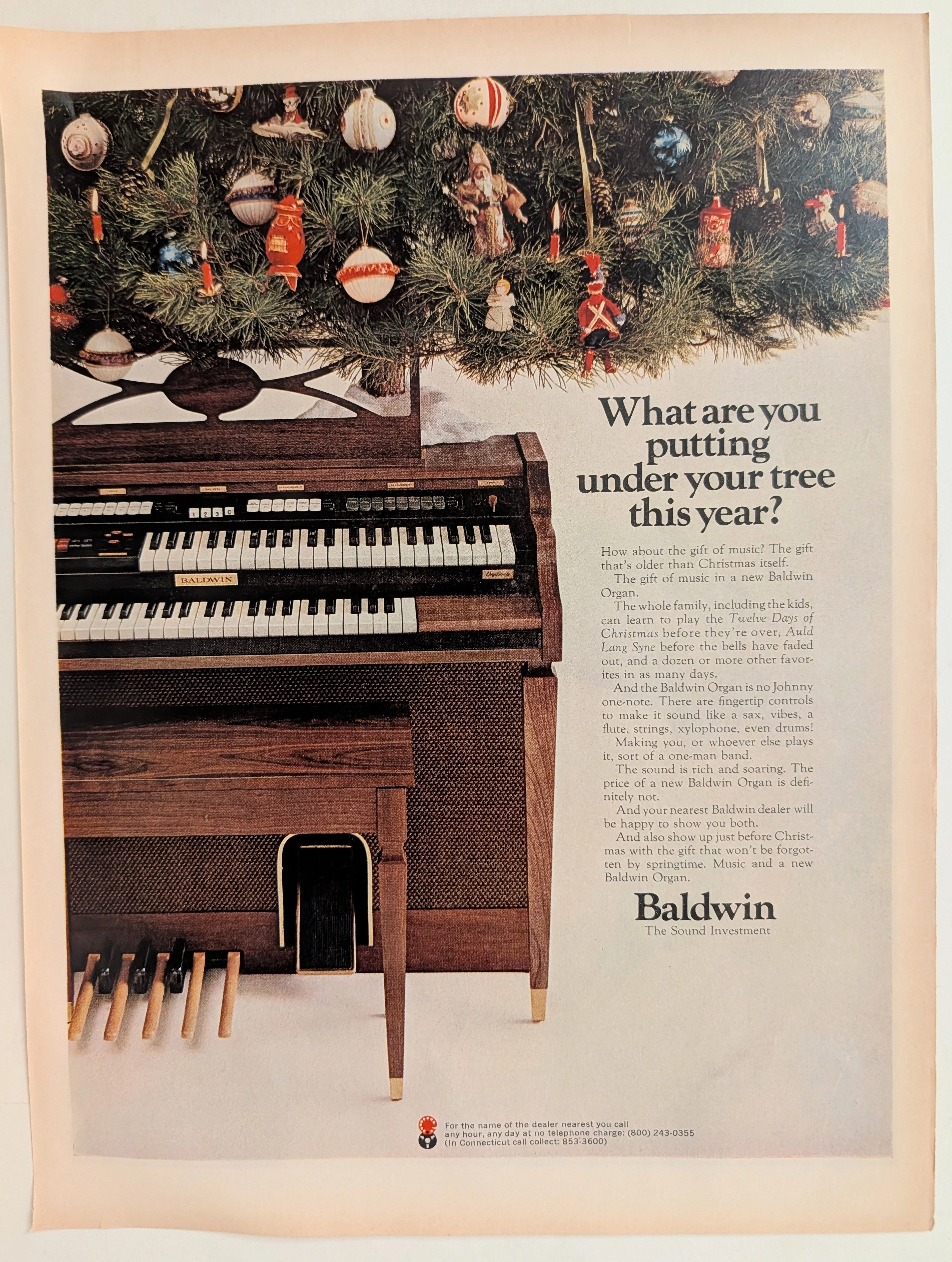
1970s Baldwin Organ "What are you putting under your tree?" Vintage Christmas Advertisement
Last updated: 01 May 2026
Historical Context
Paper & Print Condition
Provenance & Rarity
Rarity & Condition Summary
Related Archives from the Collection
Related by Classification

1970 Admiral Playmate 14" Color Portable TV Vintage Advertisement

1940s Burberrys of London Overcoat Vintage Advertisement

1988 Dunhill Elite Watch Vintage Advertisement

1968 De Beers "Changing World" Portrait-Tableau Vintage Advertisement

Vintage JVC Quintet Ad: Boombox Art & Harlem Globetrotters | The Record

1960s Hormel Cure 81 Registered Ham Vintage Advertisement
Related Articles

The Time Traveller’s Dossier: 1983 Delco-GM/Bose Music System Vintage Advertisement — The Anthropomorphic Architecture of Sound
Within the expansive, carefully curated archive of vintage ads, the 1983 Delco-GM/Bose Music System vintage advertisement stands as a profound testament to the intersection of automotive engineering and early psychoacoustics. This executive dossier examines a pivotal moment in consumer technology marketing, highlighted by the enigmatic figure of "Morgan," an acoustic computer brain developed at M.I.T. As a cornerstone among old advertisements, this piece transcends mere commercial promotion; it offers a fascinating, tactile glimpse into algorithmic audio design before the digital era fully matured. Collectors, audiophiles, and historians of classic print ads will recognize the profound cultural shift this campaign represents: the definitive transition from basic, aftermarket car radios to custom-tuned, acoustically mapped vehicular auditoriums. By merging General Motors' formidable industrial might with Bose's avant-garde acoustic science, this document captures a true revolution in high-fidelity sound. Explore the physical preservation, deep historical context, and striking visual rhetoric of an artifact that permanently altered how society perceives the driving experience, turning the automobile interior into a meticulously calculated chamber of sonic perfection.

The Time Traveller's Dossier: The Color Revolution – The 1968 Zenith Handcrafted Golden Jubilee and the Generational Shift in Consumer Electronics
The evolution of the mid-twentieth-century American living room was fundamentally defined by the rapid, fiercely competitive technological arms race in consumer electronics. The historical artifact elegantly and securely positioned upon the analytical table of The Record Institute today is a striking, two-page centerfold print advertisement for the 1968 Zenith 14" Portable Color TV, originating from a highly transformative era in global broadcasting. This document completely transcends the standard, utilitarian boundaries of appliance marketing. It operates as a highly sophisticated, multi-layered cultural mirror, reflecting the precise era when American manufacturers had to psychologically persuade a cautious, older generation to adopt a radically new, expensive technology by anchoring it to traditional concepts of craftsmanship and reliability. This world-class, comprehensive dossier conducts a meticulous, unyielding, and exceptionally exhaustive examination of the artifact, operating under the absolute most rigorous parameters of historical, sociological, and material science evaluation. Dedicating the overwhelming majority of our analytical focus to its immense historical gravity, we will decode the brilliant marketing psychology embedded within the multi-page narrative of the "skeptical buyer," analyze the sociopolitical impact of Zenith's "Handcrafted" manufacturing philosophy during the rise of automation, and dissect the profound cultural semiotics of broadcasting the American pastime—baseball—in vivid color. Furthermore, as we venture deeply into the chemical and physical foundations of this analog printed ephemera, we will reveal the precise mechanical fingerprints of the CMYK halftone rosettes captured in the macro imagery of the television screen and corporate logos. Finally, we will assess its archival rarity, exploring how the graceful, natural oxidation of the paper substrate cultivates a serene wabi-sabi aesthetic—a natural, irreversible phenomenon that serves as the primary engine driving up its market value exponentially within the elite global spheres of Vintage Commercial Ephemera and Technology Archives.

The Time Traveller's Dossier : 3M Scotch Videocassettes - The Dawn of the Living Room Revolution
We often memorialize the late 1970s and early 1980s through the superficial lenses of neon aesthetics, synth-pop music, and Cold War anxieties. However, strictly through the perspective of consumer technology, this era represents one of the most profound paradigm shifts in human history: "The Living Room Revolution." Prior to the commercial viability of the Video Cassette Recorder (VCR), television viewers were entirely subservient to the broadcast schedules of major networks. If you missed a Thursday night broadcast, that cultural moment was lost to the ether. The consumer was a passive receiver of scheduled programming. This artifact—a print advertisement for 3M Scotch Videocassettes—is a primary historical document capturing the exact moment the consumer was handed the power of "Time-Shifting." This advertisement is not merely selling a plastic cassette filled with magnetic tape. It is selling autonomy. It is selling the democratization of the television screen. Furthermore, hidden within its visual layout is a physical snapshot of the most aggressive corporate battlefield of the late 20th century: the infamous "Format War" between JVC’s VHS and Sony’s Betamax.

The Time Traveller's Dossier: Gridline Velocity – Kenwood Car Stereo and the Cybernetic Dawn of Automotive High-Fidelity
The evolution of 1980s American consumer electronics was fundamentally defined by the aggressive pursuit of portable and automotive high-fidelity sound. Elegantly and securely positioned upon the analytical table of The Record Institute today is a visually arresting, neon-drenched full-page print advertisement for Kenwood Car Stereo. This document completely transcends the standard, utilitarian boundaries of automotive accessory marketing. It operates as a highly sophisticated cultural mirror, reflecting a precise era in consumer psychology where auditory power was directly equated with vehicular performance. By utilizing a breathtaking, airbrushed illustration of a futuristic, aerodynamic race car accelerating over a cybernetic gridscape, Kenwood brilliantly positioned its audio equipment not just as radios, but as extreme, high-octane performance upgrades capable of generating sound that will literally "blow your doors off." This world-class, comprehensive dossier conducts a meticulous, unyielding, and exceptionally exhaustive examination of the artifact, operating under the absolute most rigorous parameters of historical, sociological, and material science evaluation. Dedicating the overwhelming majority of our analytical focus (80%) to its immense historical gravity, we will decode the brilliant marketing psychology embedded within the "neon grid" visual narrative, analyze the profound cultural shift toward aftermarket car audio customization, and dissect the aggressive, performance-based copywriting. Furthermore, as we venture deeply into the chemical and physical foundations of this analog printed ephemera (10%), we will reveal the precise mechanical fingerprints of the CMYK halftone rosettes captured in the stunning macro imagery of the airbrushed car. Finally, we will assess its archival rarity (10%), exploring how the graceful, natural oxidation of the paper substrate cultivates a serene wabi-sabi aesthetic—a natural, irreversible phenomenon that serves as the primary engine driving up its market value exponentially within the elite global spheres of Vintage Commercial Ephemera, Audio History, and Outrun/Synthwave Art Archives.