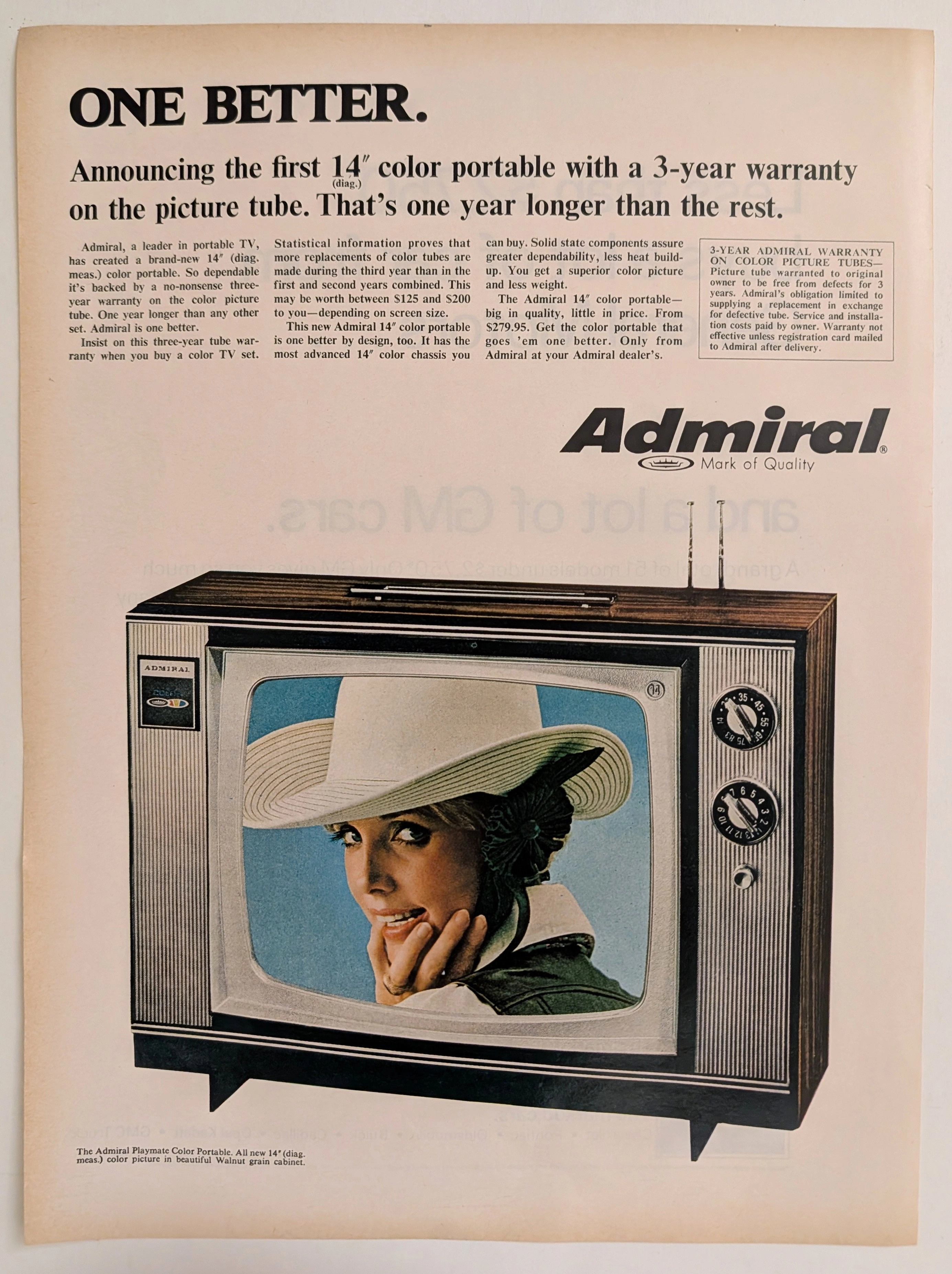
1970 Admiral Playmate 14" Color Portable TV Vintage Advertisement
Last updated: 30 Apr 2026
Historical Context
Paper & Print Condition
Provenance & Rarity
Rarity & Condition Summary
Related by Classification

Vintage JVC Quintet Ad: Boombox Art & Harlem Globetrotters | The Record

Vintage 1981 Sony Walkman Ad: Portable Audio Legend | The Record

1955 RCA Victor Director 21 Color Television Vintage Advertisement

1970 American Gas Association Air Conditioning Vintage Advertisement

1980 Craig Powerplay R3 Car Stereo Featuring the DeLorean DMC-12

Oshkosh B'gosh "Home Grown" Denim Advertisement
Related Articles

The Time Traveller's Dossier: The Zenith of the American Living Room – Admiral Rectangular Color TV
The evolution of the American domestic interior during the mid-twentieth century was fundamentally redefined by the introduction and subsequent democratization of color television. The historical artifact elegantly and securely positioned upon the analytical table of The Record Institute today is a majestic, full-page print advertisement for Admiral Color TV, originating from the transitional technological era of the late 1960s. This document completely transcends the traditional boundaries of consumer electronics marketing. It operates as a highly sophisticated, multi-layered cultural and historical mirror, reflecting the exact moment when the magic of color broadcasting collided with the rigorous aesthetic demands of suburban domestic styling on a single printed page. This world-class, comprehensive dossier conducts a meticulous, unyielding, and exceptionally deep examination of the artifact, operating under the absolute most rigorous parameters of historical, sociological, and material science evaluation. With our analytical focus dedicated heavily to its historical gravity, we will decode the brilliant marketing psychology embedded within the "rectangular" tube innovation, analyze the space-age luxury of the "Sonar" remote control, and dissect the rich semiotics of disguised technology through "genuine walnut veneers". Furthermore, as we venture deeply into the chemical and physical foundations of this analog printed ephemera, we will reveal the precise mechanical fingerprints of the CMYK halftone rosettes and the graceful, natural oxidation of the paper substrate. This precise intersection of visual nostalgia, mid-century commercial artistry, and the immutable chemistry of time cultivates a serene wabi-sabi aesthetic—a natural, irreversible phenomenon that serves as the primary engine driving up its market value exponentially within the elite global spheres of Vintage Commercial Ephemera, Consumer Electronics Archives, and Mid-Century Lifestyle collecting.

The Time Traveller's Dossier: The Architecture of the Airwaves – Admiral Color Television, the Sonar Remote, and the Transformation of the American Living Room
The evolution of the twentieth-century American domestic sphere was fundamentally defined by the rapid, uncompromising integration of broadcast technology into the daily rituals of the nuclear family. The historical artifact elegantly and securely positioned upon the analytical table of The Record Institute today is a striking, text-dense full-page print advertisement for Admiral Big Screen Color Televisions, originating from the late 1960s. This document completely transcends the standard, utilitarian boundaries of appliance marketing. It operates as a highly sophisticated, multi-layered cultural mirror, reflecting a precise era in consumer psychology where the television set was aggressively repositioned: from a novel, standalone mechanical box into a massive, aesthetically dominant piece of "handcrafted" wooden furniture, complete with the space-age luxury of wireless command. This world-class, comprehensive dossier conducts a meticulous, unyielding, and exceptionally exhaustive examination of the artifact, operating under the absolute most rigorous parameters of historical, sociological, and material science evaluation. Dedicating the overwhelming majority of our analytical focus to its immense historical gravity (80%), we will decode the brilliant marketing psychology embedded within the "Stereo Theatre" concept, analyze the profound sociopolitical impact of the "Color Sonar" remote control, and dissect the economic realities of mid-century high-fidelity entertainment. Furthermore, as we venture deeply into the chemical and physical foundations of this analog printed ephemera (10%), we will reveal the precise mechanical fingerprints of the CMYK halftone rosettes captured in the macro imagery of the broadcast screens. Finally, we will assess its archival rarity (10%), exploring how the graceful, natural oxidation of the paper substrate cultivates a serene wabi-sabi aesthetic—a natural, irreversible phenomenon that serves as the primary engine driving up its market value exponentially within the elite global spheres of Vintage Commercial Ephemera and Technology Archives.

The Time Traveller’s Dossier: 1983 Delco-GM/Bose Music System Vintage Advertisement — The Anthropomorphic Architecture of Sound
Within the expansive, carefully curated archive of vintage ads, the 1983 Delco-GM/Bose Music System vintage advertisement stands as a profound testament to the intersection of automotive engineering and early psychoacoustics. This executive dossier examines a pivotal moment in consumer technology marketing, highlighted by the enigmatic figure of "Morgan," an acoustic computer brain developed at M.I.T. As a cornerstone among old advertisements, this piece transcends mere commercial promotion; it offers a fascinating, tactile glimpse into algorithmic audio design before the digital era fully matured. Collectors, audiophiles, and historians of classic print ads will recognize the profound cultural shift this campaign represents: the definitive transition from basic, aftermarket car radios to custom-tuned, acoustically mapped vehicular auditoriums. By merging General Motors' formidable industrial might with Bose's avant-garde acoustic science, this document captures a true revolution in high-fidelity sound. Explore the physical preservation, deep historical context, and striking visual rhetoric of an artifact that permanently altered how society perceives the driving experience, turning the automobile interior into a meticulously calculated chamber of sonic perfection.

The Time Traveller's Dossier : 1980 Fuzzbuster Elite - The Architecture of Electronic Insurgency
We are observing an artifact of a silent, invisible war. Before this era, the American highway was marketed as a vector of absolute, unbridled freedom. The automobile was the ultimate vessel of personal sovereignty. Here, the paradigm shifts into something darker. The open road has become a zone of constant surveillance. The state has weaponized the electromagnetic spectrum to monitor and penalize the citizen. In response, the citizen weaponized the dashboard. This is the 1980 Fuzzbuster Elite by Electrolert. It is not a car accessory. It is a piece of civilian counter-measures equipment. In an era defined by the deeply unpopular 55 MPH national speed limit and the rise of police microwave radar, this device commodified paranoia. It packaged civil disobedience into a sleek, chrome-trimmed metal box that plugged directly into a cigarette lighter. It represents the exact moment when the act of driving transitioned from a physical experience into an electronic arms race.