The Time Traveller's Dossier: Engineering as High Art – 1981 Honda CBX Advertisement
The History
To decode the sociological architecture embedded within this printed artifact, it is mandatory to contextualize the macroeconomic landscape of the early 1980s. This era was defined by the aggressive global expansion of Japanese manufacturing (JDM dominance), which fundamentally disrupted Western automotive hierarchies by introducing unprecedented levels of precision engineering.
Part 1: The Binary Shift: The Outlaw vs. The Connoisseur
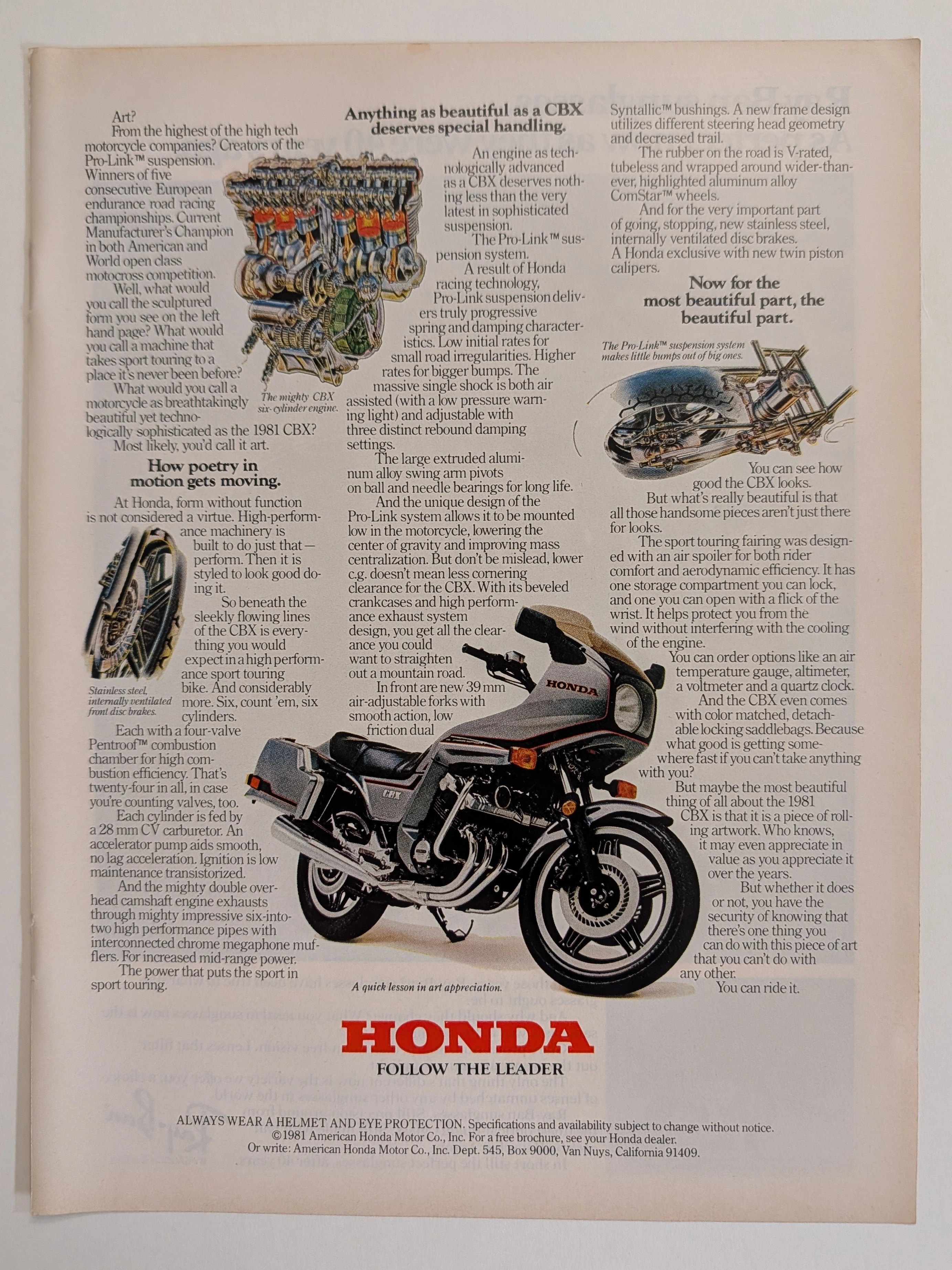
The narrative architecture of this artifact is built upon a strict, uncompromising binary contrast. Historically, the Western cultural consciousness often linked motorcycles to the gritty, rebellious "outlaw" biker gangs of the 1960s and 70s—an image associated with raw noise, mechanical simplicity, and social defiance. Honda needed to completely obliterate that narrative to sell a premium, hyper-complex machine. This advertisement executes the pivot flawlessly. The messaging deliberately contrasts the old world of raw, unrefined riding with a new world of sophisticated "sport touring." By framing the motorcycle not as a renegade's chopper, but as a "technologically advanced" luxury vehicle equipped with a Pro-Link suspension and a 24-valve engine, Honda successfully mapped its product onto the upward mobility and intellectual vanity of the affluent consumer.
Part 2: The Technocratic Discourse & Mechanical Supremacy
Executing this binary shift required the invention of a new vocabulary. The copywriting abandons traditional motorcycle tropes of raw speed and instead adopts the refined language of an art gallery mixed with an aerospace laboratory.
"What would you call a motorcycle as breathtakingly beautiful yet technologically sophisticated as the 1981 CBX? Most likely, you'd call it art... A quick lesson in art appreciation."
The strategic deployment of extreme mechanical terminology—Pentroof combustion chamber, transistorized ignition, internally ventilated front disc brakes—aligned the product with the era's public obsession with high technology. Positioning the six-cylinder engine as a "sculptured form" provided consumers with a logical, intellectually superior rationale for purchasing an immensely powerful machine, neutralizing any perception of recklessness with the shield of engineering appreciation.
Part 3: The Sovereign Pilot and the Era of Sport Touring
The socioeconomic structure of the early 80s saw the rise of the wealthy professional class. For a motorcycle of this caliber and cost to succeed, it required the explicit approval of a buyer who valued comfort and cutting-edge tech over pure adrenaline. The advertisement’s focus on the aerodynamic fairing, "rider comfort," and "detachable locking saddlebags" created a new consumer category: the Sport Tourer. This conceptual boundary eradicated the line between a high-performance sports machine and a practical, long-distance luxury vehicle.
Part 4: Visual Semiotics: Transparency and Supreme Confidence
The supporting technical illustrations (vignettes) function as precise semiotic indicators of Honda's absolute confidence, engineering consent through visual transparency:
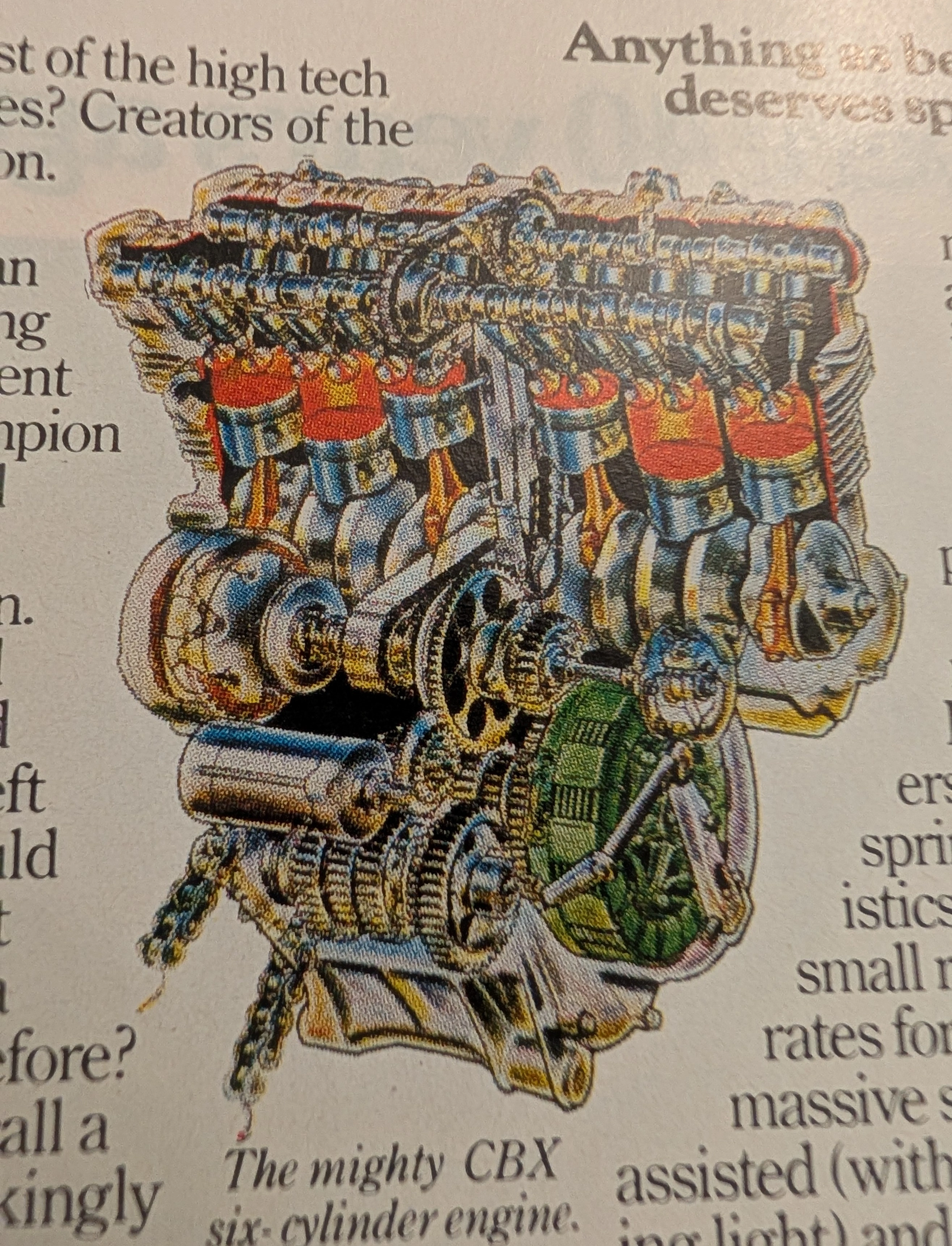
The Engine Cutaway: Displaying the internal architecture of the massive inline-six engine is a flex of industrial supremacy. It signifies that the true beauty of the machine lies not just in its exterior styling, but in its hidden mechanical heart. It treats the engine block like a watchmaker treats a horological complication.
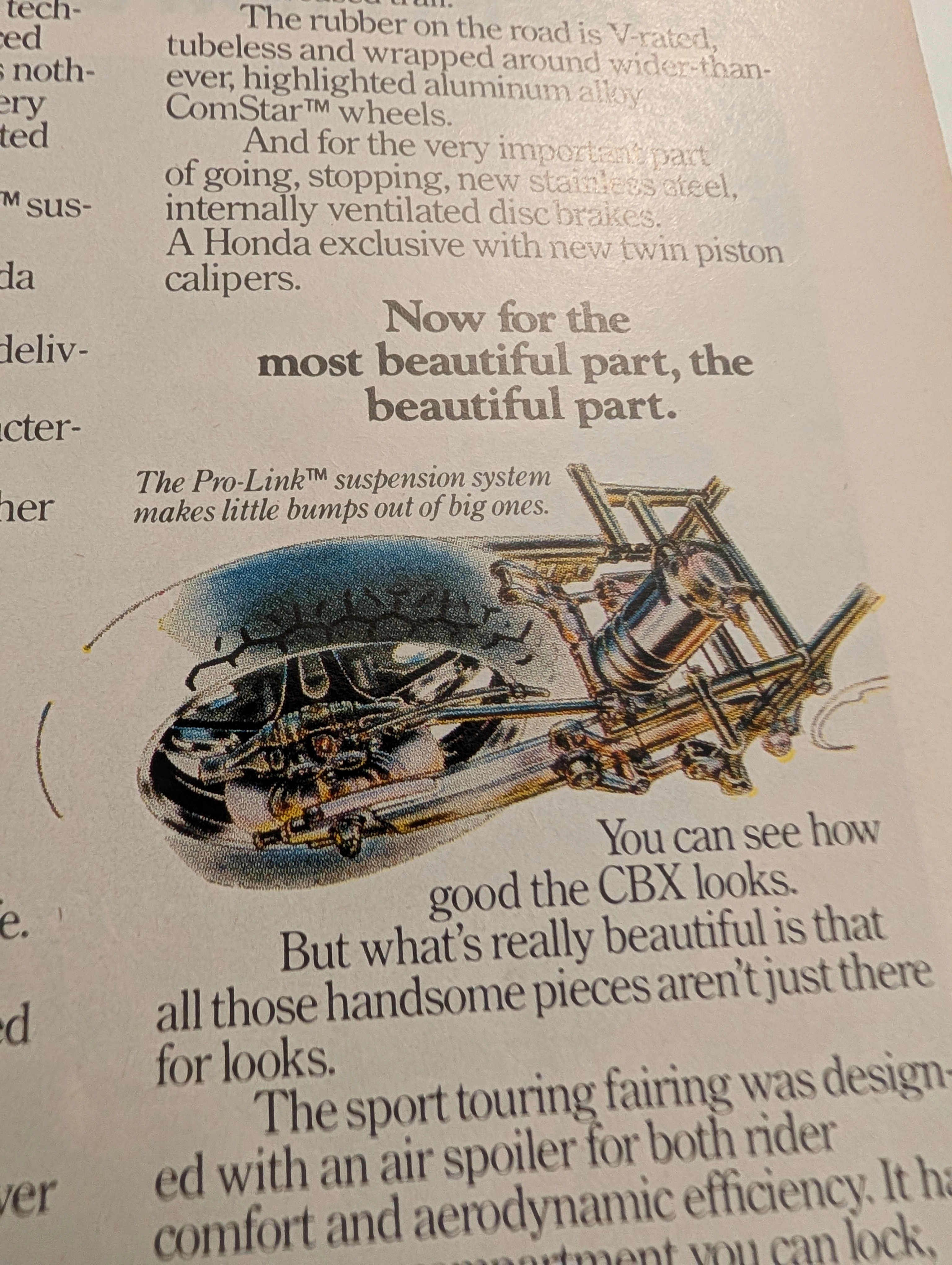
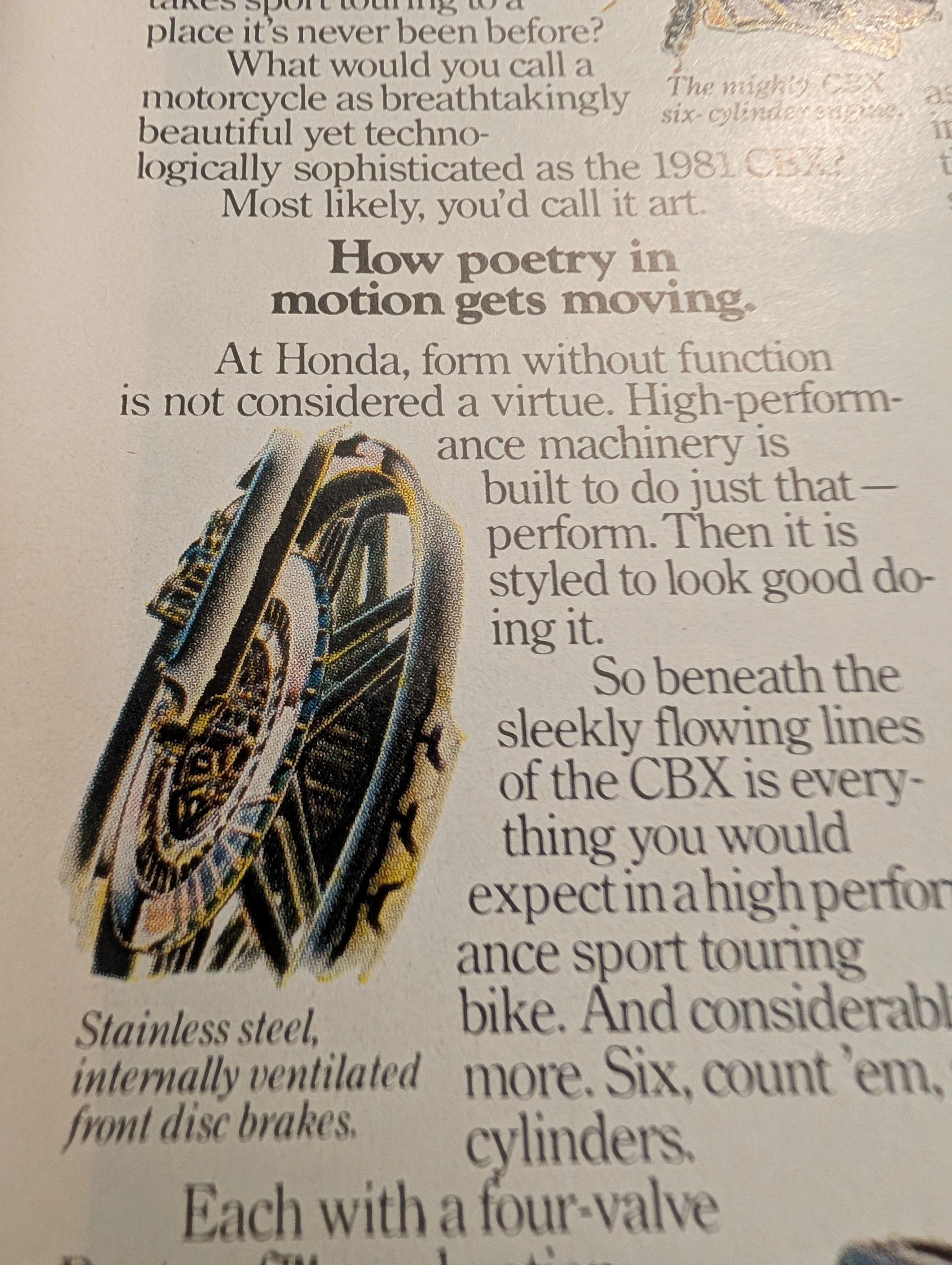
The Suspension and Brakes: By isolating and detailing the Pro-Link suspension and vented disc brakes, the ad visually reinforces the text’s claim of "special handling" and safety. It replaces the historical fear of motorcycle danger with the assurance of absolute mechanical control.
Part 5: Pop Culture Impact and Enduring Legacy
The visual language pioneered in this exact era left an indelible, structural mark on global automotive pop culture. The aesthetic of hyper-detailed, exposed Japanese engineering seen in this 1981 advertisement became the foundational DNA for the "Cyberpunk" aesthetic. The mechanical complexity showcased here directly mirrors the iconic, highly detailed machinery seen in landmark anime like Akira (1988), where the high-tech motorcycle is the ultimate symbol of power and futuristic dominance.
In the modern commercial arena, the contemporary obsession with vintage JDM (Japanese Domestic Market) culture and classic superbikes operates on a cyclical return to the era this ad represents. Today's automotive enthusiasts revere the Honda CBX as a mechanical unicorn—a glorious, over-engineered masterpiece from a time when analog mechanics reached their absolute zenith before the complete digital takeover. This artifact is the foundational source code for modern superbike mythology.
The Paper
As a physical entity, this tear sheet is an unrepeatable record of late-analog offset printing. The medium-weight coated magazine stock was engineered for mass distribution, yet its current state demands evaluation through the Japanese aesthetic philosophy of wabi-sabi (侘寂)—the recognition of beauty in impermanence and the natural progression of time.
Visual Forensics & Substrate Analysis:
Examining the extreme close-ups of this artifact reveals the mechanical heartbeat of the 1980s press. Under magnification, the illusion of depth in the silver fairing and engine shadows shatters into a precise, mathematical galaxy of CMYK halftone rosettes. The distinct grain of the offset lithography is aggressively visible in the vibrant red and gold accents of the engine cutaway. The margins exhibit authentic "toning"—a gradual, irreversible yellowing caused by the natural oxidation of lignin within the wood pulp. This organic degradation cannot be cloned by modern digital processes. The evolving patina elevates the piece from a uniform industrial print to a singular, historically scarred artifact. The wabi-sabi nature of this page ensures that its aesthetic and historical value increases precisely because it is slowly returning to the earth.
The Rarity
Rarity Class: S (Superior / Museum Grade)
Within archival parameters, this artifact holds a definitive Class S designation. The paradox of analog print ephemera lies in its initial mass production versus its extreme current scarcity. Magazines of the early 1980s were quintessential disposable media, destined for the recycling bin. The survival of this specific page—enduring over four decades without yielding to moisture damage, destructive handling, or structural center creases—is an archival anomaly. The Honda CBX is a legendary "holy grail" machine among classic motorcycle collectors; therefore, finding an original 1981 advertisement in this immaculate condition, detailing its most famous component (the six-cylinder engine), is incredibly rare. Such pristine remnants are fiercely sought after by curators of automotive history and vintage motorsport enthusiasts for museum-grade preservation.
Visual Impact
The aesthetic authority of this piece lies in a masterclass of asymmetrical composition and psychological design. The immediate focal point dances between the sleek, silver profile of the fully assembled CBX at the bottom center and the highly complex, color-rendered cutaway of the six-cylinder engine at the top left. This creates a powerful leading line, forcing the viewer's eye to travel from the raw internal mechanics down to the refined, aerodynamic final product. The artist strategically utilizes a stark, white negative space to project the intricate mechanical components forward from the two-dimensional plane. It is a highly calculated visual mechanism aimed at commanding absolute attention, inviting the viewer to study the page like an engineering schematic rather than a traditional advertisement.
The Archive Continues
Continue the Exploration
Pierre Cardin · Fashion
The Time Traveller's Dossier: The Architecture of Masculine Dominance – Pierre Cardin Editorial Illustration (Circa 1980s)
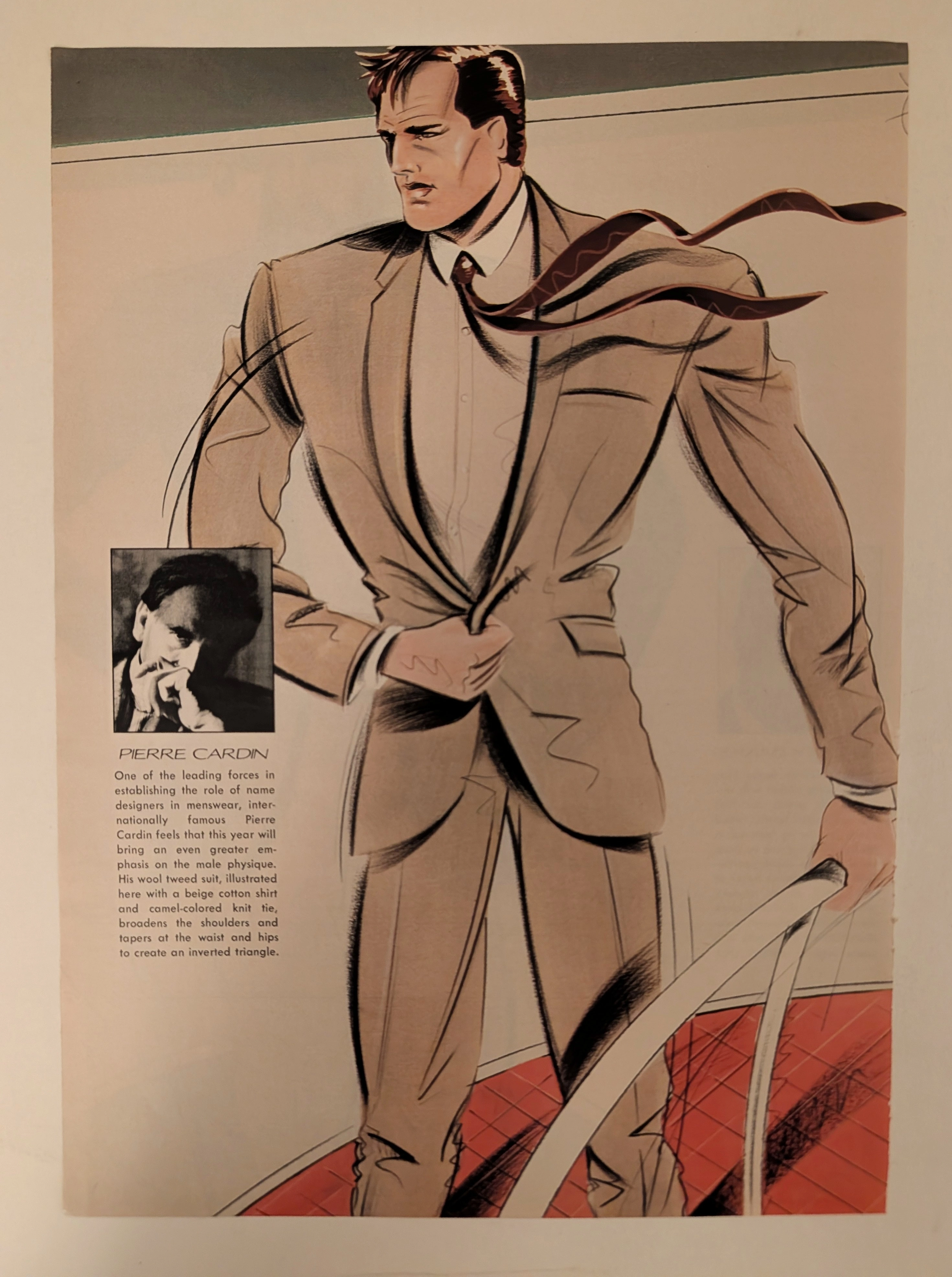
History is not merely written; it is tailored, draped, and aggressively padded at the shoulders. Long before digital algorithms dictated the sterile parameters of modern menswear, and before the casualization of the corporate wardrobe stripped the modern executive of his sartorial armor, societal engineering was executed through the calculated geometry of the designer suit. The historical artifact before us is not a mere disposable magazine tear sheet; it is a perfectly weaponized blueprint of 1980s hyper-masculinity, a visual manifesto of corporate dominance, and an unwavering testament to an era when clothing was utilized as a tool for physical and psychological intimidation. This museum-grade, academic archival dossier presents an exhaustive deconstruction of a late-analog editorial illustration featuring the revolutionary menswear of Pierre Cardin, dating to the pivotal "Power Suit" era of the 1980s. Operating on a profound, ruthless binary structure, this document records a calculated paradigm shift within the global fashion industry. It captures the precise historical fracture where menswear transitioned conceptually from the conservative, conformity-driven "Organization Man" of the mid-20th century into the aggressive, space-commanding "Power Broker" of the 1980s. Through the highly specialized lens of late-analog commercial artistry and stringent visual forensics, this document serves as a masterclass in the psychological marketing of gender and power. It established the foundational archetype for the modern, alpha-male aesthetic—an archetype that unconditionally dictates the visual and strategic totems of corporate dominance even today.
Sky Way · Travel
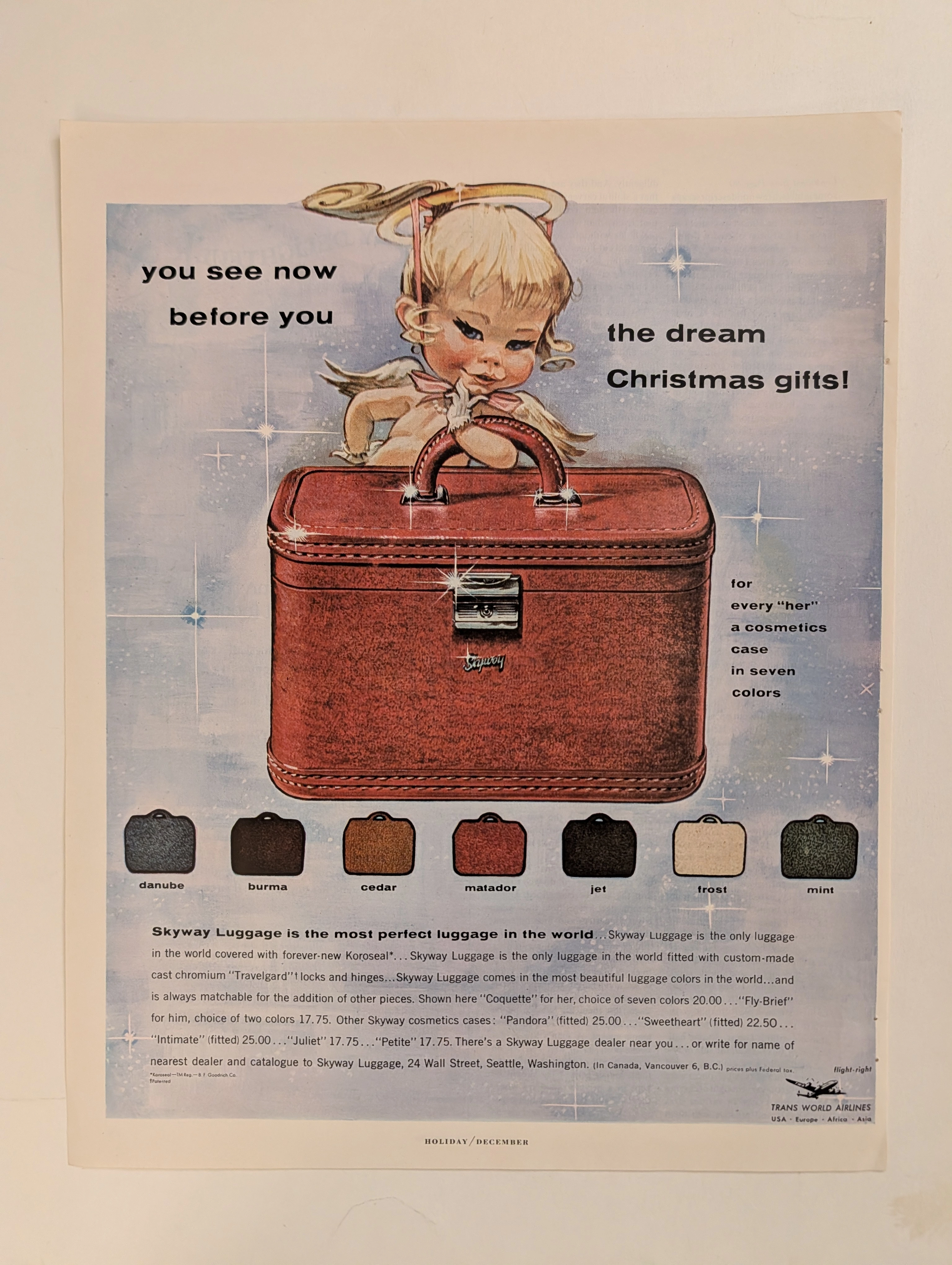
The Time Traveller's Dossier: The Aesthetics of Gifting and Consumer Hypnosis – Skyway Luggage Advertisement (Circa 1950s)
The history of commercial marketing is rarely driven by cold, rational logic; it is forged, molded, and dictated through the weaponization of emotion, manufactured desire, and the carefully engineered magic of the holiday season. Long before digital algorithms were deployed to predict and manipulate our purchasing behaviors, social engineering and consumer psychology were executed with devastating precision through the tip of a master illustrator’s brush on the pages of glossy magazines. The historical artifact standing before us is not merely a run-of-the-mill mid-century holiday campaign for a luggage brand. It is an absolute visual "Trojan Horse"—one of the most cunningly designed blueprints ever utilized to bypass the consumer's psychological defenses. It serves as an unwavering testament to an era when the stark, industrial rigidity of manufactured goods was brilliantly concealed beneath the irresistible wrapping paper of festive innocence. This museum-grade academic archival dossier presents an exhaustive, uncompromising deconstruction of a late-analog print advertisement from Skyway Luggage. Operating on a ruthlessly calculated, gender-segregated binary narrative structure, this campaign captures a critical paradigm shift: the exact historical moment when luggage transcended its utilitarian status as a mere "storage box" and was conceptually elevated into a highly coveted "dream Christmas gift." Through the highly specialized lens of mid-century commercial artistry and stringent visual forensics, this document serves as a masterclass in the psychological marketing of manufactured desire. It established the foundational archetype for the holiday retail economy—an archetype that unconditionally dictates the global lifestyle merchandising strategies of today.
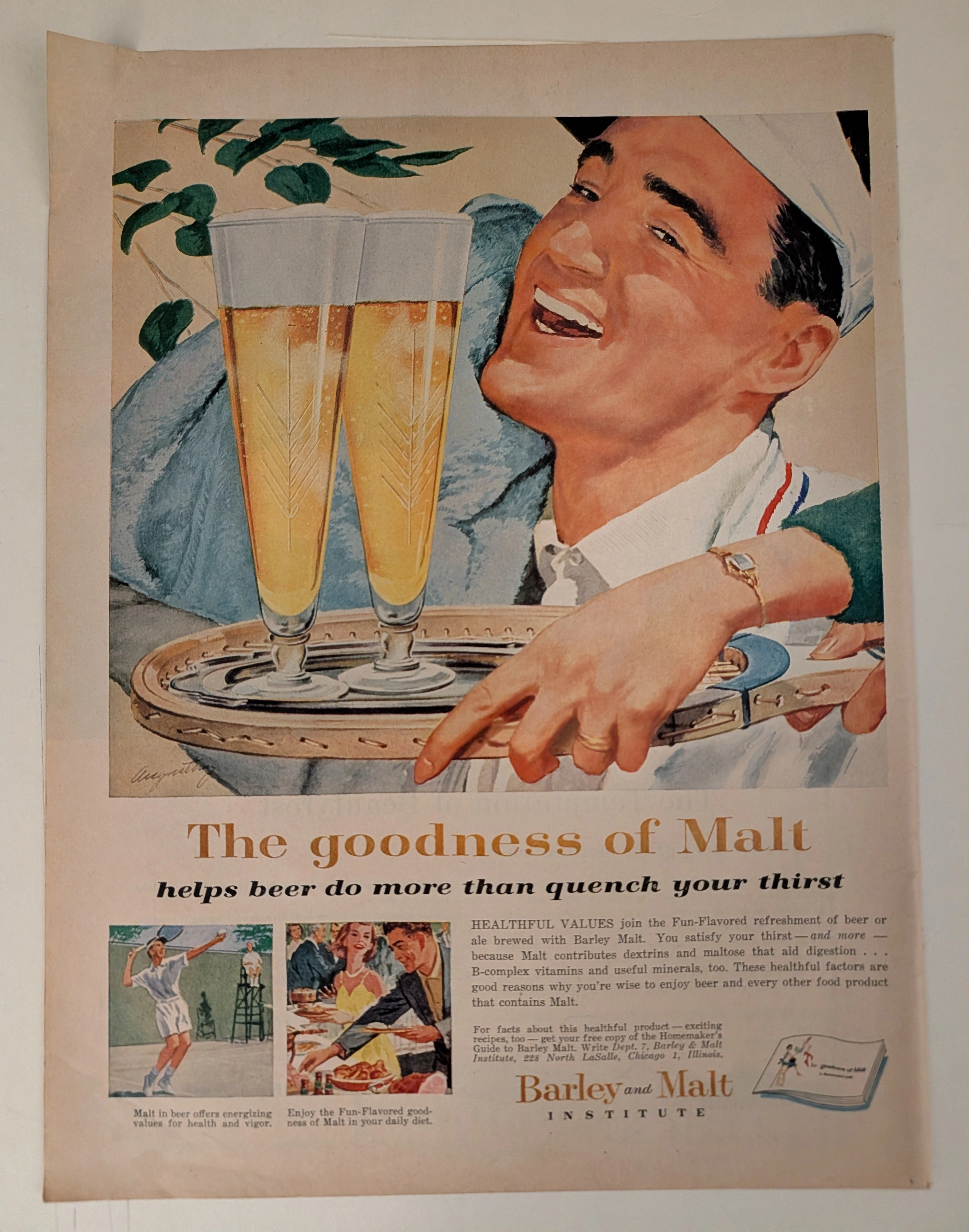
The Time Traveller's Dossier: How a 1959 Beer Ad Turned Alcohol into 'Health Food' – Barley and Malt Institute Advertisement
History is not written; it is printed. Before digital algorithms dictated human behavior, societal engineering was executed through the calculated geometry of the four-color offset press. The artifact before us is not merely an advertisement; it is a weaponized blueprint of middle-class aspiration. This museum-grade archival dossier presents an academic deconstruction of a 1959 print advertisement commissioned by the Barley and Malt Institute of Chicago. Operating on a profound binary structure, it documents a calculated paradigm shift within the American alcohol industry. It illustrates the precise historical fracture where beer was conceptually transitioned from a stigmatized working-class vice into a health-conscious staple of suburban domesticity. Through the lens of mid-century commercial artistry and precise visual forensics, this document serves as a masterclass in psychological marketing, establishing cultural tropes that unconditionally dominate modern pop culture and contemporary branding