The Time Traveller's Dossier : Bagpipes of Spring - The Dawn of Synchronized Culture — The Record Institute JournalThe Time Traveller's Dossier : Bagpipes of Spring - The Dawn of Synchronized Culture — The Record Institute JournalThe Time Traveller's Dossier : Bagpipes of Spring - The Dawn of Synchronized Culture — The Record Institute Journal
1 / 3

✦ 3 Photos — Click any image to view in high resolution

May 12, 2026

The Time Traveller's Dossier : Bagpipes of Spring - The Dawn of Synchronized Culture

OtherIllustration: Charles La Salle
Archive Views: 14

The History

To understand this artifact, one must understand the ecosystem from which it was violently torn.

The Saturday Evening Post was not just a magazine.

It was the cultural bedrock of the American Republic in the early to mid-twentieth century. Under the editorial iron fist of George Horace Lorimer, the Post became the arbiter of middle-class morality, aspiration, and entertainment.

It possessed a circulation that modern digital platforms would envy, given the population size of the era.

It arrived weekly. It was dependable. It was ubiquitous.

This physical page represents the zenith of that empire.

During this era, literature was not strictly divided into highbrow isolation and lowbrow pulp. The Post existed in the middle space. It paid exorbitant sums to secure the finest literary talent of the generation. They understood that mass appeal did not necessitate intellectual bankruptcy.

This was the shift. The democratization of elite storytelling.

The Architect of the American Mythos

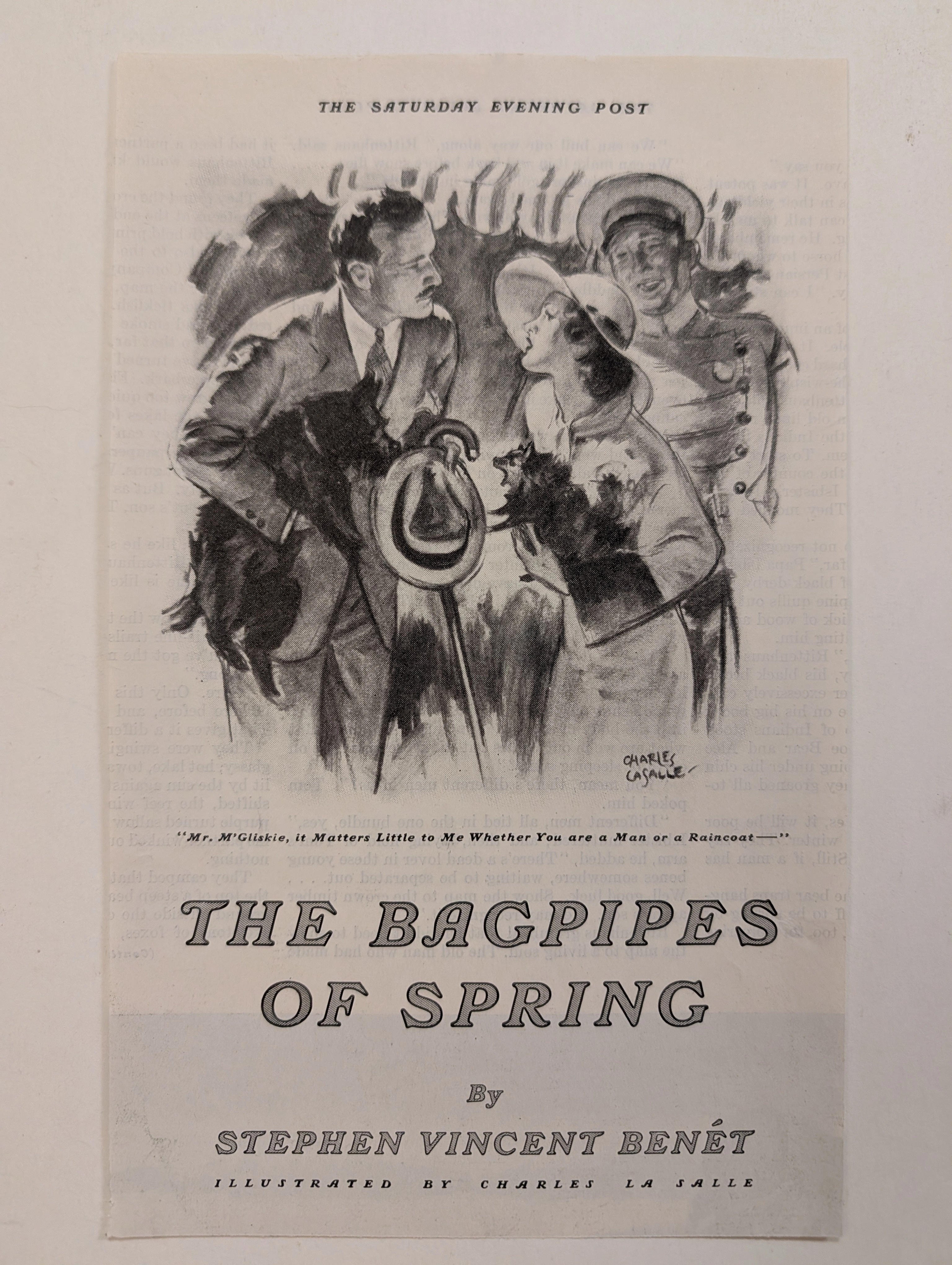
Stephen Vincent Benét’s name sits anchored at the bottom of the page.

He was not a hack writer. He was a Pulitzer Prize-winning poet. A craftsman of the American mythos. Best known for "John Brown's Body" and "The Devil and Daniel Webster," Benét possessed a unique capability to weave folklore with contemporary anxieties.

His presence in a mass-market weekly signifies a crucial historical dynamic.

The public demanded quality. The publishers supplied it.

Benét’s inclusion here demonstrates how the machinery of capitalism—fueled by advertising dollars—subsidized the dissemination of high literature.

Readers did not have to visit a dusty library to engage with premier authors. The authors were delivered to their breakfast tables, nestled alongside advertisements for automobiles, soap, and canned soup.

This symbiosis between art and commerce was the defining economic engine of twentieth-century print media.

The Mechanics of Mass Distribution

Consider the logistical miracle required to place this image in the hands of the reader.

Before the internet, information moved at the speed of trains.

The production of this single page required vast industrial complexes. Forests of timber converted into mechanical pulp. Vats of petroleum-based inks. Massive rotary printing presses shaking the foundations of buildings in Philadelphia.

The text was set using the Linotype machine. An operator typed on a keyboard, and molten lead was cast into lines of type. It was a dangerous, hot, and heavy process. The physical weight of the words was tangible.

Once printed, millions of copies were bundled, loaded onto railcars, and dispersed through a complex vascular system of distribution points, newsstands, and postal routes.

It was an engineering marvel masquerading as a leisure item.

The Competitors and the Landscape

The Post did not exist in a vacuum. It fought a relentless war for attention against titans like Collier's, Liberty, and McCall's.

Collier's leaned towards aggressive investigative journalism and a slightly sharper political edge. Liberty offered reading times for its articles, catering to a fast-paced modern life.

Yet, the Post dominated through a calculated projection of Americana. It offered a mirror that reflected not exactly what America was, but what America wished to be.

The landscape was fraught. Depending on the exact year of publication—judging by the cloche hat and tailored coats, this sits in the interwar period, navigating the roaring twenties or the sobering realities of the Great Depression.

During times of economic or social distress, the fiction within these pages served a dual purpose.

It was escapism.

But it was also a moral compass. The stories frequently reinforced traditional values of grit, honesty, and eventual justice.

The Visual Interpreter

Charles La Salle is credited as the illustrator.

In the era before ubiquitous photography, the illustrator held immense power. They were the visual directors of the written word.

La Salle had to compress an entire narrative conflict into a single, static frame. The editor allotted him perhaps half a page to hook a reader casually flipping through the issue.

If the illustration failed, the story was skipped.

La Salle’s work here is precise. He utilizes charcoal or graphite, relying on strong value contrasts rather than color. He captures a specific social tension—a well-dressed man, an equally fashionable woman, two dogs locked in an aggressive standoff, and a uniformed figure in the background observing the chaos.

The quote, "Mr. M'Gliskie, it Matters Little to Me Whether You are a Man or a Raincoat—", acts as a secondary hook.

It is absurd. It demands context. It forces the reader to begin the first paragraph.

The Historical Shift

This artifact marks a definitive point in human history.

It is the era of the "Shared Narrative."

Today, cultural consumption is hyper-individualized. Two people sitting in the same room are consuming entirely different realities on their respective devices.

When this page was printed, narrative was a collective experience. If the Post published a story by Benét on a Thursday, millions of people were discussing that exact story on Friday.

It created a synchronized national dialogue. It homogenized regional dialects and localized viewpoints into a broader national identity.

The technology of mass printing built the modern nation-state's cultural identity.

The shift was profound: from local oral traditions to national standardized text.

This piece of paper is the fossilized remain of that transition. It is the architecture of modern mass media, built with ink and wood pulp instead of code and silicon.

The Paper

The substrate is a highly acidic, mechanical wood pulp paper.

Estimated weight: 45 to 55 GSM (Grams per Square Meter).

It was designed for mass production, not longevity. The heavy presence of lignin—the natural polymer in wood that binds cellulose fibers together—is the architect of its own destruction. Exposure to ultraviolet light and oxygen causes the lignin to oxidize, shifting the paper from its original off-white to a brittle, dry yellow.

The printing method is a combination of letterpress for the typography and halftone screen reproduction for La Salle’s illustration.

Observe the illustration closely under magnification. The continuous tones of the original charcoal drawing are broken down into a matrix of microscopic dots. The variation in the size of these dots creates the optical illusion of shading.

The typography is deeply debossed into the paper fibers, a tactile signature of the physical pressure applied by the lead type on the rotary press.

It smells of vanilla and dust—the chemical off-gassing of decaying organic material.

It is a dying object, recording time through its own slow deterioration.

The Rarity

Rarity in archives is rarely about sheer numbers. It is about survival against intent.

Millions of these pages were printed. They were designed to be disposable. They were meant to be read on a train and left on the seat. They were meant to be used to start fires or wrap fragile goods.

Its physical existence is not unique.

However, its contextual value elevates its classification.

To find a surviving page, cleanly severed, unmarred by water damage or severe tearing, preserves a pristine window into the visual and literary standards of the era. It is Class A because of its function as a representative sample of peak mass-market publishing.

The monetary value is negligible. The historical data it contains regarding typography, illustration trends, and editorial strategy is immense.

Visual Impact

The composition is aggressively horizontal, designed to span the width of a broadsheet-style magazine page.

La Salle builds a triangle of psychological tension. The apex is the man's stern face; the base extends from the snarling dogs to the woman's dismissive profile.

The background is intentionally washed out, an impressionistic void that forces the viewer's eye strictly onto the interaction between the figures.

There is no color psychology here, only the stark reality of monochrome. The heavy blacks are reserved for the man's coat and the dominant dog, grounding the left side of the image with visual weight.

The typography is a masterclass in 1930s display styling. "THE BAGPIPES OF SPRING" utilizes an inline, shaded serif font. It is bold, architectural, and commands authority.

It is not merely a title; it is a declaration.

The visual layout is engineered to interrupt the reader's scanning pattern. The interplay of elegant typography and dynamic illustration was the ultimate algorithm of its day—designed purely to capture human attention and hold it hostage until the story was read.

Exhibition Halls

Share This Archive

The Archive Continues

Continue the Exploration

The Time Traveller's Dossier: The Tailfin of Rebellion – "Blue Cadillac" by Peter Lloyd

Cadillac · Automotive

The Time Traveller's Dossier: The Tailfin of Rebellion – "Blue Cadillac" by Peter Lloyd

History is not written; it is printed. Before digital algorithms dictated human behavior, societal engineering was executed through the calculated geometry of the four-color offset press. The historical artifact before us is a magnificent two-page magazine spread—an original, magazine-sized print carefully extracted from its source publication. It serves as a weaponized blueprint of counter-culture defiance and a testament to the absolute zenith of the golden age of airbrush illustration. This museum-grade archival dossier presents an academic deconstruction of Peter Lloyd’s breathtaking illustration for Michael Malone’s fiction piece, "Blue Cadillac." Operating on a profound binary structure, it documents a calculated paradigm shift where the wholesome, conservative American Dream of the 1950s is violently hijacked by the liberated, rebellious spirit of the late 20th century. Through the lens of late-analog commercial artistry and precise visual forensics, this document serves as a masterclass in psychological semiotics, establishing the visual tropes of the American open road that relentlessly dominate modern retro-futuristic pop culture.

The Time Traveller's Dossier: The Anatomy of Autonomy – The 1966 Bulova Commander Collection and the American System of Watchmaking

ฺีฺBulova · Fashion

The Time Traveller's Dossier: The Anatomy of Autonomy – The 1966 Bulova Commander Collection and the American System of Watchmaking

The evolution of the mid-twentieth-century luxury consumer market was fundamentally propelled by an intense post-war desire for unwavering reliability and transparent corporate accountability. The historical artifact elegantly and securely positioned upon the analytical table of The Record Institute today is a striking, full-page print advertisement for the 1966 Bulova Commander Collection, originating from a highly transformative era in global horology. This document completely transcends the standard, utilitarian boundaries of jewelry marketing. It operates as a highly sophisticated, multi-layered cultural mirror, reflecting the precise era when American industrial might directly challenged the fragmented traditions of European watchmaking, explicitly packaging and selling the concept of total mechanical autonomy to the American middle-class consumer. This world-class, comprehensive dossier conducts a meticulous, unyielding, and exceptionally exhaustive examination of the artifact, operating under the absolute most rigorous parameters of historical, sociological, and material science evaluation. With the vast majority of our analytical focus dedicated to its immense historical gravity, we will decode the brilliant marketing psychology embedded within the "If you want something done right, do it yourself" campaign, analyze the sociopolitical impact of the "American System of Watchmaking," and dissect the profound visual semiotics of the exploded mechanical view. Furthermore, as we venture deeply into the chemical and physical foundations of this analog printed ephemera, we will reveal the precise mechanical fingerprints of the CMYK halftone rosettes captured in the macro imagery of the watch dial and alligator strap. Finally, we will assess its archival rarity, exploring how the graceful, natural oxidation of the paper substrate cultivates a serene wabi-sabi aesthetic—a natural, irreversible phenomenon that serves as the primary engine driving up its market value exponentially within the elite global spheres of Vintage Commercial Ephemera and Horological Archives.

The Time Traveller's Dossier : 1968 Pepsi-Cola - The Thermodynamics of Youth

Pepsi-Cola · Beverage

The Time Traveller's Dossier : 1968 Pepsi-Cola - The Thermodynamics of Youth

The year is 1968. The globe is fracturing under the weight of profound social and political upheaval. Then, carbonated beverages were marketed on the gentle merits of family gatherings and nostalgic heritage. Now, the commercial battlefield demands a new, aggressive demographic loyalty. This artifact is a masterclass in the weaponization of temperature and identity. It documents the precise escalation of the Cola Wars, shifting the focus from the liquid itself to the psychographic profile of the consumer. It is the architectural blueprint of the "Pepsi Generation." A manufactured, sun-drenched sanctuary of youth, action, and athletic leisure. It rejects the warm nostalgia of the establishment. It demands a visceral, freezing shock to the system. It is a declaration of absolute thermodynamic supremacy. Taste that beats the others cold.

Published by

The Record Institute

Taxonomy Match

Related Articles

The Time Traveller’s Dossier: Circa 1970s Shakespearean Richard III Vintage Illustration — The Tudor Web of Blood — related article
Read Article

The Time Traveller’s Dossier: Circa 1970s Shakespearean Richard III Vintage Illustration — The Tudor Web of Blood

Delve into the archives to explore this definitive Circa 1970s Shakespearean Richard III vintage illustration, a profoundly dark and historically layered piece of theatrical and literary art. Likely produced as an educational broadside or promotional poster for a mid-to-late 20th-century theatrical run, this piece transcends basic historical depiction, serving instead as a macabre visual map of the corpse-paved path to the English throne as dramatized by William Shakespeare. For collectors of Gothic art, literary ephemera, and vintage ads, this artifact stands as a masterful intersection of historical reverence and narrative design. Unlike standard old advertisements or classic print ads that promote consumer goods, this illustration acts as a haunting visual codex of the "Tudor Myth." Its preservation of chilling literary iconography makes it a highly coveted piece of specialized print ephemera, capturing the visceral dread of Shakespeare's most infamous usurper.

The Time Traveller's Dossier: The Architecture of Masculine Dominance – Pierre Cardin Editorial Illustration (Circa 1980s) — related article
Read Article

The Time Traveller's Dossier: The Architecture of Masculine Dominance – Pierre Cardin Editorial Illustration (Circa 1980s)

History is not merely written; it is tailored, draped, and aggressively padded at the shoulders. Long before digital algorithms dictated the sterile parameters of modern menswear, and before the casualization of the corporate wardrobe stripped the modern executive of his sartorial armor, societal engineering was executed through the calculated geometry of the designer suit. The historical artifact before us is not a mere disposable magazine tear sheet; it is a perfectly weaponized blueprint of 1980s hyper-masculinity, a visual manifesto of corporate dominance, and an unwavering testament to an era when clothing was utilized as a tool for physical and psychological intimidation. ​This museum-grade, academic archival dossier presents an exhaustive deconstruction of a late-analog editorial illustration featuring the revolutionary menswear of Pierre Cardin, dating to the pivotal "Power Suit" era of the 1980s. Operating on a profound, ruthless binary structure, this document records a calculated paradigm shift within the global fashion industry. It captures the precise historical fracture where menswear transitioned conceptually from the conservative, conformity-driven "Organization Man" of the mid-20th century into the aggressive, space-commanding "Power Broker" of the 1980s. Through the highly specialized lens of late-analog commercial artistry and stringent visual forensics, this document serves as a masterclass in the psychological marketing of gender and power. It established the foundational archetype for the modern, alpha-male aesthetic—an archetype that unconditionally dictates the visual and strategic totems of corporate dominance even today.

The Time Traveller's Dossier: The Oil Baron's Chariot – 1970s "HOU$TON" Editorial Illustration — related article
Read Article

The Time Traveller's Dossier: The Oil Baron's Chariot – 1970s "HOU$TON" Editorial Illustration

History is not written; it is printed. Before digital algorithms dictated human behavior, societal engineering was executed through the calculated geometry of the four-color offset press. The historical artifact before us is not merely a magazine editorial illustration; it is a weaponized blueprint of American myth-making and a testament to the era of unchecked petro-wealth. This museum-grade archival dossier presents an academic deconstruction of a 1970s print feature on Houston, Texas, brilliantly illustrated by the legendary Eraldo Carugati. Operating on a profound binary structure, it documents a calculated paradigm shift in the global perception of wealth. It illustrates the precise historical fracture where the "Texas Oil Boom" transitioned from a regional economic event into a larger-than-life cultural archetype. Through the lens of late-analog commercial artistry and precise visual forensics, this document serves as a masterclass in psychological semiotics, establishing the visual tropes of the brash, high-rolling American Wildcatter that unconditionally dominates modern pop culture.

The Marilyn Monroe Enigma: Uncovering 1950s Hollywood Secrets Through Ultra-Rare Vintage Magazine Art (Class SS) — related article
Read Article

The Marilyn Monroe Enigma: Uncovering 1950s Hollywood Secrets Through Ultra-Rare Vintage Magazine Art (Class SS)

This museum-grade editorial explores an ultra-rare SS-Class archival piece from The Record Institute. It chronicles the 1980 Playboy magazine discovery of lost Marilyn Monroe negatives, eventually solved by legendary illustrator Jon Whitcomb. The artifact not only captures the vulnerability of the 1950s ultimate sex symbol alongside Arthur Miller but also serves as a poignant historical record of the transition from the Golden Age of Illustration to modern photography, celebrating the visceral charm of analog paper preservation.