THE TIME TRAVELER'S DOSSIER :THE APPARITION OF HERITAGE — THE STRIDING MAN — The Record Institute JournalTHE TIME TRAVELER'S DOSSIER :THE APPARITION OF HERITAGE — THE STRIDING MAN — The Record Institute JournalTHE TIME TRAVELER'S DOSSIER :THE APPARITION OF HERITAGE — THE STRIDING MAN — The Record Institute JournalTHE TIME TRAVELER'S DOSSIER :THE APPARITION OF HERITAGE — THE STRIDING MAN — The Record Institute Journal
1 / 4

✦ 4 Photos — Click any image to view in high resolution

March 11, 2026

THE TIME TRAVELER'S DOSSIER :THE APPARITION OF HERITAGE — THE STRIDING MAN

Beverage / WhiskeyBrand: Johnnie walkerPhoto: Uncredited Master Illustrator / Advertising Agency Artist.Illustration: Uncredited Master Illustrator / Advertising Agency Artist.
Archive Views: 26
Heritage AdvertisementsTravel & Tourism

The History

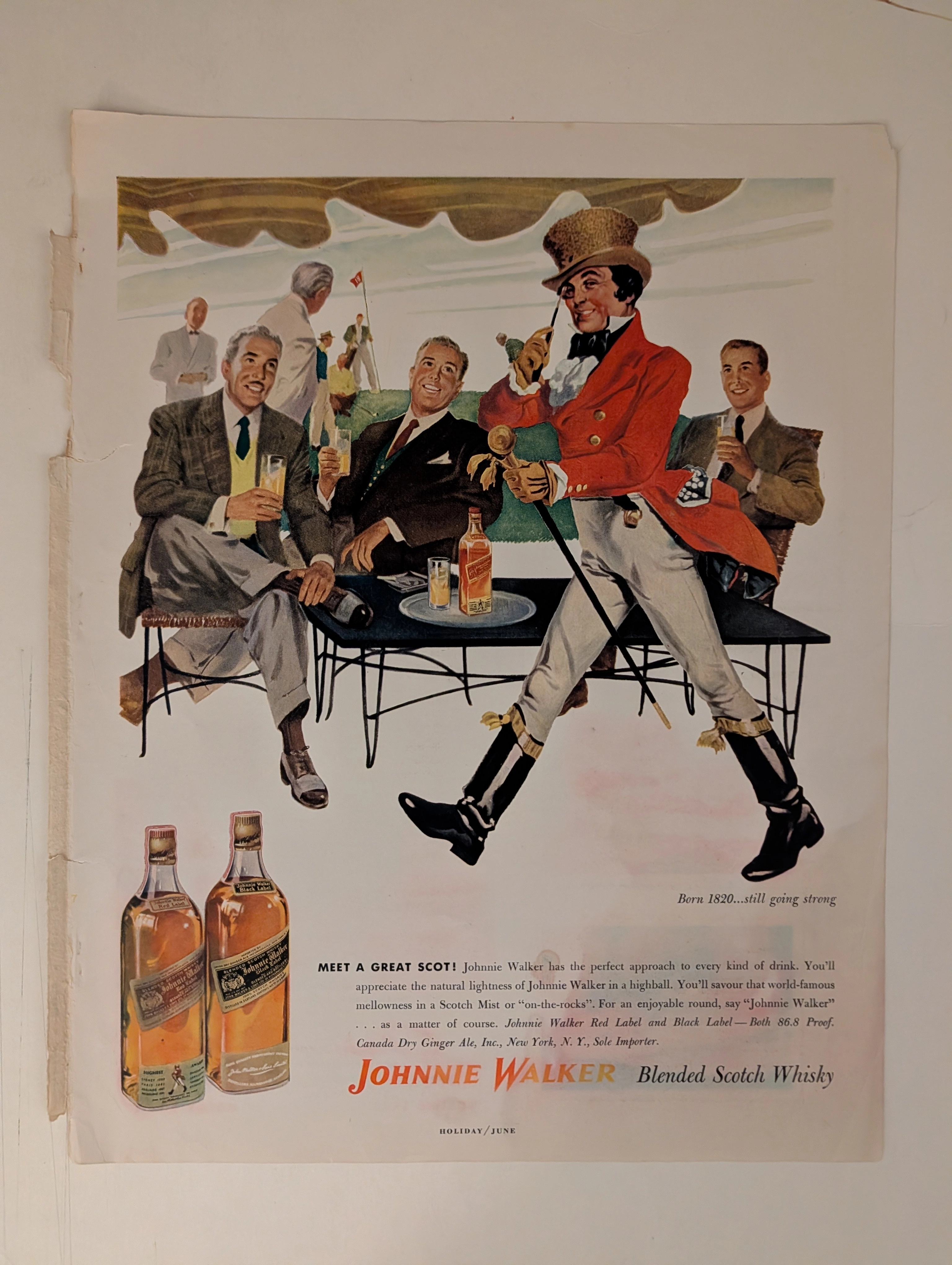
Welcome to the heavily guarded, velvet-roped sanctuaries of mid-century American aristocracy. To merely glance at this document is a severe dereliction of curatorial duty; we must forensically interrogate its psychological intent. In the post-WWII era, America was experiencing an unprecedented economic explosion. A new class of wealthy executives, managers, and suburbanites had emerged. However, new money always craves the validation of old heritage.

This advertisement is the ultimate sociological mechanism designed to provide that validation. Examine the trio of men seated under the scalloped awning. They are not working; they are at absolute leisure. Their attire—the soft-shouldered tweed jackets, the club ties, the casual yet perfectly pressed slacks—screams of the "Ivy League" or "WASP" aesthetic. Behind them, men engage in golf, a sport requiring vast expanses of manicured land, signifying ultimate exclusivity. By placing a bottle of Johnnie Walker on their table, the advertising agency is executing a flawless piece of social engineering: If you consume this liquid, you are not just drinking alcohol; you are purchasing entry into this specific, exclusionary socio-economic echelon.

[ PART II: THE APPARITION OF HERITAGE — THE STRIDING MAN ]
The absolute focal point of this canvas is not the product, but the mascot. The "Striding Man" is one of the most successful, universally recognized corporate avatars in the history of global capitalism. Originally sketched on a menu by the great illustrator Tom Browne in 1908, the figure was designed to transform the founder, John Walker, from a humble grocer into an Edwardian dandy.

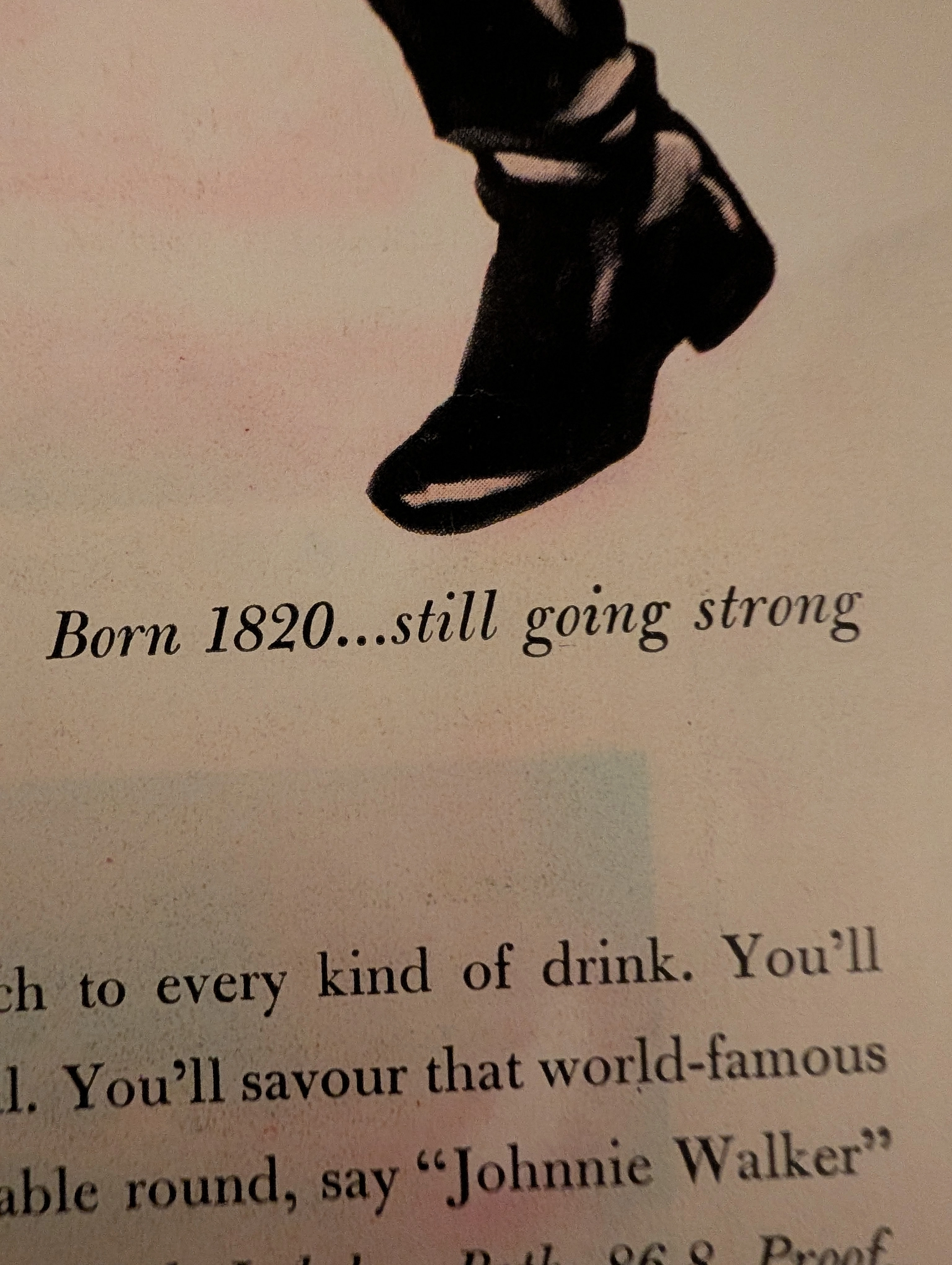
Notice how the artist has rendered him here. He is disproportionately large compared to the men in the background. He is a ghost, an idea, a physical manifestation of pedigree crossing over from the 19th century directly into the mid-20th century. His Hessian boots with tassels, the riding crop, the monocle, and the beaver-hair top hat are hyper-specific markers of British nobility. The tagline anchored directly beneath his boot—"Born 1820... still going strong"—is a brilliant psychological hook. It promises the anxious, newly wealthy American consumer that by purchasing this whisky, they are inheriting over a century of unshakeable European tradition and stability.

[ PART III: THE ALCHEMY OF COPYWRITING AND HIDDEN CORPORATE ANCHORS ]
The copywriting at the base of the page is a masterclass in subtle, persuasive arrogance. It commands: "MEET A GREAT SCOT!". It does not beg you to buy; it introduces you to a dignitary. It assumes you are already worldly enough to "appreciate the natural lightness" and "savour that world-famous mellowness".

However, the true forensic anchor of this document lies in the microscopic italicized text at the very bottom: "Canada Dry Ginger Ale, Inc., New York, N.Y., Sole Importer.". This is a massive historical clue. For decades, the Canada Dry corporation held the exclusive US distribution rights to Johnnie Walker, a partnership that dominated the mid-century liquor market. This specific corporate imprint roots the ethereal artwork firmly into the concrete reality of New York-based, post-war corporate logistics. Furthermore, the discreet text "HOLIDAY / JUNE" reveals its origin. Holiday magazine (published 1946-1977) was the most luxurious, sophisticated travel magazine in America. This ad was placed precisely where the absolute elite of the nation would see it.

[ PART IV: FORENSIC MACRO LITHOGRAPHY AND ICONOGRAPHY ]
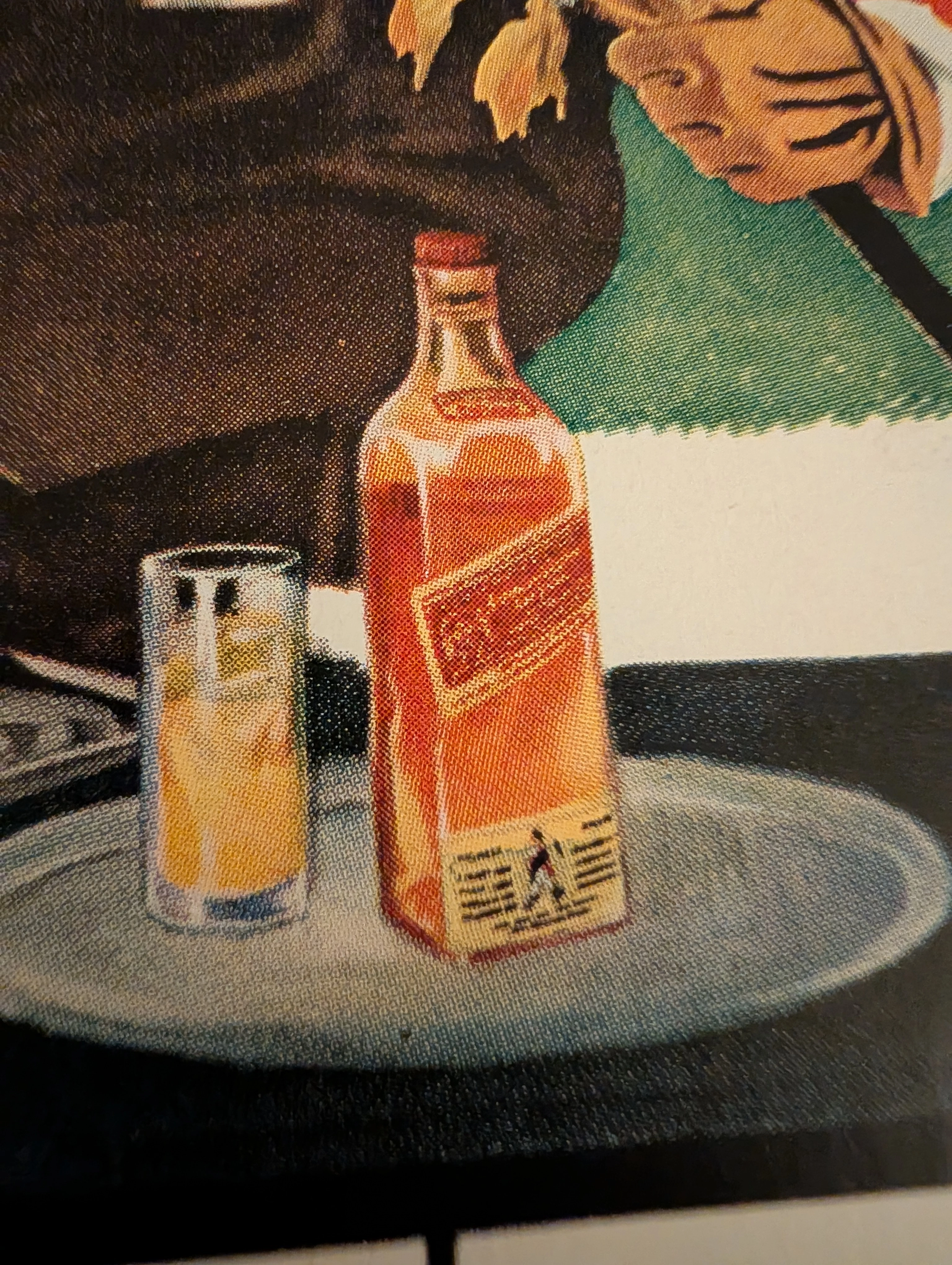
At The Record, our curatorial gaze penetrates down to the molecular level of the ink. Direct your attention to the extreme macro crop of the highball glass and the bottle resting on the table.

Here, the illusion of the painting breaks down into the brutal, beautiful reality of mid-century offset lithography. You can explicitly see the "halftone rosettes"—the microscopic, overlapping dots of cyan, magenta, yellow, and black ink that trick the human eye into perceiving solid colors and shading. The reflection of the ice cubes in the glass and the amber glow of the whisky are revealed to be nothing more than a calculated mathematical arrangement of ink dots.

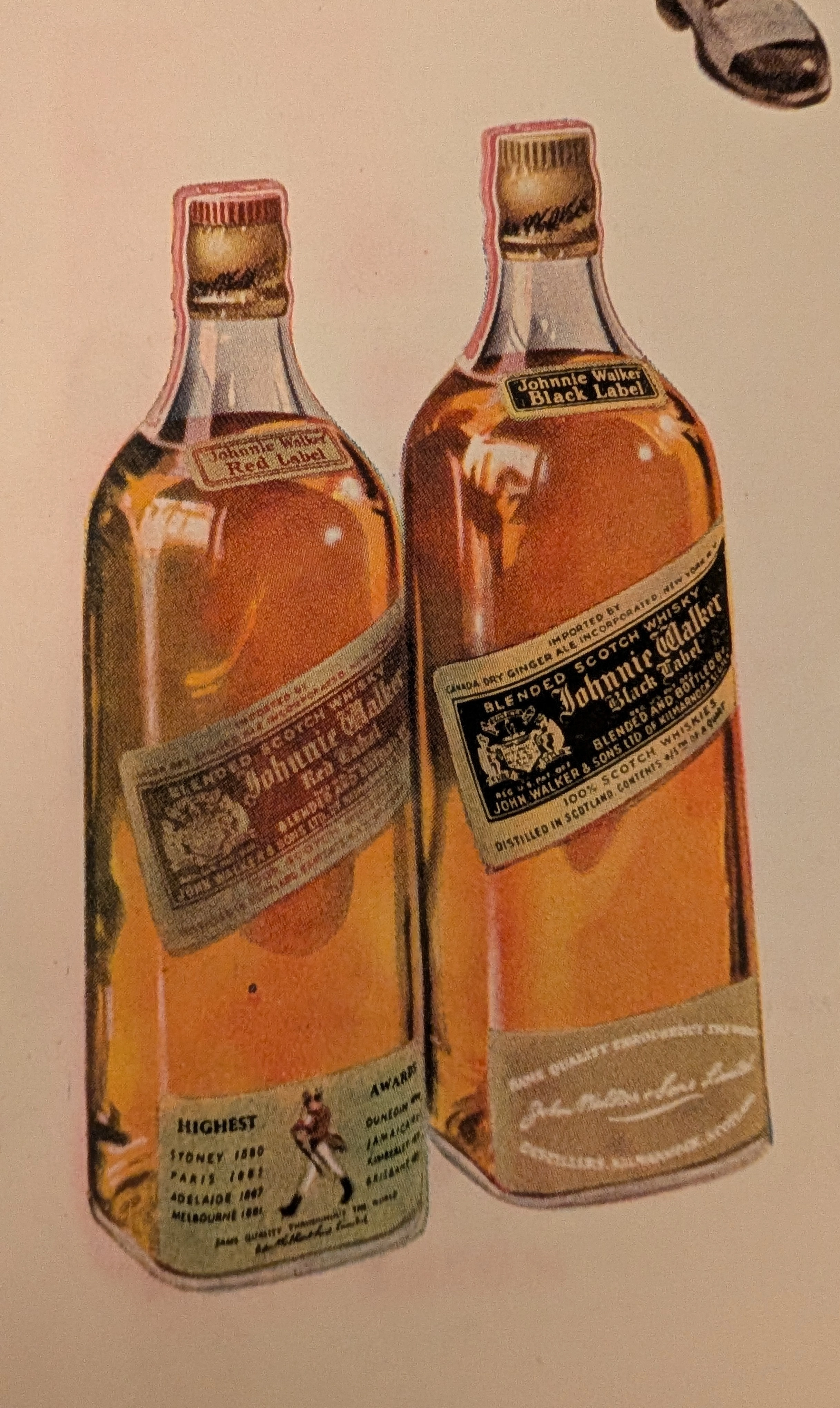
Examine the two bottles at the bottom left. The artist has painstakingly rendered the distinctive square bottles—a design innovation introduced by Alexander Walker in 1860 to reduce breakage and pack more bottles into shipping crates. Furthermore, the iconic labels, applied at a precise angle of 24 degrees, are rendered with hyper-realistic fidelity, showcasing the "Johnnie Walker Red Label" and "Black Label" designations alongside the intricate Royal Warrant crests. This is not just art; it is forensic product documentation.

The Paper

The physical medium of this artifact is just as historically profound as the artwork it carries. We must maintain absolute, uncompromising reverence for the inevitable, tragic beauty of analog destruction.

Examine the extreme left edge of the entire canvas. You will notice a deeply jagged, uneven, and violently torn perimeter running vertically from top to bottom. Amateurs and sterile perfectionists might view this as damage. At The Record, we view this as the "Scar of Liberation." It is the undeniable physical proof that this high-quality page was forcefully and purposefully ripped from the metal staples of a thick, original issue of Holiday magazine. It was rescued from the incinerator of history by someone who recognized its artistic value decades ago.

Furthermore, observe the surface of the paper itself. Over roughly 70 years, ambient oxygen and ultraviolet light have waged a relentless chemical war against the paper's inherent wood-pulp lignin. This irreversible oxidation process has birthed a magnificent, undeniable "patina." What was once a sterile, bright white background has gracefully degraded into a deep, warm, toasted Antique Ivory.

This is the profound Japanese aesthetic of wabi-sabi—the spiritual realization of finding absolute perfection in impermanence, flaw, and decay. This paper is quietly, literally burning itself alive at a molecular level. Its slow, majestic, and irreversible death is precisely what transfigures it from a disposable piece of mid-century corporate marketing into an immortal piece of Primary Art. No digital screen can ever replicate the tactile fragility or the distinct olfactory signature of this decaying 1950s pulp.

The Rarity

To understand the immense, almost incalculable valuation of this artifact, you must comprehend the brutal reality of ephemera survival. The post-war era was defined by rapid consumption; magazines were read on airplanes or in country club lounges and immediately discarded.

The statistical probability of a full-page, highly detailed Johnnie Walker advertisement from Holiday magazine surviving seven decades with its halftone colors so vividly saturated, its typography perfectly intact, and its historical importer data preserved is staggeringly low.

When you fuse this pristine physical preservation with the monumental sociological signaling of the American leisure class, the mythological iconography of the Striding Man, the forensic evidence of mid-century lithography, and the breathtaking wabi-sabi degradation of its torn paper stock, this artifact unequivocally commands the highly prestigious Rarity Class A designation. It has evolved far beyond a disposable piece of vintage commercial advertising. It is a highly coveted Historical Relic, a museum-grade testament to transatlantic commerce and the psychology of wealth, demanding to be framed and fiercely protected by an alpha curator who understands the heavy, beautiful weight of analog history.

Visual Impact

The Visual Impact of this vertical canvas is a masterclass in establishing an immediate, unassailable socio-economic hierarchy. The architectural layout employs a brilliant "foreground-background" psychological dichotomy.

In the background, bathed in the soft, diffused, and highly privileged light of a country club awning, sit three impeccably tailored men. Their posture is relaxed, their smiles are effortlessly confident; they represent the static, untouchable summit of the post-war American Dream. Behind them, the green expanse of a golf course—the ultimate spatial luxury—stretches to the horizon.

However, the foreground erupts with kinetic, almost supernatural energy. The iconic "Striding Man"—dressed in an aristocratic crimson riding coat, pristine white breeches, Hessian boots, and a top hat—is marching across the canvas from left to right. He is not a man; he is an apparition, an avatar of unbroken lineage and relentless progress. The visual weight of his bright red coat forces the viewer's eye to follow his stride, seamlessly leading down to the meticulously rendered bottles of Red and Black Label whisky waiting in the lower-left quadrant. The violently torn left edge of the page provides a brutal, physical frame to this scene of high-society serenity, anchoring the illusion firmly to the tragic reality of physical decay.

Share This Archive

The Archive Continues

Continue the Exploration
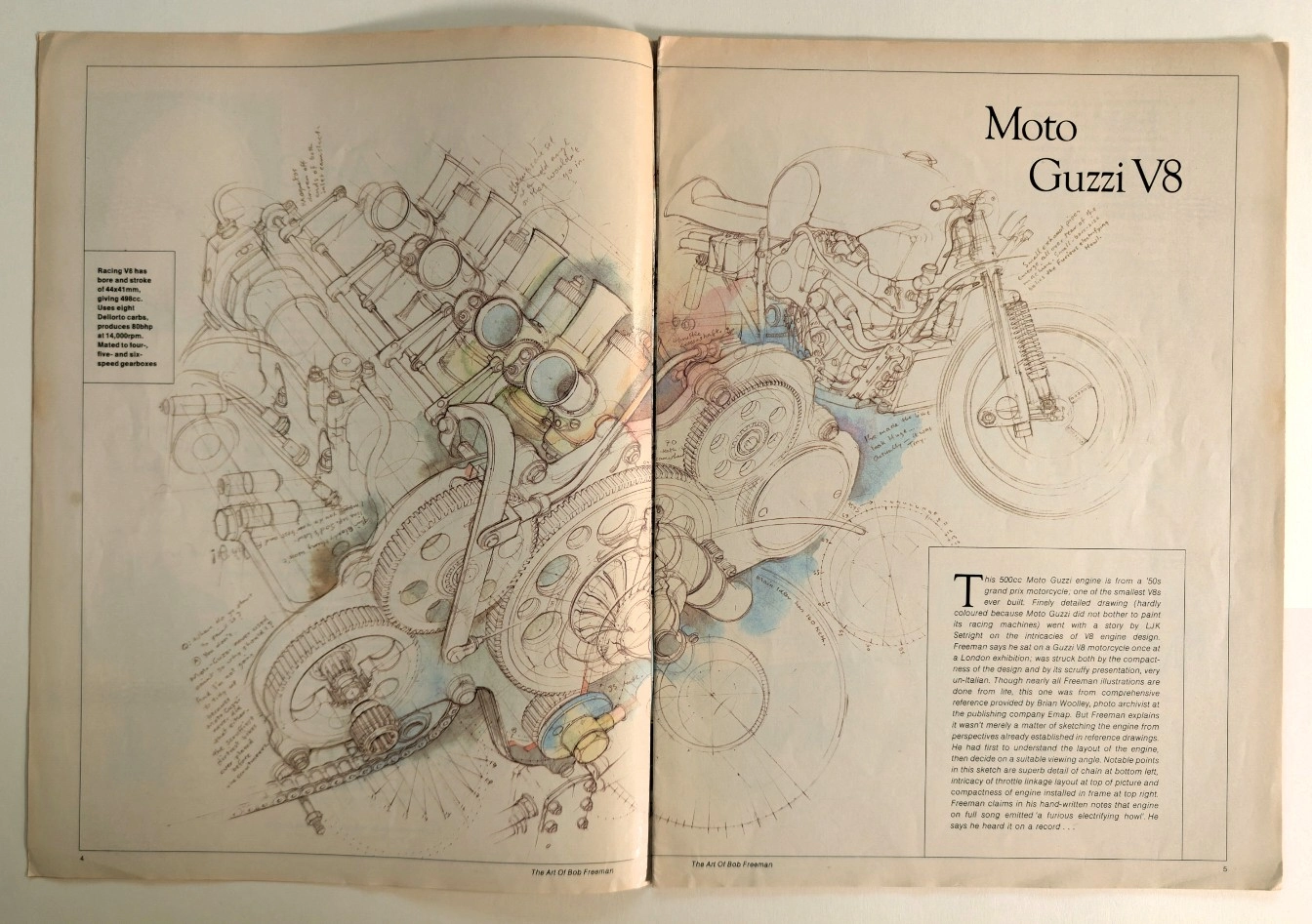
Anatomy of a Monster: The Moto Guzzi V8 Technical Masterpiece

Anatomy of a Monster: The Moto Guzzi V8 Technical Masterpiece

Unearthing a rare technical illustration of the legendary Moto Guzzi V8 engine by Bob Freeman, preserved on naturally aged, pre-2000 analog print media.
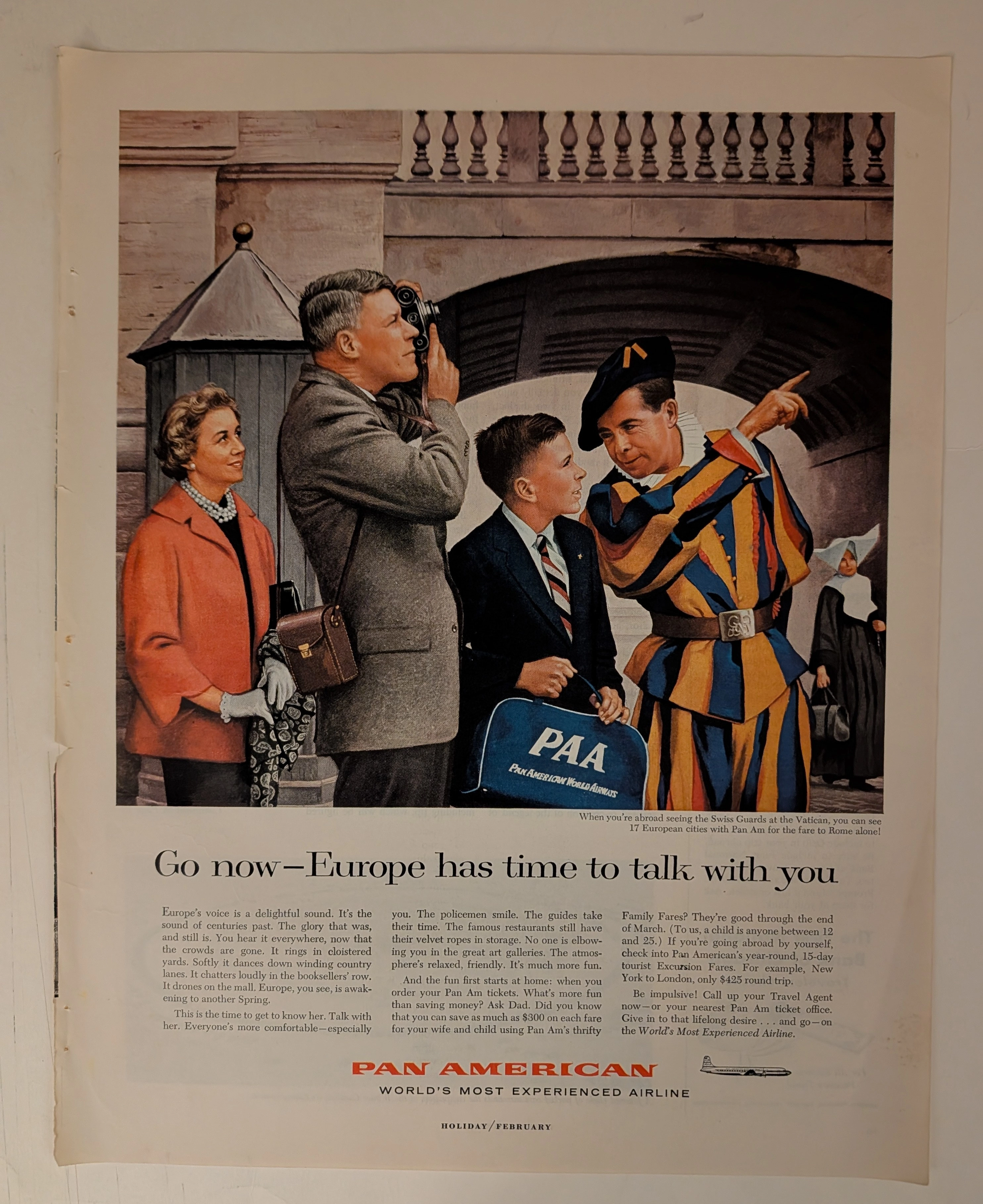
THE TIME TRAVELER'S DOSSIER: PAN AM - THE ARCHITECTURE OF THE AMERICAN TOURIST

PAN AMERICAN WORLD AIRWAYS · Travel

THE TIME TRAVELER'S DOSSIER: PAN AM - THE ARCHITECTURE OF THE AMERICAN TOURIST

The artifact currently subjected to our uncompromising, museum-grade analysis is a profoundly preserved Historical Relic excavated from the zenith of mid-century American aviation prosperity. This Primary Art Document is a full-page magazine advertisement for Pan American World Airways. Functioning as a "Forensic Blueprint of the American Leisure Class Abroad," the document masterfully weaponizes European heritage and history to validate the affluent, off-season travel of post-war American consumers. ​Its historical context is irrefutably anchored by the microscopic silhouette of a Douglas DC-7B aircraft, placing this artifact squarely in the twilight of the propeller age, just before the dawn of the Boeing 707 jet era. Grounded by extreme macro details of the iconic PAA flight bag, the bold corporate typography, and the breathtaking wabi-sabi chemical degradation highlighted by its violently torn binding edge, this artifact commands an irreplaceable status, cementing its Rarity Class S designation as a masterpiece of corporate sociological engineering.
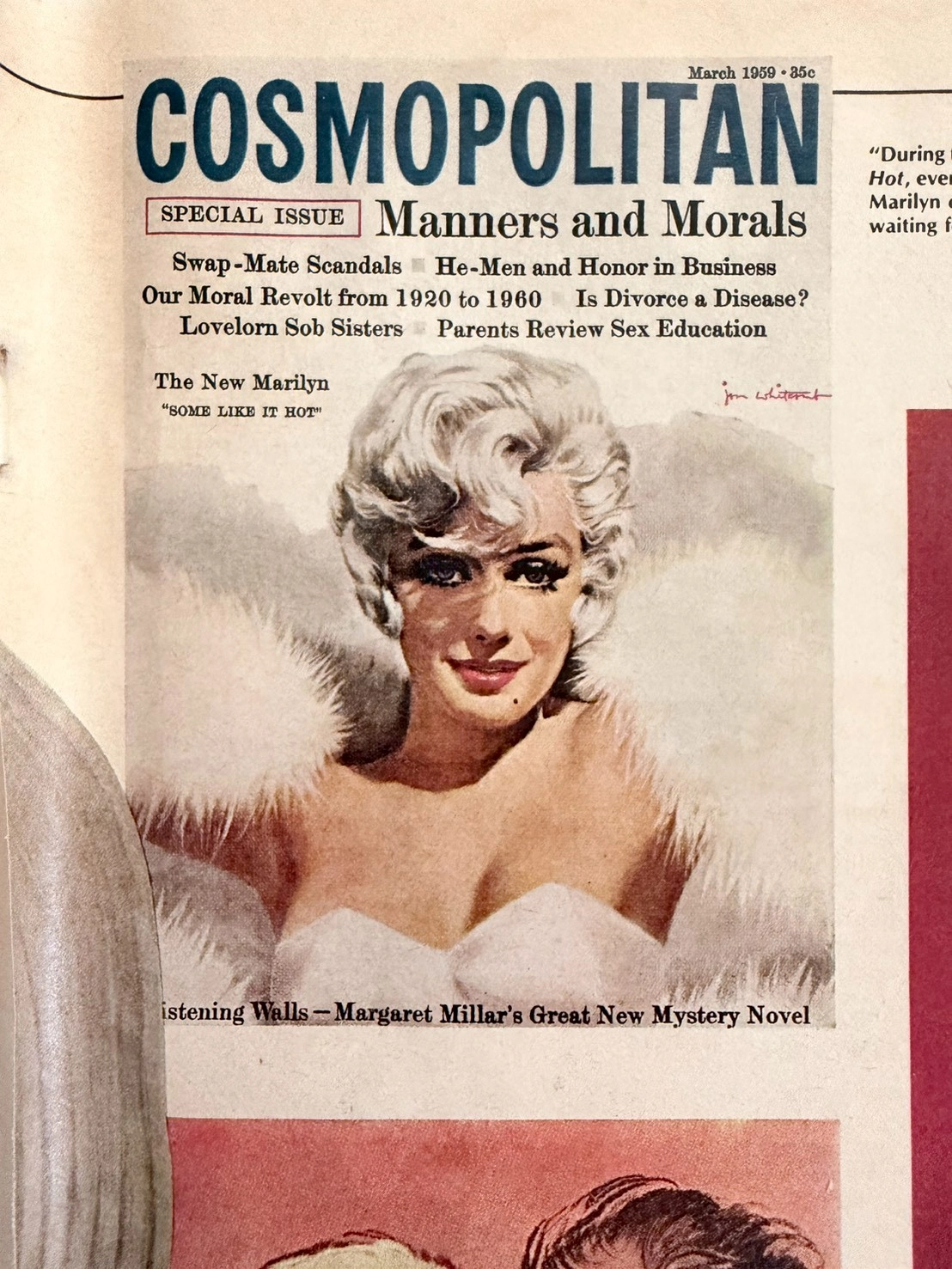
The Marilyn Monroe Enigma: Uncovering 1950s Hollywood Secrets Through Ultra-Rare Vintage Magazine Art (Class SS)

The Marilyn Monroe Enigma: Uncovering 1950s Hollywood Secrets Through Ultra-Rare Vintage Magazine Art (Class SS)

This museum-grade editorial explores an ultra-rare SS-Class archival piece from The Record Institute. It chronicles the 1980 Playboy magazine discovery of lost Marilyn Monroe negatives, eventually solved by legendary illustrator Jon Whitcomb. The artifact not only captures the vulnerability of the 1950s ultimate sex symbol alongside Arthur Miller but also serves as a poignant historical record of the transition from the Golden Age of Illustration to modern photography, celebrating the visceral charm of analog paper preservation.
Published by

The Record Institute

Taxonomy Match

Related Articles

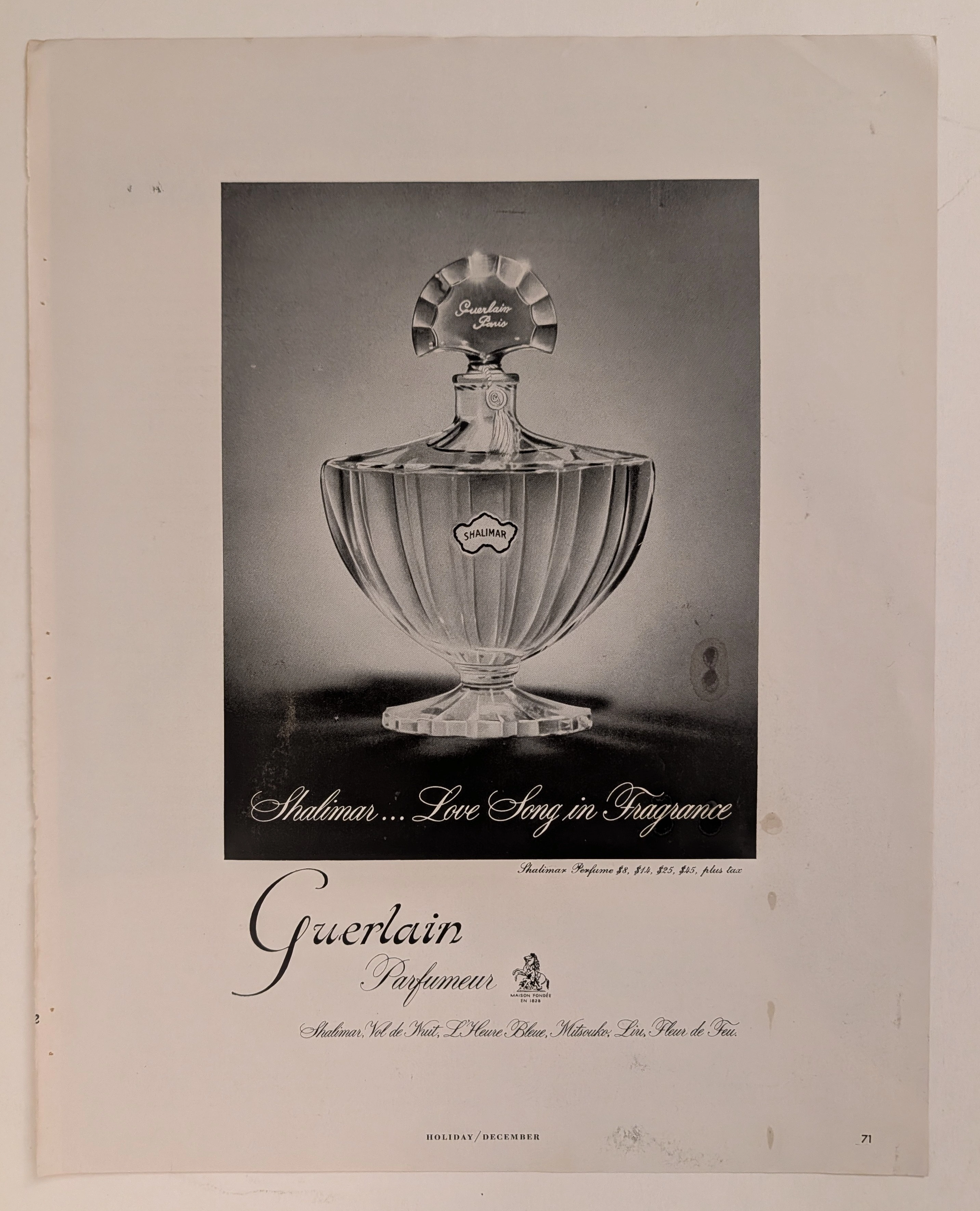
The Time Traveller's Dossier: The Architecture of Desire – Guerlain "Shalimar" Advertisement (Circa Mid-20th Century) — related article
Read Article

The Time Traveller's Dossier: The Architecture of Desire – Guerlain "Shalimar" Advertisement (Circa Mid-20th Century)

History is not an accidental sequence of events; it is a meticulously engineered illusion crafted by those who command the aesthetic and cultural narratives of their time. Long before digital algorithms could sterilely dictate consumer preferences, the ultimate manifestation of psychological manipulation and corporate alchemy was executed through the calculated precision of the halftone printing press and the absolute mastery of analog darkroom photography. The historical artifact before us is not merely a disposable page torn from a vintage magazine. It is a perfectly weaponized blueprint of exoticism, a visual declaration of extreme luxury, and an unwavering testament to an era where fragrance was sold not as a cosmetic, but as an immortal "Love Song." ​This museum-grade, academic archival dossier presents an exhaustive, microscopic deconstruction of a mid-20th-century print advertisement for the legendary Guerlain "Shalimar" perfume. Operating on a profound and ruthless binary structure, this document records a calculated paradigm shift within the global luxury industry. It captures the precise historical fracture where a concoction of botanical extracts and synthetic molecules was conceptually transmuted into a literal, physical embodiment of a mythical Eastern romance. Through the highly specialized lens of late-analog commercial artistry and stringent visual forensics, this document serves as a masterclass in psychological marketing. It established the foundational archetype for selling intangible emotions at astronomical markups—an archetype that unconditionally dictates the visual and strategic totems of the modern haute parfumerie industry today.

THE TIME TRAVELLER'S DOISSIER — THE WWII HOME FRONT AND THE AESTHETICS OF DESTRUCTION — related article
Read Article

THE TIME TRAVELLER'S DOISSIER — THE WWII HOME FRONT AND THE AESTHETICS OF DESTRUCTION

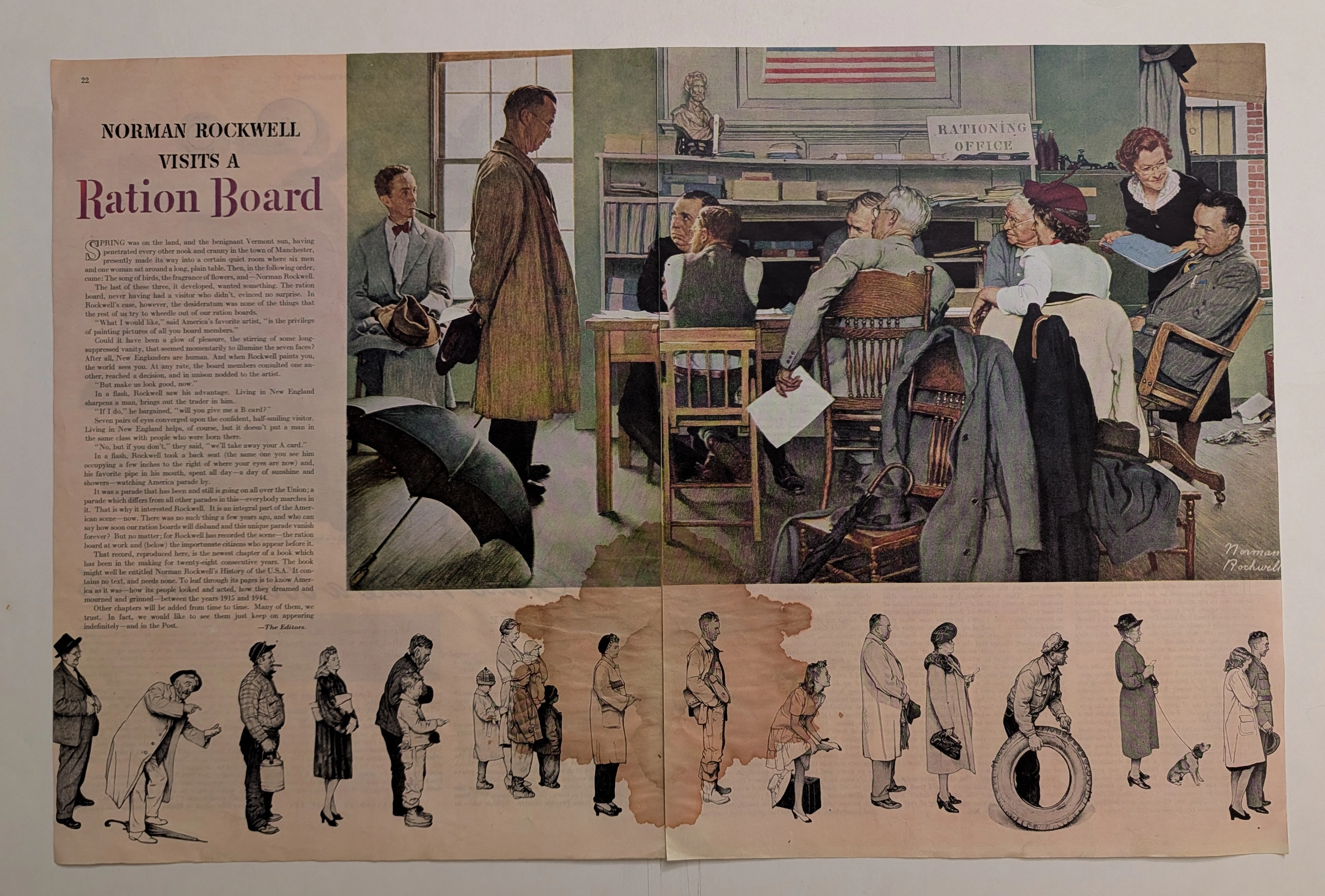
Executive summary of the original vintage double-page cut sheet featuring Norman Rockwell's WWII masterpiece, "Norman Rockwell Visits a Ration Board" (circa 1944). This artwork masterfully captures the egalitarian struggle of the American home front rationing system. The massive, rust-colored water stain blooming across the highly acidic 80-year-old paper is not damage, but a profound 'historical scar' that exemplifies the beautiful decay of analog media. Surviving wartime paper drives, this frame-ready primary artifact commands a Rarity Class S designation.

THE TIME TRAVELER'S DOSSIER: THE ARCHITECTURE OF POWER AND THE BIRTH OF THE DIGITAL WORLD IN THE 50S — related article
Read Article

THE TIME TRAVELER'S DOSSIER: THE ARCHITECTURE OF POWER AND THE BIRTH OF THE DIGITAL WORLD IN THE 50S

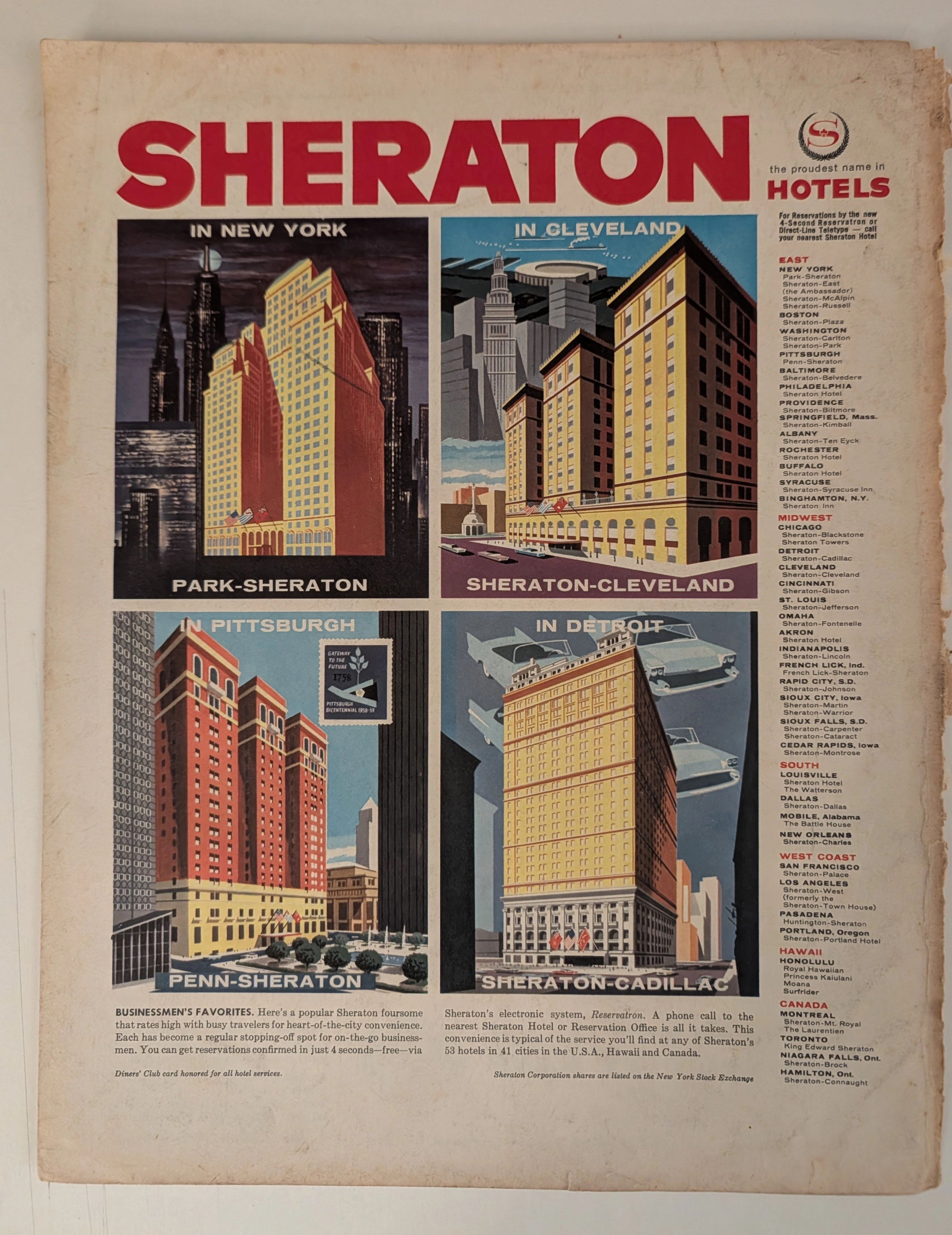
The artifact under exhaustive, uncompromising museum-grade analysis is a remarkably preserved Historical Relic originating from the absolute zenith of the post-war American economic boom. This Primary Art Document is a sweeping, monumental full-page advertisement for the Sheraton Hotels empire, forensically dated to circa 1958–1959 via the explicitly illustrated Pittsburgh Bicentennial (1758-1958) stamp embedded within the artwork. This document is not merely a travel advertisement; it is a profound "Sociological Blueprint of the American Corporate Ascendancy." Visually anchored by four hyper-stylized, architectural illustrations of Sheraton's flagship properties—New York, Cleveland, Pittsburgh, and Detroit—the piece captures the era's unbridled optimism. Each panel is a masterpiece of mid-century commercial illustration, particularly the Detroit panel featuring ethereal, floating tail-fin automobiles symbolizing the Motor City's dominance. Furthermore, this artifact documents critical milestones in global business history. It proudly advertises the acceptance of the Diners' Club card, marking the revolutionary dawn of the modern credit card era. It also boasts of Sheraton's "Reservatron" electronic system—one of the earliest commercial applications of computing in the hospitality industry—and proudly declares its listing on the New York Stock Exchange. Rescued from the binding of a forgotten, heavy-stock periodical, this pre-2000s analog artifact is an unforgeable testament to the Japanese aesthetic of wabi-sabi. Printed on inherently acidic wood-pulp paper, it exhibits a beautifully violent, jagged right margin and a deep, warm amber oxidation across its surface. This majestic, unstoppable chemical degradation transforms a mass-produced corporate propaganda piece into an irreplaceable, ready-to-frame Primary Art Document of mid-century architectural and economic history.

THE TIME TRAVELER'S DOSSIER: HOLLYWOOD PROPAGANDA AND THE DAWN OF MULTIMEDIA SYNERGY — related article
Read Article

THE TIME TRAVELER'S DOSSIER: HOLLYWOOD PROPAGANDA AND THE DAWN OF MULTIMEDIA SYNERGY

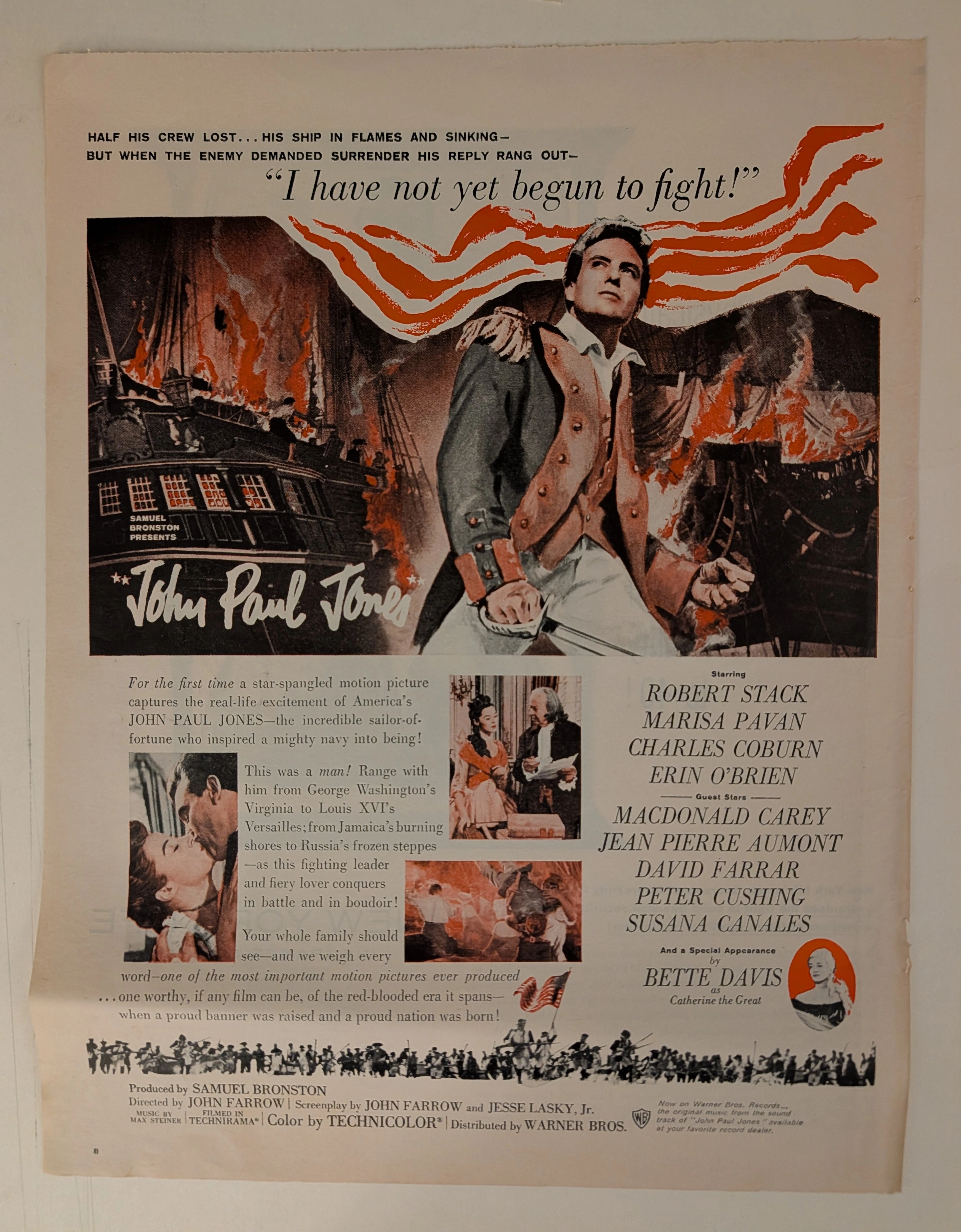
The artifact under exhaustive, uncompromising, and unprecedented museum-grade analysis is a remarkably preserved Historical Relic originating from the zenith of Hollywood's post-war epic era. This Primary Art Document is a monumental, full-page theatrical advertisement for the 1959 biographical epic "John Paul Jones", produced by the legendary independent film mogul Samuel Bronston and distributed by Warner Bros.. ​This is not merely a movie poster; it is a "Forensic Blueprint of Cold War American Nationalism and Multimedia Synergy." Released in 1959, at the height of the Cold War, the advertisement aggressively weaponizes the foundational mythos of the United States Navy. The commanding, blood-red headline, "I have not yet begun to fight!", serves as a psychological anchor, projecting unyielding American defiance to both domestic audiences and global adversaries. Visually dominated by the rugged, heroic portrait of Robert Stack, the ad expertly balances masculine wartime aggression with romantic subplots and diplomatic intrigue featuring Charles Coburn as Benjamin Franklin. Furthermore, it showcases elite Hollywood casting power by explicitly highlighting a "Special Appearance by Bette Davis as Catherine the Great" in a striking red cameo vignette. ​Crucially, this artifact documents an early, masterful execution of cross-platform corporate synergy. The bottom corner explicitly markets the original Max Steiner soundtrack on Warner Bros. Records, proving that the commercialization of the "Original Motion Picture Soundtrack" was already highly codified. ​Rescued from the inevitable oblivion of disposable entertainment media, this pre-2000s analog artifact is a breathtaking embodiment of the Japanese aesthetic of wabi-sabi. Printed on inherently acidic mid-century wood-pulp paper, it exhibits beautifully authentic edge wear and a profound, warm amber oxidation across its surface. This unstoppable molecular death transforms a mass-produced piece of Hollywood propaganda into an irreplaceable, ready-to-frame Primary Art Document of cinematic and sociological history.

THE TIME TRAVELER'S DOSSIER :THE BIRTH OF THE WIDE-TRACK — related article
Read Article

THE TIME TRAVELER'S DOSSIER :THE BIRTH OF THE WIDE-TRACK

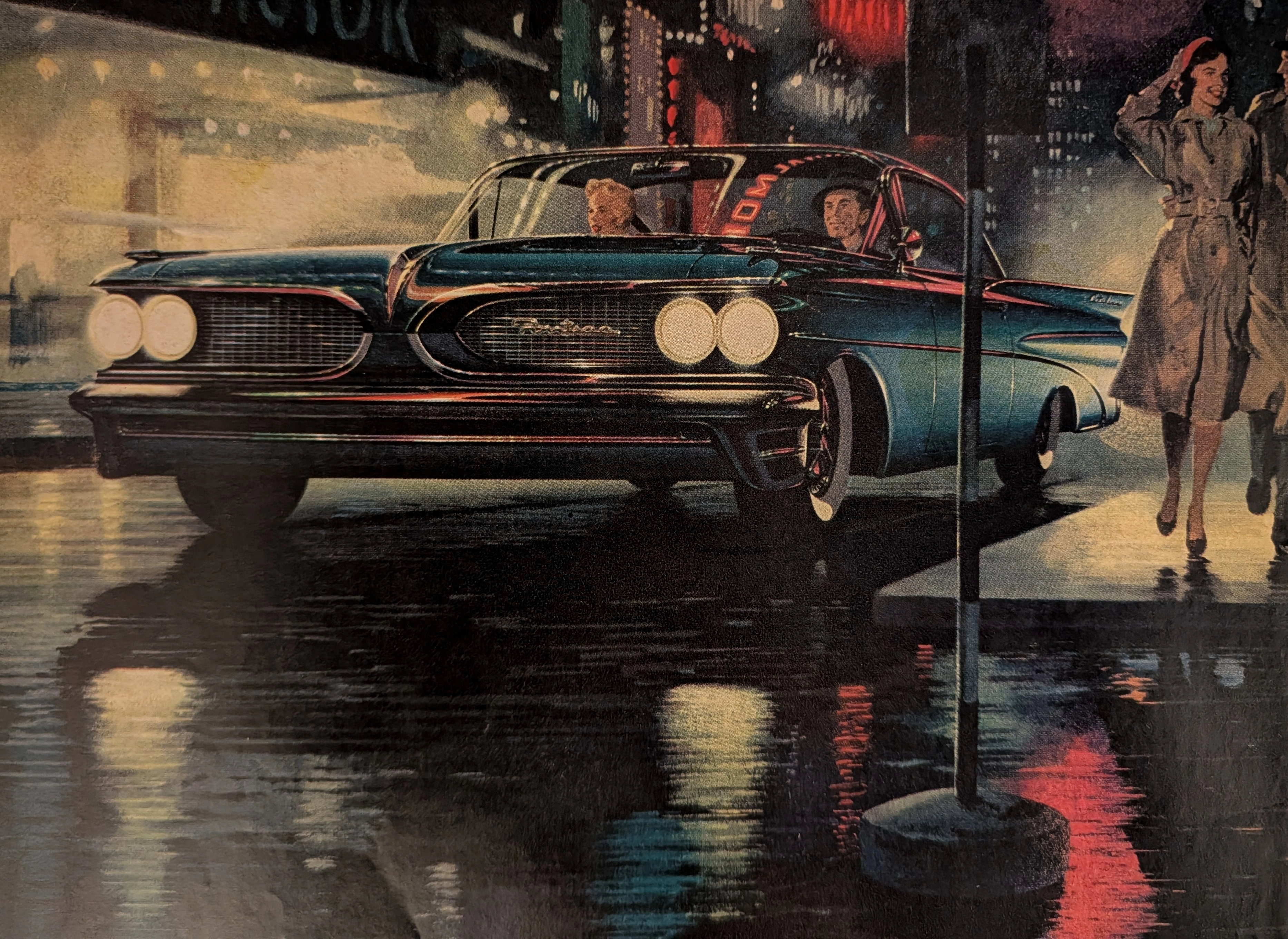
The artifact currently subjected to our uncompromising, museum-grade analysis is a profoundly preserved Historical Relic excavated from the turning point of Detroit's "horsepower and handling" wars. This Primary Art Document is a full-page magazine advertisement for the 1959 Pontiac, explicitly introducing the brand's revolutionary "Wide-Track" engineering. Functioning as a "Forensic Blueprint of Automotive Rebranding," the document masterfully weaponizes the peerless artistic talents of Fitz and Van to transform Pontiac from a conservative, aging brand into America's most aggressive performance marque. Its historical context is irrefutably anchored by the extreme macro details of its proprietary engineering claims and the highly coveted "Body by Fisher" corporate hallmark. Grounded by these physical timestamps, the microscopic artist signature, and its breathtaking wabi-sabi chemical degradation, this artifact commands an irreplaceable status, cementing its Rarity Class A designation.

The Time Traveller's Dossier: The Architecture of Eternity – De Beers "Glory of Bells" Advertisement (Circa early 1940s) — related article
Read Article

The Time Traveller's Dossier: The Architecture of Eternity – De Beers "Glory of Bells" Advertisement (Circa early 1940s)

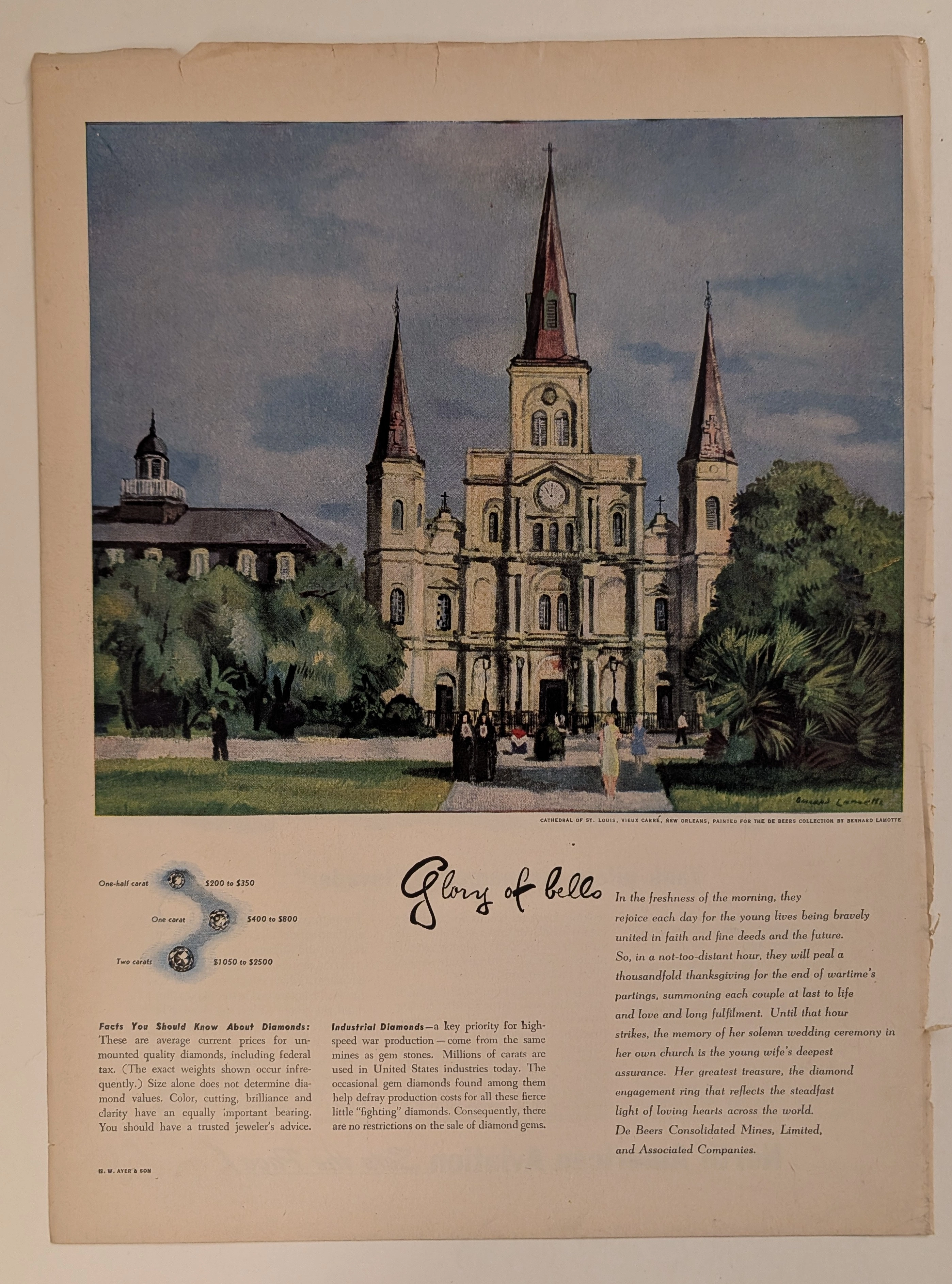
History is not shaped by chance; it is engineered by those who control the narrative and own the resources. Long before the digital age fragmented human attention, the ultimate manifestations of social engineering and psychological manipulation were executed through the calculated precision of the four-color offset printing press and the masterful strokes of commercial fine art. The historical artifact presented before us is not merely a page from a vintage magazine. It is a perfectly weaponized blueprint of corporate capitalism, a masterpiece of emotional extortion, and a foundational document in the creation of one of the most successful, universally accepted illusions in the history of human commerce: the diamond engagement ring. This museum-grade, academic archival dossier presents an exhaustive, microscopic deconstruction of a World War II-era print advertisement for De Beers Consolidated Mines, Limited, executed by the legendary advertising agency N.W. Ayer & Son. Operating on a profound and ruthless binary structure, this document records a calculated paradigm shift within the global luxury and gemstone industry. It captures the precise historical fracture where a monopolized carbon allotrope was conceptually transmuted from a rare gemstone into an absolute, non-negotiable sacrament of love, faith, and matrimony. Through the highly specialized lens of late-analog commercial artistry and stringent visual forensics, this document serves as a masterclass in psychological marketing. It established the foundational archetype for linking extreme financial expenditure with spiritual and emotional devotion—an archetype that unconditionally dictates the visual and strategic totems of the modern diamond industry today.