THE TIME TRAVELER'S DOSSIER: THE HOME FRONT SMILE AND THE 1944 PSYCHOLOGICAL WAR
The History
( THE HISTORY: World War II, Propaganda, and the Spirit of 7-Up )
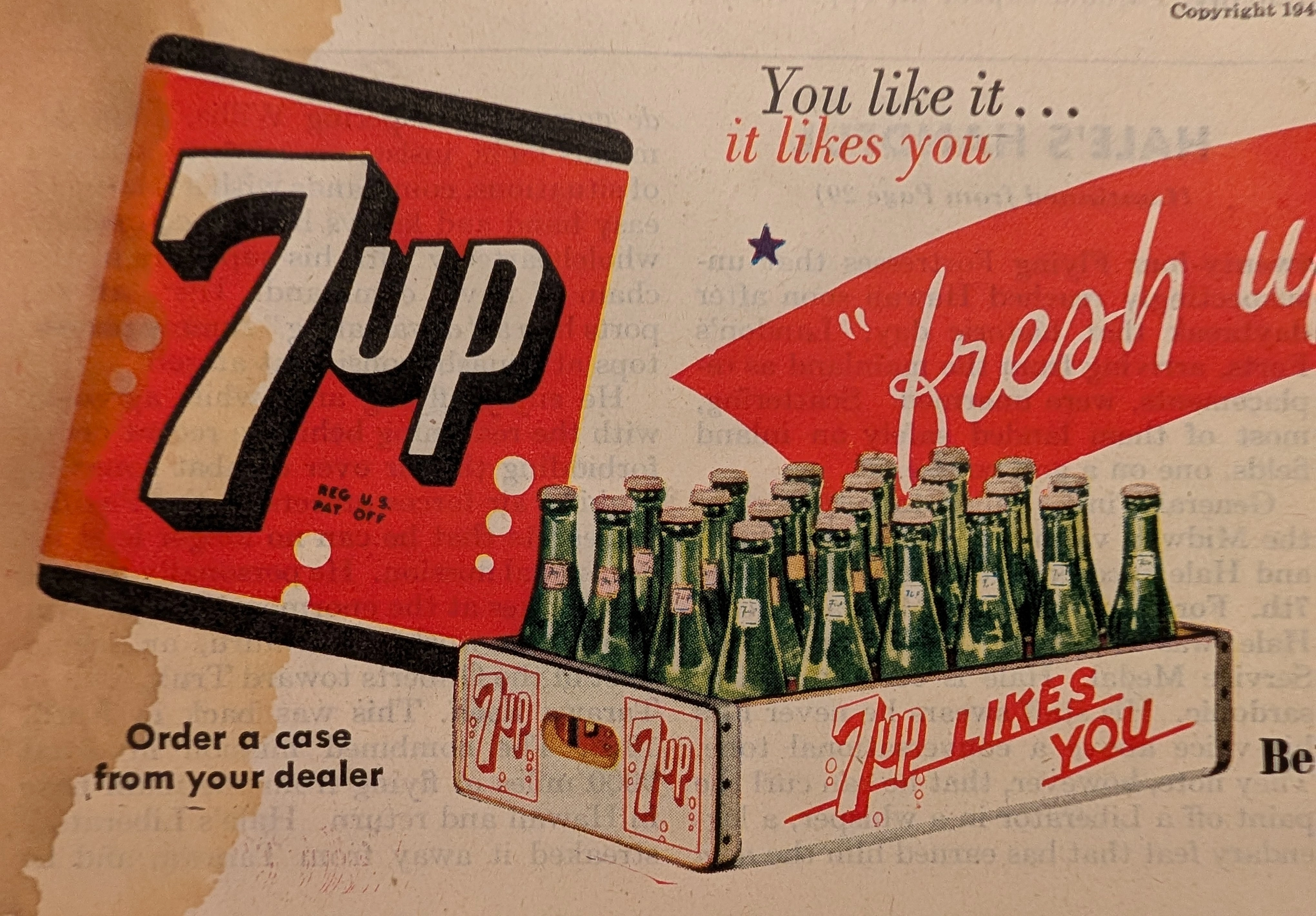
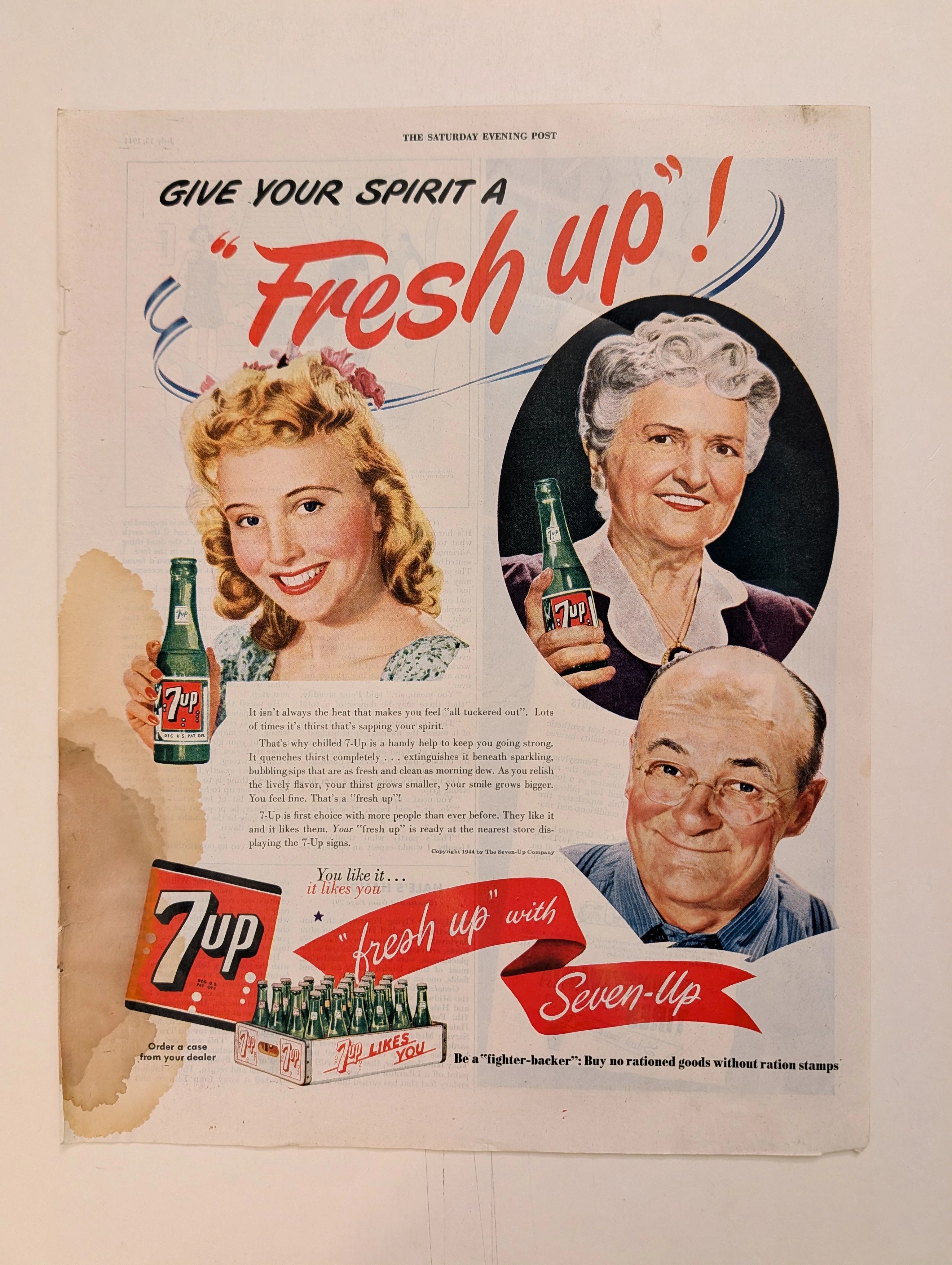
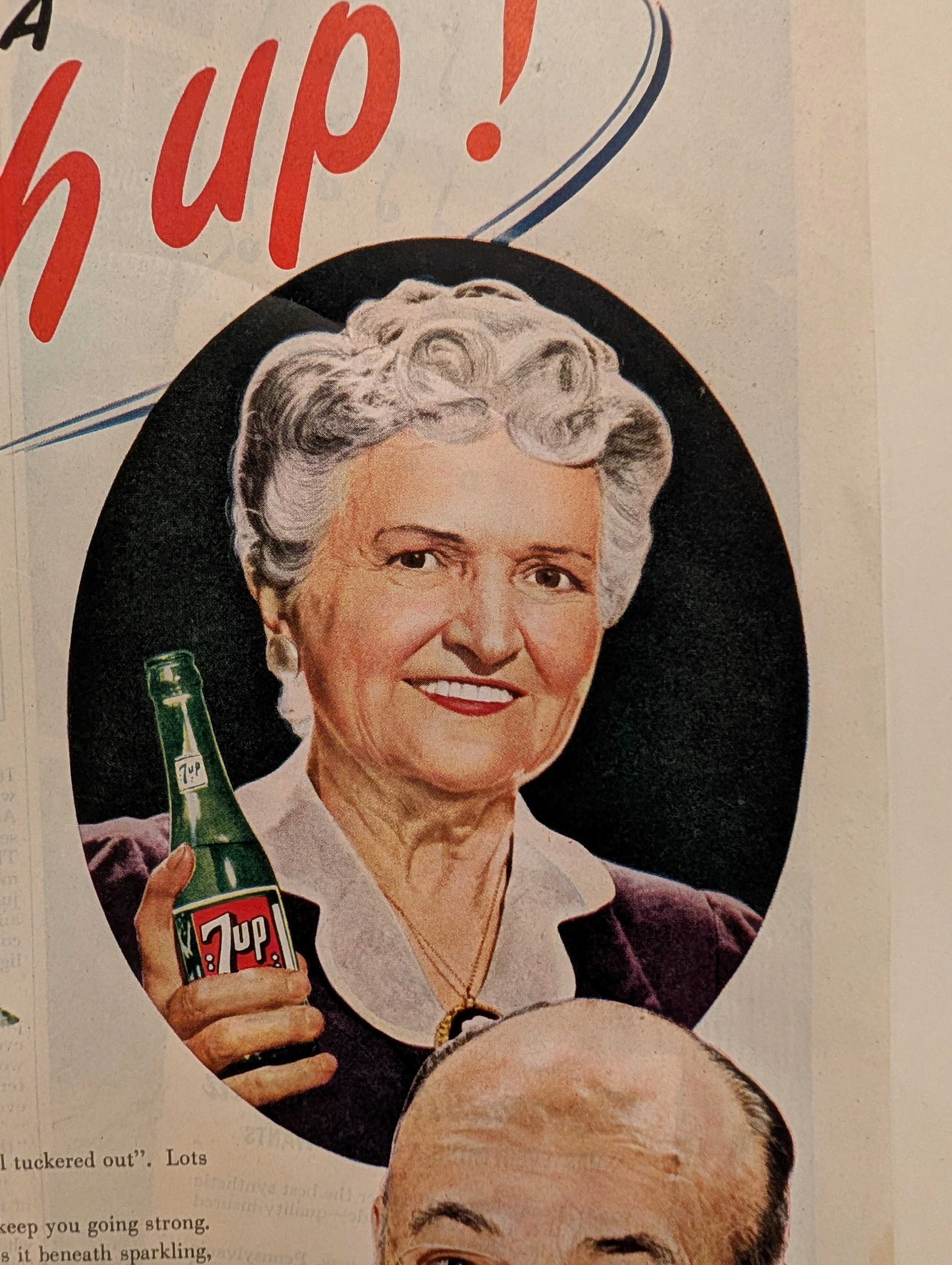
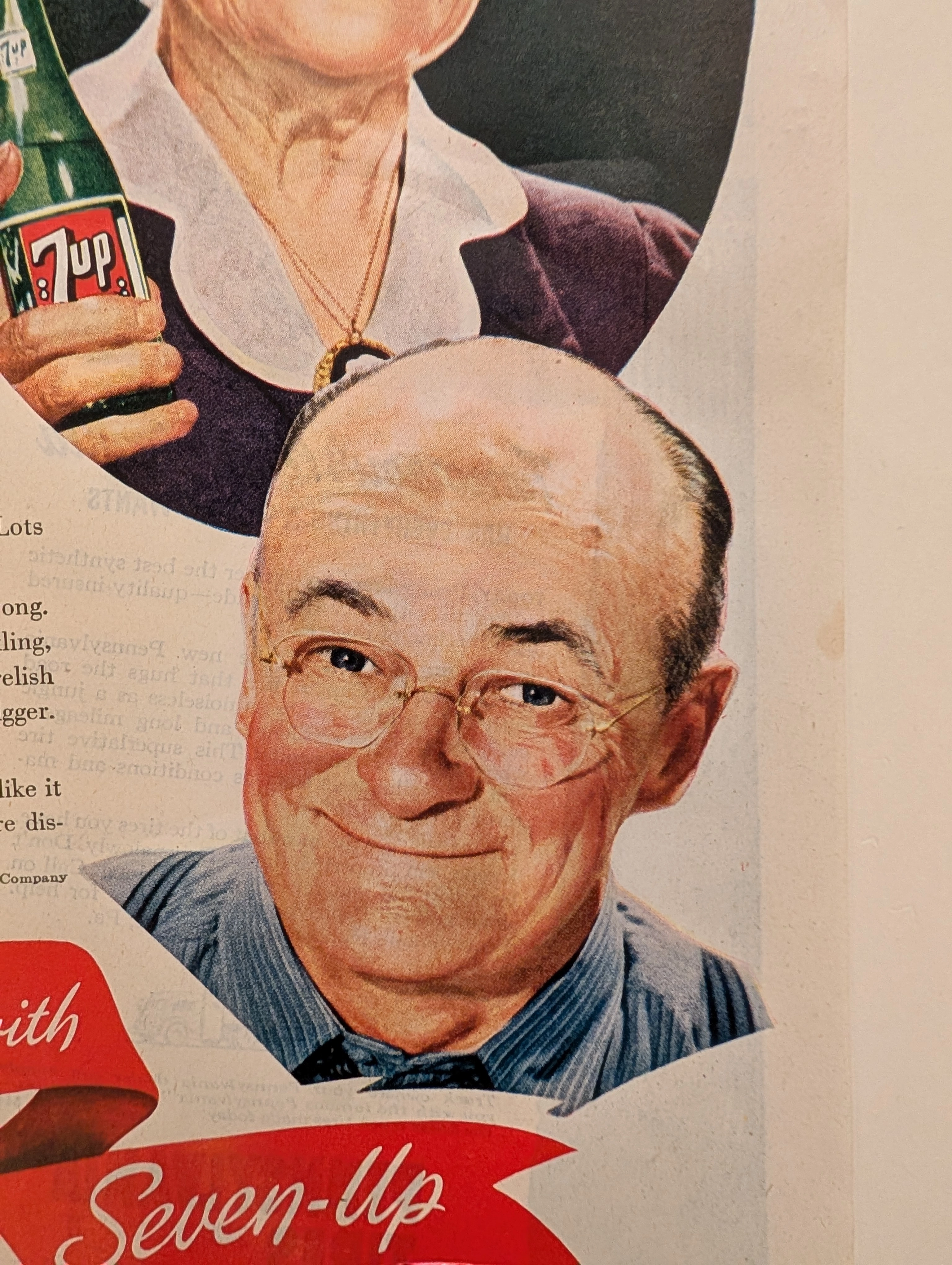
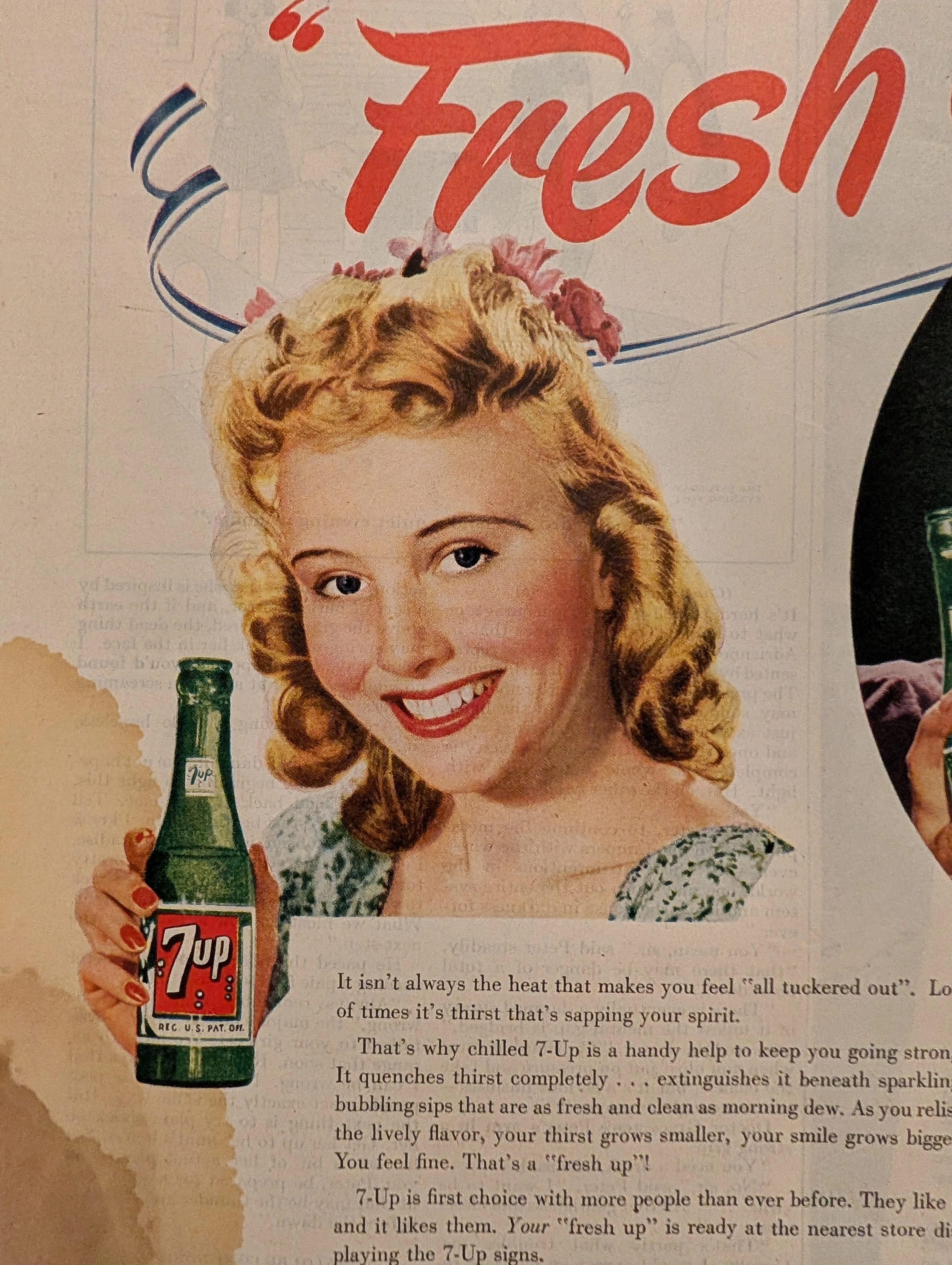
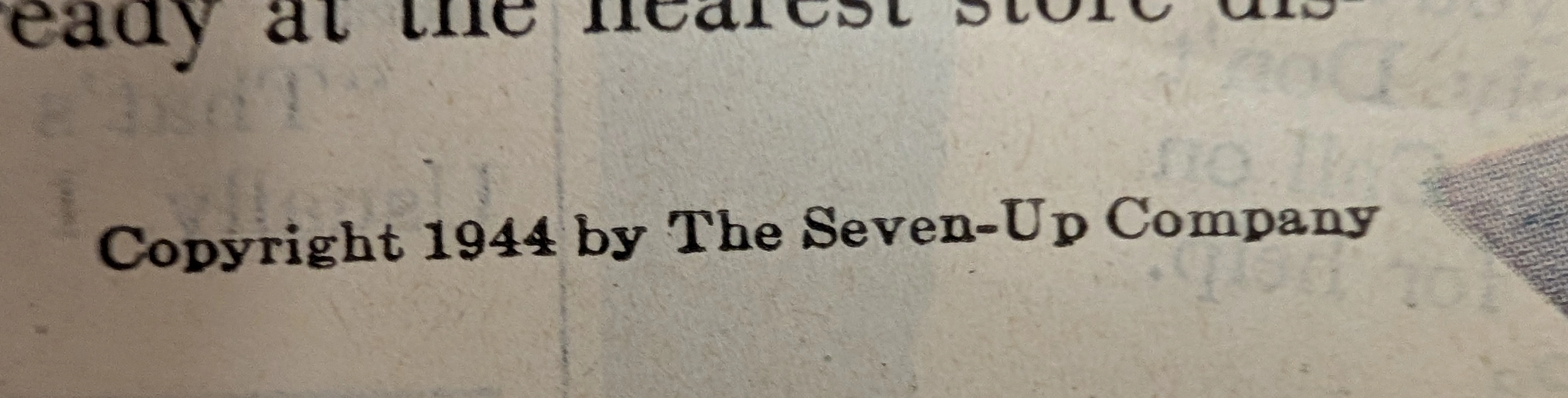
Step into the vault of The Record, where we do not simply observe paper; we interrogate it. The artifact before you is a vibrant 7-Up advertisement surgically extracted from a 1944 edition of The Saturday Evening Post. To the untrained eye, this is merely a charming mid-century beverage ad featuring the smiling faces of three distinct American generations. But as Chief Curator, I direct your focus to the microscopic text buried in the bottom right corner: "Be a 'fighter-backer': Buy no rationed goods without ration stamps." In an instant, this piece of commercial marketing is transmuted into a weapon of wartime psychological alignment.
The year 1944 represented the grueling, blood-soaked apex of World War II. As Allied forces prepared for the monumental D-Day invasion, the American "Home Front" was buckling under the immense psychological and physical strain of the war machine. The U.S. government had instituted draconian rationing protocols. Sugar, coffee, meat, and gasoline were severely restricted. A profound, collective "war weariness" was sapping the spirit of the nation.
The Seven-Up Company recognized this spiritual vacuum and executed a masterpiece of psychological marketing. They were no longer selling carbonated water; they were selling a spiritual resurrection—"Give your spirit a 'Fresh up'!" The genius of this ad lies in its subtle redirection of the citizen's burden. It suggests that the exhaustion Americans felt wasn't just the crushing weight of global conflict; it was merely thirst. 7-Up offered a guilt-free, non-rationed moment of relief.
Furthermore, by integrating the "fighter-backer" slogan, 7-Up brilliantly chained its corporate identity to unwavering patriotism. It commanded citizens to obey the rationing laws, implicitly stating that drinking a 7-Up was the beverage choice of a loyal American supporting the troops. This page is not a soda advertisement; it is a primary historical document of wartime propaganda seamlessly blended with consumerism.
( THE PAPER: The Aesthetics of Decay — The Watermark of Time )
The absolute core of The Record's philosophy is the glorification of analog decay. This artifact is an individual, standard-sized cut page, isolated from its original binding. Its most breathtaking feature is not the illustration, but the massive, dramatic water stain blossoming along its left margin.
Printed in the 1940s on highly acidic wood-pulp paper, this document was born with a chemical death sentence. When moisture met the inherent lignin within the paper fibers, it triggered an aggressive oxidation process. The resulting rust-colored stain and the deep, warm amber patina of the paper are not damages; they are unforgeable historical scars. This is the profound aesthetic of wabi-sabi—finding beauty in inevitable destruction. This paper is burning alive at a molecular level, and its extreme physical fragility is what elevates it from disposable media to a verified, irreplaceable Primary Art Print.
( THE RARITY: Class A — A Survivor of the War Machine )
During WWII, paper was critical ammunition. Millions of magazines were surrendered to nationwide "Paper Drives," shredded and pulped to manufacture artillery boxes and rationing books. The survival rate of a fragile magazine page from 1944 is astoundingly low.
Because it survived the wartime incinerators, evaded eight decades of environmental ruin, and bears such a majestic, naturally occurring water stain, this artifact undeniably commands a Rarity Class A designation. You are not looking at a vintage ad; you are looking at a dying survivor of the 20th century's greatest conflict, ready to be framed before it turns to dust.
Exhibition Halls
The Archive Continues
Continue the Exploration
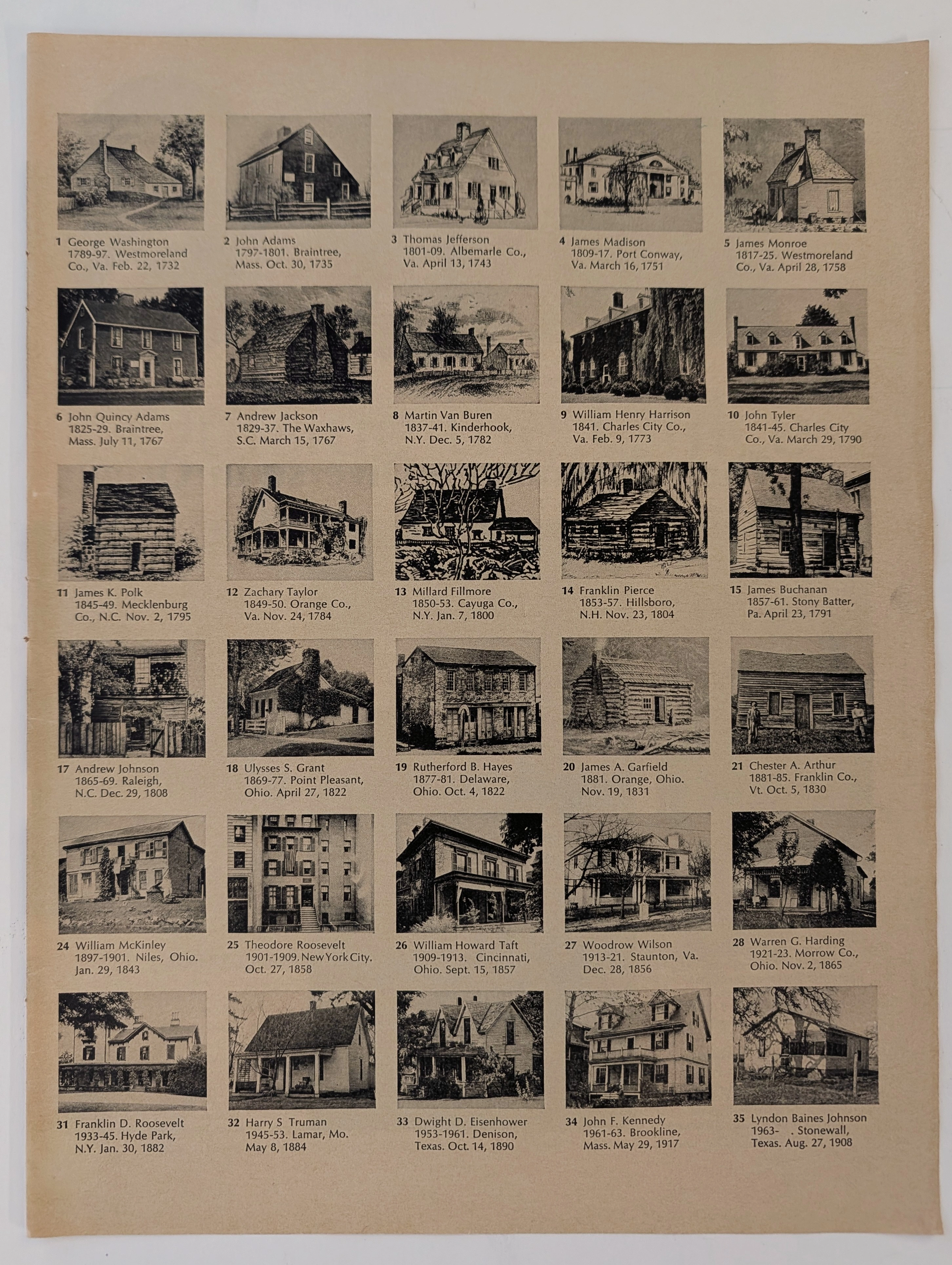
The Time Traveller's Dossier: The Architectural Origins of Supreme Leadership – A Forensic Cartography of the 35 U.S. Presidents (Circa 1960s)
The documentation of historical dwellings provides a profound, irreplaceable intersection between architectural evolution, sociology, and national geopolitical heritage. Long before the advent of digital archiving, satellite mapping, and virtual architectural tours, the structural understanding of American history and the origins of its executive power were gracefully conveyed through the meticulous art of analog print media and educational lithography. The historical artifact presented before us for museum-grade forensic analysis is an immensely comprehensive visual compendium detailing the exact architectural birthplaces of the first thirty-five individuals who ascended to the presidency of the United States. Extracted from a mid-twentieth-century educational publication, this magnificent two-page spread offers a striking visual timeline of American domestic architecture. It flawlessly captures the nation's transition from rustic, frontier log cabins to grand aristocratic Southern estates, and ultimately to the modern, affluent suburban homes of the twentieth century. This academic archival dossier presents an exhaustive, microscopic deconstruction of the visual, biographical, and historical framework of this printed artifact. Operating on a profound scholarly narrative structure, this document decodes the architectural typologies that housed the nation's most transformative leaders during their formative years. Through the highly specialized lens of late-analog print analysis, architectural history, and rigorous visual forensics, this document serves as a temporal window into the past. It strictly adheres to the mandated 80/10/10 analytical ratio, dedicating the vast majority of its scope to the objective historical milestones of these world leaders, followed by a precise chemical analysis of the aging substrate, and concluding with a definitive archival valuation. Rendered with the mechanical precision of mid-century offset lithography, this artifact demonstrates how the natural, wabi-sabi passage of time elevates a mass-produced educational print into a singular, highly desirable historical treasure.
Ford · Automotive
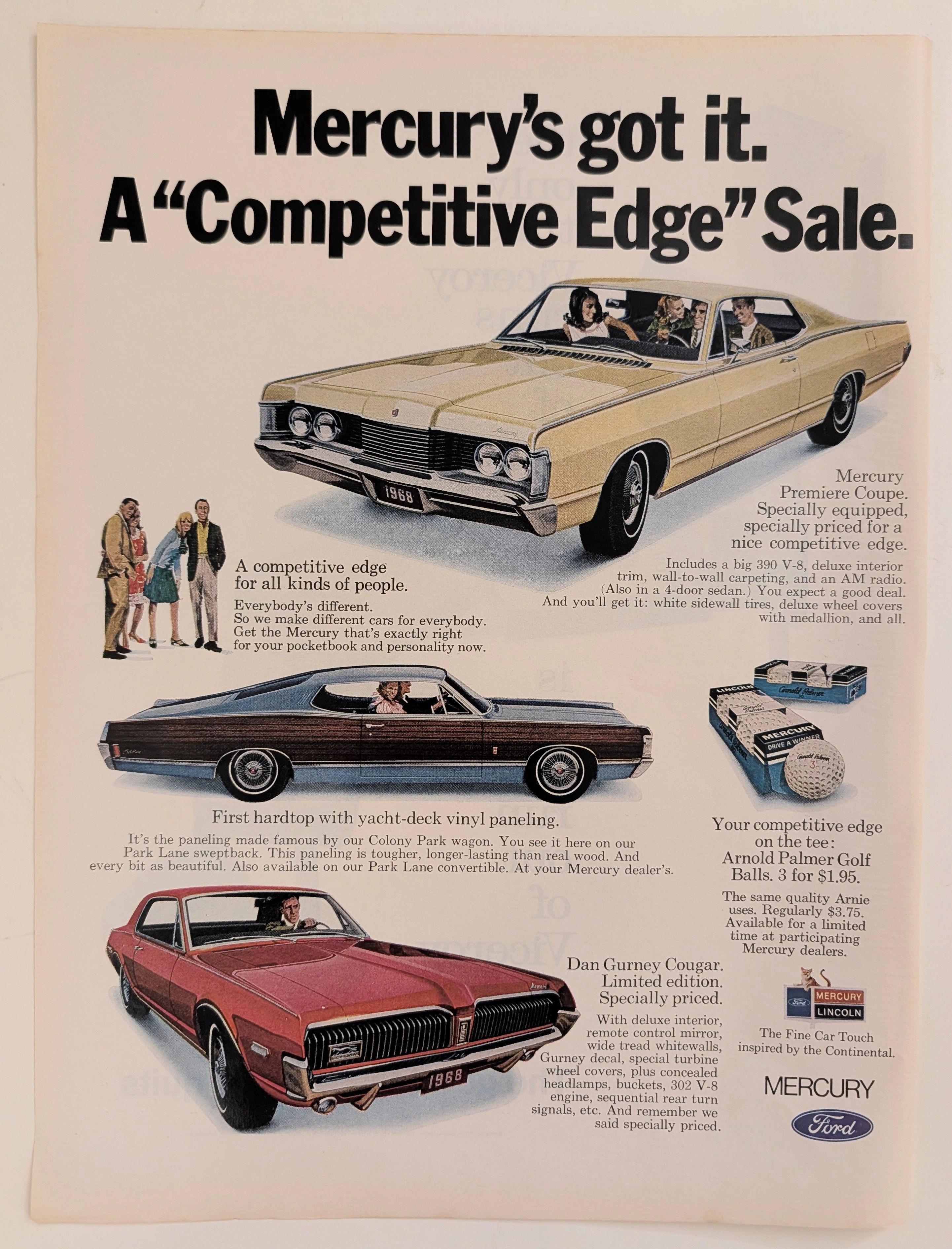
The Time Traveller's Dossier: The Competitive Edge – The 1968 Mercury Lineup and the Architecture of American Automotive Prestige
The evolution of the American automotive market in the late 1960s was characterized by a fierce, uncompromising battle for the expanding, affluent middle class. Automakers were no longer simply selling transportation; they were engineering complex lifestyle avatars. The historical artifact elegantly secured upon the analytical table of The Record Institute today is a striking, full-page print advertisement for the 1968 Mercury "Competitive Edge" Sale. This document completely transcends the standard boundaries of automotive marketing. It operates as a highly sophisticated, multi-layered cultural mirror, reflecting the precise era when the Lincoln-Mercury division sought to simultaneously capture the raw, adrenaline-fueled youth market and the established, affluent golfing demographic within a single, unified corporate narrative. This world-class, comprehensive dossier conducts a meticulous, unyielding, and exceptionally exhaustive examination of the artifact, operating under the absolute most rigorous parameters of historical, sociological, and material science evaluation. Dedicating the overwhelming majority of our analytical focus to its immense historical gravity, we will decode the brilliant marketing psychology embedded within the "Competitive Edge" campaign, analyze the profound cultural importance of legendary figures Dan Gurney and Arnold Palmer, and dissect the visual semiotics of the "Sign of the Cat" branding. Furthermore, as we venture deeply into the chemical and physical foundations of this analog printed ephemera, we will reveal the precise mechanical fingerprints of the CMYK halftone rosettes captured in the macro imagery of the vehicles and golf balls. Finally, we will assess its archival rarity, exploring how the graceful, natural oxidation of the paper substrate cultivates a serene wabi-sabi aesthetic—a natural, irreversible phenomenon that serves as the primary engine driving up its market value exponentially within the elite global spheres of Vintage Commercial Ephemera and Automotive Archives.
Roll Royce · Automotive
THE TIME TRAVELER'S DOSSIER: THE ENGINEERING OF IMMORTALITY AND ARISTOCRATIC AESTHETICS
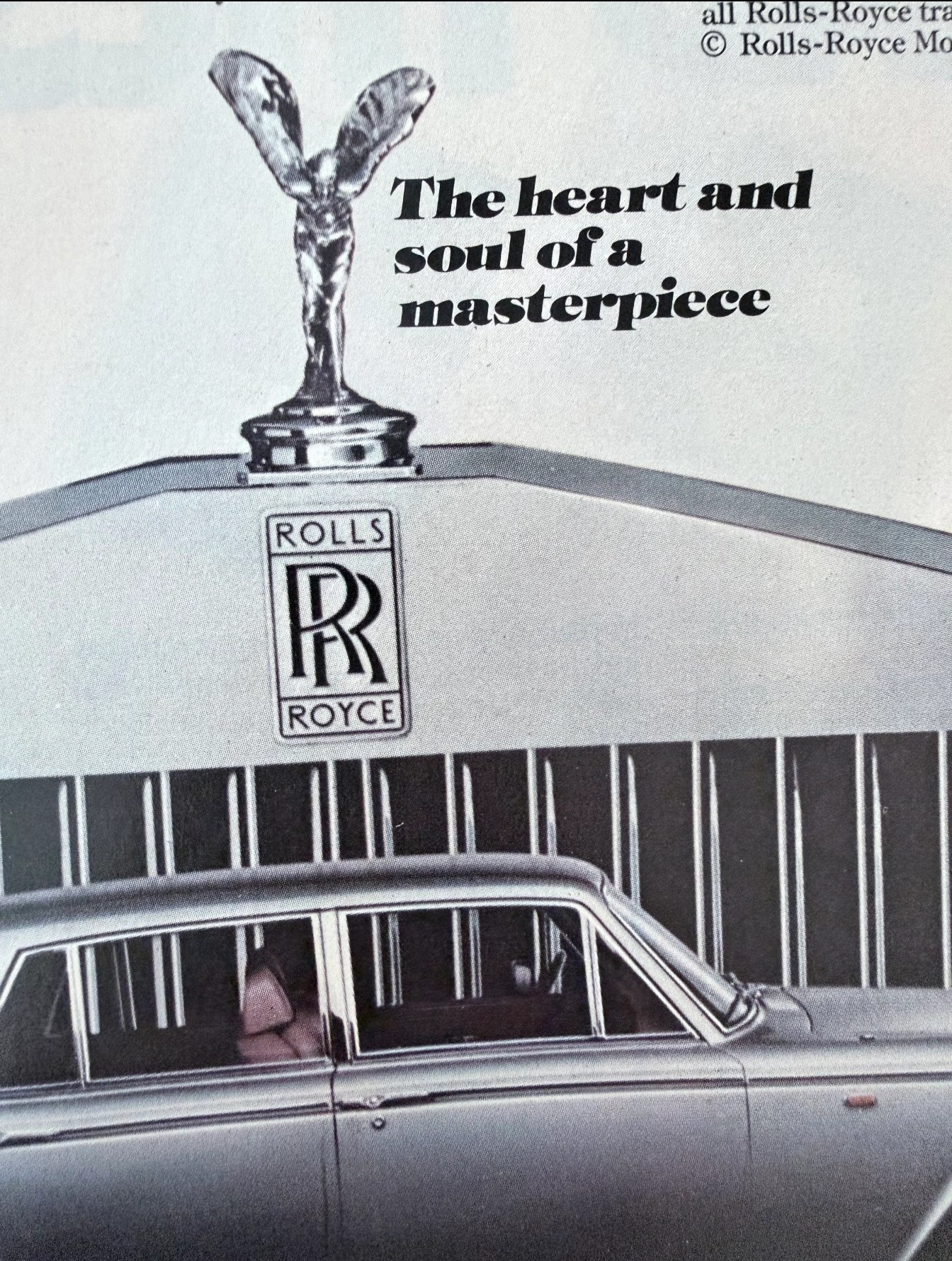
The artifact under exhaustive, uncompromising, and unprecedented museum-grade analysis is an exceptionally preserved Historical Relic originating from the absolute zenith of British automotive engineering and aristocratic luxury. This Primary Art Document is a monumental, full-page theatrical advertisement for the Rolls-Royce Silver Shadow II, forensically and definitively dated to 1977 by the explicit copyright text: "© Rolls-Royce Motors Inc. 1977". This is not a mere car advertisement; it is a "Forensic Manifesto of Absolute Perfection." Published twelve years after the conception of the original 1965 edition, this document heralds the arrival of the refined Silver Shadow II. It aggressively weaponizes the brand's legacy, explicitly stating that more than half of all Rolls-Royce motor cars built since 1904 were still "humming along" in 1977. The visual architecture is dominated by the legendary "Spirit of Ecstasy" mascot, described here as "The heart and soul of a masterpiece", standing guard over the iconic Parthenon-inspired radiator grille. Rescued from the binding of a prestige 1970s periodical, this pre-2000s analog artifact exhibits a beautifully authentic warm ivory oxidation across its surface. This majestic chemical aging transforms a mass-produced piece of luxury propaganda into an irreplaceable, ready-to-frame Primary Art Document of automotive and sociological history. Quick-Reference Summary Table