THE TIME TRAVELLER'S DOISSIER — THE WWII HOME FRONT AND THE AESTHETICS OF DESTRUCTION
The History
" THE HISTORY: World War II, The Tribunal of Rations, and the Soul of America "
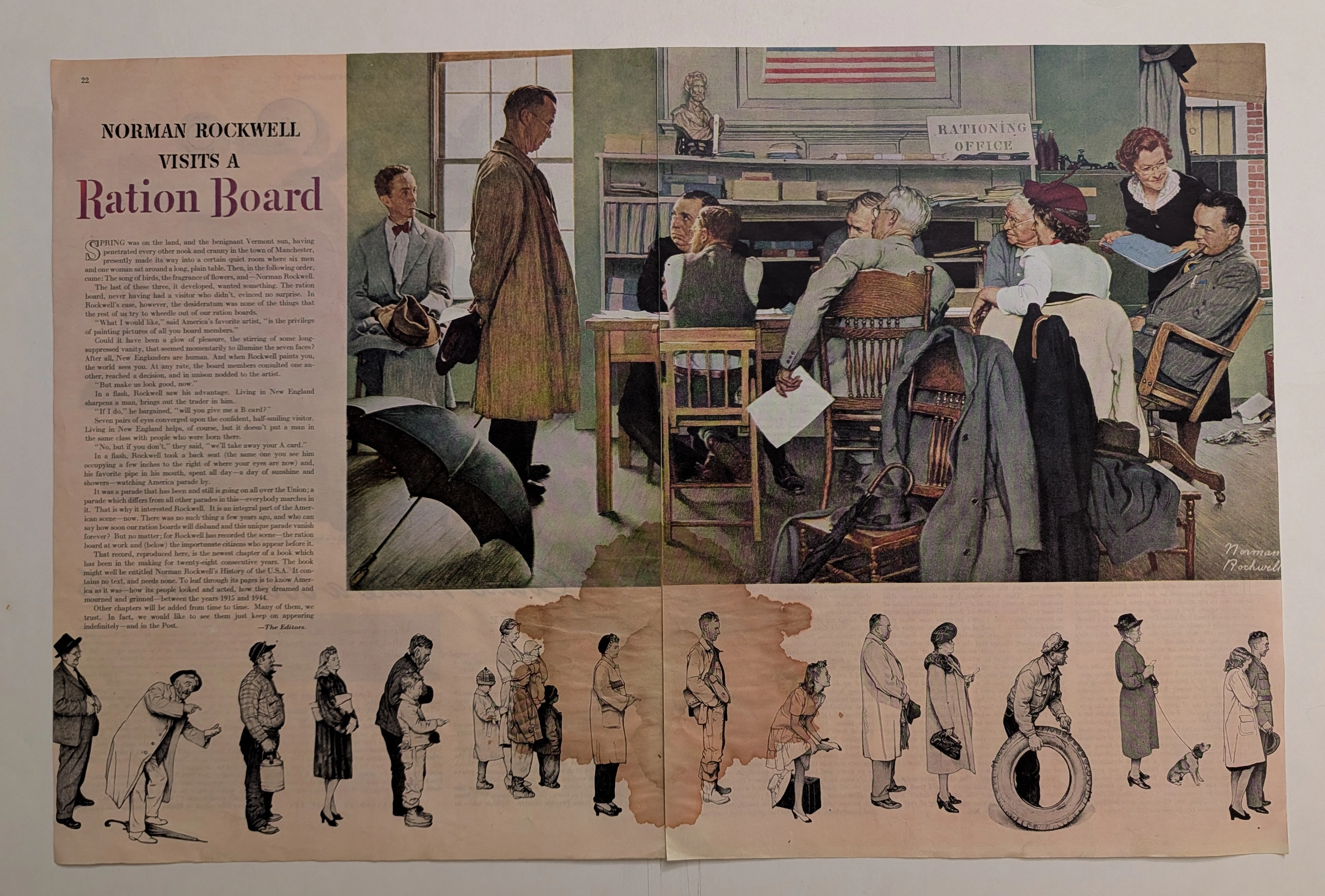
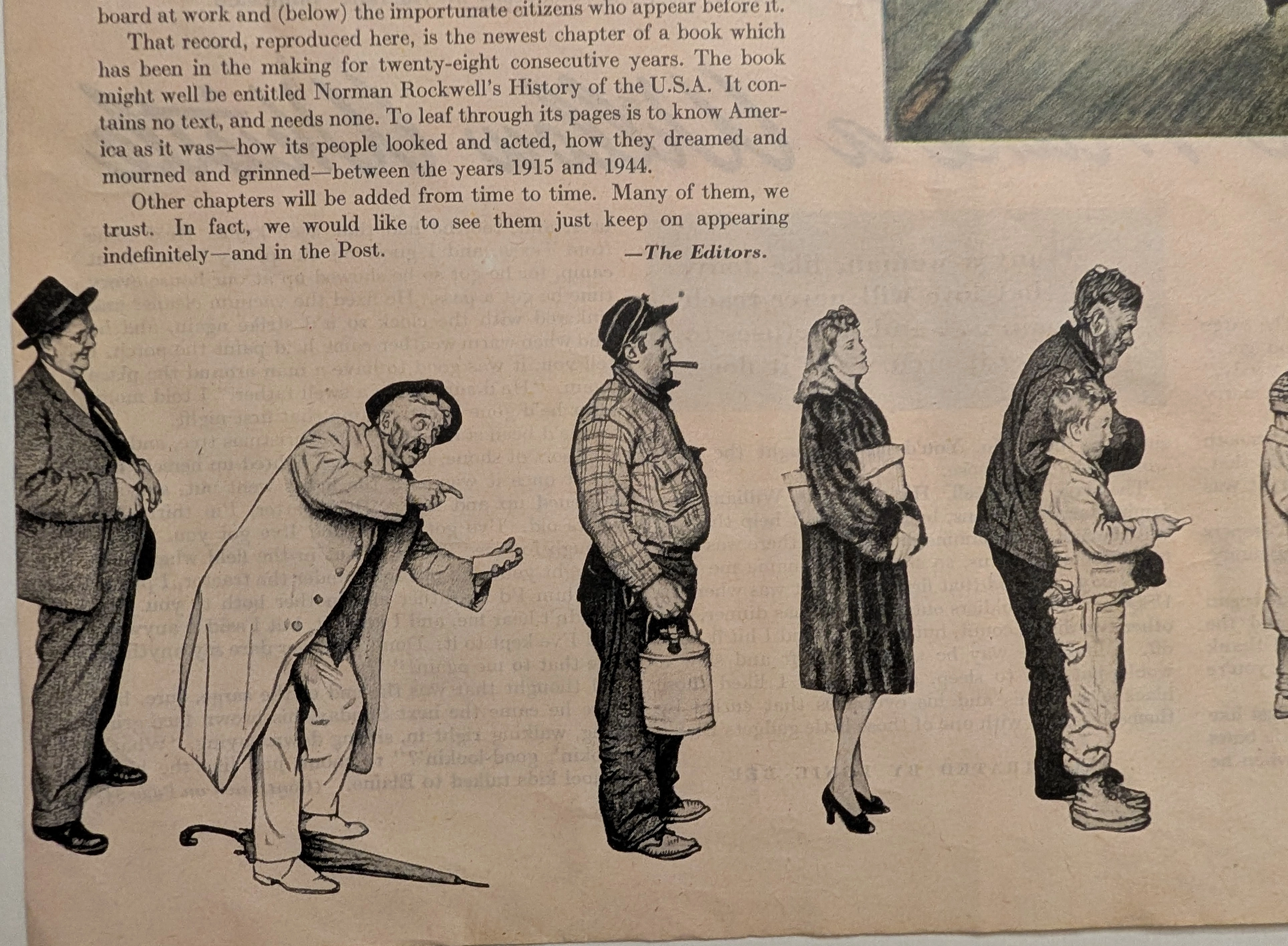
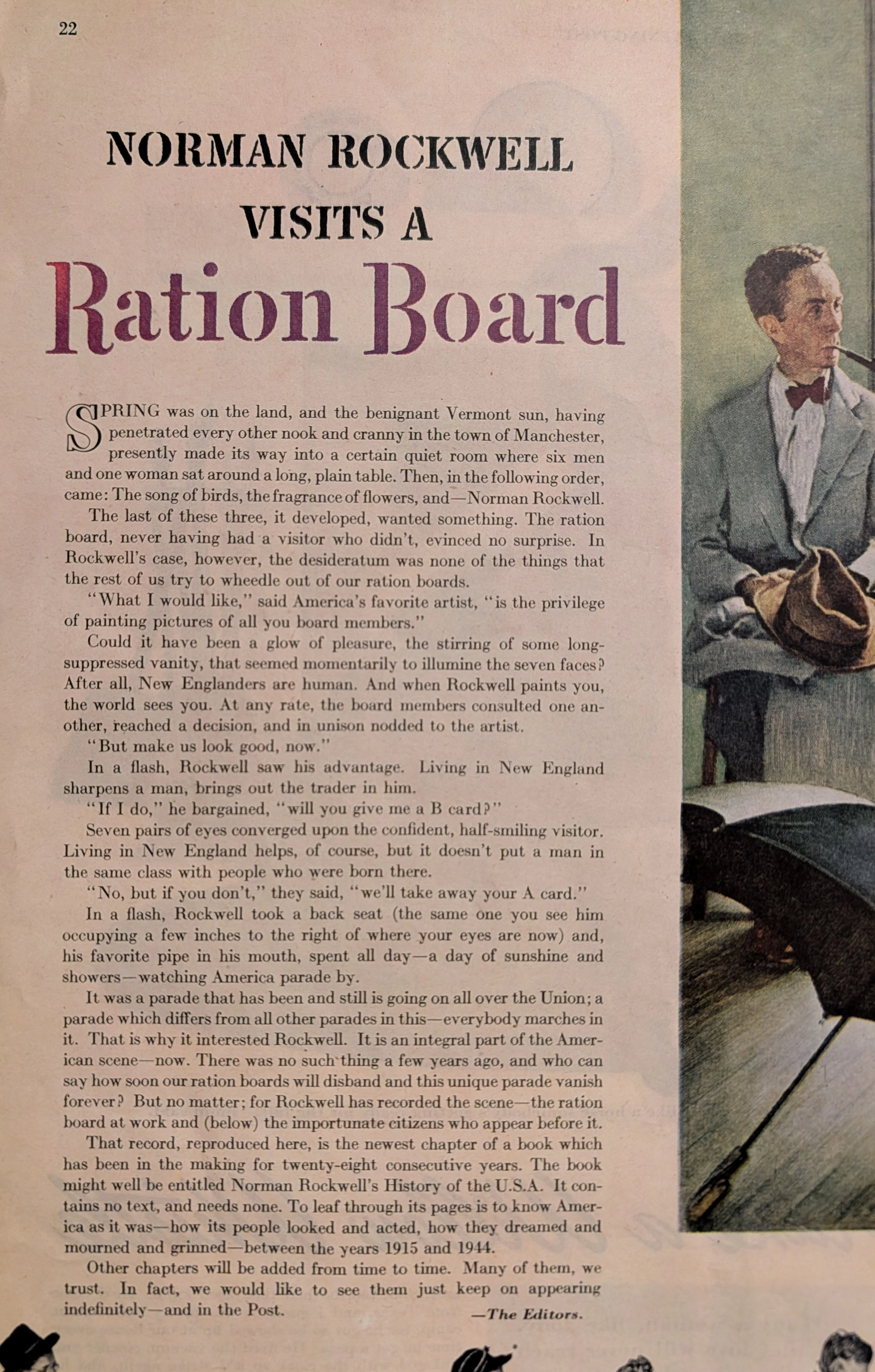
Welcome to the inner sanctum of The Record, where we do not merely deal in paper; we act as the custodians of frozen time. The artifact you are staring at is not just an illustration; it is a mirror held up to humanity during its darkest, most defining hour of the 20th century. This is a monumental masterpiece titled "Norman Rockwell Visits a Ration Board" (published circa 1944), born from the brilliant mind and meticulous brush of America’s undisputed master of illustration, Norman Rockwell.
To truly absorb the visceral gravity of this piece, you must strap into our time machine and hurl yourself back to the suffocating tension of World War II. While American soldiers were bleeding into the soil of Europe and the sands of the Pacific, the "Home Front" was engaged in a quiet, desperate war of sacrifice. The United States government enacted draconian rationing policies. Gasoline, tires, sugar, meat, and shoes were severely restricted to fuel the war machine. The absolute arbiters of life, livelihood, and mobility in every town were the "Ration Boards"—ordinary citizens thrust into positions of god-like local authority.
Rockwell brilliantly chronicles a real event from his adopted hometown of Manchester, Vermont. He paints a quiet, tense room where six men and one woman sit stoically around a plain table. Looming over them in the background is a bust of Abraham Lincoln, a silent judge of their patriotic duty. The man standing on the far left, clutching his hat and pipe with a nervous, ingratiating smile? That is Norman Rockwell himself. The accompanying text humorously reveals that Rockwell attempted to use his immense celebrity to bribe the board, offering to paint their portraits in exchange for a coveted "B Card" (which granted extra gasoline). The unyielding, fiercely egalitarian New England board members stared him down and bluntly replied: "No, but if you don't [paint us well], we'll take away your A card."
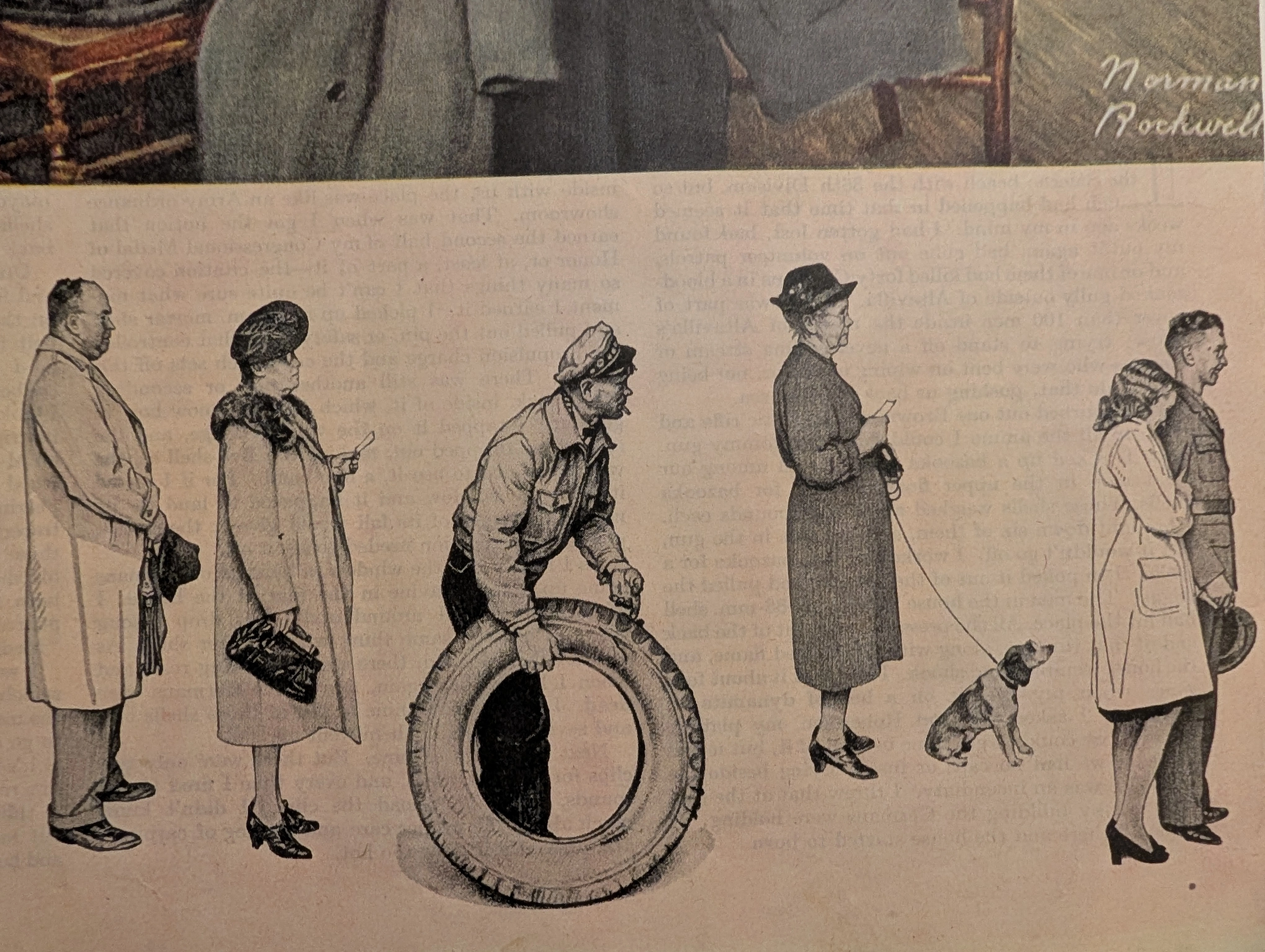
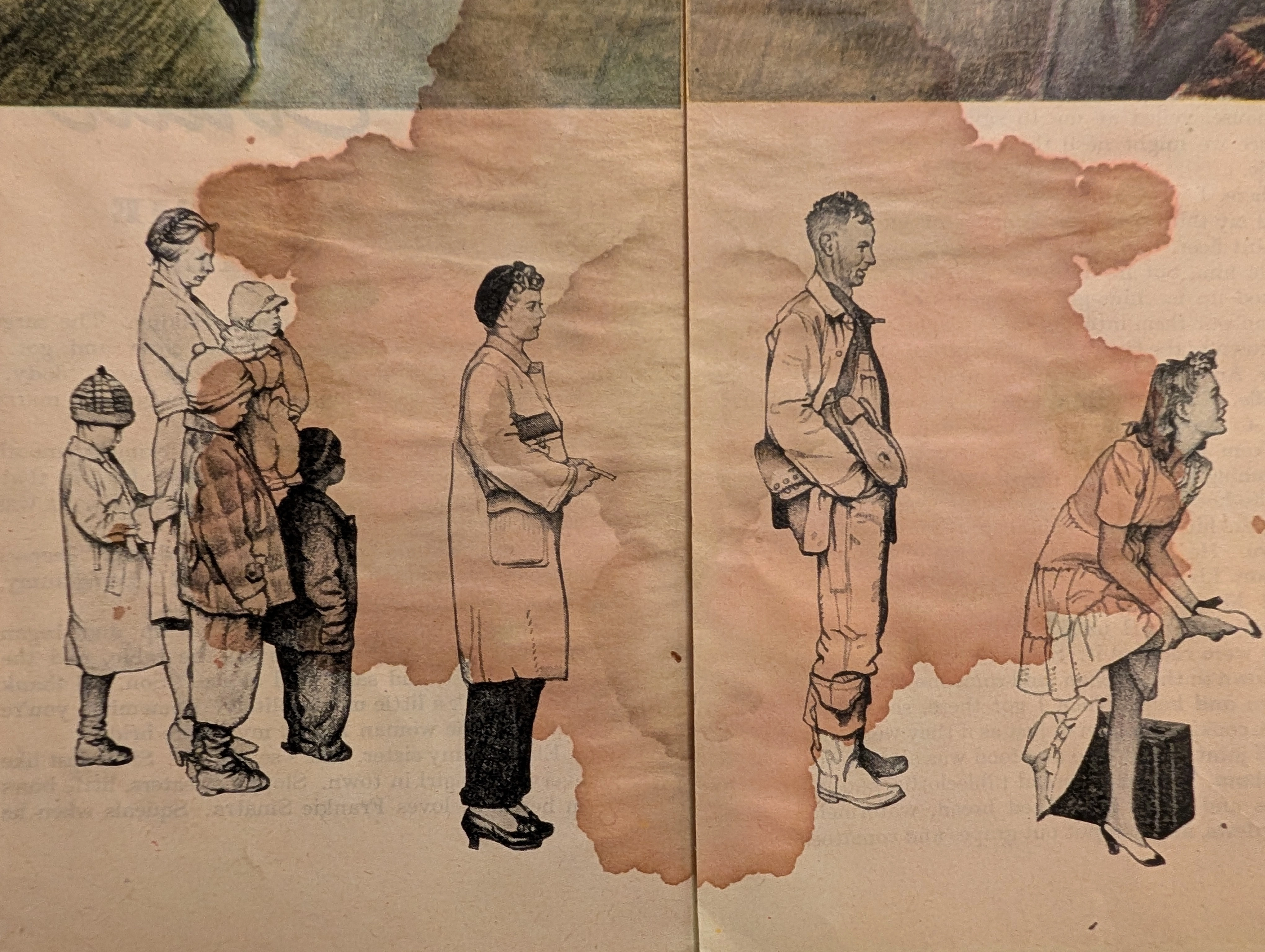
This is Rockwell’s true genius. He uses his own humiliation to broadcast the most vital propaganda of the war: Absolute Equality. In that room, there are no celebrities, no titans of industry—only Americans bound by the same restrictions. This message is immortalized in the continuous "parade" of citizens forming a line across the bottom of the spread. From the wealthy dowager and the sharp-suited businessman to the mechanic hauling a massive rubber tire and the grandmother walking her dog, every single soul is forced to wait in the exact same line of deprivation. It is the most powerful, egalitarian snapshot of American endurance ever committed to paper.
(THE PAPER: The Beautiful Death — The Bloodstain of Time )
At The Record, our operational philosophy is absolute: we curate analog magazine pages and explicitly cut and sell them as individual, frame-ready sheets. We do this because the medium itself is dying, and its death is breathtaking. For this specific double-page spread, its historical magnitude is rivaled only by its physical "wounds."
Manufactured in the 1940s, this paper is composed of highly acidic wood pulp. It was born with a chemical death sentence. Observe the magnificent, massive water stain blooming aggressively across the lower quadrant, bleeding right through the parade of citizens. To an untrained eye, this is damage. To a master curator, this is a "Historical Scar." Over 80 years, the moisture reacted with the paper's inherent lignin and ambient oxygen, creating a deep rust-colored oxidation that looks remarkably like dried blood from the war era itself. This profound wabi-sabi—the beauty of imperfection and decay—reinforces the sheer fragility of this artifact. This paper is burning alive at a molecular level, and its organic decay makes it infinitely more valuable than a pristine digital reproduction.
(THE RARITY: Class S — A Survivor of the Incinerators)
During World War II, paper was a critical munition. Through nationwide "Paper Drives," millions of magazines were collected, shredded, and recycled into ammunition boxes and wartime packaging. The survival rate of a complete, intact double-page spread from 1944 is staggeringly low.
The fact that this specific sheet escaped the wartime shredders, survived eight decades of environmental hazards, and acquired such a dramatically beautiful, abstract water stain elevates its desirability to the stratosphere. Because it is a verified Norman Rockwell WWII masterwork combined with extreme physical scarcity, this piece undeniably commands a Rarity Class S designation. It has evolved from a mass-produced periodical into a singular piece of primary art. You are not buying a picture; you are preserving a dying breath of the 1940s.
Exhibition Halls
The Archive Continues
Continue the Exploration
Chesterfield · Tobacco
THE TIME TRAVELER'S DOSSIER:THE SMILE IN THE TRENCHES AND THE HOME FRONT BRAINWASHING
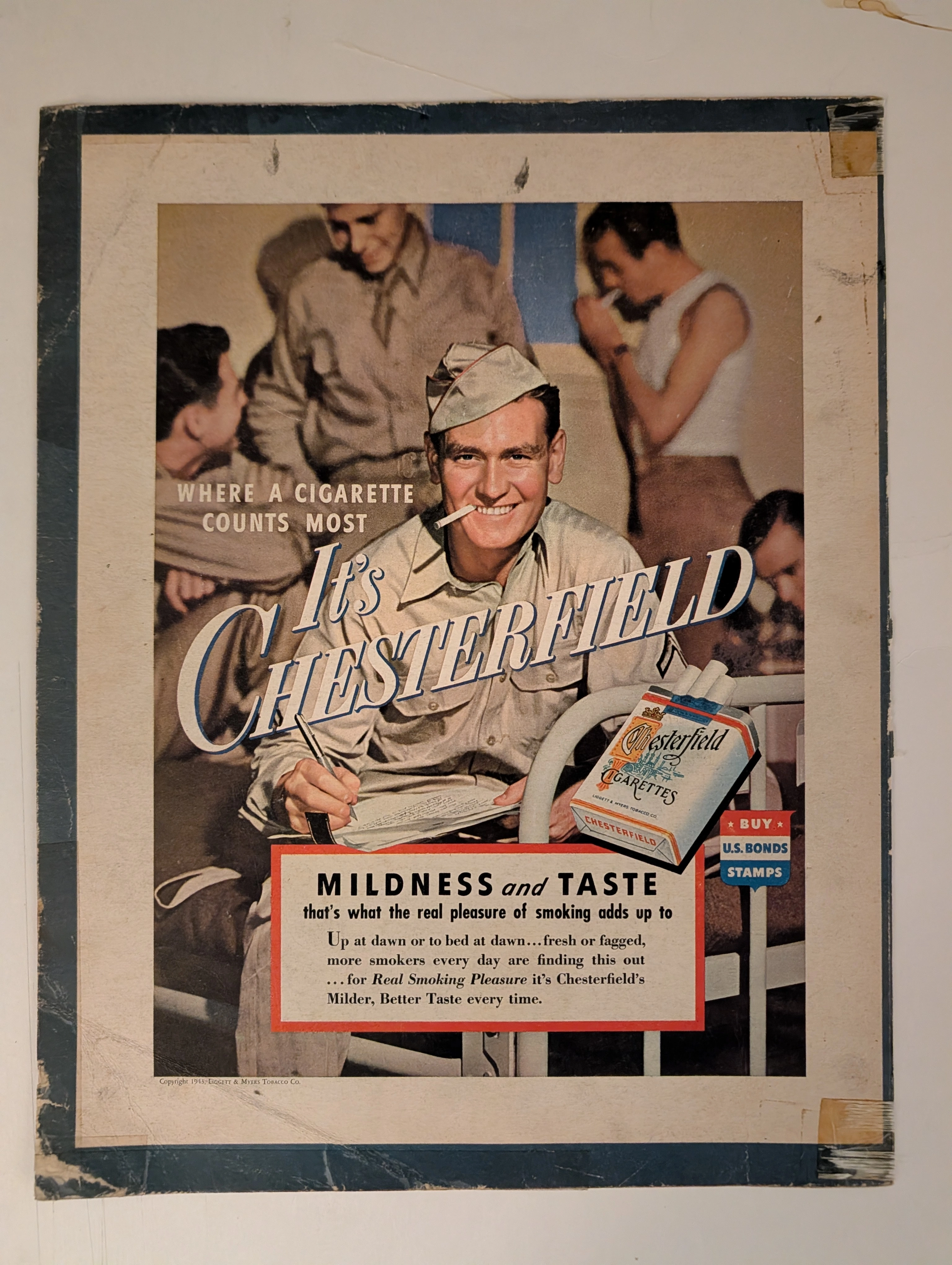
The artifact under exhaustive, uncompromising museum-grade analysis is a profoundly battle-scarred Historical Relic originating from the absolute climax of World War II. This Primary Art Document is a monumental advertisement for Chesterfield Cigarettes, forensically dated to 1943 (verified by the copyright text: "Copyright 1943, LIGGETT & MYERS TOBACCO CO."). This document transcends mere tobacco marketing; it is a profound "Sociological Blueprint of Wartime Psychological Comfort." The visual architecture targets the Home Front by depicting a wholesome American G.I. writing a letter home on a military cot. The headline, "WHERE A CIGARETTE COUNTS MOST", positions the product as a vital psychological lifeline. Furthermore, it explicitly functions as state-aligned propaganda, featuring a patriotic shield commanding citizens to "BUY U.S. BONDS STAMPS". Printed on highly acidic wood-pulp paper, it exhibits severe edge trauma, heavy oxidation, and the calcified residue of ancient cellophane tape applied by a desperate owner decades ago. This unstoppable molecular death transforms a mass-produced piece of wartime propaganda into an irreplaceable Primary Art Document of Rarity Class S.
THE TIME TRAVELER'S DOSSIER: THE COMMODIFICATION OF STATUS AND THE ART OF THE ELEGANT ILLUSION
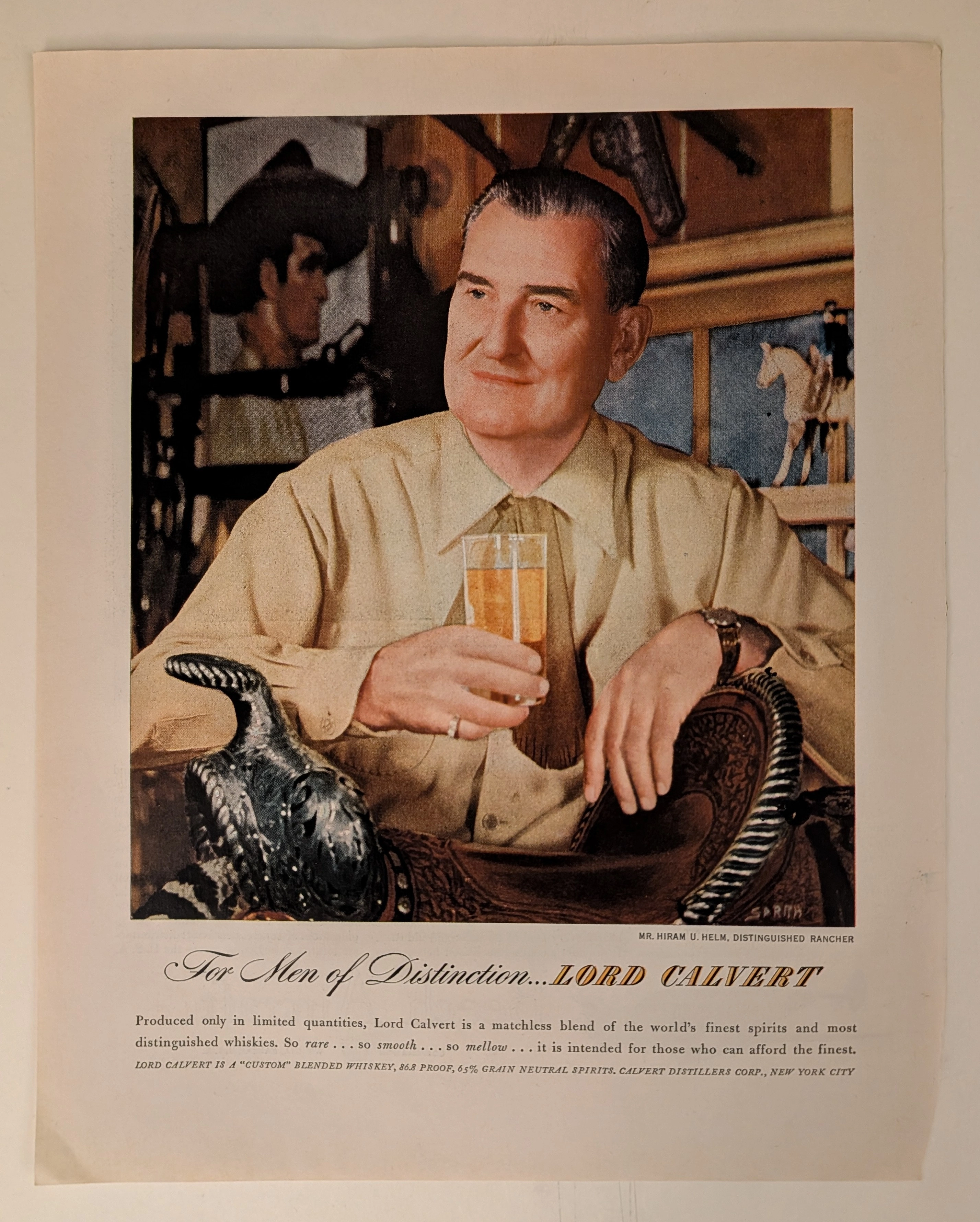
The artifact under exhaustive, uncompromising, and unprecedented museum-grade analysis is an exceptionally preserved Historical Relic originating from the absolute zenith of Madison Avenue's psychological marketing era (circa late 1940s to 1950s). This Primary Art Document is a monumental, full-page advertisement for LORD CALVERT, produced by the Calvert Distillers Corp., New York City. This piece represents the visual anchor for one of the most legendary, extensively studied, and phenomenally successful advertising campaigns in the history of American capitalism: "For Men of Distinction". It features a masterful, hyper-realistic portrait of Mr. Hiram U. Helm, Distinguished Rancher, deliberately painted/photographed to exude rugged sophistication, wealth, and aristocratic leisure. The artwork proudly bears the signature of SARRA (Valentino Sarra), a titan of mid-century commercial photography and illustration known for his cinematic lighting and profound character studies. This document is a profound "Sociological Blueprint of Aspirational Wealth." It masterfully utilized the psychology of exclusivity, marketing a blended whiskey composed of "65% Grain Neutral Spirits" as a "Custom" blend intended only "for those who can afford the finest". Rescued from the inevitable oblivion of disposable mass media, this mid-century analog artifact is a breathtaking embodiment of the Japanese aesthetic of wabi-sabi. Printed on inherently acidic wood-pulp paper, it exhibits a beautifully authentic, warm amber oxidation across its entire surface. This unstoppable molecular death transforms a piece of mass-produced corporate propaganda into an irreplaceable, ready-to-frame Primary Art Document of post-war sociological history.
John Paul Jones · Entertainment
THE TIME TRAVELER'S DOSSIER: HOLLYWOOD PROPAGANDA AND THE DAWN OF MULTIMEDIA SYNERGY
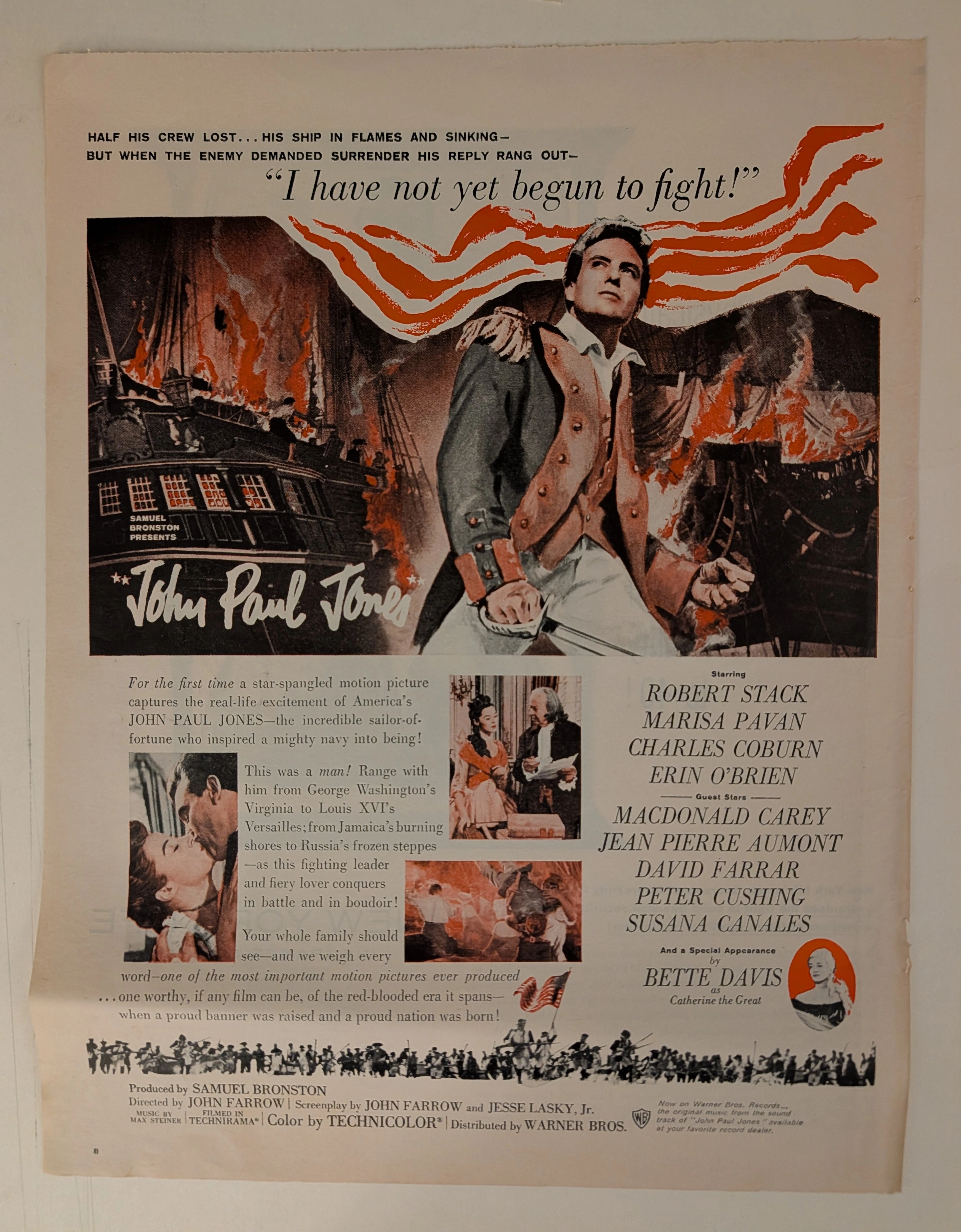
The artifact under exhaustive, uncompromising, and unprecedented museum-grade analysis is a remarkably preserved Historical Relic originating from the zenith of Hollywood's post-war epic era. This Primary Art Document is a monumental, full-page theatrical advertisement for the 1959 biographical epic "John Paul Jones", produced by the legendary independent film mogul Samuel Bronston and distributed by Warner Bros.. This is not merely a movie poster; it is a "Forensic Blueprint of Cold War American Nationalism and Multimedia Synergy." Released in 1959, at the height of the Cold War, the advertisement aggressively weaponizes the foundational mythos of the United States Navy. The commanding, blood-red headline, "I have not yet begun to fight!", serves as a psychological anchor, projecting unyielding American defiance to both domestic audiences and global adversaries. Visually dominated by the rugged, heroic portrait of Robert Stack, the ad expertly balances masculine wartime aggression with romantic subplots and diplomatic intrigue featuring Charles Coburn as Benjamin Franklin. Furthermore, it showcases elite Hollywood casting power by explicitly highlighting a "Special Appearance by Bette Davis as Catherine the Great" in a striking red cameo vignette. Crucially, this artifact documents an early, masterful execution of cross-platform corporate synergy. The bottom corner explicitly markets the original Max Steiner soundtrack on Warner Bros. Records, proving that the commercialization of the "Original Motion Picture Soundtrack" was already highly codified. Rescued from the inevitable oblivion of disposable entertainment media, this pre-2000s analog artifact is a breathtaking embodiment of the Japanese aesthetic of wabi-sabi. Printed on inherently acidic mid-century wood-pulp paper, it exhibits beautifully authentic edge wear and a profound, warm amber oxidation across its surface. This unstoppable molecular death transforms a mass-produced piece of Hollywood propaganda into an irreplaceable, ready-to-frame Primary Art Document of cinematic and sociological history.