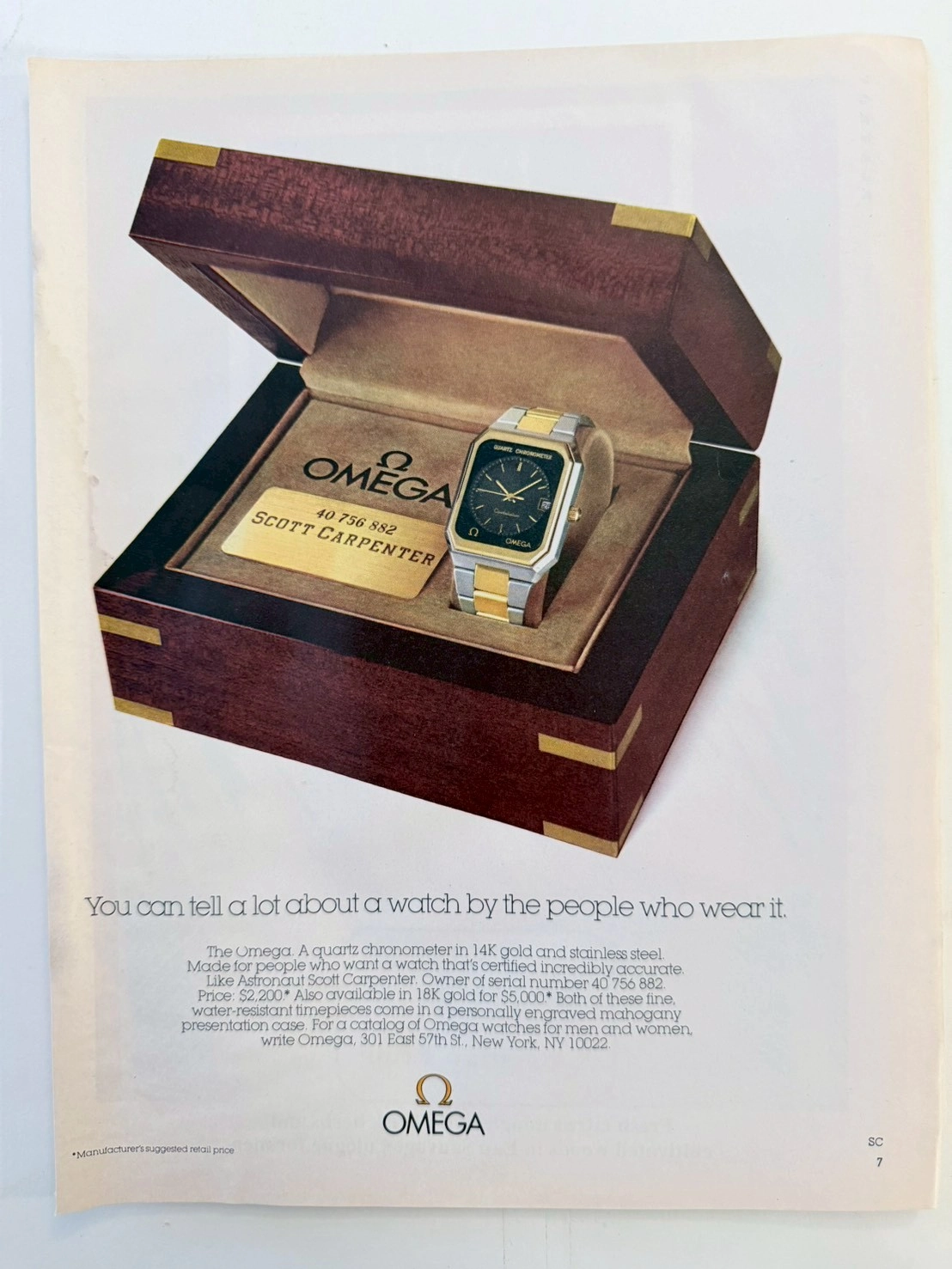
The Temporal War, The Quartz Crisis, and the Ego of Mankind ] In the grand tapestry of human history, there are terrifyingly few moments when the measurement of "time" transforms from a mundane convenience into the razor-thin boundary between survival and a cold, silent death. The page you are examining is not a mere advertisement conjured up to push inventory in a forgotten magazine. It is a "document of war"—a tangible artifact chronicling two of the most ferocious battlegrounds of the 20th century: the Cold War’s Space Race and the brutal economic conflict that nearly erased the Swiss watchmaking industry from existence, known as the Quartz Crisis. Before you lies the Omega Quartz Chronometer. Forged in stainless steel and heavily accented with 14K solid gold, it rests with imperial dignity inside a velvet-lined mahogany presentation box. But the true, spine-chilling power of this advertisement emanates from the engraved brass plaque. It bears a name and a specific serial number: Scott Carpenter, 40 756 882. To comprehend the profound depth of this artifact, you must understand the titan whose name is etched into that brass. Malcolm Scott Carpenter (1925-2013) was not a male model hired by an advertising agency. He was a living god of the aerospace era. Carpenter was one of the legendary "Mercury Seven"—the very first group of astronauts selected by NASA to conquer the unknown. On May 24, 1962, he was strapped into the Aurora 7 capsule and hurled into the dark, unforgiving void of space. He orbited the Earth three times, battling malfunctioning automatic systems, critically low fuel, and a terrifying reentry miscalculation that caused him to splash down in the Atlantic Ocean 250 miles off course. During those harrowing 4 hours and 56 minutes, time was the only thread tethering him to the mortal realm. The timepiece an astronaut of this caliber chooses is not an accessory; it is an instrument of ultimate survival, a symbol of the absolute zenith of human precision. However, this advertisement was not printed in the 1960s during Carpenter’s prime. It was weaponized in the late 1970s to early 1980s. This was an era of apocalyptic dread for Switzerland—the "Quartz Crisis." The advent of cheap, hyper-accurate, battery-powered quartz watches from Japan and America was slaughtering centuries of Swiss mechanical heritage. Hundreds of storied brands were forced into bankruptcy. While other companies panicked and slashed prices in a race to the bottom, OMEGA orchestrated a counter-attack fueled by staggering arrogance and unparalleled ego. They did not retreat. Instead, they took the quartz technology that was cheapening the market and violently elevated it to the status of ultra-luxury. They encased a quartz movement in polished 14K gold, fine-tuned it to pass the rigorous tests of a certified Chronometer, and slapped an exorbitant price tag on it: $2,200 (escalating to a mind-bending $5,000 for the 18K solid gold iteration). In the late 70s, pricing a battery-powered watch at that tier was an act of absolute madness—or sheer brilliance. The psychological warfare is cemented in the ad’s copy: "You can tell a lot about a watch by the people who wear it." OMEGA was whispering directly into the ears of the world’s elite: "This is not the disposable quartz watch of the common man. This is the instrument of the aristocracy. This is the exact caliber of precision trusted by Scott Carpenter, a hero who conquered the cosmos." This page perfectly encapsulates how a desperate Swiss empire merged the mythos of the Space Age with luxury marketing to save its very soul. THE PAPER: The Aesthetics of Decay — An Art Form Burning Alive ] As the Chief Curator of The Record, my obsession lies not just in the narrative, but in the preservation of a "beautiful death." The artifact before you is an "Individual Cut Page," surgically extracted from a pre-2000s analog publication. The brutal, enchanting reality of vintage analog print is that it was manufactured using highly acidic wood-pulp paper. It was never engineered for immortality. Over the span of forty years, the lignin woven into the paper’s microscopic fibers has engaged in a relentless chemical war with ambient oxygen and ultraviolet light. This process of oxidation is exactly what birthed the breathtaking "patina"—the warm, amber-to-cream discoloration creeping along the margins. The faint ghosts of moisture, the distinct scent of aging pulp, and the delicate brittleness felt upon touch are not damages; they are the "Signatures of Time." No digital screen, no modern reprint can replicate this alchemy. This specific page is slowly, inexorably burning itself to ash at a molecular level. By cutting it from a discarded magazine, we have rescued it from the landfill, transmuting it from "disposable media" into a standalone "Primary Art Print." It preserves the tactile genius of offset lithography from an era when ink was mixed by human hands. THE RARITY: A Breathing Witness Authentic analog print media is hurtling toward extinction. The vast majority of pages from the 1970s and 80s have been incinerated, devoured by mold, or simply dissolved into dust. The fact that this specific OMEGA "Scott Carpenter" advertisement survived with its visuals immaculate, while its borders showcase the magnificent decay of aging paper, is a physical miracle. When you calculate the explosive, overlapping demand from three distinct collector factions—NASA space history archivists, vintage OMEGA horology purists, and mid-century advertising art collectors—this piece undeniably ascends to Rarity Class A. It is no longer just a piece of paper with a watch on it. It is a time capsule encapsulating Swiss arrogance, human bravery, and the tragic, beautiful fragility of analog paper, ready to be framed before it fades into eternity.
THE TIME TRAVELER'S DOSSIER: THE GENESIS OF ARROGANCE — OMEGA, THE QUARTZ CRISIS, AND THE SPACE HERO
An original vintage magazine cut page featuring the OMEGA Quartz Chronometer, endorsed by NASA Mercury Seven astronaut Scott Carpenter. This standard-sized ephemera captures Omega's luxurious counter-offensive during the "Quartz Crisis," elevating battery-powered movements to haute horlogerie. The natural degradation and warm patina of the pre-2000s acidic paper transform this surviving ad into a highly collectible Class A historical artifact.
Cite this article
- MLA
- Naodhinsuk, Ronin. “THE TIME TRAVELER'S DOSSIER: THE GENESIS OF ARROGANCE — OMEGA, THE QUARTZ CRISIS, AND THE SPACE HERO.” The Record Institute, 5 March 2026, https://therecord.institute/journal/the-time-travelers-dossier-the-genesis-of-arrogance-omega-the-quartz-crisis-and-the-space-hero.
- APA
- Naodhinsuk, R. (2026, March 5). THE TIME TRAVELER'S DOSSIER: THE GENESIS OF ARROGANCE — OMEGA, THE QUARTZ CRISIS, AND THE SPACE HERO. The Record Institute. https://therecord.institute/journal/the-time-travelers-dossier-the-genesis-of-arrogance-omega-the-quartz-crisis-and-the-space-hero
- CHICAGO
- Naodhinsuk, Ronin. 2026. “THE TIME TRAVELER'S DOSSIER: THE GENESIS OF ARROGANCE — OMEGA, THE QUARTZ CRISIS, AND THE SPACE HERO.” The Record Institute, March 5, 2026. https://therecord.institute/journal/the-time-travelers-dossier-the-genesis-of-arrogance-omega-the-quartz-crisis-and-the-space-hero.