The Time Traveller's Dossier : 1960s Youthquake - The Weaponization of Nostalgia — The Record Institute JournalThe Time Traveller's Dossier : 1960s Youthquake - The Weaponization of Nostalgia — The Record Institute JournalThe Time Traveller's Dossier : 1960s Youthquake - The Weaponization of Nostalgia — The Record Institute JournalThe Time Traveller's Dossier : 1960s Youthquake - The Weaponization of Nostalgia — The Record Institute JournalThe Time Traveller's Dossier : 1960s Youthquake - The Weaponization of Nostalgia — The Record Institute Journal
1 / 5

✦ 5 Photos — Click any image to view in high resolution

April 28, 2026

The Time Traveller's Dossier : 1960s Youthquake - The Weaponization of Nostalgia

Fashion
Archive Views: 9

The History

The Demographic Guillotine
The timeline is anchored in the late 1960s, a period characterized by violent cultural schisms. The postwar Baby Boomers had reached adolescence. They possessed unprecedented economic power and a profound disdain for the conformity of the 1950s. The commercial establishment found itself facing a demographic guillotine. If they continued to market to the aging matriarch, they would perish. They had to pivot toward the youth. But how does an establishment industry sell to a generation defined by anti-establishment rebellion? The answer is laid bare in the copywriting of this artifact. "If you are old enough to remember bright red lipstick, then you are too old to wear it." This is not a mere fashion tip. It is a declaration of generational warfare. It is the weaponization of age. The beauty industry is actively telling its former core demographic that they are obsolete. They are "too aging, too period-piece." By drawing a hard line in the sand, the industry creates an exclusive, impenetrable club for the young. The teenager is granted absolute aesthetic authority. The mother is relegated to the dustbin of history. This marks the exact historical shift where youth ceased to be a transitional phase and became the ultimate, permanent cultural ideal.

The Exhumation and Irony of the 1930s
Notice the specific decade chosen for exhumation: the 1930s. The text refers to the "campy trivia of the '30s" and the "Bonnie beret." This anchors the artifact to the cultural shockwave of the 1967 film Bonnie and Clyde, starring Faye Dunaway. The late 60s youth did not look to the 1950s or 1940s; those eras belonged to their parents. They looked further back, to the Great Depression. Why? Because the 1930s, like the late 1960s, was an era of profound economic and social instability. The youth found a dark mirror in the cynical, glamorous outlaws of the past. However, they did not adopt the 1930s with historical reverence. They adopted it with irony. The artifact explicitly uses the word "campy." Susan Sontag defined "camp" in 1964 as the love of the unnatural, of artifice and exaggeration. By treating the 1930s as camp, the teenager neutralizes the weight of history. The Jean Harlow pillows behind the model are not tributes to a tragic star; they are flattened, graphic decorations. History is stripped of its context, hollowed out, and worn as a costume. It is the genesis of postmodern vintage culture.

The Decontextualization of Crimson
For decades prior to this artifact, bright red lipstick carried specific, heavy connotations. During World War II, it was a symbol of patriotic duty and resilient femininity. In the 1950s, it was the uniform of the polished, suburban wife. Consequently, the early 1960s "Mod" movement entirely rejected red. Icons like Twiggy championed pale, frosted lips and heavily painted eyes to look like youthful, alien dolls, actively erasing the adult female mouth. Therefore, reintroducing "Old Red" to a fifteen-year-old girl in the late 60s was a calculated shock tactic. It is explicitly labeled "a whole new discovery." The crimson lip is stripped of its adult sexuality and its patriotic history. It is repurposed as a "swinging accent." Against the stark white of the minismock, the red is jarring, almost violent. It is no longer an organic enhancement of the face; it is a graphic application. It is pop-art applied to human skin. The industry realized that nostalgia operates on a twenty-to-thirty-year cycle. By taking the discarded symbols of the previous generation and handing them to the young, they manufactured an endless loop of profitable rebellion.

The Commodification of the Counterculture
The artifact presents a masterclass in synthetic rebellion. The text casually mentions a "fuzzy hippie hairdo by Kenneth" and a "minismock (Gayle Kirkpatrick, $70)." We must decode these signifiers. The "hippie" movement was born in the mud of Woodstock and the poverty of Haight-Ashbury as a genuine rejection of capitalism. Yet here, the "hippie" aesthetic is being engineered by Kenneth Battelle—the most exclusive, establishment hairdresser in New York, famous for styling Jacqueline Kennedy. Furthermore, the dress costs seventy dollars in late-1960s currency, a small fortune for a teenager. This is the complete pacification and commercialization of the counterculture. The establishment observed the revolution, sanitized it, applied a designer label to it, and sold it back to wealthy teenagers. The raw anger of the youthquake is transmuted into an expensive, consumable "look." The rebellion is no longer a threat to the system; it is the primary engine of the system's economic growth.

The Pop-Art Surrealism and the Super Store
The second page of the spread is dominated by a collage of pop-art elements. A disembodied, stylized illustration of a blonde woman. Matchbooks featuring nothing but floating, glossy red lips. And most critically, a graphic of a black storefront crowned with the words "SUPER STORE" in bright, primary colors. This visual composition tracks the transition of American consumption. The floating lips echo the work of Andy Warhol and Roy Lichtenstein, artists who elevated commercial advertising to high art, and whom the fashion industry subsequently cannibalized. The female form is fractured into consumable parts. But the "SUPER STORE" graphic is the true prophecy. In the 1960s, youth fashion was driven by small, independent boutiques (like Mary Quant's Bazaar in London). The inclusion of a neon-lit "Super Store" signals the incoming corporatization of boutique culture. It foreshadows the massive retail conglomerates of the 1970s and 80s that would mass-produce these "rebellious" trends on a global scale. The artifact documents the exact moment when the avant-garde underground was swallowed whole by the mainstream retail machine.

The Paper

The artifact is printed on standard, high-gloss coated magazine stock typical of high-end fashion publications of the era, likely weighing between 80 to 90 GSM.

The printing method utilizes heat-set web offset lithography. The technological achievement here is the crisp registration of the CMYK halftone dots, particularly necessary to achieve the violent, "shocking" crimson of the lips and nails against the vast expanses of negative white space.

The paper exhibits the inevitable chemistry of its era. The wood pulp has begun to oxidize, leaving a faint, warm yellowing at the extreme margins.

The glossy surface reflects light with a cold, commercial efficiency. It is a fragile, two-dimensional skin that successfully captured and froze the chaotic, shifting tectonic plates of 1960s cultural identity. It is an industrial artifact masquerading as a cultural mirror.

The Rarity

Classification: Class B

Millions of these fashion magazines were printed, distributed, and subsequently discarded in waiting rooms and teenage bedrooms across the nation. Materially, a tear-out from this era is not exceedingly rare.

However, its classification is elevated due to its profound contextual value.

It is remarkably difficult to find a single editorial spread that so blatantly articulates the mechanics of generational marketing. The explicit text detailing the exclusion of the older generation, combined with the pop-art graphics and the high-society appropriation of "hippie" culture, makes it a flawless academic specimen.

It is a pristine fossil of the moment the beauty industry learned to weaponize irony.
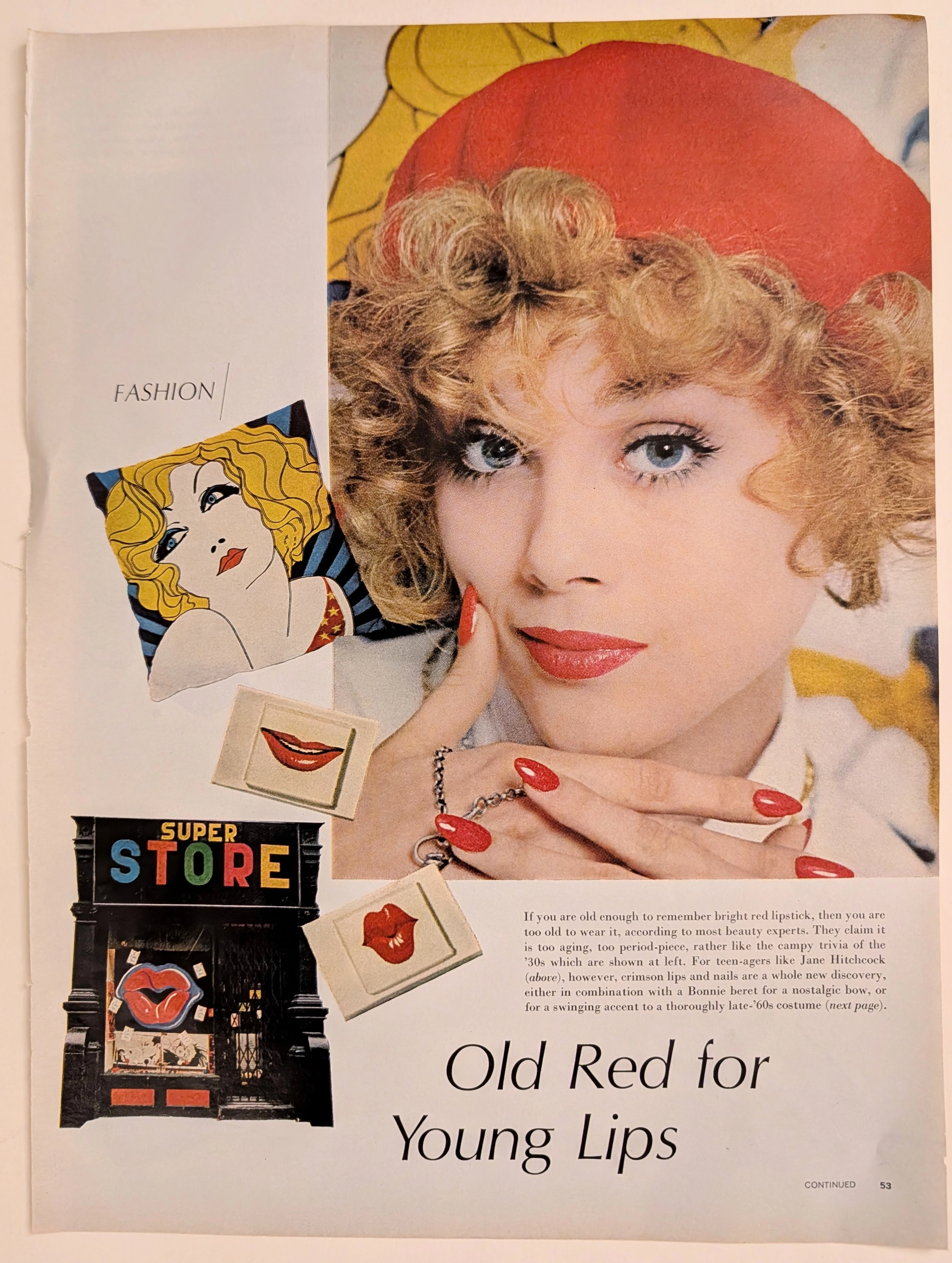
Visual Impact

The composition is an exercise in stark, graphic confrontation.

The first page is dominated by aggressive negative space. The model sits centrally, her limbs forming sharp, geometric angles. The stark white of her dress blends into the white of the environment, making the "shock accents" of her red lips, nails, and the black, disembodied faces on the pillows visually detonate.

The viewer's eye is not allowed to rest. It is forced to bounce between the crimson focal points.

The second page descends into a chaotic, surrealist collage. The scale is intentionally disjointed. The model's face is massive, while the "Super Store" is miniature. The floating lips act as visual waypoints.

Color psychology is binary. The white represents the blank slate of youth, an erasure of the past. The red represents the aggressive, blood-vitality of the new aesthetic regime. It is a visual assault disguised as a beauty tutorial.

Share This Archive

The Archive Continues

Continue the Exploration

Rolex "Perpetually Yours"

Rolex "Perpetually Yours"

This rare mid-century Rolex "Perpetually Yours" advertisement captures the genesis of the modern Rolex empire. Featuring the legendary Oyster Perpetual, it celebrates the historic union of the world's first waterproof 'Oyster' case (1926) and the revolutionary self-winding 'Perpetual' rotor (1931). A true museum-grade horological archive, this piece represents the ultimate mechanical blueprint that defined Rolex's eternal supremacy.

The Time Traveller’s Dossier: 1970s The Vargas Girl Vintage Illustration — The Ethereal Elegance of the American Pin-Up

Vargas Girl · Other

The Time Traveller’s Dossier: 1970s The Vargas Girl Vintage Illustration — The Ethereal Elegance of the American Pin-Up

Discover the captivating allure of the 1970s The Vargas Girl vintage illustration, a quintessential masterpiece of mid-to-late 20th-century editorial and commercial art. This exquisite piece transcends typical vintage ads by encapsulating the playful, sophisticated, and idealized sexuality that defined the era's publishing landscape. Featuring Alberto Vargas' legendary watercolor and airbrush technique, the illustration portrays an elegant, nude woman adorned with a delicate sun hat and a suggestive smile, perfectly punctuated by the flirtatious caption: "... And a pinch to grow on." It brilliantly illustrates how classic print ads and editorial features constructed a powerful narrative of liberated yet deeply romanticized femininity. For archivists, cultural historians, and collectors of old advertisements and pop-culture ephemera, this Vargas Girl stands as a definitive artifact. It not only highlights the artistic zenith of the American pin-up but also visually immortalizes a transitional era in publishing, making it a highly prized document in the history of commercial illustration.

Vintage PRAYBOY 1984 Cover: The Vanishing Analog Satire | The Record

Vintage PRAYBOY 1984 Cover: The Vanishing Analog Satire | The Record

An in-depth look at the 1984 PRAYBOY parody cover. A masterpiece of 1980s analog studio photography on degrading vintage paper, driving up the value of this magazine-sized original print.

Published by

The Record Institute

Taxonomy Match

Related Articles

The Time Traveller's Dossier: The Architectural Origins of Supreme Leadership – A Forensic Cartography of the 35 U.S. Presidents (Circa 1960s) — related article
Read Article

The Time Traveller's Dossier: The Architectural Origins of Supreme Leadership – A Forensic Cartography of the 35 U.S. Presidents (Circa 1960s)

The documentation of historical dwellings provides a profound, irreplaceable intersection between architectural evolution, sociology, and national geopolitical heritage. Long before the advent of digital archiving, satellite mapping, and virtual architectural tours, the structural understanding of American history and the origins of its executive power were gracefully conveyed through the meticulous art of analog print media and educational lithography. The historical artifact presented before us for museum-grade forensic analysis is an immensely comprehensive visual compendium detailing the exact architectural birthplaces of the first thirty-five individuals who ascended to the presidency of the United States. Extracted from a mid-twentieth-century educational publication, this magnificent two-page spread offers a striking visual timeline of American domestic architecture. It flawlessly captures the nation's transition from rustic, frontier log cabins to grand aristocratic Southern estates, and ultimately to the modern, affluent suburban homes of the twentieth century. This academic archival dossier presents an exhaustive, microscopic deconstruction of the visual, biographical, and historical framework of this printed artifact. Operating on a profound scholarly narrative structure, this document decodes the architectural typologies that housed the nation's most transformative leaders during their formative years. Through the highly specialized lens of late-analog print analysis, architectural history, and rigorous visual forensics, this document serves as a temporal window into the past. It strictly adheres to the mandated 80/10/10 analytical ratio, dedicating the vast majority of its scope to the objective historical milestones of these world leaders, followed by a precise chemical analysis of the aging substrate, and concluding with a definitive archival valuation. Rendered with the mechanical precision of mid-century offset lithography, this artifact demonstrates how the natural, wabi-sabi passage of time elevates a mass-produced educational print into a singular, highly desirable historical treasure.

TThe Time Traveller's Dossier: The Democratization of Memory – An Academic Archival Analysis of the Kodak Instamatic 104 Advertisement — related article
Read Article

TThe Time Traveller's Dossier: The Democratization of Memory – An Academic Archival Analysis of the Kodak Instamatic 104 Advertisement

The human desire to capture a fleeting moment and preserve it for eternity is a profound psychological instinct. The historical artifact elegantly positioned upon the analytical table of The Record Institute today is a full-page print advertisement for the Kodak Instamatic 104, originating from the mid-1960s. This document transcends the boundaries of conventional camera promotion; it is a profound declaration of technological emancipation. It represents the exact historical juncture where photography was permanently liberated from the exclusive domain of skilled technicians and delivered directly into the hands of the everyday consumer. This comprehensive, world-class academic archival dossier will conduct a meticulous and deep examination of the artifact, operating under the most rigorous parameters of historical and material science evaluation. We will decode the brilliant copywriting that masterfully elevates everyday life into a "vacation," and illuminate the engineering triumphs of the 126 film cartridge and the revolutionary Flashcube system. Furthermore, venturing into the chemical foundations of this analog offset lithography, we will reveal the mechanical fingerprints of the CMYK halftone rosettes and the natural, graceful oxidation of the paper substrate. This precise intersection of visual nostalgia and the chemistry of time cultivates a serene wabi-sabi aesthetic—a natural phenomenon that serves as the primary engine driving up its market value exponentially within the elite global spheres of Vintage Photography Ephemera collecting.

The Time Traveller's Dossier: How a 1959 Beer Ad Turned Alcohol into 'Health Food' – Barley and Malt Institute Advertisement — related article
Read Article

The Time Traveller's Dossier: How a 1959 Beer Ad Turned Alcohol into 'Health Food' – Barley and Malt Institute Advertisement

History is not written; it is printed. Before digital algorithms dictated human behavior, societal engineering was executed through the calculated geometry of the four-color offset press. The artifact before us is not merely an advertisement; it is a weaponized blueprint of middle-class aspiration. This museum-grade archival dossier presents an academic deconstruction of a 1959 print advertisement commissioned by the Barley and Malt Institute of Chicago. Operating on a profound binary structure, it documents a calculated paradigm shift within the American alcohol industry. It illustrates the precise historical fracture where beer was conceptually transitioned from a stigmatized working-class vice into a health-conscious staple of suburban domesticity. Through the lens of mid-century commercial artistry and precise visual forensics, this document serves as a masterclass in psychological marketing, establishing cultural tropes that unconditionally dominate modern pop culture and contemporary branding

THE TIME TRAVELER'S DOSSIER: THE ARCHITECTURE OF POWER AND THE BIRTH OF THE DIGITAL WORLD IN THE 50S — related article
Read Article

THE TIME TRAVELER'S DOSSIER: THE ARCHITECTURE OF POWER AND THE BIRTH OF THE DIGITAL WORLD IN THE 50S

The artifact under exhaustive, uncompromising museum-grade analysis is a remarkably preserved Historical Relic originating from the absolute zenith of the post-war American economic boom. This Primary Art Document is a sweeping, monumental full-page advertisement for the Sheraton Hotels empire, forensically dated to circa 1958–1959 via the explicitly illustrated Pittsburgh Bicentennial (1758-1958) stamp embedded within the artwork. This document is not merely a travel advertisement; it is a profound "Sociological Blueprint of the American Corporate Ascendancy." Visually anchored by four hyper-stylized, architectural illustrations of Sheraton's flagship properties—New York, Cleveland, Pittsburgh, and Detroit—the piece captures the era's unbridled optimism. Each panel is a masterpiece of mid-century commercial illustration, particularly the Detroit panel featuring ethereal, floating tail-fin automobiles symbolizing the Motor City's dominance. Furthermore, this artifact documents critical milestones in global business history. It proudly advertises the acceptance of the Diners' Club card, marking the revolutionary dawn of the modern credit card era. It also boasts of Sheraton's "Reservatron" electronic system—one of the earliest commercial applications of computing in the hospitality industry—and proudly declares its listing on the New York Stock Exchange. Rescued from the binding of a forgotten, heavy-stock periodical, this pre-2000s analog artifact is an unforgeable testament to the Japanese aesthetic of wabi-sabi. Printed on inherently acidic wood-pulp paper, it exhibits a beautifully violent, jagged right margin and a deep, warm amber oxidation across its surface. This majestic, unstoppable chemical degradation transforms a mass-produced corporate propaganda piece into an irreplaceable, ready-to-frame Primary Art Document of mid-century architectural and economic history.

The Time Traveller's Dossier: The Geopolitics of Supreme Power – Cartographic Origins of the 35 U.S. Presidents (Circa Mid-1960s) — related article
Read Article

The Time Traveller's Dossier: The Geopolitics of Supreme Power – Cartographic Origins of the 35 U.S. Presidents (Circa Mid-1960s)

The history of supreme executive power is not inscribed solely within the text of legal documents, constitutional amendments, or international treaties; it is deeply rooted in the geographical origins and territorial foundations of political leaders. Long before the modern era of complex spatial data analysis or digital infographics, the structural understanding of state power in the United States was conveyed through the meticulous art of cartographic illustration. The historical artifact presented before us for museum-grade forensic analysis is not merely a conventional fold-out extracted from a mid-20th-century educational publication. It is a profound "geopolitical visual encyclopedia," meticulously compiling and categorizing the geographic birthplaces of the thirty-five individuals who had ascended to the highest office in the White House up to that point in history. This academic archival dossier presents an exhaustive, microscopic deconstruction of the historical and aesthetic framework of the diagram titled "The 35 Presidents and the 14 States They Came From." Operating on a profound scholarly narrative structure, this document decodes the shifting tectonic plates of executive power in the United States—from the foundational era concentrated on the Eastern Seaboard, moving steadily into the Midwest, and ultimately expanding toward the Southern and Western frontiers. Through the highly specialized lens of late-analog print analysis, American political history, and rigorous visual forensics, this document serves as a temporal window. It allows us to explore the foundational roots of the "American Dream" as conveyed through the birthplaces of these statesmen, ranging from humble log cabins to opulent estates, all rendered with the mechanical precision of mid-century offset lithography.

The Time Traveller's Dossier: The Architect of the Great Society – Lyndon B. Johnson — related article
Read Article

The Time Traveller's Dossier: The Architect of the Great Society – Lyndon B. Johnson

The presidency of the United States during the mid-twentieth century was an office defined by epochal challenges, sweeping domestic transformations, and the profound weight of global leadership. The historical artifact elegantly and securely positioned upon the analytical table of The Record Institute today is a majestic, large-format political lithograph portraying Lyndon Baines Johnson, the 36th President of the United States. Originating from the transformative core of the 1960s, this document completely transcends the traditional boundaries of political memorabilia. It operates as a highly sophisticated, multi-layered cultural and historical mirror, reflecting the exact moment when unparalleled legislative ambition intersected with the intricate realities of the geopolitical landscape on a single printed page. This world-class, comprehensive dossier conducts a meticulous, profound, and historically objective examination of the artifact, operating under the absolute most rigorous parameters of sociological and material science evaluation. We will decode the brilliant iconographic strategy embedded within this portrait, analyze the legendary political machinery of a statesman who mastered the United States Senate, and dissect the rich, aspirational semiotics surrounding the Great Society initiatives alongside the challenging context of the Cold War era. Furthermore, as we venture deeply into the chemical and physical foundations of this analog printed ephemera, we will reveal the precise mechanical fingerprints of the CMYK halftone rosettes and the graceful, natural oxidation of the paper substrate. This precise intersection of visual nostalgia, mid-century commercial artistry, and the immutable chemistry of time cultivates a serene wabi-sabi aesthetic—a natural, irreversible phenomenon that serves as the primary engine driving up its market value exponentially within the elite global spheres of Vintage Political Ephemera and Presidential Archives collecting.