Vintage PRAYBOY 1984 Cover: The Vanishing Analog Satire | The Record
Click any image to view in high resolution
The History
PRAYBOY: THE SATIRICAL MASTERPIECE
When Sanctity Met Satire in the 1980s
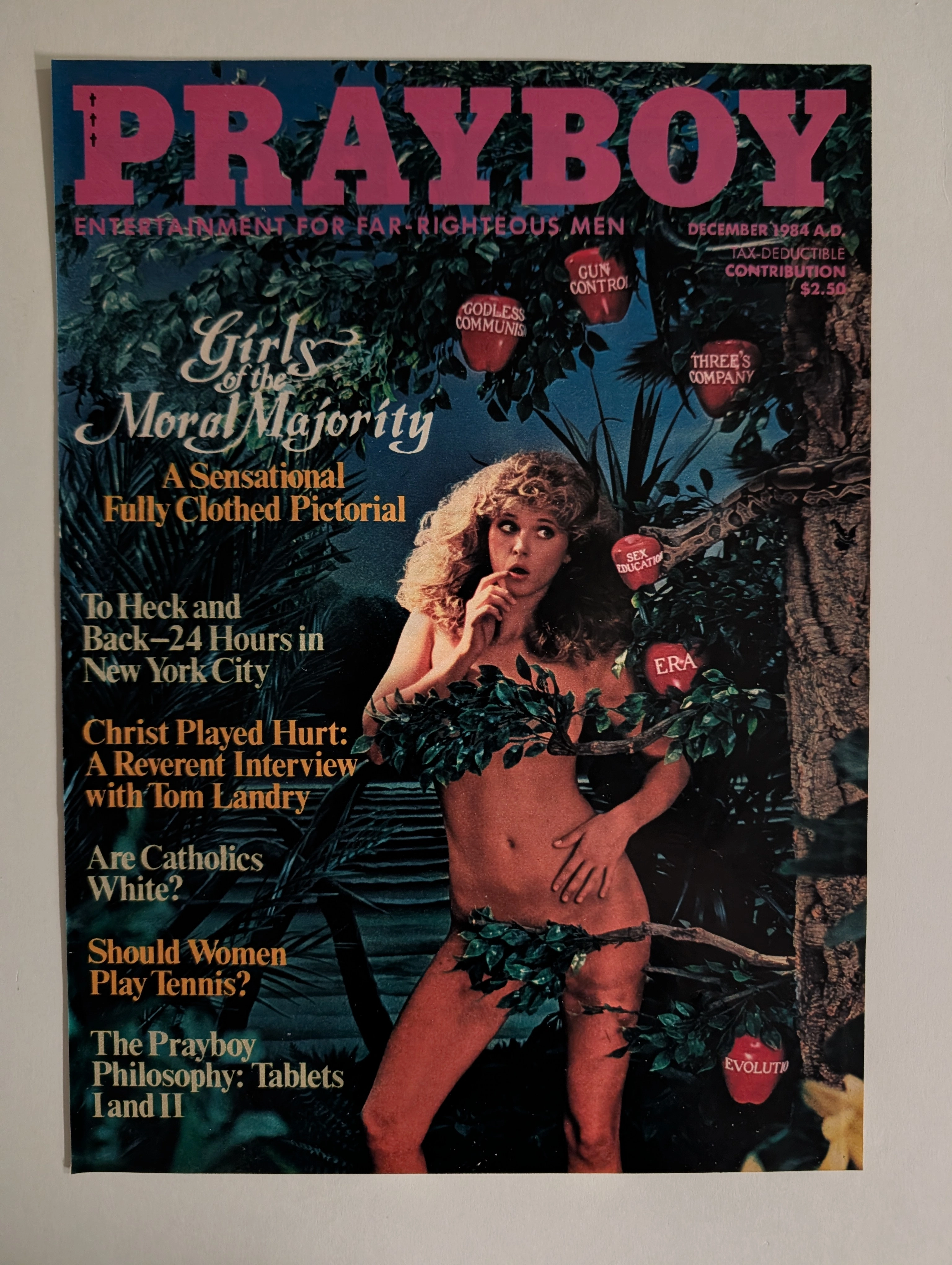
This is not a conventional magazine cover; it is a "Museum Grade Artifact" of 1980s cultural rebellion. The December 1984 issue of "PRAYBOY" (Entertainment for Far-Righteous Men) is a brilliant, biting parody of Playboy, mocking the extreme conservative "Moral Majority" of the era. This magazine-sized analog print is a fading piece of bold historical satire.
🏛️ CHAPTER I: THE HISTORY OF REBELLION & SATIRE
The Cultural Clash: In the 1980s, right-wing religious conservatism was a dominant political force in the US. This cover fearlessly parodies those ideals, featuring Eve attempting to cover herself under the headline "Girls of the Moral Majority: A Sensational Fully Clothed Pictorial." The apples of sin are labeled with the era's hot-button issues like "EVOLUTION," "GUN CONTROL," and "SEX EDUCATION."
📷 CHAPTER II: THE GOLDEN AGE OF ANALOG CRAFTSMANSHIP
Practical Set Design: Created pre-Photoshop, this required masterful studio photography and art direction. The lighting simulating moonlight, the placement of the artificial Eden, and the hand-painted typography on real apples were all physical, analog accomplishments captured on film.
⏳ CHAPTER III: THE FRAGILITY OF HISTORY & PAPER DEGRADATION
The Chemistry of Decay: Pre-2000 paper contains Lignin, which oxidizes over time. This page is literally consuming itself through acidic autocatalysis. Its survival over 40 years gives it a beautiful, natural patina that authenticates its museum-grade status.
📈 CHAPTER IV: THE ECONOMICS OF SCARCITY
Niche Scarcity: Parody publications had drastically lower print runs than mainstream media. Combined with the daily destruction of vintage paper by the elements, this magazine-sized original print has evolved into a highly scarce Alternative Asset for any sophisticated home art gallery.
The Archive Continues
Continue the Exploration

THE TIME TRAVELER'S DOSSIER: THE FLAVOR OF AUTHENTICITY AND THE PROPHET OF CAPITALISM
The artifact under uncompromising, museum-grade analysis is a flawlessly preserved Historical Relic originating from the cultural epicenter of 1970. This Primary Art Document is a monumental, full-page advertisement for Coca-Cola, officially copyrighted in 1970. It serves as the definitive visual anchor for one of the most legendary and heavily studied marketing campaigns in human history: "It's the real thing." This is not a mere beverage promotion; it is a profound sociological masterstroke. Emerging at the dawn of the 1970s—an era defined by counter-culture, political disillusionment, and a search for genuine meaning—Coca-Cola aggressively positioned its product as the ultimate, unassailable anchor of authenticity. The commanding copywriting, "Real life calls for real taste... When you ask for it, be sure you get it", is a psychological directive urging consumers to reject artificiality. Visually, the artifact is a triumph of mid-century hyper-realism. The towering glass, weeping with visceral, tactile condensation, and the monolithic block typography elevate a 15-cent soda to the status of an absolute cultural leviathan. Rescued from the inevitable oblivion of disposable mass media and preserved as a standalone Archival Artifact, the inherently acidic analog paper is undergoing a majestic chemical degradation. It exhibits a beautiful, warm patina, with natural biological oxidation softening the iconic red "Enjoy Coca-Cola" emblem. This unstoppable molecular death transforms a piece of mass-produced corporate propaganda into an irreplaceable, ready-to-frame Primary Art Document of American pop-art history.

The Time Traveller's Dossier: How a 1959 Beer Ad Turned Alcohol into 'Health Food' – Barley and Malt Institute Advertisement
History is not written; it is printed. Before digital algorithms dictated human behavior, societal engineering was executed through the calculated geometry of the four-color offset press. The artifact before us is not merely an advertisement; it is a weaponized blueprint of middle-class aspiration. This museum-grade archival dossier presents an academic deconstruction of a 1959 print advertisement commissioned by the Barley and Malt Institute of Chicago. Operating on a profound binary structure, it documents a calculated paradigm shift within the American alcohol industry. It illustrates the precise historical fracture where beer was conceptually transitioned from a stigmatized working-class vice into a health-conscious staple of suburban domesticity. Through the lens of mid-century commercial artistry and precise visual forensics, this document serves as a masterclass in psychological marketing, establishing cultural tropes that unconditionally dominate modern pop culture and contemporary branding

HONDA · Automotive
The Time Traveller's Dossier: Engineering as High Art – 1981 Honda CBX Advertisement
History is not written; it is printed. Before digital algorithms dictated human behavior, societal engineering was executed through the calculated geometry of the four-color offset press. The historical artifact before us is not merely an advertisement; it is a weaponized blueprint of mechanical aspiration and a testament to the golden age of Japanese technological supremacy. This museum-grade archival dossier presents an academic deconstruction of a 1981 print advertisement for the legendary Honda CBX. Operating on a profound binary structure, it documents a calculated paradigm shift within the global motorcycle industry. It illustrates the precise historical fracture where the motorcycle was conceptually transitioned from a stigmatized symbol of counter-culture rebellion into a highly sophisticated, aerodynamic marvel tailored for the affluent connoisseur. Through the lens of late-analog commercial artistry and precise visual forensics, this document serves as a masterclass in psychological marketing, establishing the archetype of the high-tech superbike that unconditionally dominates modern automotive pop culture.