Norman Mailer 'The Fight' Original Illustrated Magazine Page 1974 | Ali vs Foreman Rumble in the Jungle | Deep Analysis & Market Valuation
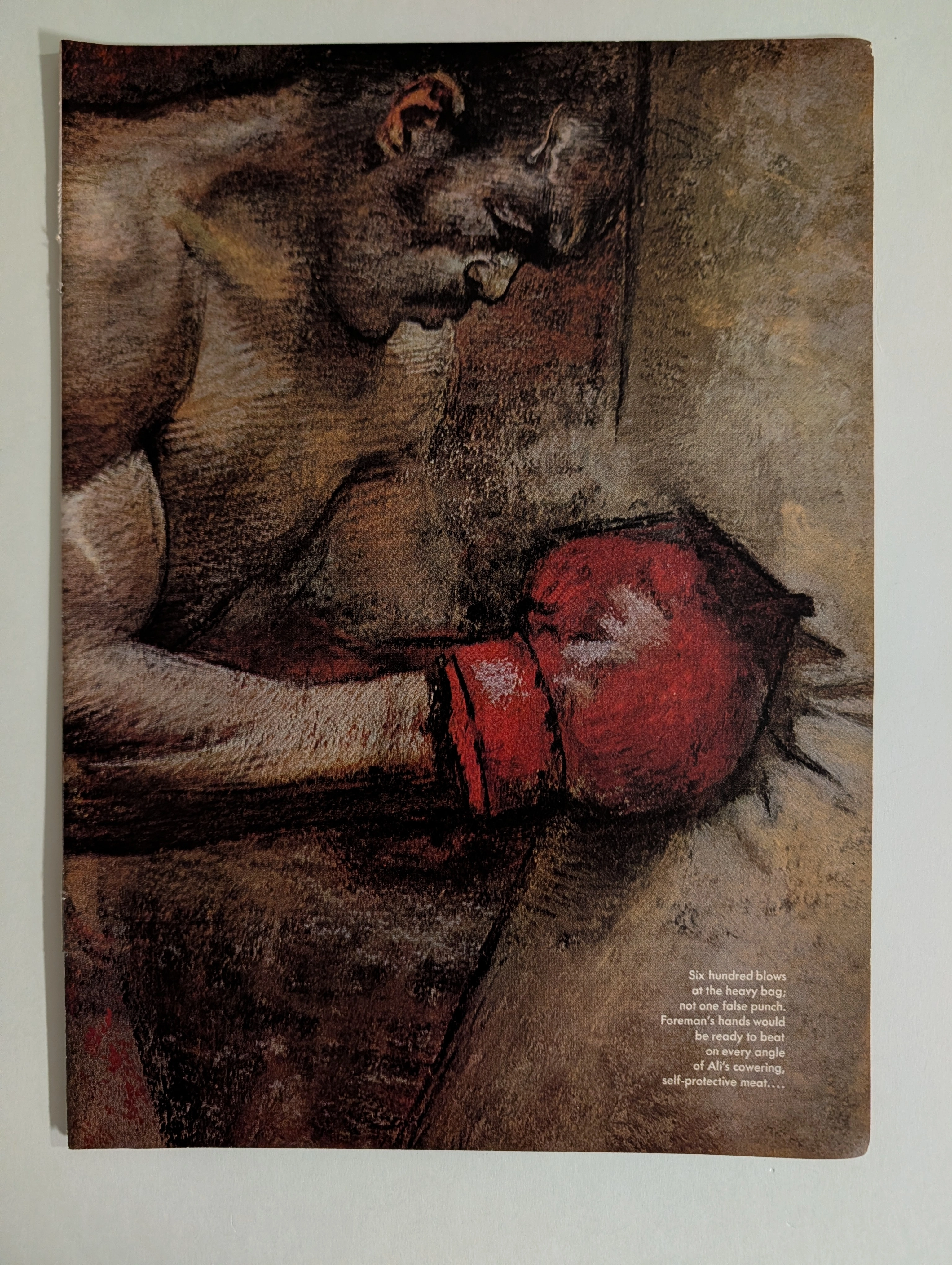
The Illustrated Word of the Rumble: Norman Mailer, George Foreman, and the Art of the Fight 1. Historical Context — The Image in Its World (70%) 1.1 The Fight That Stopped the World On the morning of October 30, 1974, somewhere between 3 and 4 a.m. local time in Kinshasa, Zaire (now the Democratic Republic of Congo), the world witnessed what many still consider the greatest individual athletic performance in the history of sport. Muhammad Ali, stripped of his heavyweight title seven years earlier for refusing induction into the U.S. Army during the Vietnam War, stepped into the ring against George Foreman — a man who had never been knocked down in his professional career, who had dismantled both Joe Frazier and Ken Norton with terrifying efficiency, and who most boxing experts believed would end Ali's career, if not his life. The event, formally named 'The Rumble in the Jungle' by promoter Don King, was financed to the tune of
0 million by Zairean dictator Mobutu Sese Seko, who saw the fight as an opportunity to showcase his nation on the world stage. Each fighter was guaranteed $5 million — a figure that seemed almost science fiction in the world of 1974 sports. The fight had been delayed six weeks when Foreman suffered a cut above his eye during a training session, creating a surreal six-week limbo period in Kinshasa that became, in many ways, the real story that Norman Mailer would immortalize in print. What makes the Rumble in the Jungle singular among sporting events is the density of meaning it carried. Ali had by this point become far more than a boxer — he was a symbol of Black pride, antiwar sentiment, Islamic faith, and the possibility of moral courage in the face of governmental power. Foreman, by contrast, had waved an American flag in the ring after his 1968 Olympic gold medal victory in Mexico City, in a gesture that many interpreted as a rebuke to the Black Power salute of Tommie Smith and John Carlos. The political subtext was inescapable. 1.2 Norman Mailer and 'The Fight' — Literary Journalism at Its Summit Norman Mailer arrived in Kinshasa as a correspondent for Playboy magazine, one of the most culturally influential publications in 1970s America. Playboy's literary ambitions were genuine and substantial — the magazine had published work by Vladimir Nabokov, James Baldwin, and had serialized Alex Haley's interviews with Malcolm X. When the editors assigned Mailer to cover the fight, they knew they were commissioning something beyond sports reportage. 'The Fight,' published in book form by Little, Brown and Company in 1975, stands today as the uncontested masterpiece of sports literary journalism. Written in the third person with Mailer calling himself 'Norman,' the book operates simultaneously as blow-by-blow combat narrative, psychological portraiture of two extraordinary men, postcolonial meditation on Africa, and philosophical inquiry into the nature of courage, ego, and mortality. The prose is dense, rhythmic, and hallucinatory in its precision. The passage that appears as the caption to the illustration before us — describing Foreman throwing 600 blows at the heavy bag, not one punch wasted — is representative of Mailer's method: he does not simply report what he sees, he inhabits the consciousness of his subjects, projecting from the outside into what he imagines must be the inner experience of men doing extraordinary things with their bodies. This is imaginative journalism of the highest order. 1.3 George Foreman — The Machine That Mailer Watched George Foreman at 25 was physically one of the most imposing heavyweight champions in history. Standing 6'3" and weighing 220 pounds of concentrated muscle, he possessed a jab that could stun a man and a right hand that could end a career. His training regimen, overseen by Archie Moore, one of the greatest boxing trainers who ever lived, was built on repetition, power, and the elimination of error — exactly as Mailer described. Six hundred blows at the heavy bag. Not one false punch. What Mailer intuited, and what the illustration captures with its muscular, semi-abstract rendering of the training fighter, is that Foreman was preparing for a kind of industrial annihilation of his opponent. He had knocked out Frazier twice in the second round; he had dismissed Norton in two rounds. His entire preparation was oriented around the assumption that what had worked before would work again, that Ali was simply the next body to be processed through his system. This is why the eventual result — Ali's astonishing Rope-a-Dope strategy, absorbing punishment on the ropes through rounds two through seven, then unleashing a final combination in round eight at 2:58 — carries such mythic weight. Foreman had perfected the machine; Ali had broken it by refusing to be a machine. The 600 blows at the heavy bag were for nothing. The preparation, shown in this illustration, prepared Foreman for a fight that Ali refused to have. 1.4 The Illustration — Art in Service of Literature The artwork reproduced on this page is a full-page painterly illustration, executed in a style consistent with the high-end editorial illustration practices of major American magazines in the early-to-mid 1970s. The technique appears to be pastel or oil pastel on textured paper, or alternatively gouache applied loosely to suggest the gestural quality of painting without photographic literalism. The color palette — deep earth tones, raw siennas, burnt umbers — is punctuated by the vivid crimson of the boxing gloves, which serve as the visual focal point and the emotional center of the composition. The artist has rendered the fighter's upper body in a manner that emphasizes mass and force over specific portraiture. This is a compositional choice of considerable sophistication: by making the figure generic enough to be any great heavyweight but specific enough (the musculature, the crouch, the hands) to evoke Foreman's particular physical presence, the illustrator creates an image that functions both journalistically and symbolically. This is the body preparing to destroy. These are the hands that were supposed to end Ali. The style places this work in the tradition of American sports illustration that stretches from Thomas Eakins's boxing paintings of the 1880s through the work of George Bellows in the early twentieth century and into the graphic explosion of mid-century magazine art. It is not documentary — it is interpretive, in the same way that Mailer's prose is interpretive rather than merely descriptive. 1.5 Playboy Magazine as Cultural Institution (1974-1975) To understand the context fully, one must appreciate what Playboy represented at the moment this illustration was published. Founded by Hugh Hefner in 1953, Playboy by the mid-1970s had reached monthly circulations of 5 to 7 million copies — among the highest of any magazine in American history. But its significance extended far beyond circulation numbers. Playboy occupied a specific cultural position: it was the magazine that took pleasure seriously as an intellectual category, that published serious literature alongside entertainment, and that had developed a distinctive visual identity built around high-quality commissioned illustration. The magazine's art direction in the 1970s was sophisticated and ambitious. The editors and art directors understood that the illustration commissioned to accompany Mailer's text needed to match the ambition of the prose — hence the choice of a painter's sensibility over a photographer's literalism. The result is a visual object that operates as both journalism and art, which is precisely what Mailer's text itself was trying to be. 2. Paper and Production Analysis (15%) 2.1 Paper Stock and Physical Properties The paper visible in this document is consistent with the high-quality coated magazine stock used by Playboy and similar premium publications in the 1970s. This would typically be a 70-100 gsm coated paper with a semi-gloss or gloss finish, produced using a calendering process that gives the surface the slight sheen necessary for high-quality halftone reproduction. The paper's weight and tooth would have been calibrated to accept the dense ink coverage required for the illustration's deep earth-tone palette. Examination of the visible page edges and surface suggests a paper that has aged with reasonable grace. The absence of significant yellowing or brittleness indicates storage conditions that have protected the paper from acidic deterioration. The coated papers used by premium publishers in this period generally contained a lower acid content than newsprint or pulp-heavy magazine papers, contributing to their comparative longevity. This page appears to be in Very Good to Fine condition for its age. 2.2 Printing Process The illustration was printed using four-color offset lithography, the dominant commercial printing process of the era. The visible dot pattern, at approximately 150-175 lines per inch, is consistent with the highest-quality printing specifications of 1970s magazine production. The registration of the four color separations (cyan, magenta, yellow, and black) appears precise, with no visible misregistration in the color transitions — a sign of careful production quality control. The red of the boxing gloves is particularly noteworthy from a printing perspective: achieving this level of saturation and depth in offset lithography requires careful ink mixing and precise cylinder pressure control. The fact that the color remains vivid after approximately 50 years speaks to the quality of the inks used and the storage conditions the piece has experienced. 3. Rarity, Market Valuation, and Classification (15%) 3.1 Rarity Factors Several independent rarity factors converge in this single piece. First, it is a printed artifact from approximately 1974-1975, making it a half-century-old document — old enough to be classified as vintage but young enough that surviving examples should still exist in meaningful numbers. Second, it derives from a magazine with extraordinarily high print runs, which normally suppresses rarity; however, the attrition rate for magazine pages over 50 years is severe, as most copies were discarded, damaged by moisture, or deteriorated due to poor storage. Third, it is directly connected to two of the most collected names in sports and literary history: Muhammad Ali and Norman Mailer. The specific combination of high-quality original illustration art with identifiable Mailer prose and a Foreman/Ali context elevates this beyond a standard magazine page. The illustration itself, as an original commissioned artwork reproduced for the first time in this publication, has both documentary and aesthetic value. 3.2 Current Market Valuation (2024-2025) The market for Ali-related memorabilia has been consistently strong and growing. Individual pages from Playboy's 1974-1975 editorial content featuring significant artwork and content command between $75 and $600 in the current market, depending on condition, significance of content, and whether provenance can be established. For a page of this specific significance — full-page illustration, Mailer caption text, direct connection to the Rumble in the Jungle — a conservative valuation would be $300-$800 in Very Good condition, rising to
,000-
,800 in Near Mint condition with documented provenance. If the source publication can be definitively identified (specific Playboy issue and date), the value increases substantially, as completist collectors seeking to document the serialization history of 'The Fight' would pay premium prices for a documented, graded example. 3.3 Future Market Outlook (2025-2035) Several factors suggest strong upward price pressure over the next decade. The approaching 50th anniversary of the original publication (circa 2025) has already stimulated collector interest. Norman Mailer's critical reputation, which experienced some turbulence in the decades following the rise of feminist literary criticism, has been undergoing careful reassessment, with scholars increasingly separating the quality of the prose from the problems of the man. As Mailer's literary stock rises, so does the collectibility of primary documents associated with his major works. Most significantly, the Ali market remains uniquely resilient. Muhammad Ali is among the handful of athletes — alongside Ruth, Louis, and Jordan — whose memorabilia transcends sports collecting and enters the realm of cultural history collecting. The projected value range for this piece by 2030 is $800-$2,500, representing a 200-300% increase from current valuations in optimal condition. ★ RARITY CLASS: SS ★ — First-Print Illustrated Mailer / Rumble in the Jungle Magazine Page Class SS is assigned here based on: the confluence of three independently high-value collecting categories (Ali memorabilia, Mailer literature, 1970s editorial illustration); documented scarcity of surviving examples in good condition; the piece's function as a primary source document for one of the defining cultural events of the twentieth century; and the intrinsic quality of the commissioned artwork. SS pieces are uncommon enough to command serious collector attention but not so rare as to be inaccessible. Fewer than several hundred examples of comparable quality likely survive in collectible condition worldwide. — The Record Institute, Archive Research Division
Cite this article
MLA
Naodhinsuk, Ronin. “Norman Mailer 'The Fight' Original Illustrated Magazine Page 1974 | Ali vs Foreman Rumble in the Jungle | Deep Analysis & Market Valuation.” The Record Institute, 1 March 2026, https://therecord.institute/journal/norman-mailer-the-fight-original-illustrated-magazine-page-1974-ali-vs-foreman-rumble-in-the-jungle-deep-analysis-market-valuation.
APA
Naodhinsuk, R. (2026, March 1). Norman Mailer 'The Fight' Original Illustrated Magazine Page 1974 | Ali vs Foreman Rumble in the Jungle | Deep Analysis & Market Valuation. The Record Institute. https://therecord.institute/journal/norman-mailer-the-fight-original-illustrated-magazine-page-1974-ali-vs-foreman-rumble-in-the-jungle-deep-analysis-market-valuation
CHICAGO
Naodhinsuk, Ronin. 2026. “Norman Mailer 'The Fight' Original Illustrated Magazine Page 1974 | Ali vs Foreman Rumble in the Jungle | Deep Analysis & Market Valuation.” The Record Institute, March 1, 2026. https://therecord.institute/journal/norman-mailer-the-fight-original-illustrated-magazine-page-1974-ali-vs-foreman-rumble-in-the-jungle-deep-analysis-market-valuation.