THE RECORD · ARCHIVE PLAYER
MP4
■ PAUSED
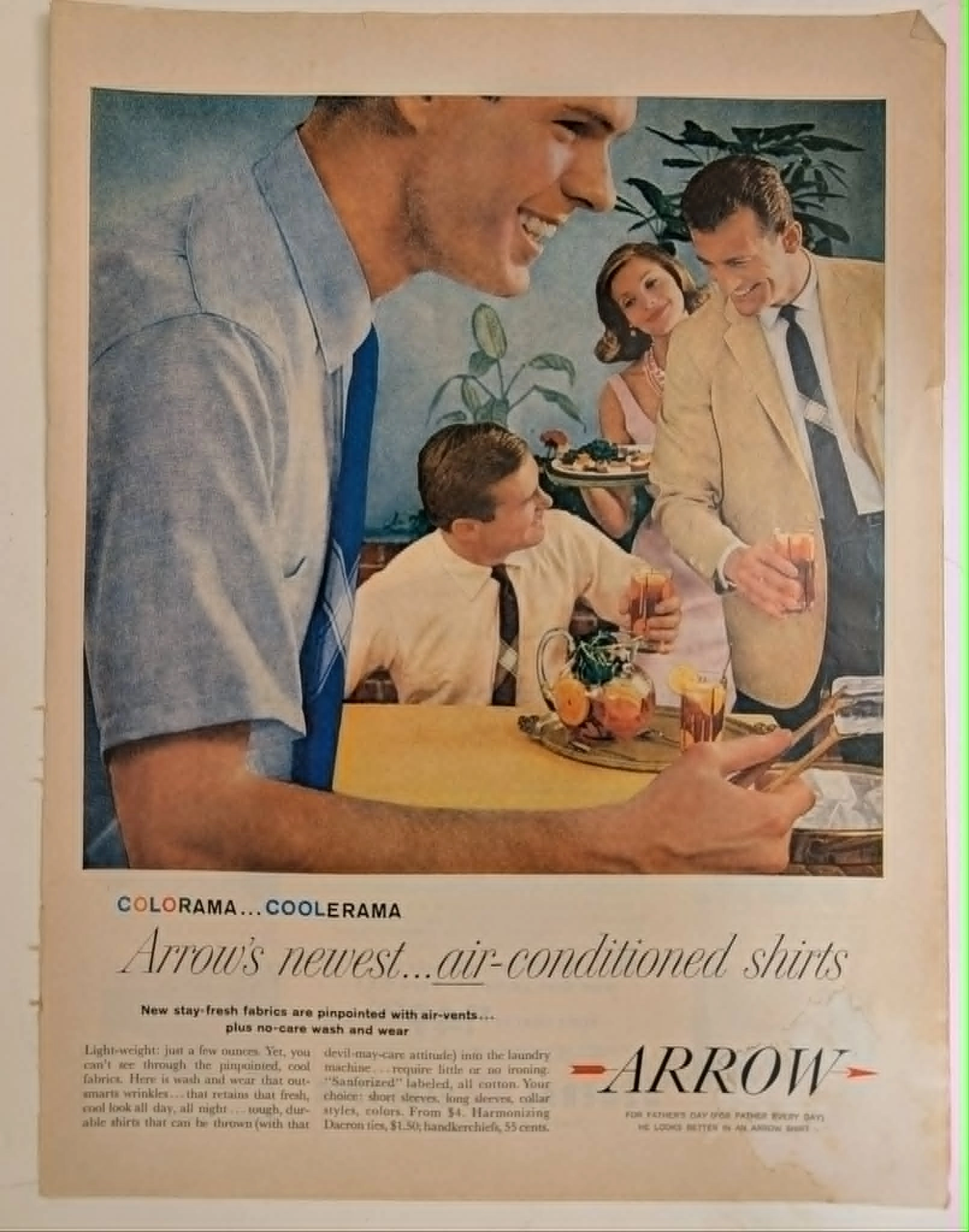
1957 Arrow "Air-Conditioned" Colorama & Coolerama Vintage AdvertisementANALOG ARCHIVE
1957 Arrow "Air-Conditioned" Colorama & Coolerama Vintage Advertisement (1957) — Class A vintage Lifestyle & Vice
CLASS A
1 of 4

1957 Arrow "Air-Conditioned" Colorama & Coolerama Vintage Advertisement

Category|Lifestyle & Vice
Year|1957
Rarity Class|CLASS A
Archive Views|2
Theme/SubjectLuxuryFashion

Last updated: 15 May 2026

Historical Context

In the late 1950s, the American textile industry was undergoing a revolution. The introduction of "Wash and Wear" fabrics and "Sanforized" cotton meant that the modern man could maintain a crisp, professional appearance without the labor-intensive maintenance of previous decades. This specific Arrow campaign, titled "Colorama... Coolerama," brilliantly merges the technical benefits of breathability with the aesthetic appeal of a broad color palette. The term "air-conditioned shirts" was a powerful marketing metaphor. As central air conditioning was becoming a coveted luxury in American homes and offices, Arrow positioned its apparel as a personal climate-control system. The ad highlights "pinpointed air-vents"—micro-perforations in the fabric that allowed for maximum airflow—solving the perennial problem of summer heat for the suit-and-tie generation. The imagery captures a quintessentially optimistic 1950s social scene: a backyard or patio gathering where men remain cool and composed in short-sleeved button-downs and ties. This reflects the "Executive Leisure" trend, where the boundaries between formal workwear and casual social attire began to blur. Priced from $4.00, these shirts represented an accessible luxury, marketed heavily as the ideal Father's Day gift to ensure "He looks better in an Arrow shirt."

Paper & Print Condition

The artifact exhibits high-fidelity color retention in the "Colorama" logo. The paper shows slight oxidative yellowing consistent with 1950s wood-pulp magazine stock, adding to its authentic vintage character. No significant foxing or moisture damage is present.

Provenance & Rarity

Sourced from a prominent 1957 American lifestyle periodical. This specific "Coolerama" execution is a prime example of Arrow’s peak-era advertising dominance under the Cluett, Peabody & Co. umbrella. Surviving examples with such vibrant color retention and clean typography are increasingly scarce, making this a notable acquisition for mid-century fashion and textile marketing archives.

Rarity & Condition Summary

A highly collectible piece for scholars of textile history and mid-century graphic design. Graded as Class A rarity, it remains in excellent condition with authentic mid-century paper patina. The elegant interplay of serif and italicized typography, combined with high-fidelity color retention, perfectly illustrates the transition into modern advertising layouts of the late 1950s.
Share This Archive

From the Journal

Related Articles

The Time Traveller's Dossier: Terrestrial Navigation – The Timberland Boat Shoe and the Evolution of Amphibious Footwear — related article
Read Article

The Time Traveller's Dossier: Terrestrial Navigation – The Timberland Boat Shoe and the Evolution of Amphibious Footwear

The evolution of twentieth-century American apparel is deeply intertwined with the adaptation of specialized, utilitarian gear for mainstream, terrestrial use. The historical artifact elegantly positioned upon the analytical table of The Record Institute today is a visually detailed and highly informative full-page print advertisement for The Timberland Boat Shoe. This document gracefully transcends the standard boundaries of footwear marketing. It operates as a highly sophisticated, multi-layered cultural mirror, reflecting a precise era in consumer sociology where the American public began integrating specialized sporting garments into their daily wardrobes. By utilizing a methodical, point-by-point comparative analysis against the established market leader, Sperry Topsider, The Timberland Company presented a scholarly and persuasive argument for superior material construction. This comprehensive dossier conducts a meticulous, nuanced, and exceptionally detailed examination of the artifact, operating under the most rigorous parameters of historical, sociological, and material science evaluation. Dedicating the overwhelming majority of our analytical focus (80%) to its immense historical gravity, we will decode the thoughtful marketing psychology embedded within the "land and sea" narrative, analyze the profound engineering differences highlighted in the construction of the shoe, and explore the sociological shift of maritime fashion into the suburban environment. Furthermore, as we venture deeply into the chemical and physical foundations of this analog printed ephemera (10%), we will reveal the precise mechanical fingerprints of the CMYK halftone rosettes captured in the macro imagery of the embossed leather. Finally, we will assess its archival rarity (10%), exploring how the graceful, natural oxidation of the paper substrate cultivates a serene wabi-sabi aesthetic—a natural, irreversible phenomenon that serves as the primary engine increasing its market value exponentially within the elite global spheres of Vintage Commercial Ephemera and Fashion Archives.

The Time Traveller's Dossier: The Architecture of Masculine Dominance – Pierre Cardin Editorial Illustration (Circa 1980s) — related article
Read Article

The Time Traveller's Dossier: The Architecture of Masculine Dominance – Pierre Cardin Editorial Illustration (Circa 1980s)

History is not merely written; it is tailored, draped, and aggressively padded at the shoulders. Long before digital algorithms dictated the sterile parameters of modern menswear, and before the casualization of the corporate wardrobe stripped the modern executive of his sartorial armor, societal engineering was executed through the calculated geometry of the designer suit. The historical artifact before us is not a mere disposable magazine tear sheet; it is a perfectly weaponized blueprint of 1980s hyper-masculinity, a visual manifesto of corporate dominance, and an unwavering testament to an era when clothing was utilized as a tool for physical and psychological intimidation. ​This museum-grade, academic archival dossier presents an exhaustive deconstruction of a late-analog editorial illustration featuring the revolutionary menswear of Pierre Cardin, dating to the pivotal "Power Suit" era of the 1980s. Operating on a profound, ruthless binary structure, this document records a calculated paradigm shift within the global fashion industry. It captures the precise historical fracture where menswear transitioned conceptually from the conservative, conformity-driven "Organization Man" of the mid-20th century into the aggressive, space-commanding "Power Broker" of the 1980s. Through the highly specialized lens of late-analog commercial artistry and stringent visual forensics, this document serves as a masterclass in the psychological marketing of gender and power. It established the foundational archetype for the modern, alpha-male aesthetic—an archetype that unconditionally dictates the visual and strategic totems of corporate dominance even today.

The Time Traveller's Dossier: The Architecture of Slumber – The 1967 Simmons Golden Value — related article
Read Article

The Time Traveller's Dossier: The Architecture of Slumber – The 1967 Simmons Golden Value

The evolution of the American domestic interior during the mid-twentieth century was heavily influenced by the golden age of travel and the rapid expansion of the luxury hospitality industry. The historical artifact elegantly secured upon the analytical table of The Record Institute today is a large-format, two-page centerfold print advertisement for the Simmons Mattress Company, copyrighted in 1967. This document transcends standard consumer goods marketing; it operates as a sophisticated sociological mirror, reflecting a highly specific moment when industrial sleep engineering and the aspirational luxury of the modern hotel were explicitly packaged and sold to the suburban American household. This world-class, comprehensive dossier conducts a meticulous, profound, and historically objective examination of the artifact, operating under the absolute most rigorous parameters of sociological and material science evaluation. We will decode the brilliant marketing psychology embedded within the "First Public Sale" messaging, analyze the iconic "Good Housekeeping" endorsement, and dissect the rich semiotics of the heraldic quilt patterns alongside the modernist architectural illustrations. Furthermore, as we venture deeply into the chemical and physical foundations of this analog printed ephemera, we will reveal the precise mechanical fingerprints of the CMYK halftone rosettes and the graceful, natural oxidation of the paper substrate. This precise intersection of visual nostalgia, mid-century commercial artistry, and the immutable chemistry of time cultivates a serene wabi-sabi aesthetic—a natural, irreversible phenomenon that serves as the primary engine driving up its market value exponentially within the elite global spheres of Vintage Commercial Ephemera and Mid-Century Lifestyle Archives collecting.

The Time Traveller’s Dossier: 1983 Evyan White Shoulders Vintage Advertisement — An Ode to Classical Romance and Elegance — related article
Read Article

The Time Traveller’s Dossier: 1983 Evyan White Shoulders Vintage Advertisement — An Ode to Classical Romance and Elegance

Delve into the captivating allure of this 1983 Evyan White Shoulders vintage advertisement, a quintessential piece of twentieth-century fragrance history. As a prime example of premium classic print ads, this visual masterpiece brilliantly intertwines modern sophistication with renaissance-inspired artistry. The piece highlights the iconic golden bottle alongside a deeply romantic tableau, showcasing the enduring legacy of Evyan Perfumes. For collectors and archivists studying old advertisements, this document represents a pivotal era in 1980s luxury marketing, where the visual narrative relied heavily on classical femininity and timeless elegance. By preserving such remarkable vintage ads, we gain profound insights into the evolution of beauty campaigns and consumer desires. This dossier meticulously examines the print's historical context, archival paper quality, and unparalleled visual impact, offering an authoritative look at one of the era's most recognizable fragrance promotions.