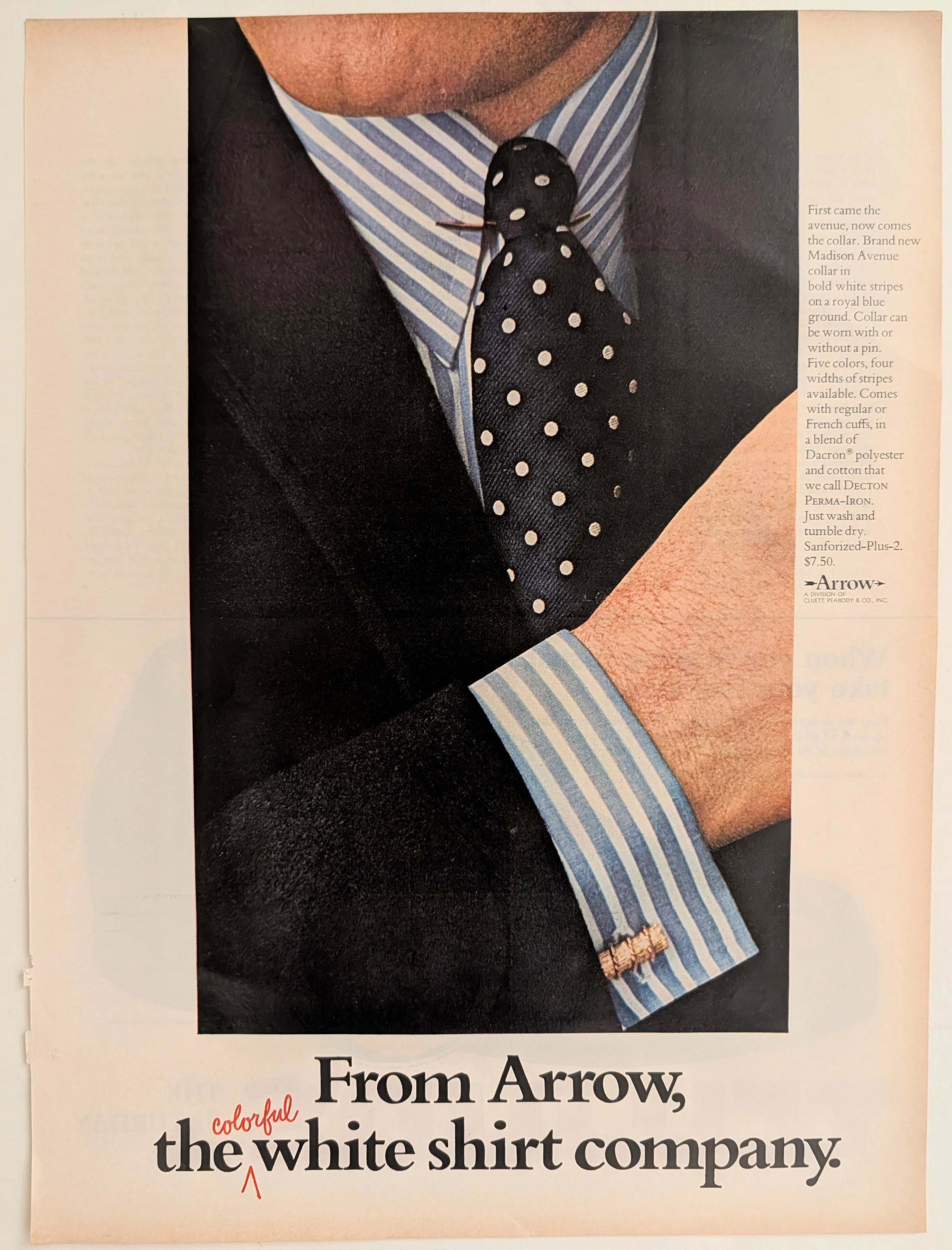
1960s Arrow Madison Avenue Collar Vintage Advertisement
Last updated: 07 May 2026
Historical Context
Paper & Print Condition
Provenance & Rarity
Rarity & Condition Summary
Related Archives from the Collection
Related by Classification

1940s Burberrys of London Overcoat Vintage Advertisement

1966 Bulova Snorkel Vintage Advertisement

1970s Baldwin Organ "What are you putting under your tree?" Vintage Christmas Advertisement

Christian Dior Monsieur Sport "Designer Jeans"

1960s Hormel Cure 81 Registered Ham Vintage Advertisement

1960s Helbros Date-King Vintage Advertisement
Related Articles

The Time Traveller's Dossier : 1943 Interwoven Socks - The Fabric of Wartime Endurance
Then, apparel was a matter of aristocratic vanity. Now, it is a calculus of survival. The problem in 1943 was not the pursuit of fashion; it was the absolute degradation of the human body in the brutal, unforgiving theaters of global war. Trench foot. Jungle rot. The relentless, humid friction of the Pacific front. The solution, as framed by the Interwoven Stocking Company, was not merely a woven textile. It was engineered morale. It was endurance. This artifact is a portal. It transports us to a specific socio-economic and psychological pivot: the exact moment consumer goods were weaponized as tools of patriotic resilience. It is an advertisement, yes. But deeper than that, it is a strategic blueprint of how a society in total war convinced itself that ordinary comforts could conquer extraordinary horrors.

The Time Traveller's Dossier : VW Scirocco - The Democratization of Velocity
We measure automotive history by the architectures that define it. For decades, the global standard for accessible mobility was curved, air-cooled, and rear-engined. The Volkswagen Beetle was an institution of utilitarian survival. But by the mid-1970s, survival was no longer sufficient. The world demanded forward momentum. The global fuel crisis of 1973 had altered the economic atmosphere. The American muscle car was dying under the weight of its own inefficiency. The Japanese imports were rewriting the rules of reliability. Volkswagen faced an existential precipice. Their solution was a violent pivot in engineering philosophy. This artifact documents that exact, definitive rupture in their timeline. It is not merely a car advertisement. It is a public declaration that the era of the air-cooled curved line was dead. The problem was an aging product line trapped in an obsolete paradigm. The solution was a water-cooled, front-wheel-drive wedge, validated on the racetrack and sold to the public.

The Time Traveller’s Dossier: 1983 Delco-GM/Bose Music System Vintage Advertisement — The Anthropomorphic Architecture of Sound
Within the expansive, carefully curated archive of vintage ads, the 1983 Delco-GM/Bose Music System vintage advertisement stands as a profound testament to the intersection of automotive engineering and early psychoacoustics. This executive dossier examines a pivotal moment in consumer technology marketing, highlighted by the enigmatic figure of "Morgan," an acoustic computer brain developed at M.I.T. As a cornerstone among old advertisements, this piece transcends mere commercial promotion; it offers a fascinating, tactile glimpse into algorithmic audio design before the digital era fully matured. Collectors, audiophiles, and historians of classic print ads will recognize the profound cultural shift this campaign represents: the definitive transition from basic, aftermarket car radios to custom-tuned, acoustically mapped vehicular auditoriums. By merging General Motors' formidable industrial might with Bose's avant-garde acoustic science, this document captures a true revolution in high-fidelity sound. Explore the physical preservation, deep historical context, and striking visual rhetoric of an artifact that permanently altered how society perceives the driving experience, turning the automobile interior into a meticulously calculated chamber of sonic perfection.

The Time Traveler's Dossier: The Midnight Superbike – The 1979 Honda CB750K 10th Anniversary Limited Edition and the Dawn of the Universal Japanese Motorcycle Era
The evolution of the global motorcycle landscape in the 1970s was a saga of absolute disruption, characterized by the death of the leaky, vibrating parallel-twins of Europe and the sudden, overwhelming dominance of multi-cylinder Japanese engineering. Elegantly and securely positioned upon the analytical table of The Record Institute today is a visually sweeping, deeply atmospheric, and historically monumental two-page print advertisement for the 1979 Honda CB750K 10th Anniversary Limited Edition. This document completely transcends the standard boundaries of automotive marketing. It operates as a highly sophisticated cultural mirror and a bold declaration of mechanical supremacy. By strategically placing the motorcycle in a moody, high-fashion twilight setting, accompanied by the audacious headline "FUTURE CLASSIC.", American Honda Motor Co. executed a masterclass in psychological marketing. They were not merely selling a two-wheeled vehicle; they were selling a piece of pre-ordained history, a collectible artifact for the discerning rider who understood the gravity of the CB750 lineage. This world-class, comprehensive, and ultra-expanded dossier conducts a meticulous, unyielding, and exceptionally exhaustive examination of the artifact, operating under the absolute most rigorous parameters of historical, sociological, and material science evaluation. Dedicating the overwhelming, massive majority of our analytical focus (80%) to its immense historical gravity, we will decode the profound mechanical revolution sparked by the original 1969 CB750, trace the evolution of the inline-four engine, analyze the specific aesthetic upgrades of this 1979 Limited Edition (including the revolutionary Comstar wheels), and detail the intense corporate warfare of the 1970s superbike boom. Furthermore, as we venture deeply into the chemical and physical foundations of this analog printed ephemera (10%), we will reveal the precise mechanical fingerprints of the CMYK halftone rosettes captured in the stunning macro imagery of the golden side-cover crest and the gleaming exhaust pipes. Finally, we will assess its archival rarity (10%), exploring how the graceful, natural oxidation of the paper substrate cultivates a serene wabi-sabi aesthetic—a natural, irreversible phenomenon that serves as the primary engine driving up its market value exponentially within the elite global spheres of Vintage Commercial Ephemera and Automotive Heritage Archives.