THE RECORD · ARCHIVE PLAYER
MP4
■ PAUSED
1964 Chevrolet Chevelle Malibu Super Sport Coupe Vintage AdvertisementANALOG ARCHIVE
1964 Chevrolet Chevelle Malibu Super Sport Coupe Vintage Advertisement (1964) — Class B vintage Automotive
CLASS B
1 of 6

1964 Chevrolet Chevelle Malibu Super Sport Coupe Vintage Advertisement

Category|Automotive
Subcategory|American
Year|1964
Rarity Class|CLASS B
Archive Views|9

Last updated: 05 May 2026

Historical Context

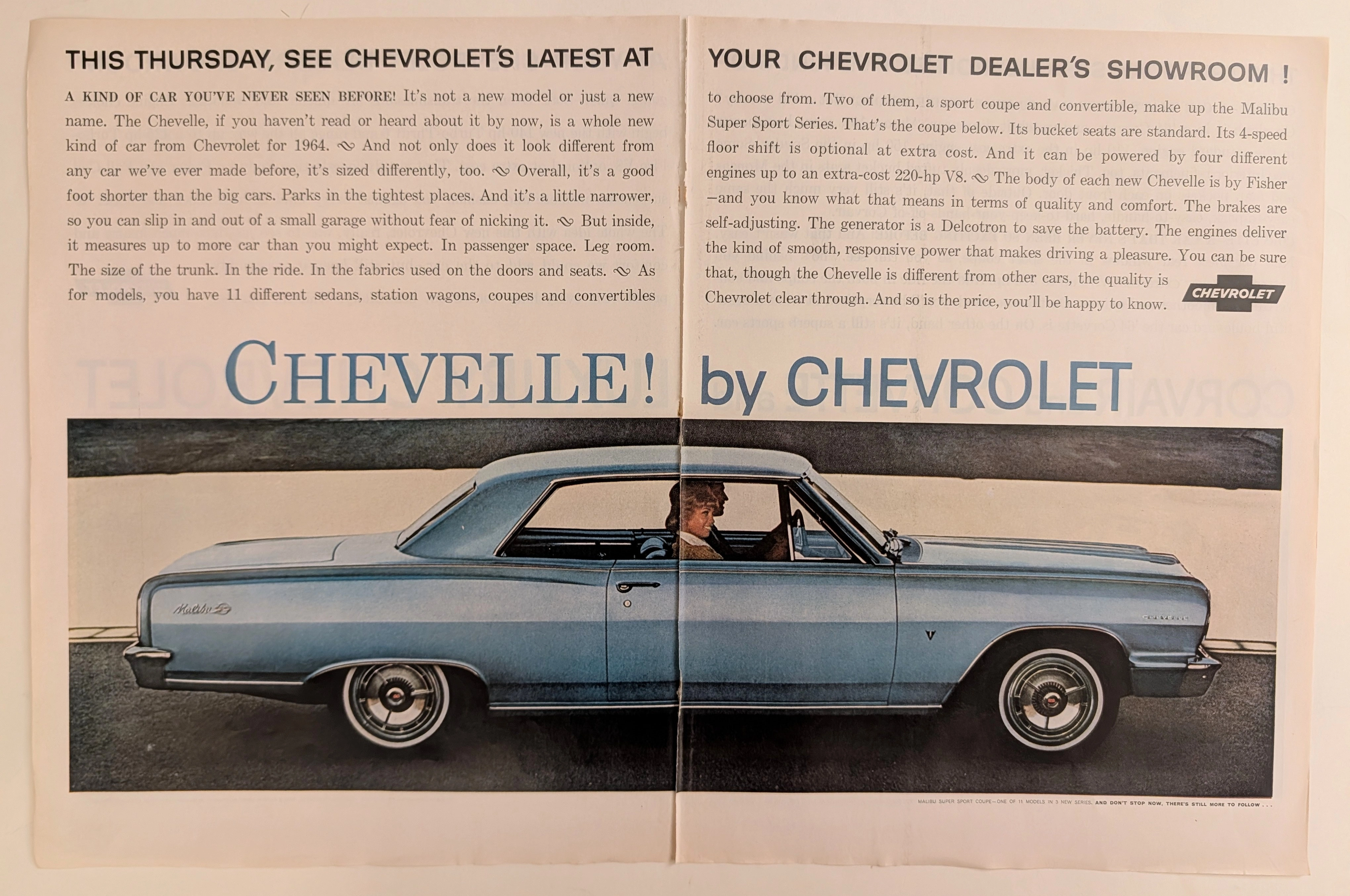
1964 Chevrolet Chevelle Malibu Super Sport Coupe "A Kind of Car You've Never Seen Before!" Vintage Advertisement The Birth of the Intermediate Segment: By the early 1960s, Chevrolet's lineup was polarized. Buyers could choose the massive, traditional full-size Bel Air or Impala, or opt for the diminutive, rear-engine Corvair or the pragmatic Chevy II compact. Recognizing a lucrative void in the middle of the market, Chevrolet introduced the Chevelle for the 1964 model year. As the advertising copy enthusiastically declares, "It's not a new model or just a new name... it is a whole new kind of car." Riding on a 115-inch wheelbase, the Chevelle was designed to be smaller and more maneuverable than the full-size cars—"a good foot shorter"—yet far more spacious and comfortable than the compacts. This "intermediate" or mid-size class would soon become the most intensely contested segment in the American auto industry. The Genesis of the Muscle Car: While the Chevelle was offered in 11 different body styles, this specific advertisement strategically features the halo model: the Malibu Super Sport (SS) Coupe. The Malibu nameplate represented the highest trim level, offering premium interior fabrics, bucket seats, and a more refined ride. The "Super Sport" designation, however, hinted at something far more potent. The ad casually mentions that the Malibu SS could be powered by engines "up to an extra-cost 220-hp V8," mated to an optional 4-speed floor shift. By dropping a powerful V8 engine into a relatively lightweight, mid-size chassis, Chevrolet was codifying the fundamental formula of the American muscle car. Although the 1964 model's 220-hp (and later 300-hp) offerings were modest compared to the monstrous big-blocks that would arrive in the late '60s, this vehicle represents ground zero for the Chevelle SS legend. Aesthetic and Commercial Presentation: Visually, the advertisement is a classic example of mid-century automotive marketing confidence. The two-page spread format allows for a sweeping, uninterrupted profile view of the Malibu SS, showcasing its clean, rectilinear styling, subtle "coke-bottle" flanks, and formal roofline. The pale blue metallic paint contrasts beautifully against the stark, minimalist background, forcing the viewer's focus entirely onto the vehicle's proportions. The copy is dense but conversational, a hallmark of the era's advertising, emphasizing practical benefits like "self-adjusting brakes" and the "Delcotron generator" alongside the emotional appeal of "smooth, responsive power." It is a masterful blend of rational persuasion and aspirational lifestyle marketing.

Paper & Print Condition

This artifact presents a fascinating study in the preservation of mid-century, large-format commercial ephemera. As a two-page spread (likely a centerfold) extracted from a high-circulation 1964 periodical, its survival in this cohesive state is a remarkable archival feat. The paper itself is a standard, medium-weight wood-pulp magazine stock characteristic of the era. Due to the inherent acidic nature of the lignin within the wood pulp, the paper exhibits a beautiful, uniform age-toning. This warm, pale-golden patina is most prominent along the outer margins and the expansive negative space, lending the piece an undeniable historical authenticity without compromising the legibility of the typography or the contrast of the image. The structural integrity of this spread is particularly noteworthy. Large-format centerfolds are notoriously susceptible to severe damage at the spine, including staple rust, harsh tearing, and complete separation of the two halves. However, this artifact maintains a solid, intact center crease with only the most minor, expected staple perforations, indicating a careful and deliberate extraction process by a dedicated archivist or collector. In terms of printing technique, the piece is a masterclass in 1960s commercial offset lithography. The cool, metallic light-blue hue of the Chevelle Malibu SS is rendered with extraordinary fidelity. Close macro-inspection reveals the intricate, high-contrast halftone dot matrix (the CMYK rosette pattern) used to simulate the car's reflective curves, chrome accents, and the nuanced shading of the interior passengers. The ink saturation remains profoundly deep, with the bold cyan and dense black typography resisting the aggressive UV fading that typically plagues 60-year-old paper artifacts. The crispness of the Chevrolet logos, the delicate script of the "Malibu" fender badge, and the sharp wheel cover details remain razor-sharp, preserving the exact visual impact intended by General Motors' advertising agency over six decades ago.

Provenance & Rarity

The provenance of this magnificent two-page spread traces back to the vibrant landscape of mid-1960s American print media. Originally bound as a striking centerfold within a premier, high-circulation general-interest periodical—likely an influential weekly such as Life, Look, or The Saturday Evening Post published in late 1963 or early 1964—this piece was born into an era of instant obsolescence. Magazines of this period were consumed voraciously by millions of households and discarded unceremoniously. Because this advertisement spans two full pages, its survival defies the immense physical odds inherent to its format. Large-format centerfolds are notoriously the most vulnerable pages in any bound publication, frequently falling victim to staple rust, forceful spine separation, and tearing at the center crease. Combined with the highly acidic nature of mid-century wood-pulp paper, which rapidly becomes brittle and heavily discolored, the attrition rate for such dual-page commercial ephemera is astronomical. Furthermore, its rarity is profoundly amplified by its cultural and automotive context. For decades, the vintage automotive collector market gravitated almost exclusively toward preserving advertisements for the flamboyant, high-horsepower big-block muscle cars of the late 1960s, or iconic flagship sports cars like the Corvette. The 1964 Chevelle Malibu SS, representing the dawn of the intermediate segment and the very genesis of the muscle car formula, was often overlooked by early archivists who failed to recognize its foundational significance. Consequently, to uncover a flawlessly conjoined, vividly preserved two-page spread that documents the exact public introduction of the Chevelle line is an extraordinary archival triumph. This artifact transcends its original commercial purpose, standing today as a highly coveted primary document for historians tracking the pivotal shift in mid-century American automotive design and consumer culture.

Rarity & Condition Summary

This exceptionally preserved two-page spread represents a rare convergence of fragile mass-media ephemera and museum-grade archival preservation. Surviving the profound physical vulnerabilities inherent to its centerfold format, it remains structurally flawless and visually vibrant, escaping the severe acid degradation typical of 1960s paper. Beyond its pristine physical state, the artifact possesses immense historical value, capturing the exact public introduction of the Chevrolet Chevelle Malibu SS. It stands as a highly desirable chronological benchmark, definitively documenting the genesis of the mid-size muscle car era and the shifting aspirations of the mid-century American consumer.

Share This Archive

From the Journal

Related Articles

The Time Traveller's Dossier : VW Type 3 Automatic - The Compromise of Engineering — related article
Read Article

The Time Traveller's Dossier : VW Type 3 Automatic - The Compromise of Engineering

We often remember early Volkswagen history through the lens of simplicity, air-cooled engines, and rugged manual transmissions. But as the American market matured, the demand for comfort began to clash with the brand's original philosophy. This document is historical evidence capturing that moment of compromise. It is not just a car advertisement; it is an engineering confession and a declaration. After a decade of hesitation, Volkswagen of America introduced a fully automatic transmission for the 1969 models. It is a turning point showing that even the most stubborn brand had to adapt to the American consumerism trend that sought ultimate convenience.

The Time Traveller's Dossier : Alfa Romeo 8C 2900B Touring Berlinetta - The Apex of Pre-War Velocity — related article
Read Article

The Time Traveller's Dossier : Alfa Romeo 8C 2900B Touring Berlinetta - The Apex of Pre-War Velocity

We categorize automotive history into the eras before and after aerodynamics. Prior to the late 1930s, luxury meant upright, carriage-like monuments of steel. Speed was achieved through brute force, pushing flat radiators and exposed fenders through the atmosphere. Then came the marriage of Vittorio Jano's Grand Prix engineering and Carrozzeria Touring's wind-cheating architecture. This artifact is a meticulous dissection of that paradigm shift. It is a photographic autopsy of the Alfa Romeo 8C 2900B Touring Berlinetta. The problem was the physics of atmospheric drag at high speeds. The solution was "Superleggera"—super-light aluminum stretched over thin steel tubes, shaped not by tradition, but by the wind itself.

The Time Traveller's Dossier : VW Scirocco - The Democratization of Velocity — related article
Read Article

The Time Traveller's Dossier : VW Scirocco - The Democratization of Velocity

We measure automotive history by the architectures that define it. For decades, the global standard for accessible mobility was curved, air-cooled, and rear-engined. The Volkswagen Beetle was an institution of utilitarian survival. But by the mid-1970s, survival was no longer sufficient. The world demanded forward momentum. The global fuel crisis of 1973 had altered the economic atmosphere. The American muscle car was dying under the weight of its own inefficiency. The Japanese imports were rewriting the rules of reliability. Volkswagen faced an existential precipice. Their solution was a violent pivot in engineering philosophy. This artifact documents that exact, definitive rupture in their timeline. It is not merely a car advertisement. It is a public declaration that the era of the air-cooled curved line was dead. The problem was an aging product line trapped in an obsolete paradigm. The solution was a water-cooled, front-wheel-drive wedge, validated on the racetrack and sold to the public.

True Blood of the Trans-Am: The 1970 Ford Mustang Boss 302 Legacy — related article
Read Article

True Blood of the Trans-Am: The 1970 Ford Mustang Boss 302 Legacy

Experience the raw spirit of an American muscle car legend through an authentic, pre-2000 analog magazine advertisement, carefully extracted as a single sheet.