1964 Ford Econoline Van Vintage Advertisement (1964) — Class B vintage Automotive
CLASS B
1 of 6

1964 Ford Econoline Van Vintage Advertisement

Category|Automotive
Subcategory|American
Year|1964
Rarity Class|CLASS B
Archive Views|44

Last updated: 06 May 2026

Historical Context

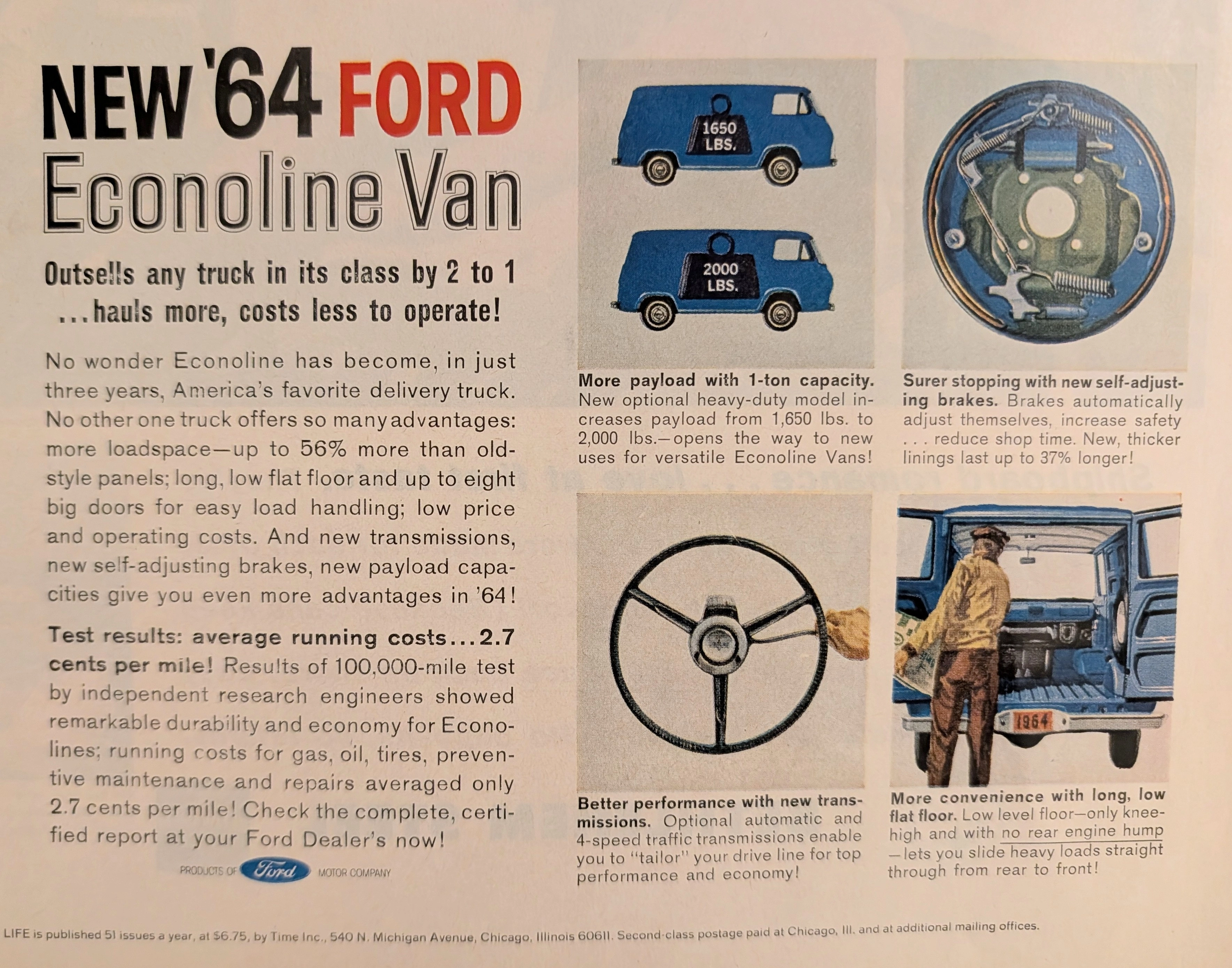
1964 Ford Econoline Van: America's Favorite Delivery Truck Vintage Advertisement The 1964 Ford Econoline Van stands as a pivotal milestone in American automotive and commercial history. Introduced as a highly efficient and versatile delivery solution, the Econoline quickly became the nation's premier delivery truck. This 1964 print advertisement highlights the vehicle's functional advancements, including a revolutionary flat cargo floor, increased 1-ton payload capacities, and an economical operational cost of just 2.7 cents per mile. The Commercial Landscape of the 1960s In the early 1960s, the American commercial vehicle market was undergoing a significant transformation. Businesses required compact, reliable, and capacious vehicles to handle urban deliveries and tradesman duties. Ford's introduction of the Econoline series in 1961 revolutionized this space. Moving away from traditional panel deliveries based on passenger car chassis, Ford utilized a dedicated, forward-control van architecture. By 1964, as this advertisement proudly proclaims, the Econoline was outselling competitors by a two-to-one margin, cementing its status as "America's favorite delivery truck." Engineering and Practicality The 1964 advertisement meticulously details the engineering improvements that solidified the Econoline's market dominance. A central selling point was the "long, low flat floor." Achieved by placing the engine forward and between the front seats, Ford eliminated the awkward rear-engine hump found in competing models of the era. This low-level floor—described as "only knee-high"—allowed heavy loads to be slid straight through from rear to front with unprecedented ease. Furthermore, the introduction of a new heavy-duty model increased the payload capacity from 1,650 lbs. to an impressive 2,000 lbs. (a full 1-ton capacity), opening the Econoline up to rigorous new commercial applications. Economy and Fleet Performance Operational efficiency was paramount for fleet operators and independent business owners alike. Ford emphasized this through certified independent research tests, citing an incredibly low average running cost of just 2.7 cents per mile—a figure that comprehensively covered gas, oil, tires, preventive maintenance, and repairs. The advertisement also highlights crucial technological upgrades for the '64 model year, including new self-adjusting brakes with thicker linings designed to increase safety and reduce shop time. Additionally, new optional automatic and 4-speed traffic transmissions allowed businesses to tailor their driveline for peak performance and economy.

Paper & Print Condition

Printed on standard mid-century consumer magazine stock. The ink retains excellent saturation, particularly in the striking "NEW '64 FORD" typography and the distinct blue halftone illustrations of the Econoline. Minor, uniform oxidation typical of acidic paper from the 1960s is present but does not detract from legibility or visual impact.

Provenance & Rarity

Sourced from a mainstream 1964 American periodical (specifically noted in the margin as LIFE magazine, published by Time Inc.). While the original print run was extensive, well-preserved examples retaining crisp, unstained visuals are highly valued by automotive historians and collectors of industrial Americana.

Rarity & Condition Summary

A prime, commercially significant artifact reflecting 1960s American industrial design and marketing strategy, maintained in excellent archival condition.

Share This Archive

From the Journal

Related Articles

The Time Traveller's Dossier : VW Scirocco - The Democratization of Velocity — related article
Read Article

The Time Traveller's Dossier : VW Scirocco - The Democratization of Velocity

We measure automotive history by the architectures that define it. For decades, the global standard for accessible mobility was curved, air-cooled, and rear-engined. The Volkswagen Beetle was an institution of utilitarian survival. But by the mid-1970s, survival was no longer sufficient. The world demanded forward momentum. The global fuel crisis of 1973 had altered the economic atmosphere. The American muscle car was dying under the weight of its own inefficiency. The Japanese imports were rewriting the rules of reliability. Volkswagen faced an existential precipice. Their solution was a violent pivot in engineering philosophy. This artifact documents that exact, definitive rupture in their timeline. It is not merely a car advertisement. It is a public declaration that the era of the air-cooled curved line was dead. The problem was an aging product line trapped in an obsolete paradigm. The solution was a water-cooled, front-wheel-drive wedge, validated on the racetrack and sold to the public.

The Time Traveller's Dossier : VW Type 3 Automatic - The Compromise of Engineering — related article
Read Article

The Time Traveller's Dossier : VW Type 3 Automatic - The Compromise of Engineering

We often remember early Volkswagen history through the lens of simplicity, air-cooled engines, and rugged manual transmissions. But as the American market matured, the demand for comfort began to clash with the brand's original philosophy. This document is historical evidence capturing that moment of compromise. It is not just a car advertisement; it is an engineering confession and a declaration. After a decade of hesitation, Volkswagen of America introduced a fully automatic transmission for the 1969 models. It is a turning point showing that even the most stubborn brand had to adapt to the American consumerism trend that sought ultimate convenience.

The Time Traveller's Dossier : Alfa Romeo 8C 2900B Touring Berlinetta - The Apex of Pre-War Velocity — related article
Read Article

The Time Traveller's Dossier : Alfa Romeo 8C 2900B Touring Berlinetta - The Apex of Pre-War Velocity

We categorize automotive history into the eras before and after aerodynamics. Prior to the late 1930s, luxury meant upright, carriage-like monuments of steel. Speed was achieved through brute force, pushing flat radiators and exposed fenders through the atmosphere. Then came the marriage of Vittorio Jano's Grand Prix engineering and Carrozzeria Touring's wind-cheating architecture. This artifact is a meticulous dissection of that paradigm shift. It is a photographic autopsy of the Alfa Romeo 8C 2900B Touring Berlinetta. The problem was the physics of atmospheric drag at high speeds. The solution was "Superleggera"—super-light aluminum stretched over thin steel tubes, shaped not by tradition, but by the wind itself.

The Time Traveller's Dossier: The Sanctuary of the Highway – The 1968 Ford LTD and the Democratization of Silence — related article
Read Article

The Time Traveller's Dossier: The Sanctuary of the Highway – The 1968 Ford LTD and the Democratization of Silence

The evolution of the American domestic automobile during the mid-twentieth century was fundamentally propelled by a relentless pursuit of accessible luxury and physical isolation from the rapidly expanding, concrete-laden modern world. The historical artifact elegantly and securely positioned upon the analytical table of The Record Institute today is a striking, full-page print advertisement for the 1968 Ford LTD, originating from a highly volatile and transformative year in American history. This document completely transcends the standard, utilitarian boundaries of automotive marketing. It operates as a highly sophisticated, multi-layered cultural mirror, reflecting the precise era when raw horsepower was momentarily subjugated to the pursuit of absolute silence, and European-grade luxury was explicitly packaged and sold to the American middle-class consumer. This world-class, comprehensive dossier conducts a meticulous, unyielding, and exceptionally exhaustive examination of the artifact, operating under the absolute most rigorous parameters of historical, sociological, and material science evaluation. With the vast majority of our analytical focus dedicated to its immense historical gravity (80%), we will decode the brilliant marketing psychology embedded within Ford's audacious "Quiet" campaign, analyze the brutalist architectural juxtaposition of the concrete overpass against the sleek lines of the vehicle, and dissect the profound corporate semiotics of the iconic "Ford has a better idea" lightbulb logo. Furthermore, as we venture deeply into the chemical and physical foundations of this analog printed ephemera (10%), we will reveal the precise mechanical fingerprints of the CMYK halftone rosettes captured in the macro imagery of the wheel hubcap. Finally, we will assess its archival rarity (10%), exploring how the graceful, natural oxidation of the paper substrate cultivates a serene wabi-sabi aesthetic—a natural, irreversible phenomenon that serves as the primary engine driving up its market value exponentially within the elite global spheres of Vintage Commercial Ephemera and Automotive Archives.