THE RECORD · ARCHIVE PLAYER
MP4
■ PAUSED
1910s VIM Delivery Car Vintage AdvertisementANALOG ARCHIVE
1910s VIM Delivery Car Vintage Advertisement (1910) — Class B vintage Automotive
CLASS B
1 of 6

1910s VIM Delivery Car Vintage Advertisement

Category|Automotive
Subcategory|American
Year|1910
Rarity Class|CLASS B
Archive Views|13

Last updated: 12 May 2026

Historical Context

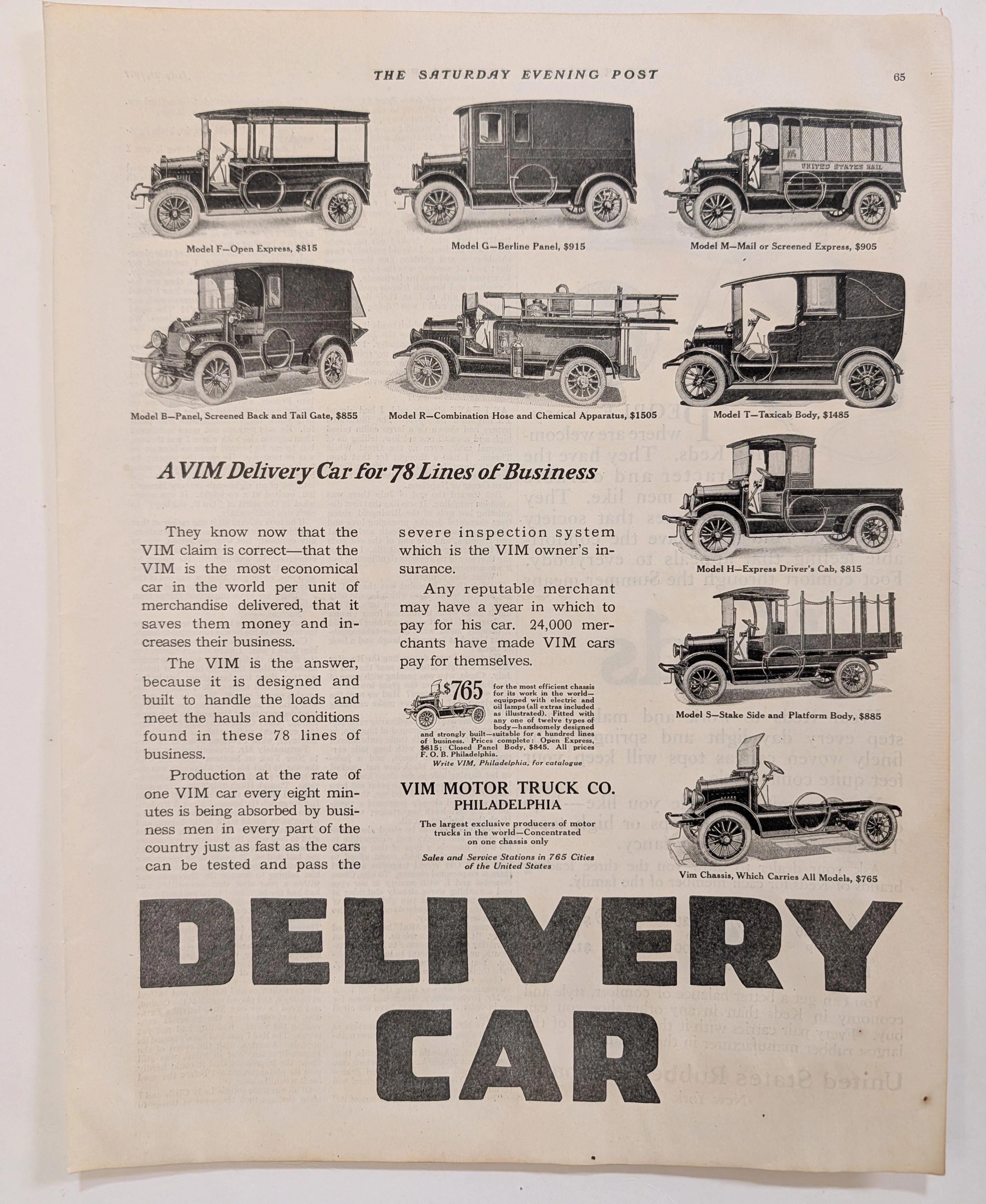
During the early stages of the American automotive boom, the VIM Motor Truck Co. positioned itself as the largest exclusive producer of motor trucks in the world by concentrating its manufacturing power on a single chassis design. This philosophy of extreme standardization allowed for rapid, economical production. The base "Vim Chassis, Which Carries All Models" was offered at an accessible $765. From this singular mechanical foundation, VIM engineered highly specialized bodies to cater to "78 Lines of Business". The advertisement operates as a comprehensive visual catalog of these commercial solutions. Notable variations include the Model F Open Express for $815, the Model M Mail or Screened Express at $905, the Model T Taxicab Body priced at $1485, and the heavy-duty Model R Combination Hose and Chemical Apparatus for municipal fire departments at $1505. By standardizing the core mechanics while diversifying the utility, VIM claimed a production rate of one vehicle every eight minutes, noting that 24,000 merchants had already integrated VIM cars into their daily operations. The company's expansive reach was further supported by sales and service stations in 765 cities across the United States. Digital Exhibition & Restoration Potential The meticulous halftone shading and precise line work of this original broadsheet make it an exceptional candidate for digital exhibition. By animating this vintage print advertisement as a living 2D artwork, the original flat illustration style, hand-drawn stroke quality, aged paper texture, and period color palette are strictly preserved. The drawn figures and vehicles can be engineered to move naturally—with fluid, organic motion contained entirely within the 2D plane. Completely avoiding 3D rendering or photorealism maintains absolute respect for the physical artifact. Integrating a synchronized, warm, and nostalgic background atmosphere—such as the rhythmic clatter of an early combustion engine, a bustling cobblestone street, or a crackling period radio—elevates the static print into a fully immersive historical tableau.

Paper & Print Condition

Paper & Print Condition: The document exhibits a natural oxidative aging, presenting the warm, aged paper texture characteristic of early 20th-century newsprint. The original flat illustration style of the vehicles is impeccably preserved, highlighting the precise hand-drawn stroke quality and meticulous halftone shading used by the artist. Crucial technical details, including distinct body panels, steering columns, and spoke wheels, retain excellent contrast without heavy ink bleed. The bold, monotone typography remains exceptionally legible against the period color palette, showing no significant ink degradation. The structural integrity of the page is well-maintained, with edges showing only minor historical wear.

Provenance & Rarity

Provenance & Rarity: Authentic print media circa 1910s, originally published as a full-page broadsheet in The Saturday Evening Post. Surviving commercial fleet advertisements from the VIM Motor Truck Company are exceedingly rare, particularly those that comprehensively catalog multiple specialized body configurations built upon a single, standardized chassis. This specific piece visually documents the critical logistical transition from horse-drawn carriages to motorized delivery fleets in early 20th-century American commerce. Its survival as an intact, full-page spread without significant physical degradation elevates it to a highly significant archival artifact for historians of urban logistics, automotive standardization, and early industrial advertising.

Rarity & Condition Summary

Rarity & Condition Summary: Classified as a Class B historical artifact, this 1910s VIM Motor Truck print advertisement is an exceptionally well-preserved specimen of early commercial cataloging. Its physical condition—characterized by natural oxidative aging, crisp monotone typography, and pristine halftone linework—far exceeds typical survival rates for Progressive Era newsprint. Because the original flat illustration style and warm paper texture remain completely unmarred, the piece serves as an ideal archival foundation for translation into a living 2D artwork. This allows the intricate mechanical illustrations to be organically animated and paired with era-appropriate background acoustics, such as the rhythmic clatter of an early combustion engine or a crackling period radio, without ever relying on modern 3D rendering. This flawless preservation elevates it to a highly significant, irreplaceable asset for both automotive historians and digital archivists.
Share This Archive

From the Journal

Related Articles

THE TIME TRAVELER'S DOSSIER: THE AUTOMOTIVE ARISTOCRACY AND THE AESTHETICS OF RUIN — related article
Read Article

THE TIME TRAVELER'S DOSSIER: THE AUTOMOTIVE ARISTOCRACY AND THE AESTHETICS OF RUIN

The artifact under rigorous, museum-grade analysis is an exceptionally preserved Historical Relic originating from the golden age of American automotive supremacy. Sourced from a vintage issue of The Saturday Evening Post, this Primary Art Document features a commanding, full-page advertisement for Packard, one of the most prestigious luxury automobile manufacturers in world history. Visually dominated by a striking, head-on illustration of a New Series Packard, the piece explicitly highlights the legendary corporate slogan: "Ask the man who owns one". Published during the turbulent economic landscape of the early 1930s Great Depression, this advertisement is a profound sociological marker. It boldly markets uncompromising luxury—boasting features like a four-speed synchro-mesh transmission and "Ride Control" shock absorbers—to an elite aristocracy largely insulated from the era's financial collapse. Physically, this pre-2000s analog artifact is a breathtaking embodiment of wabi-sabi. It exhibits a violently torn left binding edge, significant moisture blooming along the bottom margin, and deep amber lignin oxidation. This natural chemical and environmental degradation transforms a mass-produced commercial print into an irreplaceable, ready-to-frame Primary Art Document, forever capturing the magnificent mortality of the analog age.

The Time Traveller's Dossier : VW Scirocco - The Democratization of Velocity — related article
Read Article

The Time Traveller's Dossier : VW Scirocco - The Democratization of Velocity

We measure automotive history by the architectures that define it. For decades, the global standard for accessible mobility was curved, air-cooled, and rear-engined. The Volkswagen Beetle was an institution of utilitarian survival. But by the mid-1970s, survival was no longer sufficient. The world demanded forward momentum. The global fuel crisis of 1973 had altered the economic atmosphere. The American muscle car was dying under the weight of its own inefficiency. The Japanese imports were rewriting the rules of reliability. Volkswagen faced an existential precipice. Their solution was a violent pivot in engineering philosophy. This artifact documents that exact, definitive rupture in their timeline. It is not merely a car advertisement. It is a public declaration that the era of the air-cooled curved line was dead. The problem was an aging product line trapped in an obsolete paradigm. The solution was a water-cooled, front-wheel-drive wedge, validated on the racetrack and sold to the public.

The Time Traveller's Dossier: The Architecture of Unrestricted Mobility – Avis "Rent it Here - Leave it There" Advertisement (Circa 1956) — related article
Read Article

The Time Traveller's Dossier: The Architecture of Unrestricted Mobility – Avis "Rent it Here - Leave it There" Advertisement (Circa 1956)

History is not merely recorded; it is engineered, paved, and conquered through the relentless expansion of commercial logistics. Long before digital networks rendered physical distances obsolete, and before the globalized travel infrastructure became a mundane background hum of modern life, the conquest of geography was executed through bold, capital-intensive logistical paradigms. The historical artifact before us is not merely a nostalgic mid-century magazine advertisement for a car rental agency. It is a perfectly weaponized blueprint of post-war American expansionism, a visual manifesto of the "fly-drive" revolution, and an unwavering testament to an era when mastering the vast North American continent was sold as the ultimate consumer luxury. ​This museum-grade, academic archival dossier presents an exhaustive deconstruction of a mid-1950s print advertisement for the Avis Rent-a-Car system, specifically introducing their groundbreaking "Rent it here - Leave it there" service. Operating on a profound, dual-narrative storyboard structure, this document records a calculated paradigm shift within the global travel and transportation industry. It captures the precise historical fracture where the American public conceptually transitioned from the localized, static constraints of pre-war rail and personal automobile travel into the hyper-mobile, fluid, and aerospace-integrated era of the 1950s. Through the highly specialized lens of late-analog commercial illustration and stringent visual forensics, this document serves as a masterclass in the psychological marketing of freedom and corporate efficiency. It established the foundational archetype for the modern, frictionless travel economy—an archetype that unconditionally dictates the logistical strategies of the global tourism and business travel sectors today.

The Time Traveller's Dossier: The Ten-Dollar Titan – The Autolite Ford Indianapolis 500 Exhibition — related article
Read Article

The Time Traveller's Dossier: The Ten-Dollar Titan – The Autolite Ford Indianapolis 500 Exhibition

The synthesis of high-stakes motorsport engineering and everyday consumer accessibility represents a pinnacle achievement in mid-twentieth-century American commercial strategy. The historical artifact elegantly secured upon the analytical table of The Record Institute today is a majestic full-page print advertisement for Autolite Ford Ignition Coils, originating from the golden era of 1960s automobile racing. This document completely transcends the traditional boundaries of automotive parts marketing. It operates as a profound, sophisticated declaration of how cutting-edge technological innovation on the racetrack was democratized and delivered directly into the hands of the American middle class, transforming the daily commute into an extension of the Indianapolis 500. ​This world-class, comprehensive dossier conducts a meticulous and deep examination of the artifact, operating under the absolute most rigorous parameters of historical, sociological, and material science evaluation. We will decode the brilliant, kinetic pit-stop scene capturing an open-wheel race car, and analyze the dramatic visual juxtaposition of this high-speed chaos against the highly structured, calculated copywriting of the Ford Motor Company. Furthermore, as we venture into the chemical and physical foundations of this analog printed ephemera, we will reveal the mechanical fingerprints of the CMYK halftone rosettes and the graceful, natural oxidation of the paper substrate. This precise intersection of visual nostalgia, motorsport heritage, and the chemistry of time cultivates a serene wabi-sabi aesthetic—a natural, irreversible phenomenon that serves as the primary engine driving up its market value exponentially within the elite global spheres of Vintage Automotive Ephemera and Motorsports Archives collecting.