THE RECORD · ARCHIVE PLAYER
MP4
■ PAUSED
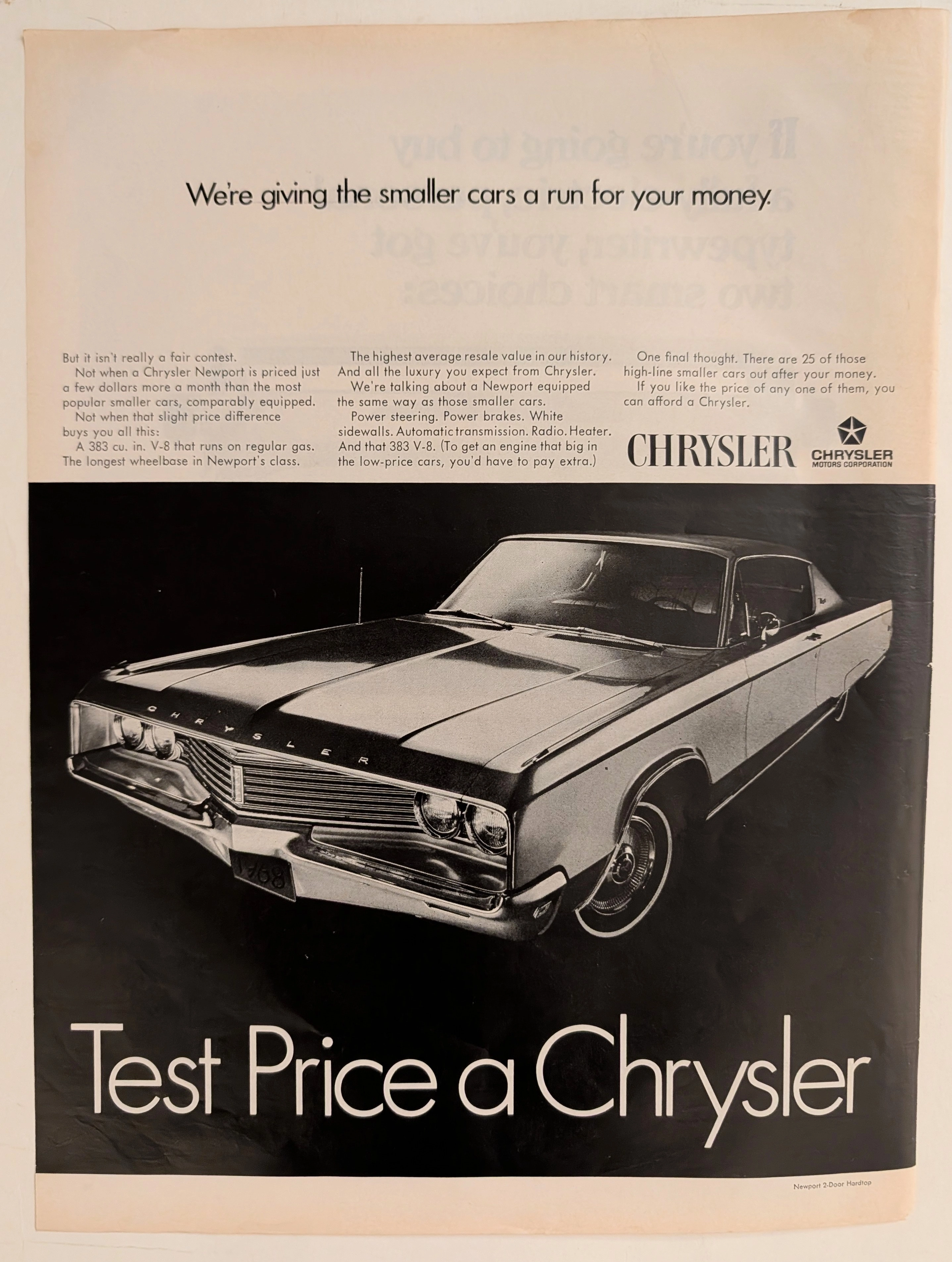
1968 Chrysler Newport 2-Door Hardtop Vintage AdvertisementANALOG ARCHIVE
1968 Chrysler Newport 2-Door Hardtop Vintage Advertisement (1968) — Class B vintage Automotive
CLASS B
1 of 4

1968 Chrysler Newport 2-Door Hardtop Vintage Advertisement

Category|Automotive
Subcategory|American
Year|1968
Rarity Class|CLASS B
Archive Views|16
Heritage AdvertisementsAutomotiveCarsChrysler

Last updated: 09 May 2026

Historical Context

The 1968 Chrysler Newport 2-Door Hardtop was a cornerstone of Chrysler’s marketing strategy to democratize luxury. By the late 1960s, the American automotive market was increasingly stratified between burgeoning compacts and traditional full-sized luxury cruisers. Chrysler's "Test Price" campaign was a direct assault on the perception that a high-end vehicle was financially out of reach for the average buyer. The advertisement boldly claims to give "smaller cars a run for your money," positioning the full-sized Newport as a superior value proposition compared to high-line smaller vehicles. At the heart of the Newport’s appeal was the standard 383 cubic inch V-8 engine designed to run on regular gasoline, providing significant power without the premium fuel costs often associated with performance luxury. Chrysler highlighted that the Newport boasted the longest wheelbase in its class, ensuring a smooth, "big car" ride that smaller competitors simply could not match. To further entice value-conscious buyers, the ad lists an impressive array of standard equipment—at least in the context of this "comparably equipped" price point—including power steering, power brakes, whitewall tires, an automatic transmission, radio, and heater. Chrysler's strategy was underpinned by the Newport's high average resale value, which they claimed was the highest in their history. This long-term financial benefit, combined with a monthly payment that was "just a few dollars more" than smaller popular cars, made the Newport an attractive upgrade for the growing American middle class. The 1968 Newport's design featured the refined "C-body" styling, characterized by a clean, horizontal grille and integrated bumpers that gave the car a wider, more prestigious road presence. By inviting consumers to "Test Price a Chrysler," the company was not just selling a car, but a lifestyle upgrade that appeared remarkably affordable.

Paper & Print Condition

The artifact is printed on standard periodical paper stock from the late 1960s. The monochrome print exhibits high contrast with minimal yellowing, effectively preserving the visual integrity of the original media. High-resolution details remain visible in the Newport's front fascia and chrome brightwork. The rendering of the whitewall tires and detailed wheel covers is particularly sharp, showcasing the technical proficiency of the period's offset lithography.

Provenance & Rarity

Provenance: This artifact was originally published in a high-circulation American weekly magazine in 1968 as part of the Chrysler Motors Corporation "Test Price" national campaign. It was professionally extracted from the original periodical binding and archived to preserve the visual integrity of the high-contrast monochrome photography. Rarity: While Chrysler's advertising output was extensive during the late 1960s, the attrition rate for ephemeral periodical paper is exceptionally high. Intact specimens featuring clean margins and the specific "Newport 2-Door Hardtop" typography are increasingly uncommon. This piece is categorized as "Uncommon" due to its exceptional archive-grade preservation.

Rarity & Condition Summary

In summary, this 1968 Chrysler Newport advertisement is a remarkable archival specimen representing the peak of monochrome automotive marketing. While Chrysler’s "Test Price" campaign was broadly distributed, the ephemeral nature of 1960s newsprint and periodical stock makes finding an example with such high-contrast integrity and clean margins notably uncommon. The paper demonstrates exceptional stability, with the deep blacks of the studio photography remaining rich and the serif typography sharp. This piece is a stable, museum-quality record of late-century American industrial promotion and consumer psychology.

Share This Archive

From the Journal

Related Articles

The Time Traveller's Dossier : 1964 Studebaker - The Final Defiance of the Independent Automaker — related article
Read Article

The Time Traveller's Dossier : 1964 Studebaker - The Final Defiance of the Independent Automaker

Then, it was a declaration of survival. A corporate manifesto masked as a product introduction. In late 1963, as this advertisement went to press, the American automotive landscape was consolidating into an impenetrable oligopoly. The Big Three—General Motors, Ford, and Chrysler—dictated the market. Studebaker, an independent manufacturer with roots dating back to wagon-building in the 19th century, was bleeding capital. This document represents their final, logical plea to the rational consumer. It highlights safety before safety was mandated. It promises performance, economy, and structural integrity. It carries the personal signature of a dying president, Sherwood H. Egbert. Now, it is an artifact of extinction. A perfectly preserved record of a company attempting to logic its way out of an emotional marketplace. It stands as a testament to the brutal reality of industrial capitalism: superior engineering and honest value cannot always overcome the sheer inertia of massive corporate scale. The shift here is not technological. It is structural. It marks the closing of the era where an independent automaker could survive purely on the merit of being "Different… by Design."

THE TIME TRAVELER'S DOSSIER: THE AUTOMOTIVE ARISTOCRACY AND THE AESTHETICS OF RUIN — related article
Read Article

THE TIME TRAVELER'S DOSSIER: THE AUTOMOTIVE ARISTOCRACY AND THE AESTHETICS OF RUIN

The artifact under rigorous, museum-grade analysis is an exceptionally preserved Historical Relic originating from the golden age of American automotive supremacy. Sourced from a vintage issue of The Saturday Evening Post, this Primary Art Document features a commanding, full-page advertisement for Packard, one of the most prestigious luxury automobile manufacturers in world history. Visually dominated by a striking, head-on illustration of a New Series Packard, the piece explicitly highlights the legendary corporate slogan: "Ask the man who owns one". Published during the turbulent economic landscape of the early 1930s Great Depression, this advertisement is a profound sociological marker. It boldly markets uncompromising luxury—boasting features like a four-speed synchro-mesh transmission and "Ride Control" shock absorbers—to an elite aristocracy largely insulated from the era's financial collapse. Physically, this pre-2000s analog artifact is a breathtaking embodiment of wabi-sabi. It exhibits a violently torn left binding edge, significant moisture blooming along the bottom margin, and deep amber lignin oxidation. This natural chemical and environmental degradation transforms a mass-produced commercial print into an irreplaceable, ready-to-frame Primary Art Document, forever capturing the magnificent mortality of the analog age.

The Time Traveller's Dossier : Alfa Romeo 8C 2900B Touring Berlinetta - The Apex of Pre-War Velocity — related article
Read Article

The Time Traveller's Dossier : Alfa Romeo 8C 2900B Touring Berlinetta - The Apex of Pre-War Velocity

We categorize automotive history into the eras before and after aerodynamics. Prior to the late 1930s, luxury meant upright, carriage-like monuments of steel. Speed was achieved through brute force, pushing flat radiators and exposed fenders through the atmosphere. Then came the marriage of Vittorio Jano's Grand Prix engineering and Carrozzeria Touring's wind-cheating architecture. This artifact is a meticulous dissection of that paradigm shift. It is a photographic autopsy of the Alfa Romeo 8C 2900B Touring Berlinetta. The problem was the physics of atmospheric drag at high speeds. The solution was "Superleggera"—super-light aluminum stretched over thin steel tubes, shaped not by tradition, but by the wind itself.

The Time Traveller's Dossier : VW Scirocco - The Democratization of Velocity — related article
Read Article

The Time Traveller's Dossier : VW Scirocco - The Democratization of Velocity

We measure automotive history by the architectures that define it. For decades, the global standard for accessible mobility was curved, air-cooled, and rear-engined. The Volkswagen Beetle was an institution of utilitarian survival. But by the mid-1970s, survival was no longer sufficient. The world demanded forward momentum. The global fuel crisis of 1973 had altered the economic atmosphere. The American muscle car was dying under the weight of its own inefficiency. The Japanese imports were rewriting the rules of reliability. Volkswagen faced an existential precipice. Their solution was a violent pivot in engineering philosophy. This artifact documents that exact, definitive rupture in their timeline. It is not merely a car advertisement. It is a public declaration that the era of the air-cooled curved line was dead. The problem was an aging product line trapped in an obsolete paradigm. The solution was a water-cooled, front-wheel-drive wedge, validated on the racetrack and sold to the public.