THE RECORD · ARCHIVE PLAYER
MP4
■ PAUSED
1964 Chevrolet Impala Sport Coupe Vintage AdvertisementANALOG ARCHIVE
1964 Chevrolet Impala Sport Coupe Vintage Advertisement (1964) — Class B vintage Automotive
CLASS B
1 of 5

1964 Chevrolet Impala Sport Coupe Vintage Advertisement

Category|Automotive
Subcategory|American
Year|1964
Rarity Class|CLASS B
Archive Views|30

Last updated: 09 May 2026

Historical Context

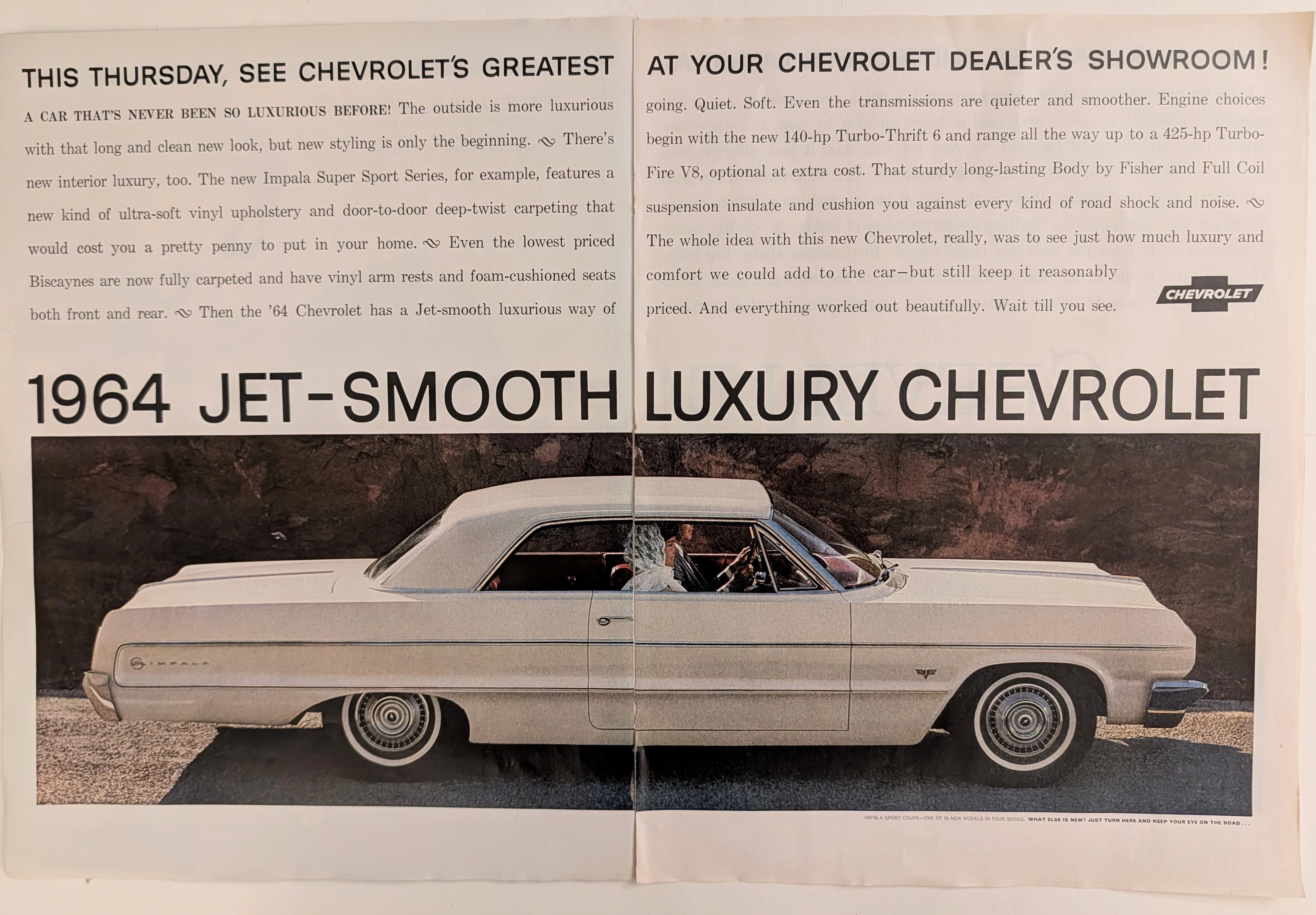
1964 Chevrolet Impala Sport Coupe Vintage Advertisement The year 1964 marked a sophisticated styling evolution for the Chevrolet Impala, representing a definitive departure from the prominent tailfins of the late 1950s in favor of a cleaner, more tailored aesthetic. This two-page spread serves as a bold public introduction to the "1964 Jet-Smooth Luxury Chevrolet" lineup. The advertisement strategically positions the Impala Sport Coupe not merely as a practical mode of transport, but as an accessible entry point into premium American luxury. The promotional copy explicitly notes that "the outside is more luxurious with that long and clean new look," highlighting General Motors' overarching strategy to offer high-end presence at a standard Chevrolet price point. Mechanically, the campaign casts a wide net by advertising a remarkably broad spectrum of powertrain options. The text details that engine choices "begin with the new 140-hp Turbo-Thrift 6 and range all the way up to a 425-hp Turbo-Fire V8". The iconic V-flag emblem, visible on the vehicle's body, serves as a visual testament to this potent V8 heritage. Furthermore, the advertisement emphasizes crucial structural and ride-quality engineering. It notes that the "sturdy long-lasting Body by Fisher and Full Coil suspension insulate and cushion you against every kind of road shock and noise," reinforcing the "Jet-smooth" marketing narrative. Visually, the composition presents the white Impala Sport Coupe in a strict profile perspective against a rugged, shadowy backdrop, a contrast that emphasizes the vehicle's sleek, low-slung stance and its distinctive pillarless hardtop roofline. The typography of the "Impala" badge remains elegant and understated, while the intricate, concentric rings of the wheel covers reflect the era's ongoing fascination with jet-age, turbine-inspired design motifs. The layout playfully utilizes its format as a magazine spread, utilizing a bottom-edge teaser that reads: "IMPALA SPORT COUPE—ONE OF 15 NEW MODELS IN FOUR SERIES. WHAT ELSE IS NEW? JUST TURN HERE AND KEEP YOUR EYE ON THE ROAD..." to draw the reader deeper into the publication.

Paper & Print Condition

The artifact is a two-page magazine centerfold or spread, exhibiting the expected central vertical crease from the original binding. High-resolution macro photography reveals the distinctive halftone dot pattern characteristic of mid-20th-century mass-market offset lithography. The paper shows minor signs of aging and marginal wear along the bottom edge, but the ink retention remains strong with high contrast in the typography.

Provenance & Rarity

As a print advertisement from a major weekly or monthly publication in late 1963 or early 1964, the sheer volume of original circulation was high. However, surviving examples that remain intact as a full spread without significant tearing or moisture damage are increasingly sought after by automotive historians and collectors.

Rarity & Condition Summary

An authentic, well-preserved artifact of American advertising history. The piece is highly representative of Campbell-Ewald's agency work for Chevrolet during the era, surviving in a stable condition ideal for digitization and historical reference.
Share This Archive

From the Journal

Related Articles

The Time Traveller's Dossier : Alfa Romeo 8C 2900B Touring Berlinetta - The Apex of Pre-War Velocity — related article
Read Article

The Time Traveller's Dossier : Alfa Romeo 8C 2900B Touring Berlinetta - The Apex of Pre-War Velocity

We categorize automotive history into the eras before and after aerodynamics. Prior to the late 1930s, luxury meant upright, carriage-like monuments of steel. Speed was achieved through brute force, pushing flat radiators and exposed fenders through the atmosphere. Then came the marriage of Vittorio Jano's Grand Prix engineering and Carrozzeria Touring's wind-cheating architecture. This artifact is a meticulous dissection of that paradigm shift. It is a photographic autopsy of the Alfa Romeo 8C 2900B Touring Berlinetta. The problem was the physics of atmospheric drag at high speeds. The solution was "Superleggera"—super-light aluminum stretched over thin steel tubes, shaped not by tradition, but by the wind itself.

The Time Traveller's Dossier : VW Type 3 Automatic - The Compromise of Engineering — related article
Read Article

The Time Traveller's Dossier : VW Type 3 Automatic - The Compromise of Engineering

We often remember early Volkswagen history through the lens of simplicity, air-cooled engines, and rugged manual transmissions. But as the American market matured, the demand for comfort began to clash with the brand's original philosophy. This document is historical evidence capturing that moment of compromise. It is not just a car advertisement; it is an engineering confession and a declaration. After a decade of hesitation, Volkswagen of America introduced a fully automatic transmission for the 1969 models. It is a turning point showing that even the most stubborn brand had to adapt to the American consumerism trend that sought ultimate convenience.

The Time Traveller's Dossier : VW Scirocco - The Democratization of Velocity — related article
Read Article

The Time Traveller's Dossier : VW Scirocco - The Democratization of Velocity

We measure automotive history by the architectures that define it. For decades, the global standard for accessible mobility was curved, air-cooled, and rear-engined. The Volkswagen Beetle was an institution of utilitarian survival. But by the mid-1970s, survival was no longer sufficient. The world demanded forward momentum. The global fuel crisis of 1973 had altered the economic atmosphere. The American muscle car was dying under the weight of its own inefficiency. The Japanese imports were rewriting the rules of reliability. Volkswagen faced an existential precipice. Their solution was a violent pivot in engineering philosophy. This artifact documents that exact, definitive rupture in their timeline. It is not merely a car advertisement. It is a public declaration that the era of the air-cooled curved line was dead. The problem was an aging product line trapped in an obsolete paradigm. The solution was a water-cooled, front-wheel-drive wedge, validated on the racetrack and sold to the public.

The Time Traveller's Dossier: The Architecture of Command and Authority – The 1956 Chrysler "PowerStyle" Manifesto — related article
Read Article

The Time Traveller's Dossier: The Architecture of Command and Authority – The 1956 Chrysler "PowerStyle" Manifesto

History is not merely chronicled through written texts; it is forged in cold steel, sculpted in gleaming chromium, and dictated by the absolute, ruthless triumph of industrial design. Long before the modern world was infected and subdued by sterile digital algorithms and soulless autonomous vehicles, there was an era where the guttural roar of a V-8 engine was the ultimate symphony of American prosperity. In this bygone epoch, automotive architecture was a literal weapon—a physical manifestation used to declare a man’s absolute sovereignty over space and time. The historical artifact that stands before us is not merely a decaying magazine advertisement ravaged by the decades. It is an absolute "Blueprint of Victory." It is the visual manifesto utilized by Chrysler in 1956 to violently obliterate the mundane complacency of its rivals, aggressively establishing the "Era of Pushbutton Command" as the mandatory new standard for the American elite. ​This museum-grade academic archival dossier will execute an exhaustive, uncompromising deconstruction of the 1956 Chrysler New Yorker "PowerStyle" campaign—the absolute zenith of the legendary "Forward Look" design philosophy. Through the highly specialized lens of visual forensics and commercial semiotics, we will expose how every single brushstroke, every shadow, and every line of copywriting was deployed in a calculated psychological war to transform the ordinary "driver" into a sovereign "pilot." This document serves as an undeniable testament to how Chrysler artificially engineered "America's most smartly different car," weaponizing the zeitgeist of the Jet Age to monopolize consumer desire. This is a Class S marketing relic that has survived the destructive progression of time to validate its supremacy in your hands today.