THE RECORD · ARCHIVE PLAYER
MP4
■ PAUSED
1943 7-Up Soft Drink "They Like It, It Likes Them" Vintage AdvertisementANALOG ARCHIVE
1943 7-Up Soft Drink "They Like It, It Likes Them" Vintage Advertisement (1943) — Class A vintage Lifestyle & Vice
CLASS A
1 of 4

1943 7-Up Soft Drink "They Like It, It Likes Them" Vintage Advertisement

Category|Lifestyle & Vice
Year|1943
Rarity Class|CLASS A
Archive Views|8

Last updated: 13 May 2026

Historical Context

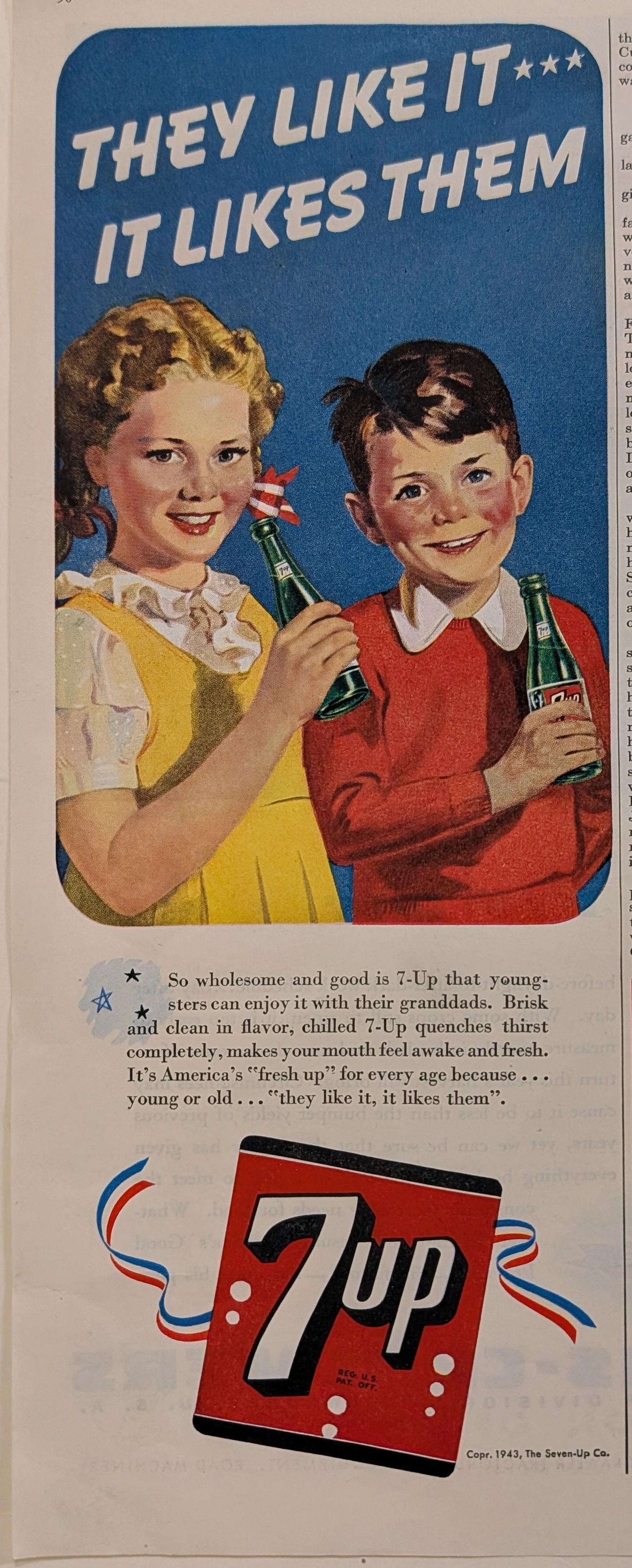
In 1943, American commercial aesthetics were deeply influenced by a cultural desire for domestic reliability amidst the backdrop of World War II. This advertisement, featuring a young girl and boy happily sharing a moment with their bottled drinks, was a strategic move to frame 7-Up as "America's 'fresh up' for every age". The narrative emphasizes a "wholesome and good" quality, suggesting that the drink is so pure that "youngsters can enjoy it with their granddads". The primary visual is rendered in a classic 1940s 2D flat illustration style. This specific creative direction deliberately preserves the original hand-drawn stroke quality and utilizes a warm, period-appropriate color palette characterized by soft textures and rosy-cheeked optimism. The illustrative approach anchors the piece as a living 2D artwork of its time, capturing an idyllic innocence that resonated strongly with wartime consumers. Technically, the advertisement highlights the physical product design through the depiction of the iconic, textured green glass bottle firmly gripped by the young boy. The foundational brand identity is cemented by the logo treatment—featuring the bold, slanted "7up" lettering and stylized white bubbles set against a striking red rectangular field. Bearing the explicit mark "Copr. 1943, The Seven-Up Co.", this piece stands as a documented historical record of a pivotal moment where beverages were marketed as functional "pick-me-ups" that promised to leave the consumer's mouth feeling "awake and fresh".

Paper & Print Condition

The physical artifact displays the characteristic aged paper texture typical of mid-century magazine stock, featuring a subtle, tactile grain. The print quality immaculately preserves the original illustrator's 2D flat hand-drawn technique. The lithographic ink saturation remains remarkably high; specifically, the deep crimson reds of the logo field and the vivid navy blue background have resisted significant ultraviolet degradation and foxing over the decades. The intricate details, from the organic brushstrokes to the delicate white highlights reflecting off the textured green glass bottles, remain exceptionally crisp, indicating careful historical preservation.

Provenance & Rarity

This item is a verified 1943 copyright production directly from The Seven-Up Co. promotional efforts during the Second World War. Advertisements from this specific wartime year are highly sought after by institutional archives for their precise cultural representation of American domestic life. Furthermore, surviving examples with such pristine preservation of the original flat illustration style and hand-drawn stroke quality are exceptionally rare. This high fidelity makes this specific print a highly prized asset for advanced archival projects, including those dedicated to preserving mid-century aesthetics through dynamic living 2D artwork adaptations, where authentic period color palettes and unblemished textures are critical.

Rarity & Condition Summary

Designated as a Class A rarity, this is an exceptional specimen of 1940s commercial lithography. The pristine preservation of the bold "7up" typography, the aged paper texture, and the overarching structural integrity of the 2D flat illustration solidify its high-tier archival status. Its immaculate condition provides an ideal foundation for advanced preservation efforts, including those that envision the historical artwork coming to life through fluid, organic motion and synchronized era-appropriate audio.

Share This Archive

From the Journal

Related Articles

THE TIME TRAVELER'S DOSSIER: THE HOME FRONT SMILE AND THE 1944 PSYCHOLOGICAL WAR — related article
Read Article

THE TIME TRAVELER'S DOSSIER: THE HOME FRONT SMILE AND THE 1944 PSYCHOLOGICAL WAR

This original 1944 7-Up advertisement cut page from The Saturday Evening Post is a vital piece of WWII Home Front ephemera. Beneath the wholesome mid-century illustrations lies a patriotic directive to support the war effort by adhering to rationing laws. The massive water stain and natural oxidation of the 80-year-old acidic paper highlight the beautiful aesthetic of decay, elevating this to a Class A primary art print.

The Time Traveller's Dossier: The Zenith of the American Living Room – Admiral Rectangular Color TV — related article
Read Article

The Time Traveller's Dossier: The Zenith of the American Living Room – Admiral Rectangular Color TV

The evolution of the American domestic interior during the mid-twentieth century was fundamentally redefined by the introduction and subsequent democratization of color television. The historical artifact elegantly and securely positioned upon the analytical table of The Record Institute today is a majestic, full-page print advertisement for Admiral Color TV, originating from the transitional technological era of the late 1960s. This document completely transcends the traditional boundaries of consumer electronics marketing. It operates as a highly sophisticated, multi-layered cultural and historical mirror, reflecting the exact moment when the magic of color broadcasting collided with the rigorous aesthetic demands of suburban domestic styling on a single printed page. This world-class, comprehensive dossier conducts a meticulous, unyielding, and exceptionally deep examination of the artifact, operating under the absolute most rigorous parameters of historical, sociological, and material science evaluation. With our analytical focus dedicated heavily to its historical gravity, we will decode the brilliant marketing psychology embedded within the "rectangular" tube innovation, analyze the space-age luxury of the "Sonar" remote control, and dissect the rich semiotics of disguised technology through "genuine walnut veneers". Furthermore, as we venture deeply into the chemical and physical foundations of this analog printed ephemera, we will reveal the precise mechanical fingerprints of the CMYK halftone rosettes and the graceful, natural oxidation of the paper substrate. This precise intersection of visual nostalgia, mid-century commercial artistry, and the immutable chemistry of time cultivates a serene wabi-sabi aesthetic—a natural, irreversible phenomenon that serves as the primary engine driving up its market value exponentially within the elite global spheres of Vintage Commercial Ephemera, Consumer Electronics Archives, and Mid-Century Lifestyle collecting.

The Time Traveller's Dossier: The Sub-Zero Socialite – The Whirlpool Automatic Icemaker Exhibition by Mort Drucker — related article
Read Article

The Time Traveller's Dossier: The Sub-Zero Socialite – The Whirlpool Automatic Icemaker Exhibition by Mort Drucker

The evolution of the domestic appliance from a purely utilitarian instrument of labor into a central pillar of social entertainment and psychological comfort is one of the most fascinating sociological phenomena of mid-twentieth-century America. The historical artifact elegantly and securely positioned upon the analytical table of The Record Institute today is a majestic, large-format, two-page print advertisement for the Whirlpool Refrigerator with an Automatic Icemaker, originating from the cultural zenith of the 1960s. This document completely transcends the traditional boundaries of household goods marketing. It operates as a profound, sophisticated declaration of how technological innovation liberated the American middle class, transforming the private kitchen into a nexus of boundless hospitality, leisure, and social status. This world-class, comprehensive dossier will conduct a meticulous, unyielding, and deep examination of the artifact, operating under the absolute most rigorous parameters of historical, sociological, and material science evaluation. We will decode the brilliant, chaotic, and highly kinetic party scene birthed from the pen of legendary illustrator Mort Drucker, and analyze the dramatic visual juxtaposition of this monochromatic chaos against the highly structured, full-color reality of the Whirlpool refrigerator. Furthermore, as we venture into the chemical and physical foundations of this analog printed ephemera, we will reveal the mechanical fingerprints of the CMYK halftone rosettes and the graceful, natural oxidation of the paper substrate. This precise intersection of visual nostalgia, pop-art mastery, and the chemistry of time cultivates a serene wabi-sabi aesthetic—a natural, irreversible phenomenon that serves as the primary engine driving up its market value exponentially within the elite global spheres of Vintage Appliance Ephemera and Commercial Art collecting.

The Treaty of Two Empires: Deconstructing the 1982 Bacardi & Coca-Cola Vintage Ad (Class S) — related article
Read Article

The Treaty of Two Empires: Deconstructing the 1982 Bacardi & Coca-Cola Vintage Ad (Class S)

Dive into the history of American consumerism with this museum-grade analysis of the iconic 1982 Bacardi and Coca-Cola co-branding advertisement. This Class S archival piece captures the definitive shift from the Golden Age of Illustration to 1980s commercial studio photography. Explore the geopolitical legacy of the "Cuba Libre" and the analog practical effects behind the immortal condensation on the Coca-Cola contour bottle.