THE RECORD · ARCHIVE PLAYER
MP4
■ PAUSED
1959 Aero Commander Business Aircraft Vintage AdvertisementANALOG ARCHIVE
1959 Aero Commander Business Aircraft Vintage Advertisement (1959) — Class B vintage Lifestyle & Vice
CLASS B
1 of 7

1959 Aero Commander Business Aircraft Vintage Advertisement

Category|Lifestyle & Vice
Year|1959
Rarity Class|CLASS B
Archive Views|32

Last updated: 19 May 2026

Historical Context

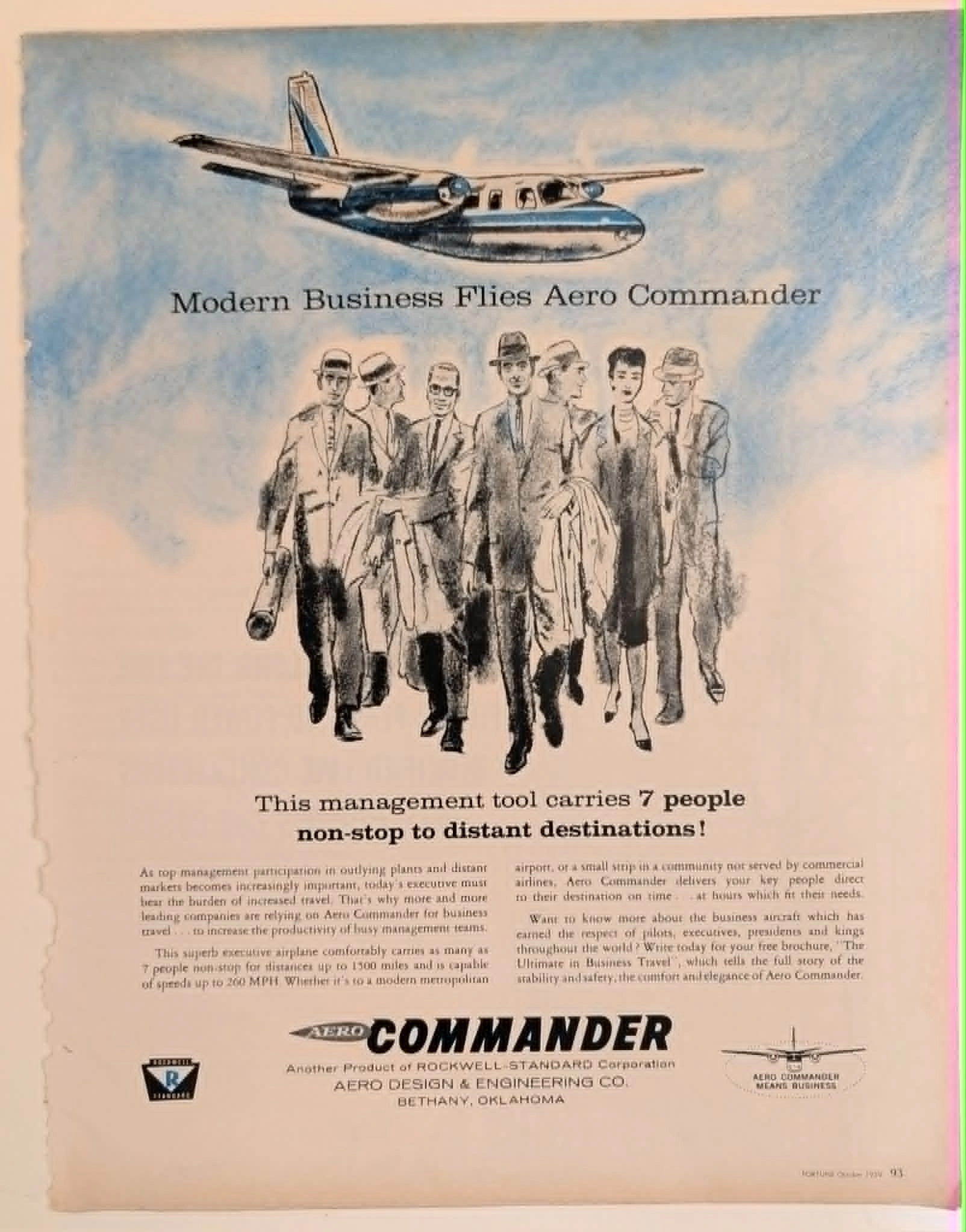
The post-war economic boom in the United States led to a significant decentralization of industry. As corporations expanded with "outlying plants and distant markets," top management required travel solutions that commercial airlines, bound by fixed schedules and major hubs, could not adequately provide. The Aero Commander emerged as a definitive solution, offering point-to-point efficiency. This 1959 advertisement, published in Fortune magazine, astutely positions the aircraft as a productivity multiplier—a "management tool" capable of carrying seven executives non-stop for up to 1,500 miles. Visually, the ad uses a striking juxtaposition: the sleek, modern twin-engine aircraft soaring in a blue-wash sky above a resolute group of professionals. The inclusion of a female executive among the group is a notable, albeit subtle, nod to the shifting dynamics of mid-century corporate environments. The artwork's sketched aesthetic lends a sense of forward momentum and serious intent, reinforcing the tagline: "Aero Commander Means Business."

Paper & Print Condition

The page displays a characteristic mid-century print quality, with a distinct, airy blue watercolor-style wash forming the sky background. The charcoal-like sketched outlines of the figures and aircraft remain crisp, retaining the original illustrator's dynamic stroke work. Minor age-toning is visible along the margins, authentic to its 1959 origin.

Provenance & Rarity

Sourced from an October 1959 issue of Fortune magazine, this piece represents a critical era in aerospace marketing. Advertisements targeting C-suite executives directly to purchase corporate aircraft are key historical markers in the evolution of modern business logistics.

Rarity & Condition Summary

Rarity Class: Class B A pristine example of mid-century corporate advertising, capturing a pivotal shift in executive travel capabilities and the decentralization of American industry.
Share This Archive

From the Journal

Related Articles

THE TIME TRAVELER'S DOSSIER: PAN AM - THE ARCHITECTURE OF THE AMERICAN TOURIST — related article
Read Article

THE TIME TRAVELER'S DOSSIER: PAN AM - THE ARCHITECTURE OF THE AMERICAN TOURIST

The artifact currently subjected to our uncompromising, museum-grade analysis is a profoundly preserved Historical Relic excavated from the zenith of mid-century American aviation prosperity. This Primary Art Document is a full-page magazine advertisement for Pan American World Airways. Functioning as a "Forensic Blueprint of the American Leisure Class Abroad," the document masterfully weaponizes European heritage and history to validate the affluent, off-season travel of post-war American consumers. ​Its historical context is irrefutably anchored by the microscopic silhouette of a Douglas DC-7B aircraft, placing this artifact squarely in the twilight of the propeller age, just before the dawn of the Boeing 707 jet era. Grounded by extreme macro details of the iconic PAA flight bag, the bold corporate typography, and the breathtaking wabi-sabi chemical degradation highlighted by its violently torn binding edge, this artifact commands an irreplaceable status, cementing its Rarity Class S designation as a masterpiece of corporate sociological engineering.

The Time Traveller's Dossier: The Empire of the Sky and the Democratization of the Globe – Pan Am "Do the town." — related article
Read Article

The Time Traveller's Dossier: The Empire of the Sky and the Democratization of the Globe – Pan Am "Do the town."

The evolution of the American leisure class during the mid-twentieth century was fundamentally propelled by the rapid expansion, technological triumph, and increasing economic accessibility of commercial jet travel. The historical artifact elegantly and securely positioned upon the analytical table of The Record Institute today is a striking, single-page print advertisement for Pan American World Airways (Pan Am), originating from the transformative decade of the 1960s. This document completely transcends the standard, utilitarian boundaries of transportation marketing. It operates as a highly sophisticated, multi-layered cultural mirror, reflecting the precise era when the globe dramatically shrank, and the majestic, ancient corners of Europe were explicitly packaged and sold to the American middle-class consumer not merely as distant dreams, but as easily attainable weekend realities. ​This world-class, comprehensive dossier conducts a meticulous, unyielding, and exceptionally exhaustive examination of the artifact, operating under the absolute most rigorous parameters of historical, sociological, and material science evaluation. With the vast majority of our analytical focus dedicated to its immense historical gravity, we will decode the brilliant marketing psychology embedded within the "World's most experienced airline" branding, analyze the romantic contrast of the bold typography against the ancient stone architecture of Castle Combe, and dissect the profound geopolitical semiotics of the iconic blue globe logo. Furthermore, as we venture deeply into the chemical and physical foundations of this analog printed ephemera, we will reveal the precise mechanical fingerprints of the CMYK halftone rosettes and the graceful, natural oxidation of the paper substrate. This precise intersection of visual nostalgia, mid-century commercial artistry, and the immutable chemistry of time cultivates a serene wabi-sabi aesthetic—a natural, irreversible phenomenon that serves as the primary engine driving up its market value exponentially within the elite global spheres of Vintage Commercial Ephemera, Aviation Archives, and Mid-Century Lifestyle collecting.

The Time Traveller's Dossier: The Architecture of Unrestricted Mobility – Avis "Rent it Here - Leave it There" Advertisement (Circa 1956) — related article
Read Article

The Time Traveller's Dossier: The Architecture of Unrestricted Mobility – Avis "Rent it Here - Leave it There" Advertisement (Circa 1956)

History is not merely recorded; it is engineered, paved, and conquered through the relentless expansion of commercial logistics. Long before digital networks rendered physical distances obsolete, and before the globalized travel infrastructure became a mundane background hum of modern life, the conquest of geography was executed through bold, capital-intensive logistical paradigms. The historical artifact before us is not merely a nostalgic mid-century magazine advertisement for a car rental agency. It is a perfectly weaponized blueprint of post-war American expansionism, a visual manifesto of the "fly-drive" revolution, and an unwavering testament to an era when mastering the vast North American continent was sold as the ultimate consumer luxury. ​This museum-grade, academic archival dossier presents an exhaustive deconstruction of a mid-1950s print advertisement for the Avis Rent-a-Car system, specifically introducing their groundbreaking "Rent it here - Leave it there" service. Operating on a profound, dual-narrative storyboard structure, this document records a calculated paradigm shift within the global travel and transportation industry. It captures the precise historical fracture where the American public conceptually transitioned from the localized, static constraints of pre-war rail and personal automobile travel into the hyper-mobile, fluid, and aerospace-integrated era of the 1950s. Through the highly specialized lens of late-analog commercial illustration and stringent visual forensics, this document serves as a masterclass in the psychological marketing of freedom and corporate efficiency. It established the foundational archetype for the modern, frictionless travel economy—an archetype that unconditionally dictates the logistical strategies of the global tourism and business travel sectors today.