THE TIME TRAVELER'S DOSSIER:THE ENGINEERING OF ELEGANCE, THE GUCCI TRUNK, AND THE ARCHITECTURE OF REASON
The History
The Bloodline of the W116, Teutonic Engineering, and Status Commodification ]
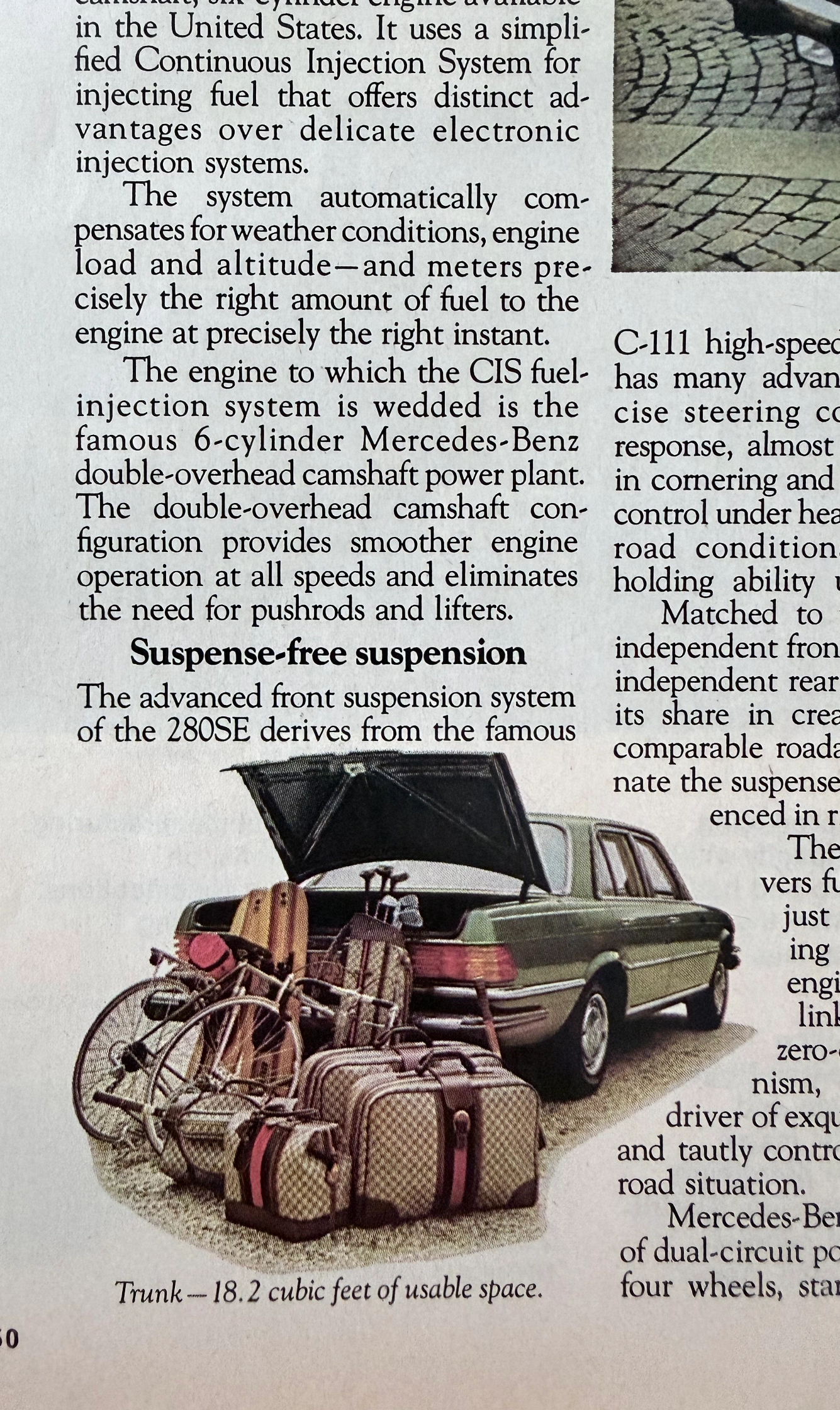
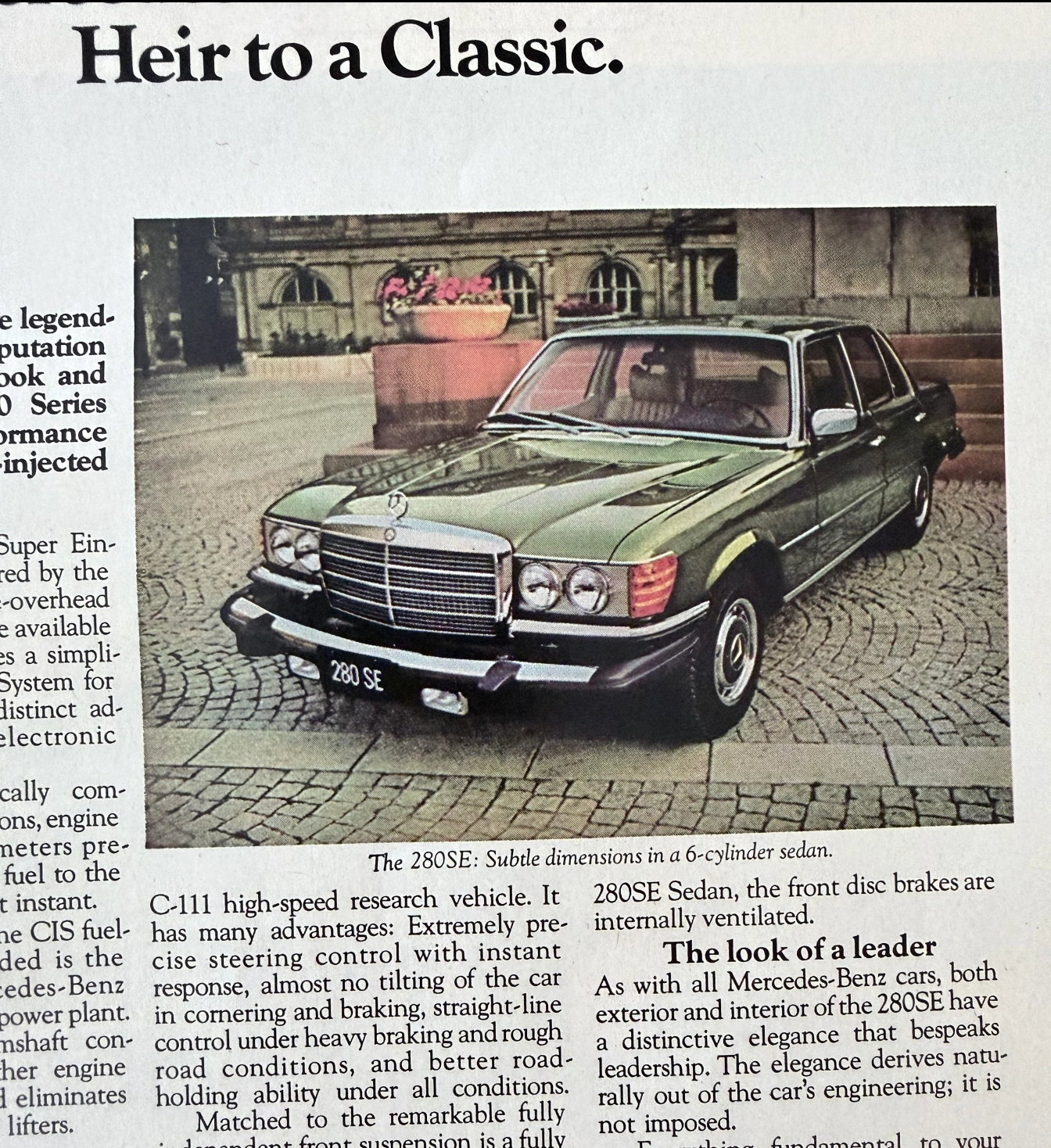
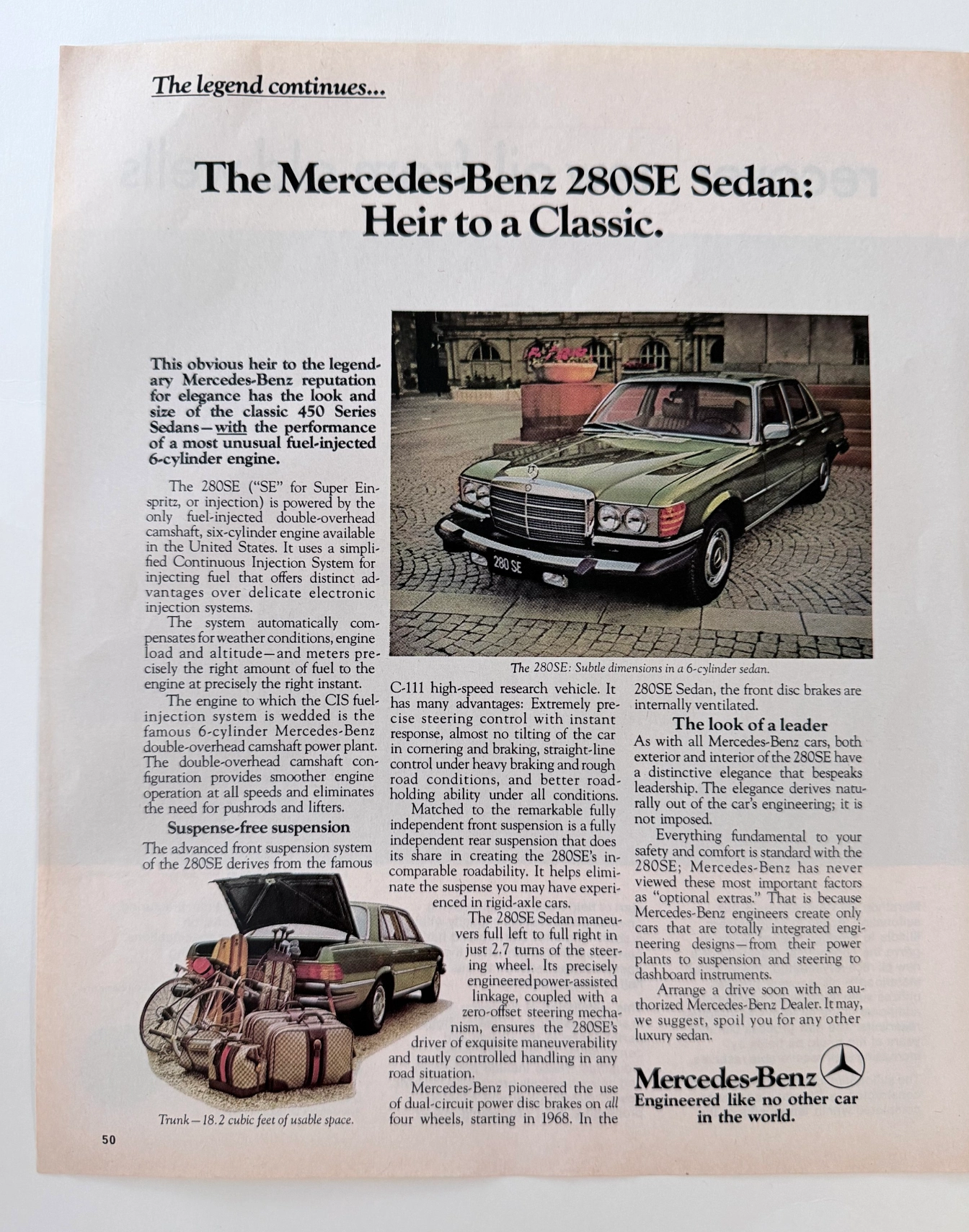
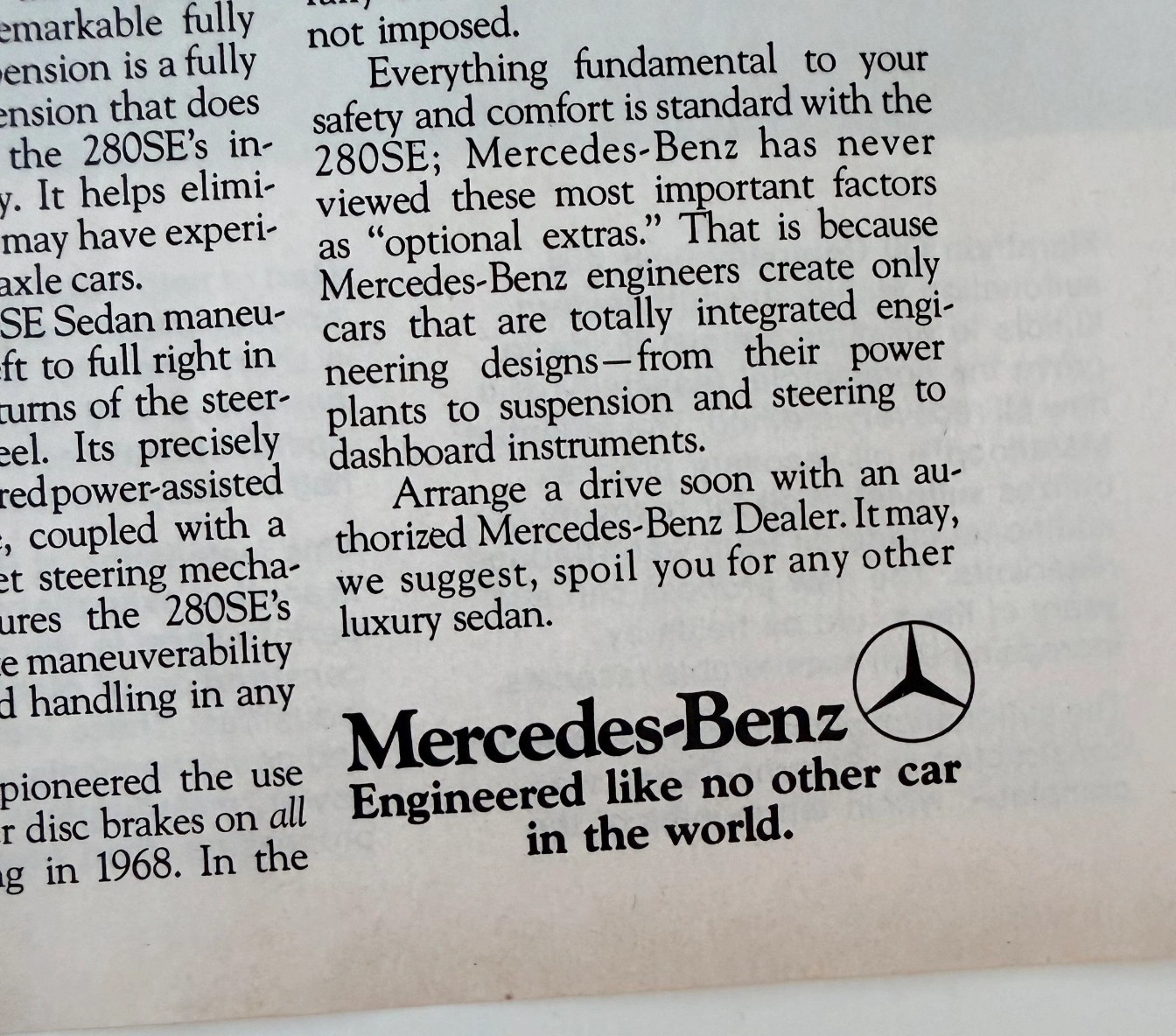
As the Chief Curator of The Record, I welcome you to the absolute zenith of West German automotive engineering. This impeccably preserved Historical Relic is a forensic "Sociological Engineering Dossier," purposefully crafted to reassert the unshakeable supremacy of the Mercedes-Benz 280SE Sedan. The bold headline declares with absolute authority: "The legend continues... The Mercedes-Benz 280SE Sedan: Heir to a Classic.". The copywriting employs pure "engineering logic," stating that this vehicle inherits the legendary proportions of the 450 Series (V8) Sedans, but delivers it with the performance of an advanced fuel-injected 6-cylinder engine featuring the "Continuous Injection System" (CIS) and a "Suspense-free suspension" derived from the C-111 high-speed research vehicle. It seals its philosophy with the immortal statement: "Mercedes-Benz Engineered like no other car in the world.".
[ THE GUCCI MASTERSTROKE: Psychological Architecture via Haute Couture Luggage ]
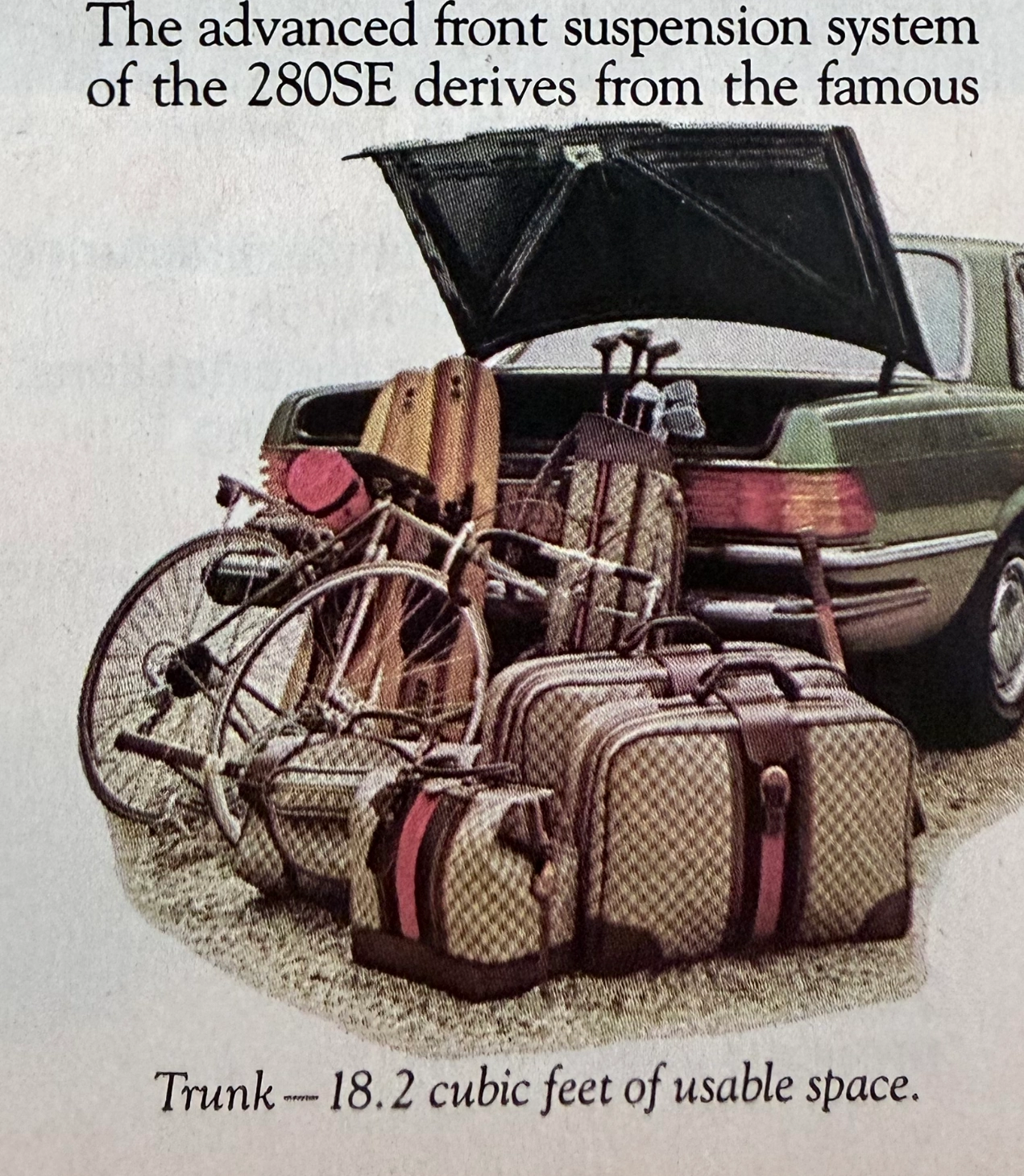
The true, chilling brilliance and psychological masterstroke of this advertisement lies in the illustration of the open trunk in the lower-left corner. To visually substantiate the claim of an immense "Trunk - 18.2 cubic feet of usable space," the artist packed the trunk with a bicycle, golf clubs, and a set of highly specific luggage featuring a beige geometric monogram pattern intersected by a distinct red-and-green vertical Web stripe. This is an undeniable, deliberate illustration of Gucci luggage. Placing the ultimate symbol of Italian haute couture inside the trunk of a German luxury sedan sends a visceral, socio-economic signal directly to the 1970s "Jet-Set" elite.
The Paper
The Aesthetics of Decay (Wabi-Sabi) — The Chemical Scars of 1970s Acidic Pulp ]
Printed on highly acidic wood-pulp magazine paper (marked as page 50), this artifact harbored a fatal chemical death sentence within its fibers. Over nearly five decades, ambient oxygen and ultraviolet light have waged a relentless chemical war against the paper's lignin. This irreversible oxidation process has birthed a magnificent "patina," elegantly transforming the once-sterile white background into a deep, warm Ivory Patina. The microscopic analog halftone dots creating the reflection on the dark green sedan and the weave of the Gucci bags have settled permanently into the degrading fibers, perfectly embodying the Japanese aesthetic of wabi-sabi.
The Rarity
Class A — A Miraculous Survivor of the Golden Age of Automotive Journalism ]
Text-heavy, highly technical automotive advertisements from the 1970s were routinely skipped over, discarded, or banished to damp garages where moisture eradicated them. The statistical probability of this specific page surviving nearly fifty years in such crisp, visually immaculate condition—devoid of devastating structural creases and free from catastrophic moisture rot—is staggeringly, miraculously low. Fused with the historical presence of the W116 and the socio-economic marker of the Gucci luggage, this artifact unequivocally commands the highly prestigious Rarity Class A designation.
Exhibition Halls
The Archive Continues
Continue the Exploration
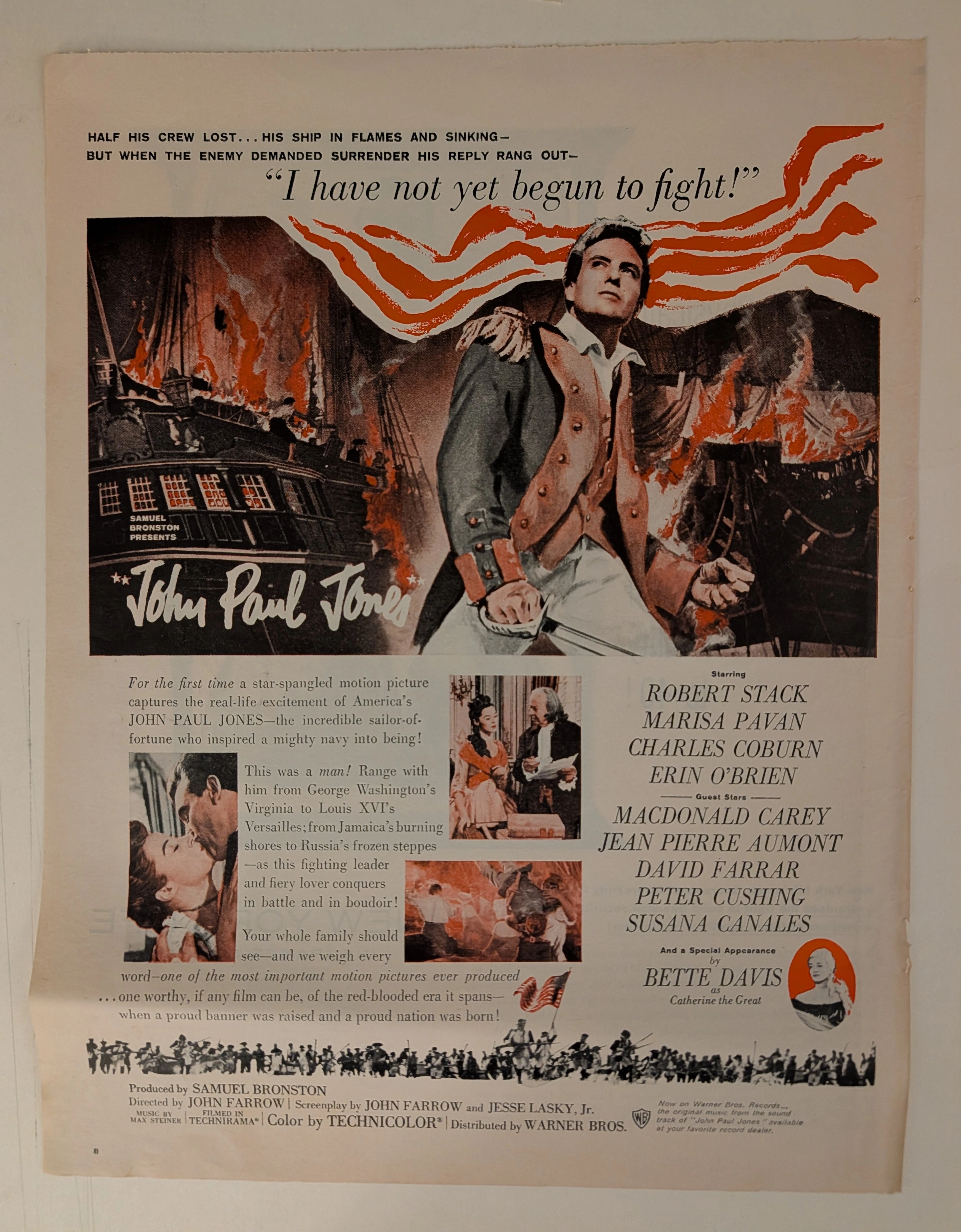
John Paul Jones · Entertainment
THE TIME TRAVELER'S DOSSIER: HOLLYWOOD PROPAGANDA AND THE DAWN OF MULTIMEDIA SYNERGY
The artifact under exhaustive, uncompromising, and unprecedented museum-grade analysis is a remarkably preserved Historical Relic originating from the zenith of Hollywood's post-war epic era. This Primary Art Document is a monumental, full-page theatrical advertisement for the 1959 biographical epic "John Paul Jones", produced by the legendary independent film mogul Samuel Bronston and distributed by Warner Bros.. This is not merely a movie poster; it is a "Forensic Blueprint of Cold War American Nationalism and Multimedia Synergy." Released in 1959, at the height of the Cold War, the advertisement aggressively weaponizes the foundational mythos of the United States Navy. The commanding, blood-red headline, "I have not yet begun to fight!", serves as a psychological anchor, projecting unyielding American defiance to both domestic audiences and global adversaries. Visually dominated by the rugged, heroic portrait of Robert Stack, the ad expertly balances masculine wartime aggression with romantic subplots and diplomatic intrigue featuring Charles Coburn as Benjamin Franklin. Furthermore, it showcases elite Hollywood casting power by explicitly highlighting a "Special Appearance by Bette Davis as Catherine the Great" in a striking red cameo vignette. Crucially, this artifact documents an early, masterful execution of cross-platform corporate synergy. The bottom corner explicitly markets the original Max Steiner soundtrack on Warner Bros. Records, proving that the commercialization of the "Original Motion Picture Soundtrack" was already highly codified. Rescued from the inevitable oblivion of disposable entertainment media, this pre-2000s analog artifact is a breathtaking embodiment of the Japanese aesthetic of wabi-sabi. Printed on inherently acidic mid-century wood-pulp paper, it exhibits beautifully authentic edge wear and a profound, warm amber oxidation across its surface. This unstoppable molecular death transforms a mass-produced piece of Hollywood propaganda into an irreplaceable, ready-to-frame Primary Art Document of cinematic and sociological history.
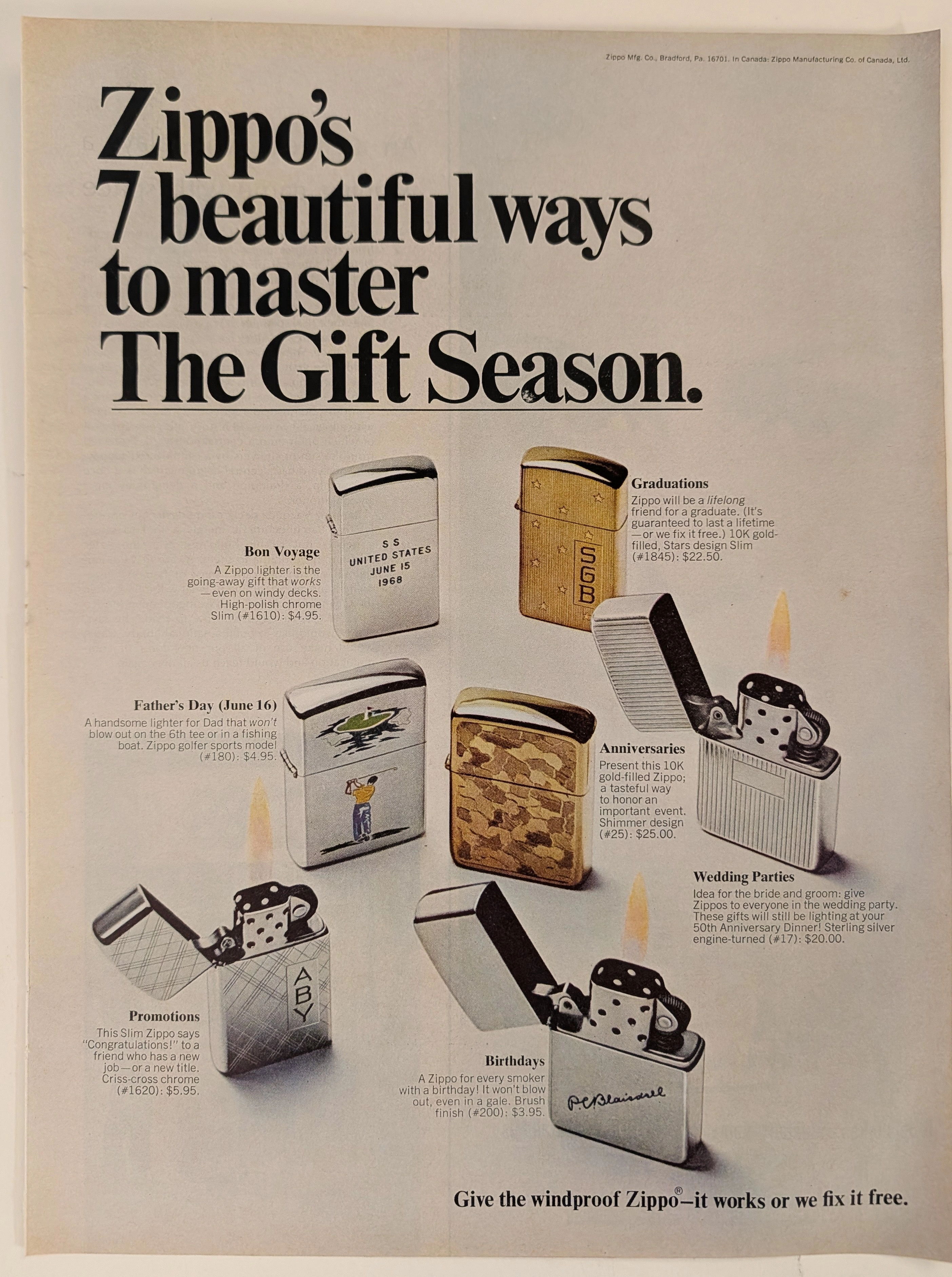
Zippo · Tobacco
The Time Traveller's Dossier: The Archive of the Immortal Flame – The 1968 Zippo "7 Beautiful Ways" Advertisement
The act of creating fire is a profound symbol of mankind's mastery over nature and the mechanical authority we hold over physical elements. The historical artifact elegantly placed upon the examination table of The Record Institute today is a full-page print advertisement for Zippo from 1968, presented under the campaign "7 beautiful ways to master The Gift Season." This document transcends conventional marketing; it is a flawless psychological projection of the mid-twentieth-century American Dream, encapsulated in metal and backed by a lifetime guarantee. This world-class archival dossier will conduct a meticulous and profound analysis of the artifact, operating under the most rigorous parameters of historical and material science evaluation. We will explore the brand's sophisticated market segmentation through seven occasion-specific lighter models, ranging from high-polish chrome to 10K gold-filled and Sterling Silver editions. Furthermore, we will delve into the magnitude of the legendary declaration, "it works or we fix it free," a promise that confidently challenges the passage of time. Advancing into the chemical foundations of this analog offset lithography, we will reveal the mechanical fingerprints of the halftone rosettes and the natural oxidation of the paper substrate. This precise intersection of metallurgical mechanics and the chemistry of time produces a serene wabi-sabi aesthetic—a phenomenon that serves as the primary engine driving up its market value exponentially within the elite global spheres of Vintage Tobacciana collecting.
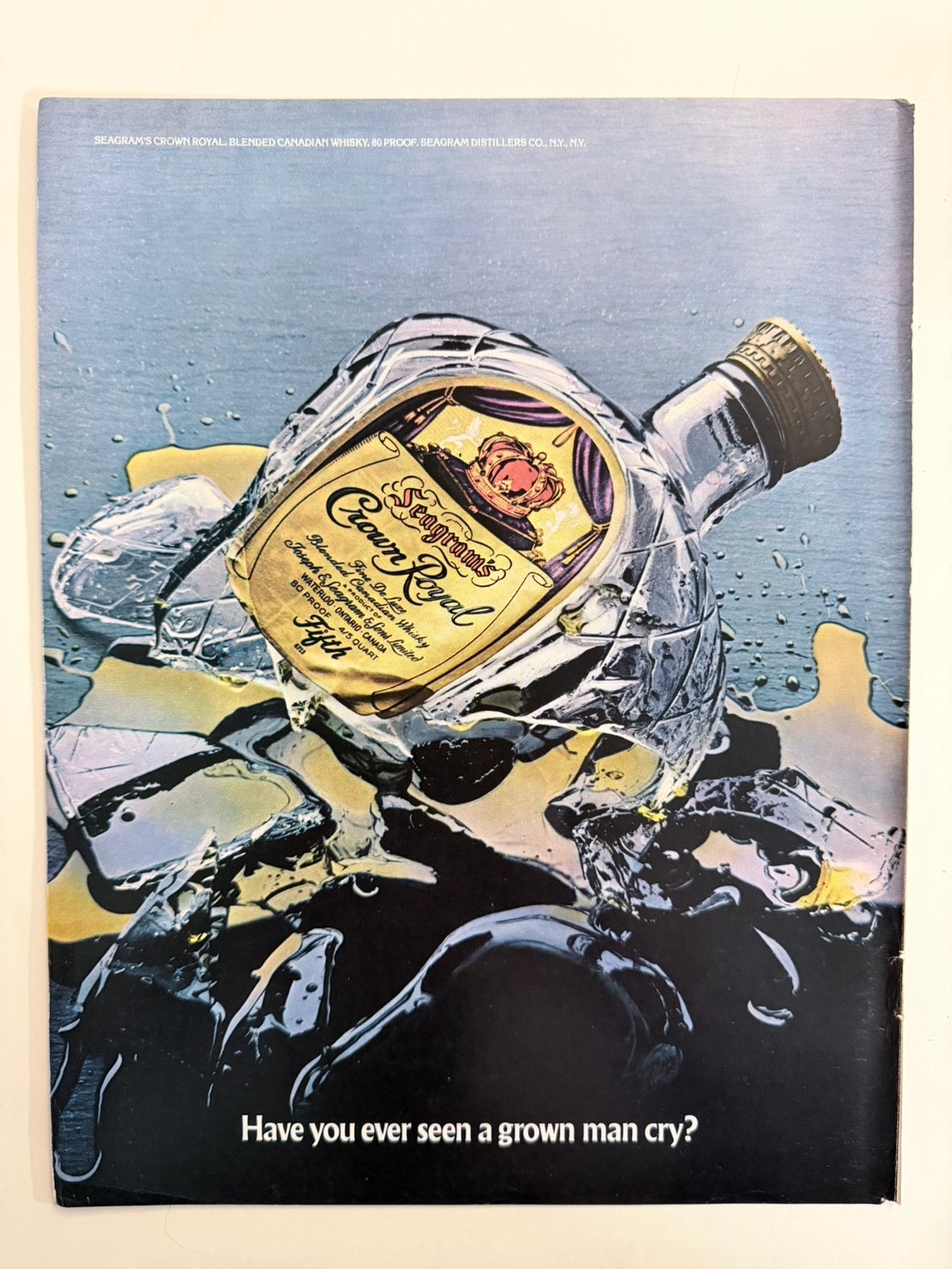
Vintage 70s Crown Royal Ad: Vanishing Analog Art | The Record
An in-depth look at the priceless 1970s Crown Royal "Have you ever seen a grown man cry?" advertisement. A masterpiece of authentic analog photography on degrading vintage paper, driving up the value of this original print as global supply inevitably shrinks.