The Time Traveller's Dossier : 1943 Kaywoodie Pipes Vintage Ad | WWII Briar History
The History
The Mediterranean Blockade and the "Pre-War" Flex
To understand the underlying brag of this advertisement, one must understand the botany and geopolitics of pipe making. The gold standard for a smoking pipe is briar—specifically, the root burl of the Erica arborea (White Heath tree), which grows almost exclusively in the rocky, arid soils of the Mediterranean region (Italy, Greece, Algeria, France). It is prized for its incredible heat resistance, porous nature, and beautiful grain.
By 1943, the Mediterranean was a raging theater of war. Trade routes were obliterated; Italian and French briar exports to the US had dropped to zero. Competitors were forced to use inferior domestic woods like hickory, cherry, or mountain laurel, which burned hot and tasted bitter. Kaywoodie, however, plays its trump card in the body text: "Kaywoodies are cut from pre-war stocks." This wasn't just a claim of quality; it was a statement of immense logistical wealth. In an era where everything from sugar to gasoline was strictly rationed, Kaywoodie was offering a rare, uncompromised slice of pre-war luxury.
The $12.50 Investment and the Meerschaum Core
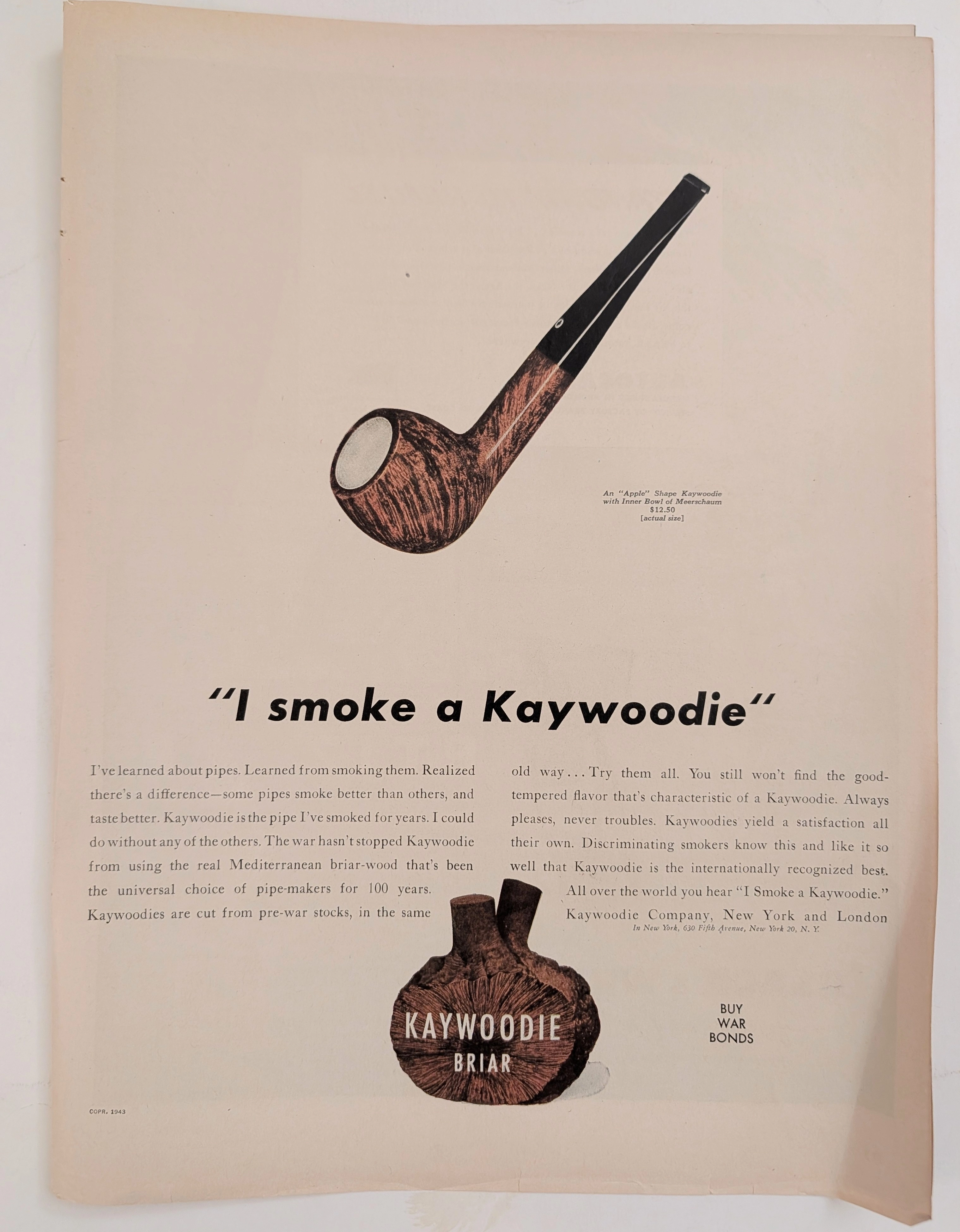
Look closely at the pricing in the right-hand margin: $12.50. To a modern reader, this sounds like pocket change. However, adjusted for inflation, $12.50 in 1943 is roughly equivalent to $225 today. This "Apple" shape pipe was not a casual purchase; it was a serious investment piece for an executive or a well-heeled professional.
Part of this exorbitant cost is attributed to the "Inner Bowl of Meerschaum." Meerschaum (German for "sea foam") is a rare, highly porous white mineral primarily mined in Turkey. By lining the inside of the briar bowl with meerschaum, Kaywoodie engineered a pipe that provided an exceptionally cool, dry smoke that didn't require a "break-in" period. It was the absolute pinnacle of smoking technology at the time, combining the rugged exterior beauty of Mediterranean briar with the superior smoking qualities of Turkish mineralogy.
Patriotism as a Postscript: "BUY WAR BONDS"
Floating quietly in the bottom right corner is the inescapable mandate of 1943: "BUY WAR BONDS." During WWII, the War Advertising Council heavily pressured American corporations to include patriotic messaging in their commercial advertising.
Its placement here is fascinating. It acts as a civic counterbalance to the sheer indulgence of a $12.50 pipe. The ad essentially whispers: Yes, treat yourself to the finest imported briar wood on the market, but do not forget your financial obligation to the boys fighting overseas. It perfectly encapsulates the dual mindset of the American home front—striving to maintain a normal, aspirational standard of living while constantly tethered to the war effort.
The Paper
This artifact is a classic example of mid-century magazine stock. Printed during a period of paper rationing and quality reduction, the page is relatively thin and uncoated. Over eight decades, the cellulose has oxidized, resulting in a warm, even, creamy off-white patina.
The printing technique is high-volume offset lithography. When examining the macro photographs of the pipe and the briar burl, the complex, intertwining grain of the wood is rendered through a dense, overlapping matrix of black and brown halftone dots. The registration is incredibly precise, giving the two-dimensional illustration of the pipe a remarkable sense of weight, polish, and three-dimensional curvature.
The Rarity
Classification: Class C (Cultural Ephemera - High Contextual Value)
While 1940s magazine advertisements are relatively common in physical archives, finding a pristine, full-page spread that so elegantly intersects luxury marketing with wartime supply chain realities elevates its contextual value. This specific ad is highly sought after by tobacciana collectors and pipe enthusiasts, as it serves as primary documentation of Kaywoodie's famous "Meerschaum-lined" era and their strategic hoarding of Mediterranean briar.
Visual Impact
The composition is a masterclass in minimalist product layout. The designer eschewed cluttered backgrounds or lifestyle illustrations of men in smoking jackets. Instead, the "Apple" shape Kaywoodie pipe floats diagonally in stark negative space, explicitly labeled as "[actual size]". This forces the viewer's eye directly onto the rich, dark grain of the wood and the striking contrast of the white meerschaum rim.
The page is visually anchored at the bottom by the heavy, textured illustration of the raw briar burl, grounding the polished final product in its raw, natural origin. The typography features a bold, confident sans-serif for the main quote—"I smoke a Kaywoodie"—which reads less like a slogan and more like a definitive statement of personal identity and discerning taste.
Exhibition Halls
Tags
The Archive Continues
Continue the Exploration

Pontiac · Automotive
THE TIME TRAVELER'S DOSSIER :THE BIRTH OF THE WIDE-TRACK
The artifact currently subjected to our uncompromising, museum-grade analysis is a profoundly preserved Historical Relic excavated from the turning point of Detroit's "horsepower and handling" wars. This Primary Art Document is a full-page magazine advertisement for the 1959 Pontiac, explicitly introducing the brand's revolutionary "Wide-Track" engineering. Functioning as a "Forensic Blueprint of Automotive Rebranding," the document masterfully weaponizes the peerless artistic talents of Fitz and Van to transform Pontiac from a conservative, aging brand into America's most aggressive performance marque. Its historical context is irrefutably anchored by the extreme macro details of its proprietary engineering claims and the highly coveted "Body by Fisher" corporate hallmark. Grounded by these physical timestamps, the microscopic artist signature, and its breathtaking wabi-sabi chemical degradation, this artifact commands an irreplaceable status, cementing its Rarity Class A designation.

Coca-Cola · Beverage
The Time Traveller's Dossier: Coca-Cola 1944 - The Weaponization of Morale
Then, sugar and carbonated water were not merely ingredients for a domestic treat; they were classified as essential psychological logistics for a global war. Now, a soda is just a soda. The problem for the United States military in 1944 was not just arming its young men with rifles and artillery; it was the monumental task of maintaining the human spirit under the soul-crushing weight of total war. The boys being trained in the muggy, moss-draped camps of the American South were destined for the meat grinders of Europe and the Pacific. They needed a tether to the homes they were leaving behind. The solution, brilliantly engineered and ruthlessly promoted by The Coca-Cola Company, was the weaponization of nostalgia. This artifact is a portal. It transports us to a sweltering training camp in 1944. It documents the exact historical moment when a private beverage corporation successfully intertwined its product with the very fabric of American patriotism, military logistics, and the linguistic evolution of its own brand identity.

THE TIME TRAVELER'S DOSSIER: THE MAGIC OF COLOR AND THE REVOLUTION OF HUMAN MEMORY
The artifact under exhaustive, uncompromising, and unprecedented museum-grade analysis is an exceptionally preserved Historical Relic originating from the absolute golden age of mid-century American consumer technology. This Primary Art Document is a monumental, full-page advertisement for Eastman Kodak Company, specifically promoting the legendary Kodachrome Film and its ecosystem of 35mm miniature cameras. Based on the featured camera models—the Kodak Pony 135 Model B, the Kodak Signet 35, and the Bantam RF—this artifact is forensically dated to the mid-1950s, specifically circa 1954–1955, extracted from a June issue of HOLIDAY magazine. This is not a mere camera advertisement; it is a profound "Sociological Blueprint of the Post-War American Dream." The headline, "This is the magic of Kodachrome Photography", encapsulates the technological democratization of color memory. Prior to this era, color photography was the exclusive domain of elite professionals. Kodachrome, with its iconic yellow and red box, transformed ordinary suburbanites into archivists of their own vibrant lives. The ad brilliantly sells not just hardware, but a deeply emotional ritual: the "home screen" slide projection. Visually anchored by the hyper-realistic red cardboard mount of the "KODACHROME TRANSPARENCY", the document is a masterclass in aspirational marketing. Rescued from the inevitable oblivion of disposable mass media, this pre-2000s analog artifact is a breathtaking embodiment of the Japanese aesthetic of wabi-sabi. Printed on inherently acidic wood-pulp paper, it exhibits a beautifully authentic jagged left binding edge, microscopic structural creasing, and a profound, warm amber oxidation across its entire surface. This unstoppable molecular death transforms a piece of mass-produced corporate propaganda into an irreplaceable, ready-to-frame Primary Art Document of photographic and sociological history.


