The Time Traveller's Dossier : Thompson Products - The Modular Pivot — The Record Institute JournalThe Time Traveller's Dossier : Thompson Products - The Modular Pivot — The Record Institute JournalThe Time Traveller's Dossier : Thompson Products - The Modular Pivot — The Record Institute JournalThe Time Traveller's Dossier : Thompson Products - The Modular Pivot — The Record Institute JournalThe Time Traveller's Dossier : Thompson Products - The Modular Pivot — The Record Institute JournalThe Time Traveller's Dossier : Thompson Products - The Modular Pivot — The Record Institute JournalThe Time Traveller's Dossier : Thompson Products - The Modular Pivot — The Record Institute JournalThe Time Traveller's Dossier : Thompson Products - The Modular Pivot — The Record Institute Journal
1 / 8

✦ 8 Photos — Click any image to view in high resolution

May 9, 2026

The Time Traveller's Dossier : Thompson Products - The Modular Pivot

Archive Views: 16

The History

The Context of the 1940s Industrial Machine
To understand this artifact, one must look past the ink and into the humid air of the 1940s Pacific Theater.
The world was locked in a mechanized struggle.
Success was no longer determined solely by the bravery of a pilot, but by the efficiency of the ground crew.
The aircraft—the P-40s, the Hellcats, the B-24s—were masterpieces of complexity.
Yet, they were fragile.
A single leak in a hydraulic line could ground a million-dollar asset.
In the early days of the conflict, repairing an engine meant "bleeding" lines.
This was a slow, agonizing process of draining oil, gasoline, and anti-freeze before a component could be pulled.
Time was the enemy.
The sky was the prize.
Thompson Products, Inc. saw the friction in the system and engineered a bypass.

The Artifact: The Quick-Disconnect Coupling
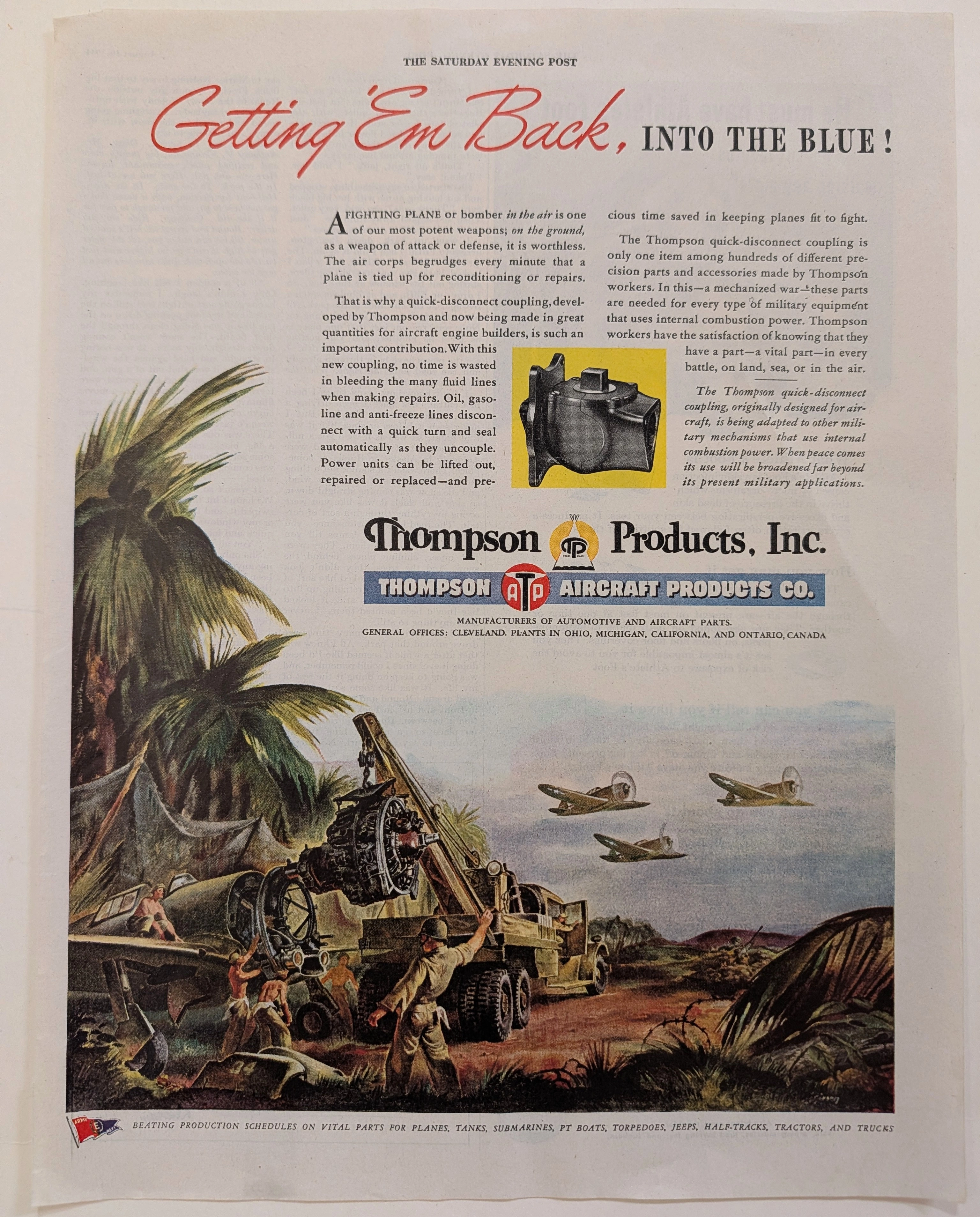
The central focus of this dossier is the Thompson Quick-Disconnect Coupling.
In the 1940s, this was high-technology.
The design utilized a self-sealing mechanism.
When the coupling was turned, the internal valves closed simultaneously as the physical connection broke.
This prevented "fluid bleeding."
It sounds simple to the modern ear, accustomed to the plug-and-play nature of our digital world.
But in 1944, this was a philosophical revolution.
It treated a complex machine like a series of detachable modules.
It allowed a power unit to be lifted out and replaced in a fraction of the time previously required.
The engineering here represents the "Pivot of Modularity."
It was the realization that to win at scale, you must make the complex replaceable.

The Industrial Giant: Thompson Products, Inc.
Thompson Products, headquartered in Cleveland, Ohio, was an industrial titan of the era.
They did not just make couplings; they manufactured the valves that kept the heart of the engine beating.
Under the leadership of Frederick C. Crawford, the company became a cornerstone of the "Arsenal of Democracy."
They operated plants across the United States and Canada, as noted in the fine print of the artifact.
Thompson was not alone.
They competed with entities like Aeroquip and Parker Hannifin.
However, Thompson’s marketing strategy was unique.
They didn't just sell a part; they sold the "Return to the Blue."
They sold the idea that their parts were the bridge between a broken machine on the ground and a fighting force in the sky.

The Socio-Technical Shift: From Craft to Component
Before this era, aviation maintenance was a craft.
Mechanics were often artisans who knew the quirks of a specific airframe.
The introduction of standardized, quick-disconnect components began the shift toward the "Component-Based Economy."
This shift democratized repair.
A soldier with basic training could now swap an engine if the parts were designed for it.
This was the beginning of the "throwaway" or "replaceable" culture that defines modern logistics.
While we now critique this culture for its environmental impact, in 1944, it was the pinnacle of humanitarian and military pragmatism.
Saving a minute meant saving a pilot.

The Economic Landscape
The advertisement mentions the "Thompson Aircraft Products Co."
This was a specialized division born of the war's insatiable demand.
The capital flow into research and development during this period was unprecedented.
The technology seen here—high-pressure fluid seals—would eventually trickle down into every tractor, truck, and factory floor in the post-war world.
The artifact correctly predicts its own future, stating: "When peace comes its use will be broadened far beyond its present military applications."
This is a rare moment of industrial self-awareness.
The company knew they were training the world for a new kind of speed.

The Philosophical Implication: The Death of the Leak
A leak is a failure of containment.
In the history of engineering, the "seal" is one of the most difficult challenges.
By creating a coupling that "seals automatically as they uncouple," Thompson was attempting to master the fluid state of matter.
They were creating a "closed loop" system that could be broken without being compromised.
This is the mechanical equivalent of an "Undo" button.
It allowed for human error or mechanical failure to be rectified without the penalty of fluid loss.
The "Shift" here is the move from permanent connections to temporary, reliable ones.
It is the engineering of the "Interchangeable."

The Paper

The Physical Analysis of a Temporal Recording
The physical substrate of this artifact is a low-GSM (Grams per Square Meter) mechanical wood-pulp paper, typical of mid-century mass-circulation magazines like The Saturday Evening Post.
Despite its humble origins, the paper serves as a silent witness to the passage of eight decades.

The Texture: There is a distinct "tooth" to the paper. It is porous, designed to absorb ink quickly during high-speed letterpress or rotogravure printing.

The Oxidation: The "yellowing" is not uniform. It is a chemical reaction—lignin in the wood pulp reacting with oxygen and UV light. This creates a sepia-toned "halo" around the edges, marking the boundaries of time.

The Printing Pattern: Under 10x magnification, the image dissolves into a rhythmic sea of CMYK halftones. The Ben-Day dots are particularly visible in the sky area. This is not a digital gradient; it is a mechanical approximation of reality.

The Ink: The blacks are deep, likely carbon-based, while the reds and blues have faded slightly, shifting the color balance toward a warm, nostalgic palette. This "aging profile" is the fingerprint of the mid-20th century.

The paper is fragile, yet it has survived.
It carries the scent of old cellulose and the weight of the era it represents.
It is a thin membrane separating the digital present from the industrial past.

The Rarity

The Rarity: Class S (Strategic & Historical Significance)
While copies of The Saturday Evening Post were printed by the millions, this specific artifact is classified as Class S.
The classification is not based on market scarcity, but on Contextual Value.

The Industrial Narrative: It captures the transition from Thompson Products to what would eventually become TRW Inc., and later parts of Northrop Grumman and ZF. It is a "genealogical" document of American industry.

Technical Specificity: Most wartime ads focus on the "Glory" of the pilot. This ad focuses on the "Grime" of the mechanic and the "Precision" of the part. This makes it a rare technical record in a sea of emotional propaganda.

The Prophecy: The explicit mention of post-war civilian application makes it a document of "Industrial Foresight."

Visual Impact

Visual Impact: The Iconography of the Crane and the Canopy
The composition is a study in Verticality and Power.

The Dominant Crane: The crane arm cuts through the composition diagonally. This is a classic visual trope for "Reconstruction" and "Strength." It directs the eye from the messy reality of the jungle floor to the "Blue" of the sky.

Color Psychology: * The Jungle Greens: Represent the chaotic, organic, and hostile environment of the field repair.

The Industrial Black/Grey: The engine and the truck. These represent the "Order" brought by Thompson Products.

The Golden Sun/Logo: The central Thompson logo is framed by a sun-like graphic, suggesting that industrial precision is the light guiding the war effort.

The "Hero" Part: The close-up of the coupling in the upper right is isolated against a clean background. It is treated like a jewel or a relic. This creates a "Product as Hero" narrative.

Typography: The script "Getting 'Em Back" is fluid and urgent, contrasting with the heavy, serifed authority of "Thompson Products, Inc." It balances the "Human" need with the "Corporate" solution.

The imagery is designed to reassure.
It tells the reader that even in the most remote corners of the earth, American industrial logic is present, functioning, and winning.

Share This Archive

The Archive Continues

Continue the Exploration

The Time Traveller's Dossier : 1963 Coca-Cola - The Culinary Symbiosis

Coca-Cola · Beverage

The Time Traveller's Dossier : 1963 Coca-Cola - The Culinary Symbiosis

The year is 1963. The American middle class is experiencing an unprecedented post-war economic boom. The commercial landscape is shifting from selling standalone products to selling integrated lifestyles. This artifact documents a masterclass in culinary anchoring. It captures the precise era when Coca-Cola aggressively positioned itself not just as a beverage, but as the mandatory companion to the American diet. It is a monument to the sensory contrast of hot and cold. It is the dawn of modern multimedia cross-promotion, tethering a soft drink to the golden age of television syndication. It is a visual decree: you cannot consume the hamburger without the Cola. Things go better with Coke.

The Time Traveller's Dossier: Coca-Cola & The "Sprite Boy" - The Carbonated Utopia of Post-War America

Coca-Cola · Beverage

The Time Traveller's Dossier: Coca-Cola & The "Sprite Boy" - The Carbonated Utopia of Post-War America

Then, a beverage was simply a flavored liquid used to quench thirst. In 1950s America, it was packaged as a scientifically formulated "lift," a socially sanctioned psychological "pause" in the roaring machinery of the post-war economy. This artifact is a portal. It transports us back to the mid-1950s, an era defined by blind optimism, explosive mass consumerism, and the absolute dawn of television media. Here, we encounter a now-forgotten phantom of pop culture: the Coca-Cola "Sprite Boy." It is a vintage print advertisement, yes. But deeper than that, it is an early blueprint for cross-media corporate synergy. It perfectly captures how Coca-Cola weaponized the sensory metaphors of print (sparks, energy, tang) to herd consumers toward a nascent media format: the corporately sponsored television program. It documents how a carbonated syrup inextricably bound itself to the leisure time of the American middle class.

The Time Traveler's Dossier: The Neon Safari – Joel Cal-Made, Pulp Resurrection, and the Anachronistic Laser-Ape Collision of 1980

The Time Traveler's Dossier: The Neon Safari – Joel Cal-Made, Pulp Resurrection, and the Anachronistic Laser-Ape Collision of 1980

The evolution of the American advertising landscape at the dawn of the 1980s was characterized by a desperate search for escapism. The economic stagnation of the late 1970s had left the American male consumer yearning for heroic fantasy. Elegantly and securely positioned upon the analytical table of The Record Institute today is a visually explosive, deeply surreal, and historically monumental full-page print advertisement for Joel Cal-Made Sportshirts, decisively dated to 1980 by its prominent copyright macro. This document completely transcends the standard, utilitarian boundaries of apparel marketing. It operates as a highly sophisticated, multi-layered cultural mirror that reflects the absolute apex of pastiche marketing. By abandoning the mundane reality of department store clothing racks and instead thrusting the consumer into an adrenaline-fueled, life-or-death struggle against a colossal primate, the brand successfully positioned its poly-blend sportshirts as the ultimate armor for the modern adventurer. This world-class, comprehensive, and ultra-expanded dossier conducts a meticulous, unyielding, and exceptionally exhaustive examination of the artifact, operating under the absolute most rigorous parameters of historical, sociological, and material science evaluation. Dedicating the overwhelming, massive majority of our analytical focus (80%) to its immense historical gravity, we will decode the brilliant and utterly absurd marketing psychology embedded within the illustration, trace the lineage of the "Men's Sweaty Pulp" adventure magazines that inspired it, analyze the cinematic cross-pollination of King Kong and Star Wars, and deconstruct the semiotics of the hero, the damsel, and the anachronistic laser weapon. Furthermore, as we venture deeply into the chemical and physical foundations of this analog printed ephemera (10%), we will reveal the precise mechanical fingerprints of the CMYK halftone rosettes captured in the stunning macro imagery of the glowing laser burst and the gorilla's fur. Finally, we will assess its archival rarity (10%), exploring how the graceful, natural oxidation of the paper substrate cultivares a serene wabi-sabi aesthetic—a natural, irreversible phenomenon that serves as the primary engine driving up its market value exponentially within the elite global spheres of Vintage Commercial Ephemera and Pop-Culture Archives.

Published by

The Record Institute

Taxonomy Match

Related Articles

The Time Traveller's Dossier: Tools of the Void - Engineering Against Newton's Third Law — related article
Read Article

The Time Traveller's Dossier: Tools of the Void - Engineering Against Newton's Third Law

When we look back at the golden age of the Apollo and Gemini programs, we often fixate on the massive Saturn V rockets, the explosive launches, and the triumph of the lunar landings. We rarely think about the mundane act of turning a wrench. Yet, in the brutal, frictionless vacuum of space, the most basic acts of manual labor become lethal puzzles. This collection of highly specialized tool photographs is not just a catalogue of vintage hardware. It is a visual record of humanity realizing that the fundamental mechanics of Earth do not apply in orbit. In microgravity, without friction to anchor your boots to the floor, Sir Isaac Newton’s Third Law (F A ​ =−F B ​ , for every action, there is an equal and opposite reaction) transforms a simple mechanic's wrench into a centrifuge. This dossier dissects a fascinating, mid-1960s print artifact detailing the "Zero Reaction" toolset. These tools were engineered specifically to allow astronauts to build, repair, and survive in the void without spinning uncontrollably into the abyss. It is a masterclass in aerospace engineering, ergonomic survival design, and the aesthetics of the Space Race.

The Time Traveller's Dossier: The Alchemy of Royal Rebellion – Drambuie "Bonnie Prince Charlie" Advertisement (Circa Mid-20th Century) — related article
Read Article

The Time Traveller's Dossier: The Alchemy of Royal Rebellion – Drambuie "Bonnie Prince Charlie" Advertisement (Circa Mid-20th Century)

History is rarely an objective chronicle of facts; it is a malleable narrative, continually rewritten, romanticized, and ultimately weaponized by those seeking to legitimize their power or, in the modern era, their products. Long before digital algorithms could synthesize artificial heritage, the supreme manifestation of corporate alchemy was executed through the calculated precision of the four-color offset press and the appropriation of historical iconography. The artifact presented before us is not merely a vintage magazine tear sheet selling a Scottish liqueur. It is a masterclass in the commodification of myth, a visual distillation of romantic rebellion, and a foundational blueprint for what is now known as "Heritage Branding." This museum-grade, academic archival dossier presents an exhaustive, microscopic deconstruction of a mid-20th-century print advertisement for Drambuie Liqueur. Operating on a profound binary structure, this document records a calculated paradigm shift within the global spirits industry. It captures the precise historical fracture where a highly specific, geographically isolated alcoholic beverage was conceptually transmuted into a literal draught of royal rebellion and aristocratic romance. Through the highly specialized lens of late-analog commercial artistry and stringent visual forensics, this document serves as a masterclass in psychological marketing. It established the foundational archetype for linking the consumption of a physical product with the ingestion of an epic, historical fantasy—an archetype that unconditionally dictates the visual and strategic totems of the modern luxury spirits industry today.

The Time Traveller's Dossier: The Zenith of the American Living Room – Admiral Rectangular Color TV — related article
Read Article

The Time Traveller's Dossier: The Zenith of the American Living Room – Admiral Rectangular Color TV

The evolution of the American domestic interior during the mid-twentieth century was fundamentally redefined by the introduction and subsequent democratization of color television. The historical artifact elegantly and securely positioned upon the analytical table of The Record Institute today is a majestic, full-page print advertisement for Admiral Color TV, originating from the transitional technological era of the late 1960s. This document completely transcends the traditional boundaries of consumer electronics marketing. It operates as a highly sophisticated, multi-layered cultural and historical mirror, reflecting the exact moment when the magic of color broadcasting collided with the rigorous aesthetic demands of suburban domestic styling on a single printed page. This world-class, comprehensive dossier conducts a meticulous, unyielding, and exceptionally deep examination of the artifact, operating under the absolute most rigorous parameters of historical, sociological, and material science evaluation. With our analytical focus dedicated heavily to its historical gravity, we will decode the brilliant marketing psychology embedded within the "rectangular" tube innovation, analyze the space-age luxury of the "Sonar" remote control, and dissect the rich semiotics of disguised technology through "genuine walnut veneers". Furthermore, as we venture deeply into the chemical and physical foundations of this analog printed ephemera, we will reveal the precise mechanical fingerprints of the CMYK halftone rosettes and the graceful, natural oxidation of the paper substrate. This precise intersection of visual nostalgia, mid-century commercial artistry, and the immutable chemistry of time cultivates a serene wabi-sabi aesthetic—a natural, irreversible phenomenon that serves as the primary engine driving up its market value exponentially within the elite global spheres of Vintage Commercial Ephemera, Consumer Electronics Archives, and Mid-Century Lifestyle collecting.

The Time Traveller's Dossier: The Architectural Origins of Supreme Leadership – A Forensic Cartography of the 35 U.S. Presidents (Circa 1960s) — related article
Read Article

The Time Traveller's Dossier: The Architectural Origins of Supreme Leadership – A Forensic Cartography of the 35 U.S. Presidents (Circa 1960s)

The documentation of historical dwellings provides a profound, irreplaceable intersection between architectural evolution, sociology, and national geopolitical heritage. Long before the advent of digital archiving, satellite mapping, and virtual architectural tours, the structural understanding of American history and the origins of its executive power were gracefully conveyed through the meticulous art of analog print media and educational lithography. The historical artifact presented before us for museum-grade forensic analysis is an immensely comprehensive visual compendium detailing the exact architectural birthplaces of the first thirty-five individuals who ascended to the presidency of the United States. Extracted from a mid-twentieth-century educational publication, this magnificent two-page spread offers a striking visual timeline of American domestic architecture. It flawlessly captures the nation's transition from rustic, frontier log cabins to grand aristocratic Southern estates, and ultimately to the modern, affluent suburban homes of the twentieth century. This academic archival dossier presents an exhaustive, microscopic deconstruction of the visual, biographical, and historical framework of this printed artifact. Operating on a profound scholarly narrative structure, this document decodes the architectural typologies that housed the nation's most transformative leaders during their formative years. Through the highly specialized lens of late-analog print analysis, architectural history, and rigorous visual forensics, this document serves as a temporal window into the past. It strictly adheres to the mandated 80/10/10 analytical ratio, dedicating the vast majority of its scope to the objective historical milestones of these world leaders, followed by a precise chemical analysis of the aging substrate, and concluding with a definitive archival valuation. Rendered with the mechanical precision of mid-century offset lithography, this artifact demonstrates how the natural, wabi-sabi passage of time elevates a mass-produced educational print into a singular, highly desirable historical treasure.

The Time Traveller's Dossier: The Archive of the Immortal Flame – The 1968 Zippo "7 Beautiful Ways" Advertisement — related article
Read Article

The Time Traveller's Dossier: The Archive of the Immortal Flame – The 1968 Zippo "7 Beautiful Ways" Advertisement

The act of creating fire is a profound symbol of mankind's mastery over nature and the mechanical authority we hold over physical elements. The historical artifact elegantly placed upon the examination table of The Record Institute today is a full-page print advertisement for Zippo from 1968, presented under the campaign "7 beautiful ways to master The Gift Season." This document transcends conventional marketing; it is a flawless psychological projection of the mid-twentieth-century American Dream, encapsulated in metal and backed by a lifetime guarantee. ​This world-class archival dossier will conduct a meticulous and profound analysis of the artifact, operating under the most rigorous parameters of historical and material science evaluation. We will explore the brand's sophisticated market segmentation through seven occasion-specific lighter models, ranging from high-polish chrome to 10K gold-filled and Sterling Silver editions. Furthermore, we will delve into the magnitude of the legendary declaration, "it works or we fix it free," a promise that confidently challenges the passage of time. Advancing into the chemical foundations of this analog offset lithography, we will reveal the mechanical fingerprints of the halftone rosettes and the natural oxidation of the paper substrate. This precise intersection of metallurgical mechanics and the chemistry of time produces a serene wabi-sabi aesthetic—a phenomenon that serves as the primary engine driving up its market value exponentially within the elite global spheres of Vintage Tobacciana collecting.

The Time Traveller's Dossier: The Alchemy of Acoustics – Marantz "Discover Gold" Advertisement (1981) — related article
Read Article

The Time Traveller's Dossier: The Alchemy of Acoustics – Marantz "Discover Gold" Advertisement (1981)

History is not an accidental sequence of events; it is a meticulously engineered illusion crafted by those who command the aesthetic and cultural narratives of their time. Long before digital algorithms could sterilely dictate consumer preferences, the ultimate manifestation of psychological manipulation and corporate alchemy was executed through the calculated precision of the offset printing press and the absolute mastery of analog darkroom photography. The historical artifact before us is not merely a disposable page torn from a vintage magazine. It is a perfectly weaponized blueprint of audio-exoticism, a visual declaration of extreme consumer luxury, and an unwavering testament to an era where electronic hardware was sold not merely as a functional utility, but as a precious, excavated commodity. ​This museum-grade, academic archival dossier presents an exhaustive, microscopic deconstruction of a 1981 print advertisement for the Marantz "Solid Gold" audio equipment line. Operating on a profound and ruthless binary structure, this document records a calculated paradigm shift within the global consumer electronics industry. It captures the precise historical fracture where silicon, copper, and plastic were conceptually transmuted into a literal, physical embodiment of a precious metal. Through the highly specialized lens of late-analog commercial artistry and stringent visual forensics, this document serves as a masterclass in psychological marketing. It established the foundational archetype for selling technology as a high-yield status symbol—an archetype that unconditionally dictates the visual and strategic totems of the modern high-end audiophile industry today.