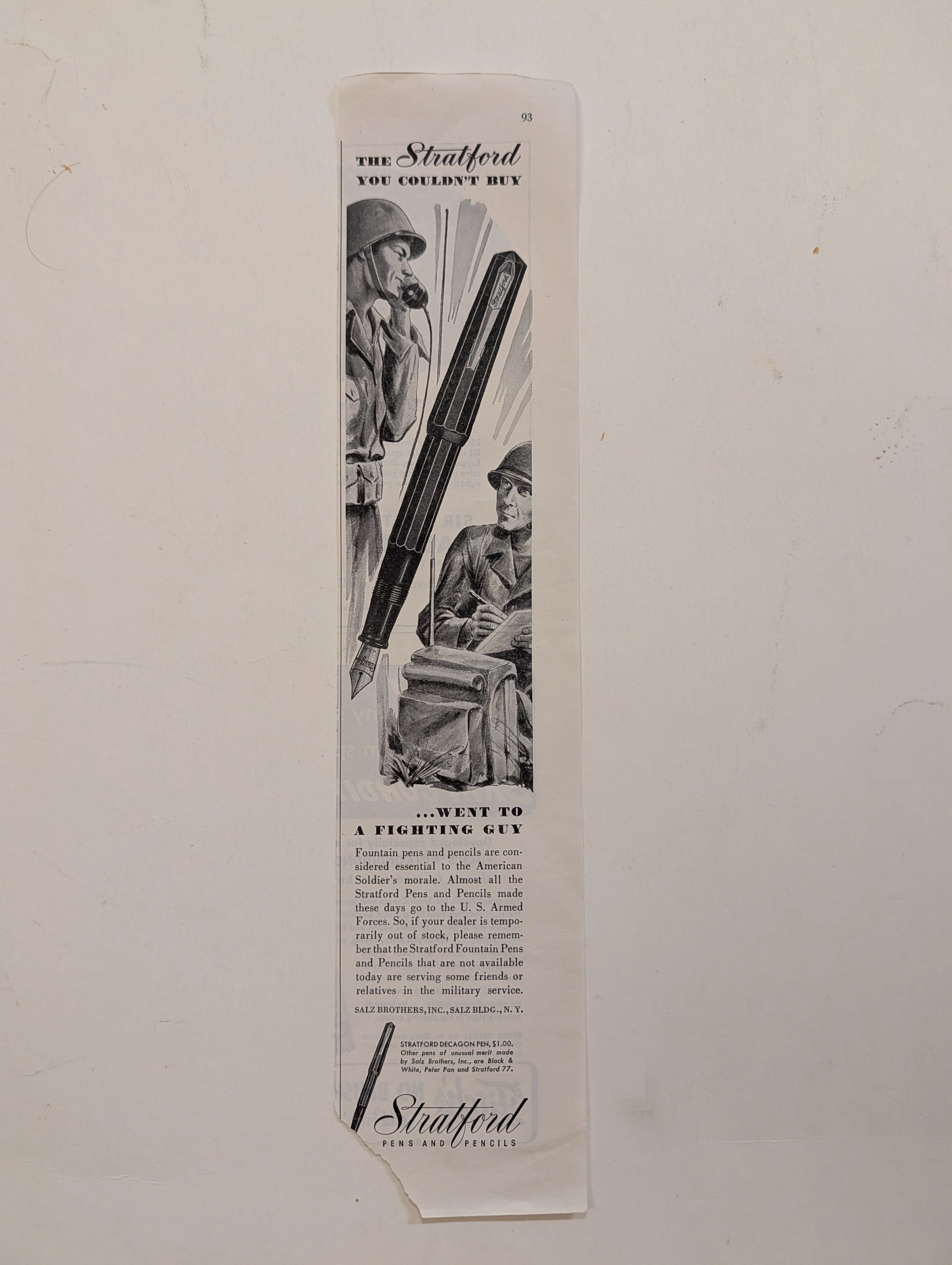
1944 Stratford Decagon Pen Vintage Advertisement: The "Fighting Guy" Campaign
Last updated: 10 May 2026
Historical Context
Paper & Print Condition
Provenance & Rarity
Rarity & Condition Summary
Related Archives from the Collection
Related by Classification

1943 Swift & Company Meat "Materiel of War" Vintage Advertisement

1940s Burberrys of London Overcoat Vintage Advertisement

Jaguar S-Type "A New Breed of Cat"

Pontiac Grand Prix "Grand New Luxury"

1944 New York Central "Wartime Housekeeping on Wheels" Vintage Advertisement

1968 De Beers "Changing World" Portrait-Tableau Vintage Advertisement
Related Articles

The Time Traveller's Dossier : Ansco Color Ad - WWII Delayed Gratification
The world was entirely grey. Or so the civilian population was led to believe. Before this artifact, color photography existed as a delicate novelty. A fragile, complex luxury reserved for controlled environments. Then came the mechanized velocity of a global war. This advertisement represents a precise sociological pivot. It openly acknowledges a stark present reality: the total militarization of emerging technology. Simultaneously, it sells a calculated future promise: the inevitable democratization of color. The immediate problem was total resource scarcity. Every frame of manufactured film was drafted into federal service. The proposed solution was societal patience. A collective civilian sacrifice, traded for the eventual, post-war delivery of a hyper-vivid, color-accurate reality.

The Time Traveller's Dossier: The Architecture of Aristocracy – Chivas Regal "Prince of Whiskies" Advertisement (Circa Mid-1950s)
analysis is a meticulously preserved, single magazine tear sheet representing a pinnacle era of mid-20th-century commercial illustration and brand positioning. Far removed from the realm of disposable consumer advertising, this artifact operates as a sophisticated sociological document. It captures a precise historical epoch where the global spirits industry—specifically the Scotch whisky sector—transitioned from marketing regional agricultural products to curating internationally recognized symbols of aristocratic heritage and refined lineage. Operating with absolute curatorial precision, this dossier deconstructs a circa mid-1950s advertisement for Chivas Regal 12-Year-Old Blended Scotch Whisky. By analyzing the intersection of classical illustration, the strategic deployment of British royal iconography, and the meticulous visual forensics of the analog printing process, this document illuminates the foundational strategies of modern heritage branding. It demonstrates how a brand gracefully orchestrated a narrative of ancient nobility and warmth to captivate the post-war American consumer, establishing an enduring standard for the premium spirits market that remains profoundly influential today.

The Time Traveller's Dossier : Pontiac WWII - The Mechanical Shift
Then, the American automotive industry sold the illusion of the open road. Now, it sold the mathematics of ballistic trajectory. The problem in early 1942 was not the pursuit of aerodynamic design or the quiet hum of a civilian engine. It was the absolute, existential threat posed by the mechanized war machines of the Axis powers. The skies over Europe and the Pacific were dominated by hostile dive bombers, and the Allied forces desperately lacked the mobile firepower to protect their exposed infantry and armored columns. The solution, as brutally and efficiently documented by the Pontiac Division of General Motors in this artifact, was the total repurposing of the American assembly line. This artifact is a portal. It transports us to the precise historical moment when the Detroit manufacturing colossus ceased the production of consumer luxury and pivoted entirely to the architecture of industrialized warfare. It is an advertisement, yes. But deeper than that, it is a psychological instrument. It was meticulously designed to condition a bewildered civilian populace, teaching them to equate the familiar corporate logo of their family automobile with the violent, necessary output of heavy artillery and anti-aircraft munitions.

The Time Traveller's Dossier: Coca-Cola 1944 - The Weaponization of Morale
Then, sugar and carbonated water were not merely ingredients for a domestic treat; they were classified as essential psychological logistics for a global war. Now, a soda is just a soda. The problem for the United States military in 1944 was not just arming its young men with rifles and artillery; it was the monumental task of maintaining the human spirit under the soul-crushing weight of total war. The boys being trained in the muggy, moss-draped camps of the American South were destined for the meat grinders of Europe and the Pacific. They needed a tether to the homes they were leaving behind. The solution, brilliantly engineered and ruthlessly promoted by The Coca-Cola Company, was the weaponization of nostalgia. This artifact is a portal. It transports us to a sweltering training camp in 1944. It documents the exact historical moment when a private beverage corporation successfully intertwined its product with the very fabric of American patriotism, military logistics, and the linguistic evolution of its own brand identity.