Exhibition Hall
The Distiller's Dossier
The art of the pour — whiskey, wine, and the liquid gold that fueled a century of advertising artistry.
20 artifacts in this collection
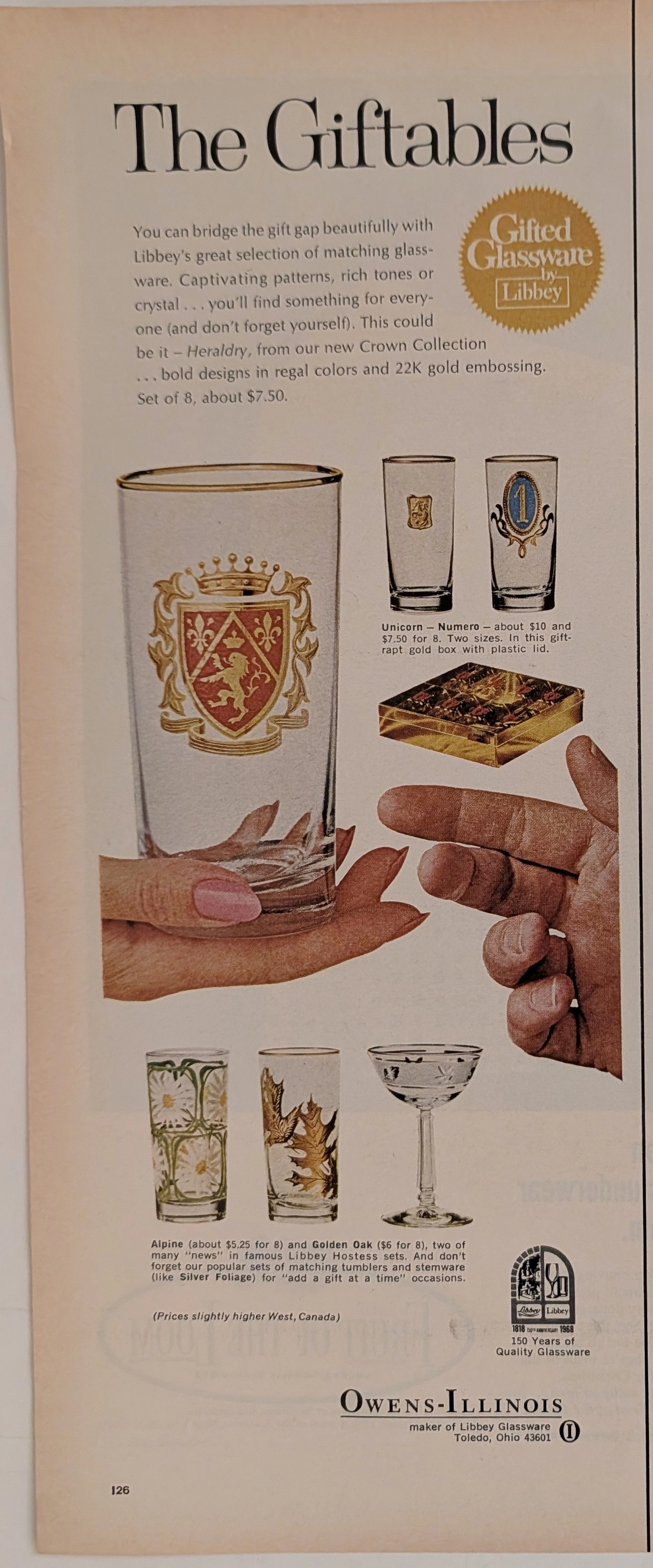
Libbey
The Time Traveller's Dossier : 1968 Libbey - The Luxury Shift
The year is 1968. The American middle class is vast, established, and affluent. The suburbs have become the new kingdom. But kingdoms require regalia. Historically, fine glassware was inherited. It was crystal, cut by hand, passed down through generations of European aristocracy. Then, a pivot occurs. The industrial machine turns its gaze toward the dining table. Owens-Illinois, through its Libbey division, changes the paradigm of possession. They do not sell simple liquid receptacles. They sell instant heritage. They sell "The Giftables". This is not merely a catalog page for tumblers. It is a documented shift in social currency. A deliberate move to commodify nobility, mass-producing 22-karat gold heraldry for the everyday consumer. The problem was a society hungry for status but disconnected from aristocratic lineage. The solution was a seven-dollar-and-fifty-cent box of manufactured royalty.
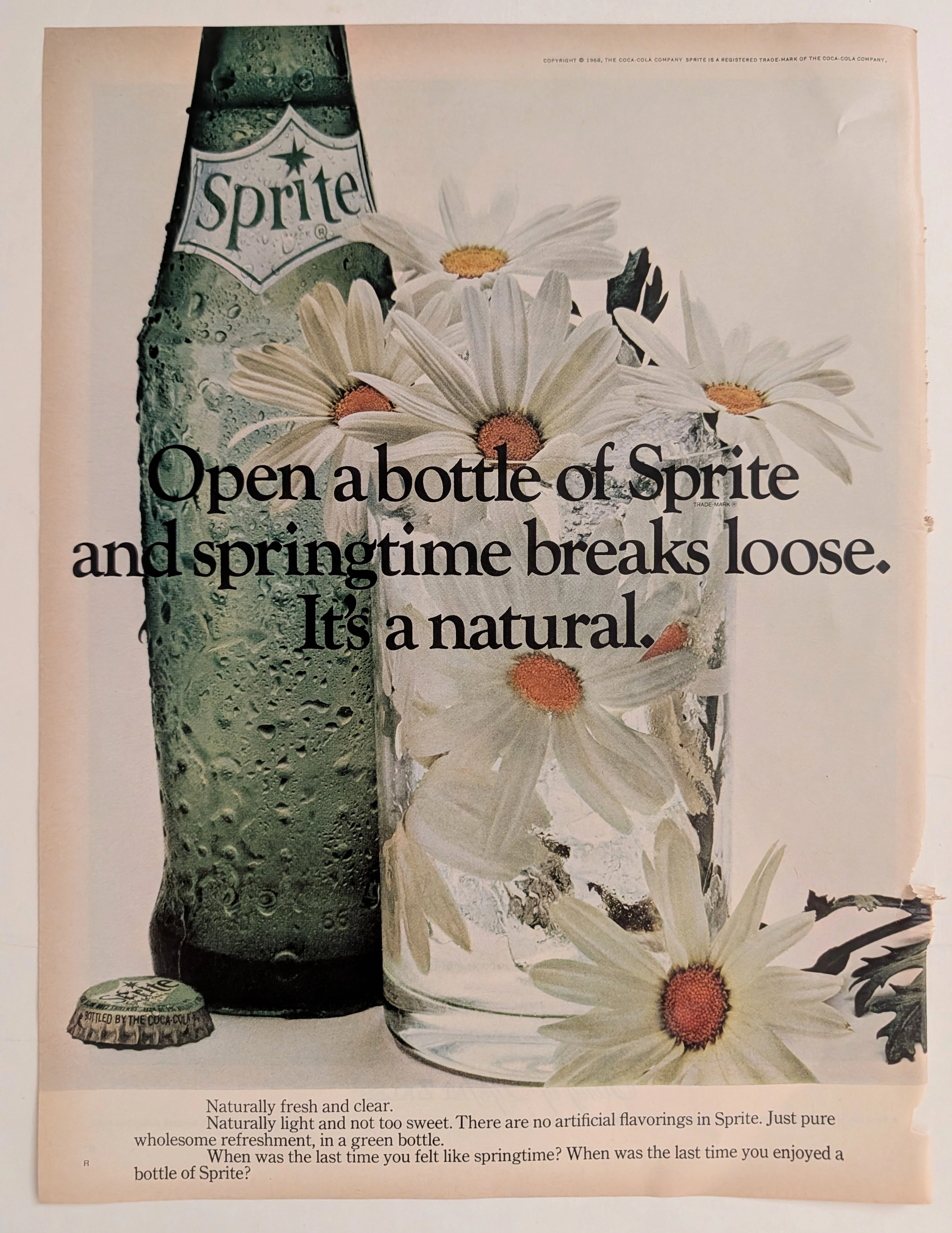
Sprite
The Time Traveller's Dossier : 1968 Sprite - The Nature Shift
The year is 1968. The era of post-war artificiality has reached its zenith. Synthetic materials are the foundation of modern life. Laboratory-born conveniences dominate the American household. Then, a pivot occurs. Sprite, a mass-produced carbonated beverage, changes the narrative. They do not sell a formula. They sell a feeling. They sell "natural". This is not merely an advertisement. It is a documented shift in consumer psychology. A deliberate move from the mechanics of industrial production to the illusion of botanical purity. The problem was a society fatigued by the synthetic. The solution was a green bottle, cold ice, and daisies.
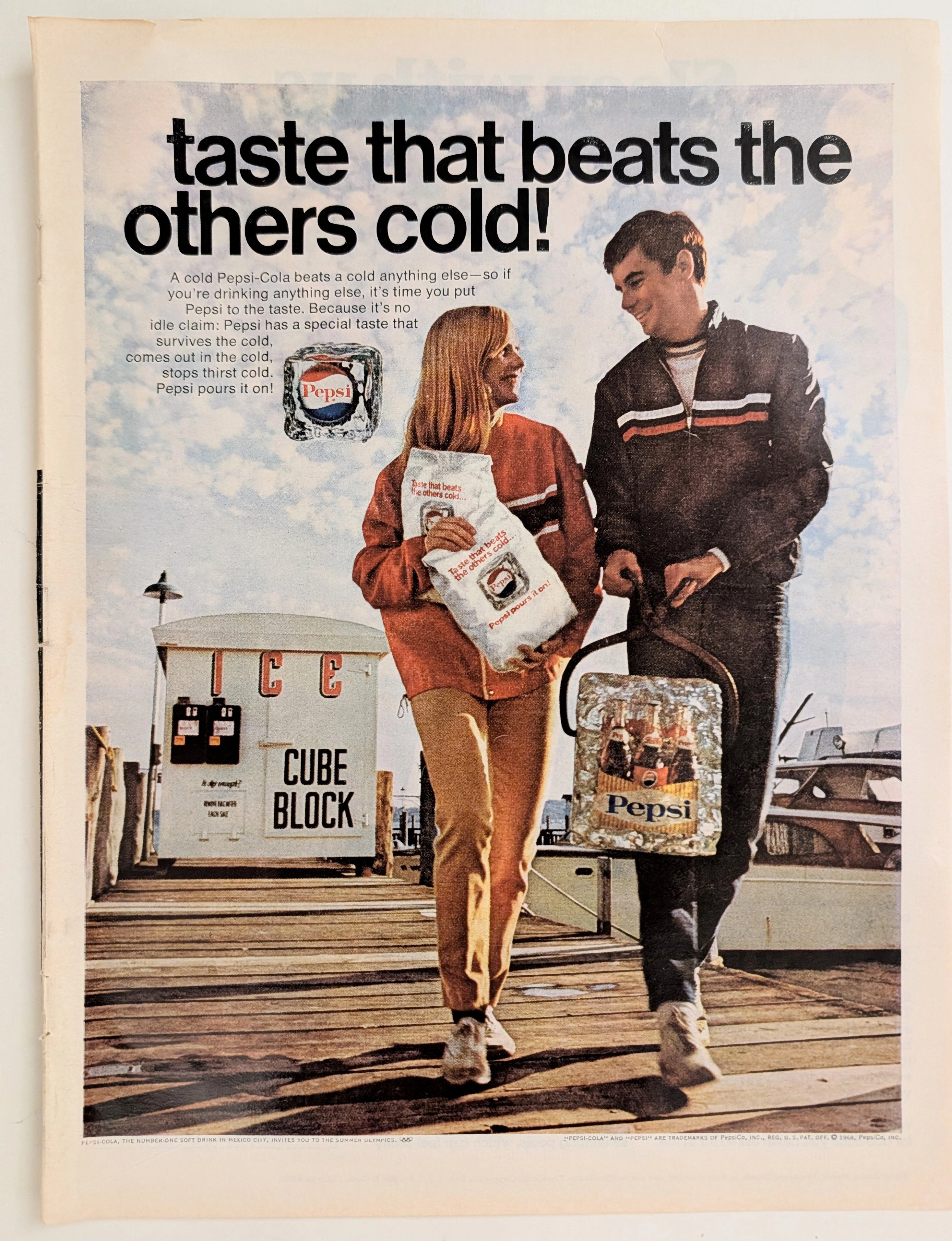
Pepsi-Cola
The Time Traveller's Dossier : 1968 Pepsi-Cola - The Thermodynamics of Youth
The year is 1968. The globe is fracturing under the weight of profound social and political upheaval. Then, carbonated beverages were marketed on the gentle merits of family gatherings and nostalgic heritage. Now, the commercial battlefield demands a new, aggressive demographic loyalty. This artifact is a masterclass in the weaponization of temperature and identity. It documents the precise escalation of the Cola Wars, shifting the focus from the liquid itself to the psychographic profile of the consumer. It is the architectural blueprint of the "Pepsi Generation." A manufactured, sun-drenched sanctuary of youth, action, and athletic leisure. It rejects the warm nostalgia of the establishment. It demands a visceral, freezing shock to the system. It is a declaration of absolute thermodynamic supremacy. Taste that beats the others cold.
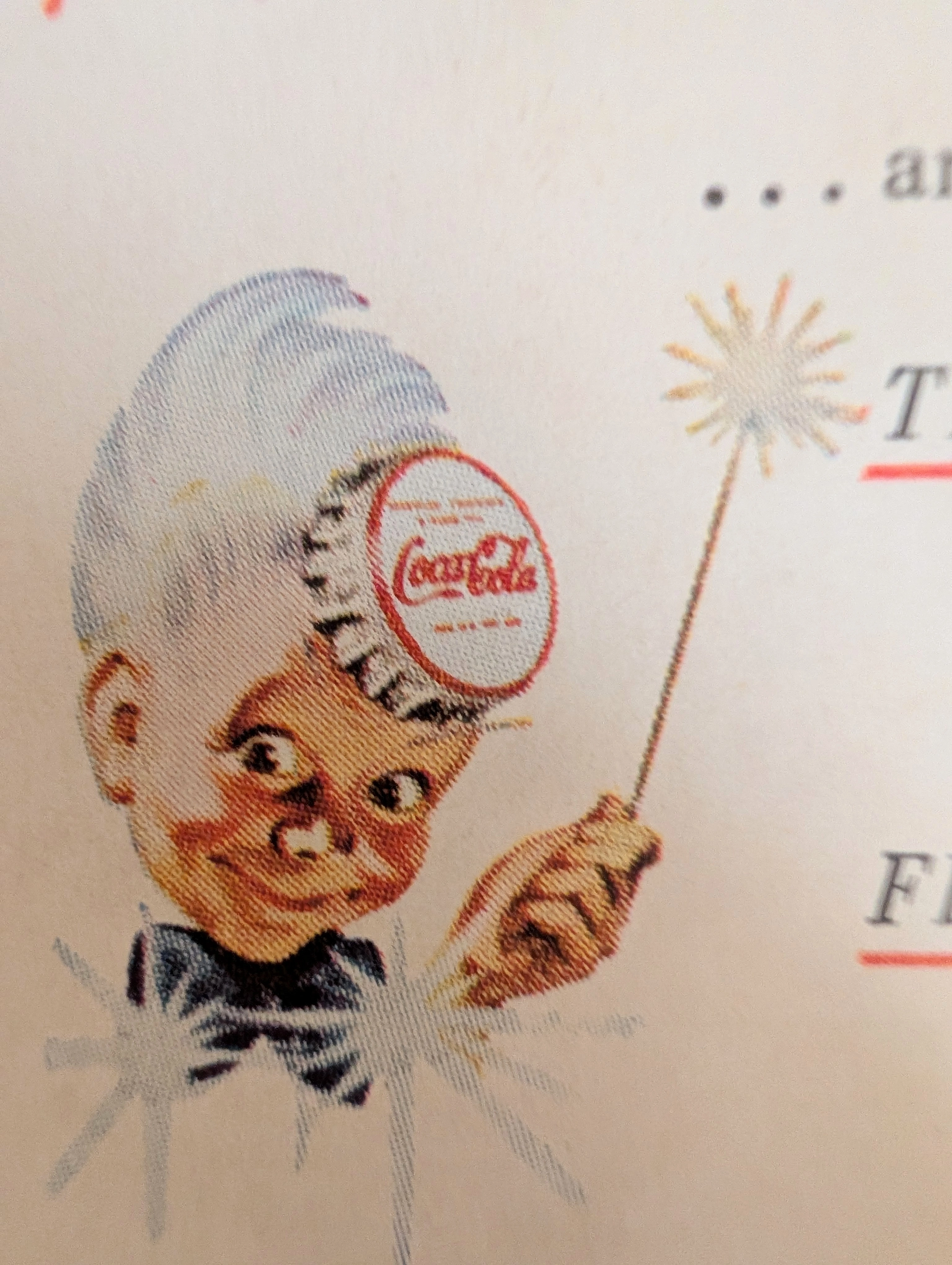
Coca-Cola
The Time Traveller's Dossier: Coca-Cola & The "Sprite Boy" - The Carbonated Utopia of Post-War America
Then, a beverage was simply a flavored liquid used to quench thirst. In 1950s America, it was packaged as a scientifically formulated "lift," a socially sanctioned psychological "pause" in the roaring machinery of the post-war economy. This artifact is a portal. It transports us back to the mid-1950s, an era defined by blind optimism, explosive mass consumerism, and the absolute dawn of television media. Here, we encounter a now-forgotten phantom of pop culture: the Coca-Cola "Sprite Boy." It is a vintage print advertisement, yes. But deeper than that, it is an early blueprint for cross-media corporate synergy. It perfectly captures how Coca-Cola weaponized the sensory metaphors of print (sparks, energy, tang) to herd consumers toward a nascent media format: the corporately sponsored television program. It documents how a carbonated syrup inextricably bound itself to the leisure time of the American middle class.
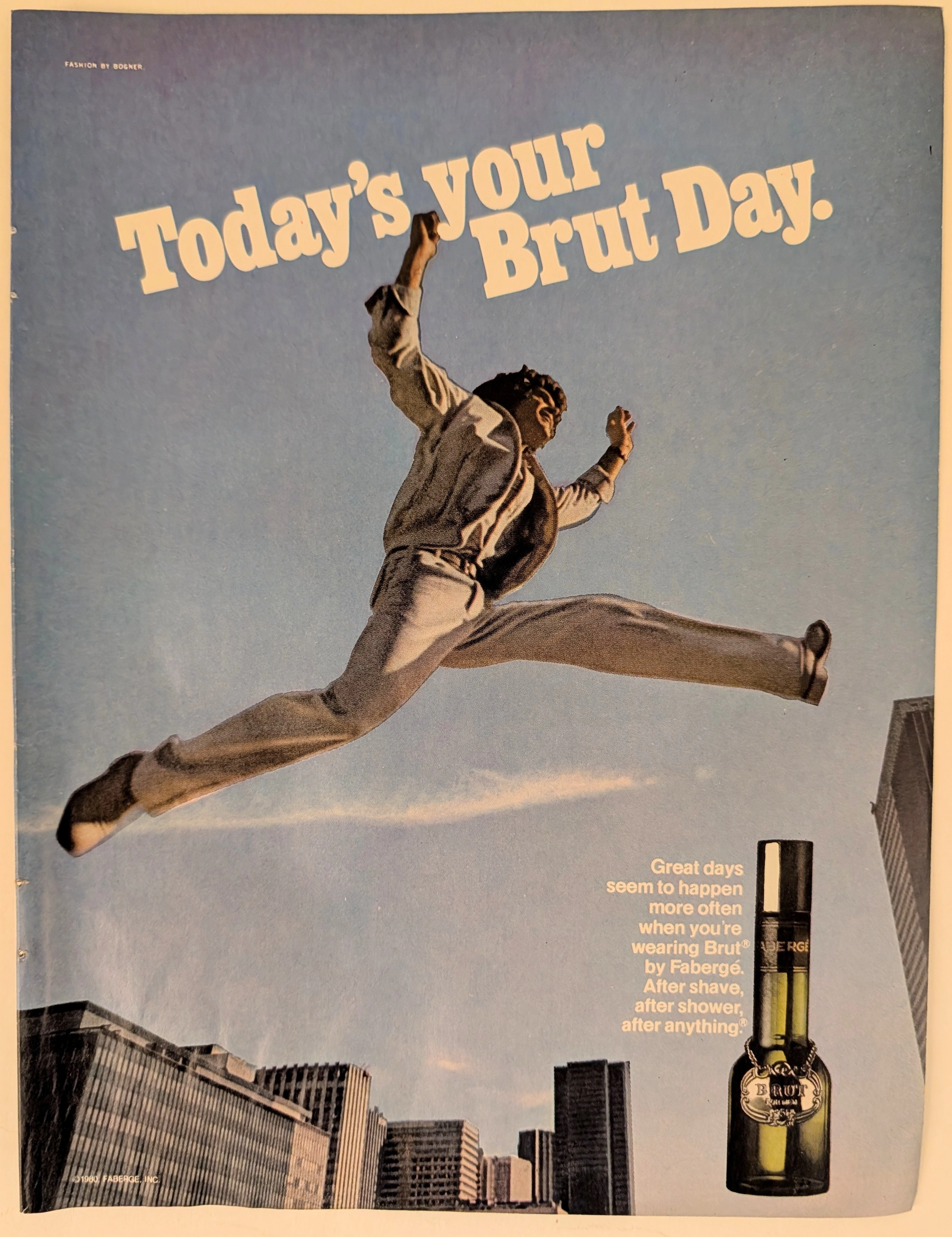
Brut
The Time Traveller's Dossier : Brut 1980 - The Grooming Shift
Then. Scent was a luxury. A scarce commodity housed in crystal. Reserved for the Sabbath. For the anniversary. For the rare, meticulously planned evening out. It was an occasion, not a routine. Now. Scent is utility. It is armor. It is a baseline expectation of modern societal engagement. The artifact before us marks the precise inflection point. The year is 1980. The moment male fragrance was deliberately uncoupled from the concept of "special occasions." It descended from the aristocratic shelf and embedded itself into the mundane rituals of the everyday man. "After shave, after shower, after anything." This is not merely advertising copy. It is a profound recalibration of masculine presentation. It is the engineered democratization of grooming.
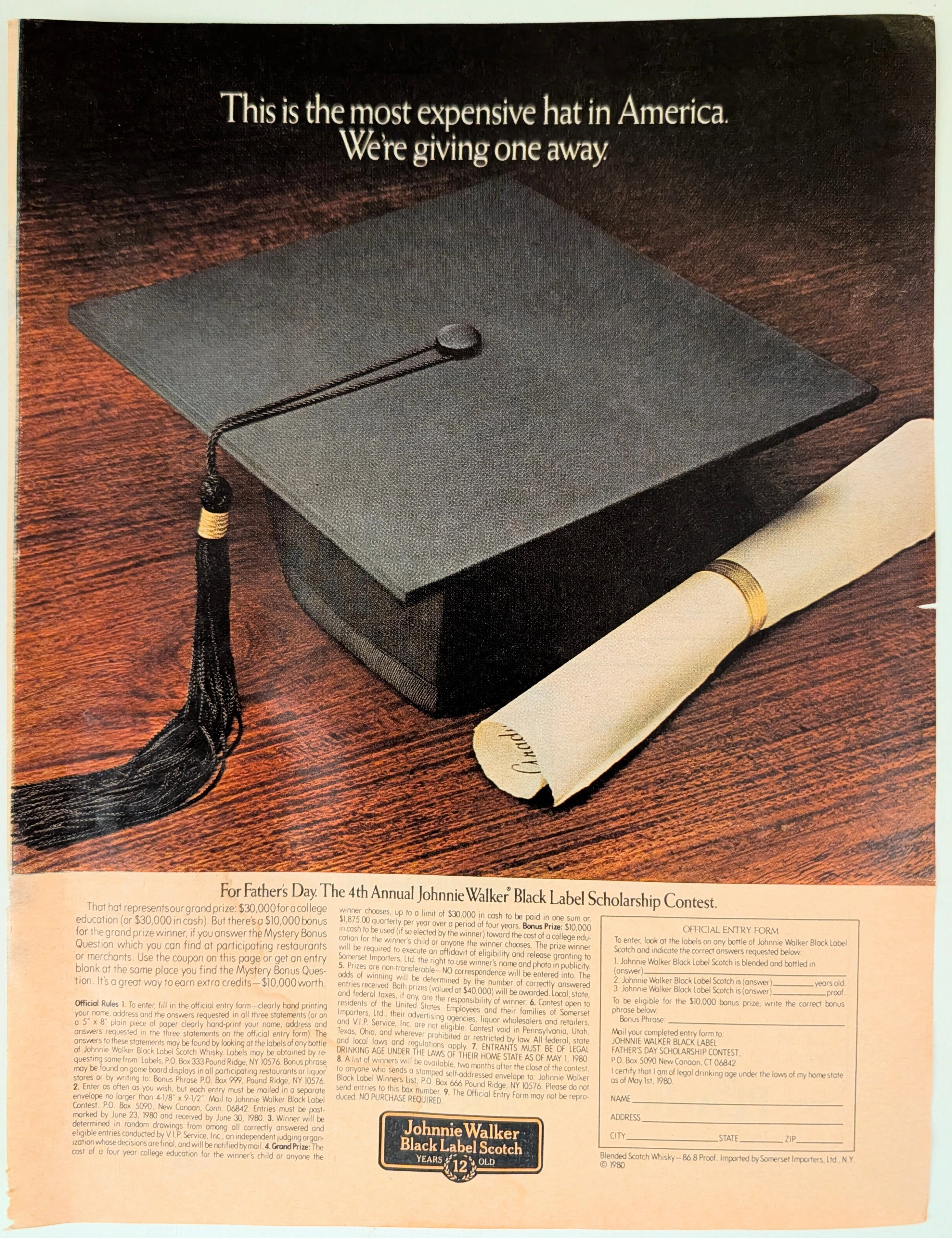
The Time Traveller's Dossier : 1980 Johnnie Walker - The Monetization of Aspiration
We observe a singular artifact from a transitional era. Before this moment, spirits were marketed through the lens of pure leisure. They were social lubricants, evening rewards, or markers of aristocratic isolation. Here, the paradigm shifts. The liquid is secondary. The product being sold is a legacy. In a period defined by economic stagflation, a whiskey brand bypasses the palate entirely to target the deepest anxiety of the American middle class: the rising cost of higher education. By framing a $30,000 scholarship as a Father’s Day promotion, the artifact reconciles the indulgence of premium alcohol with the noble sacrifice of parenthood. It is no longer a drink. It is a financial instrument. It is the monetization of parental hope.
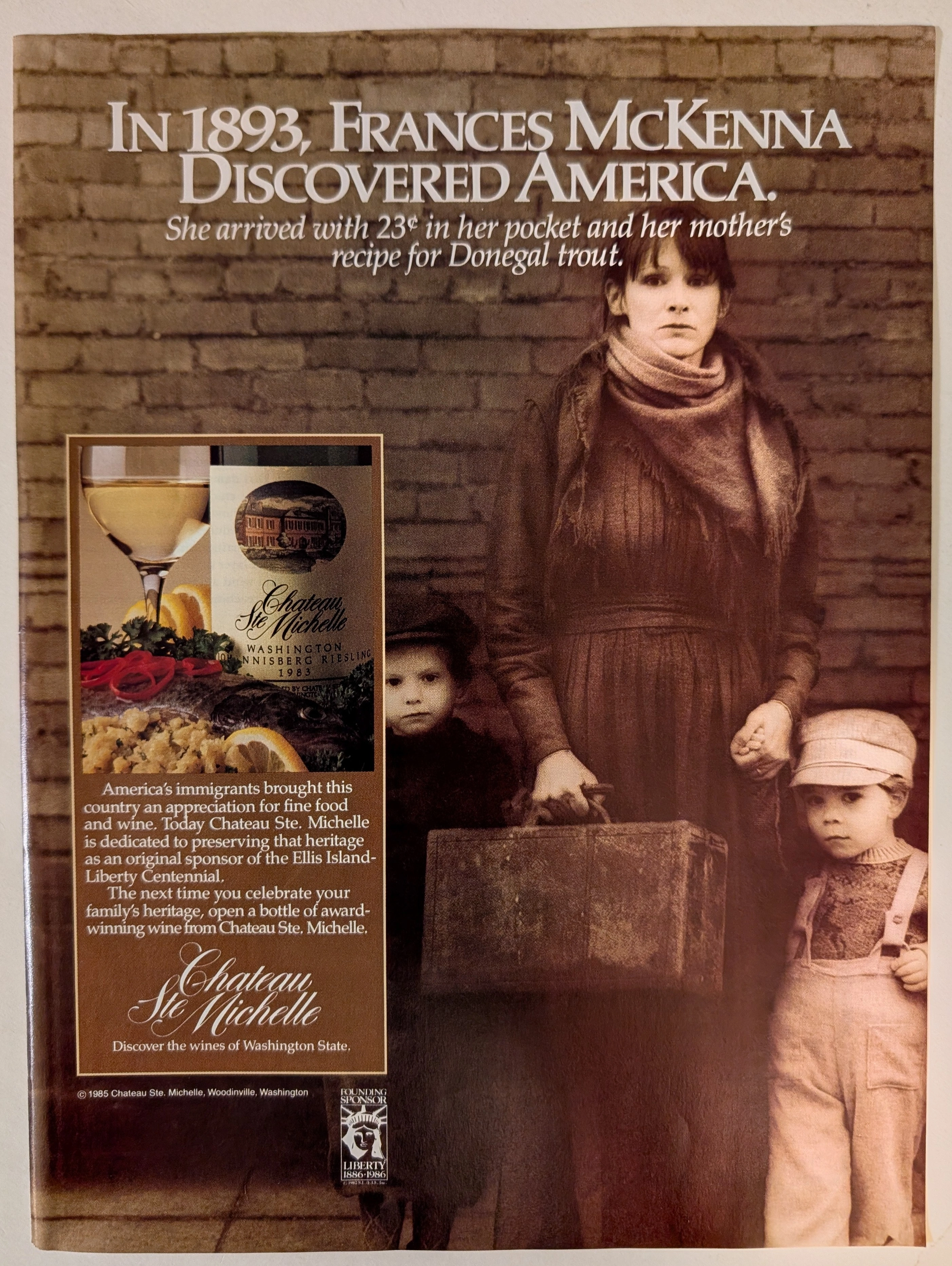
Chateau St Michelle
The Time Traveller’s Dossier: 1985 Chateau Ste. Michelle Johannisberg Riesling Vintage Advertisement — The Heritage of Arrival
Delve into the archives to explore this definitive 1985 Chateau Ste. Michelle vintage advertisement, a poignant tribute to American immigration and culinary heritage. Released during the ambitious lead-up to the Statue of Liberty's centennial, this piece transcends typical beverage marketing by weaving a grounded narrative around Frances McKenna, an 1893 Irish immigrant. For historians and collectors of vintage ads and old advertisements, this artifact stands as a masterful intersection of historical reverence and premium brand positioning. The campaign beautifully pairs a 1983 Washington Johannisberg Riesling with the enduring legacy of European culinary traditions brought to American shores. Unlike many classic print ads of the era that focused solely on product tasting notes or vineyard terroir, Chateau Ste. Michelle leveraged its role as a Founding Sponsor of the Ellis Island-Liberty Centennial to craft a deeply emotional and culturally resonant message. This document remains a profound testament to the power of heritage marketing in the late 20th century.
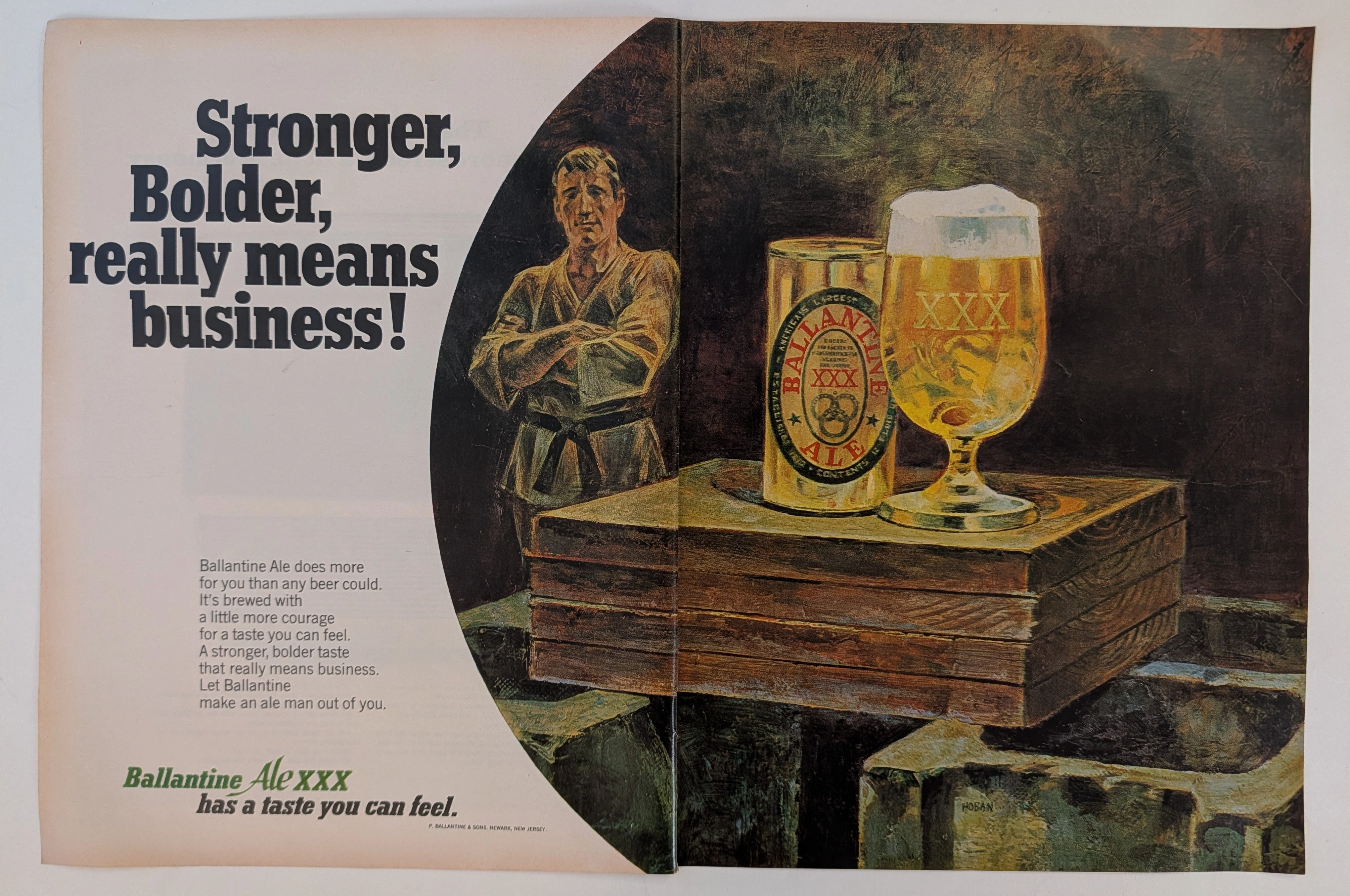
Ballantine
The Time Traveller's Dossier: The Martial Authority of the Brew – An Academic Archival Analysis of the 1968 Ballantine Ale Advertisement
The cultivation of brand identity through visual symbolism is a profound psychological discipline, acting as a mirror to the cultural aspirations of its era. The historical artifact elegantly positioned upon the analytical table of The Record Institute today is a majestic two-page print advertisement for Ballantine Ale, originating from approximately 1968. This document completely transcends the boundaries of conventional beverage promotion; it stands as a masterclass in the semiotics of mid-twentieth-century American masculinity. By seamlessly aligning the consumption of a traditional ale with the disciplined, formidable imagery of a martial arts master, the advertisement constructs a compelling narrative of strength, boldness, and unyielding character. This world-class, comprehensive academic archival dossier will conduct a meticulous and deep examination of the artifact, operating under the most rigorous parameters of historical and material science evaluation. We will decode the strategic copywriting that challenges the consumer to embrace a "stronger, bolder taste," and illuminate the profound historical lineage of the P. Ballantine & Sons brewing empire. Furthermore, as we venture into the chemical and physical foundations of this analog offset lithography, we will reveal the mechanical fingerprints of the halftone rosettes and the graceful, natural oxidation of the paper substrate. This precise intersection of visual nostalgia, mid-century commercial artistry, and the chemistry of time cultivates a serene wabi-sabi aesthetic—a natural phenomenon that serves as the primary engine driving up its market value exponentially within the elite global spheres of Vintage Breweriana collecting.
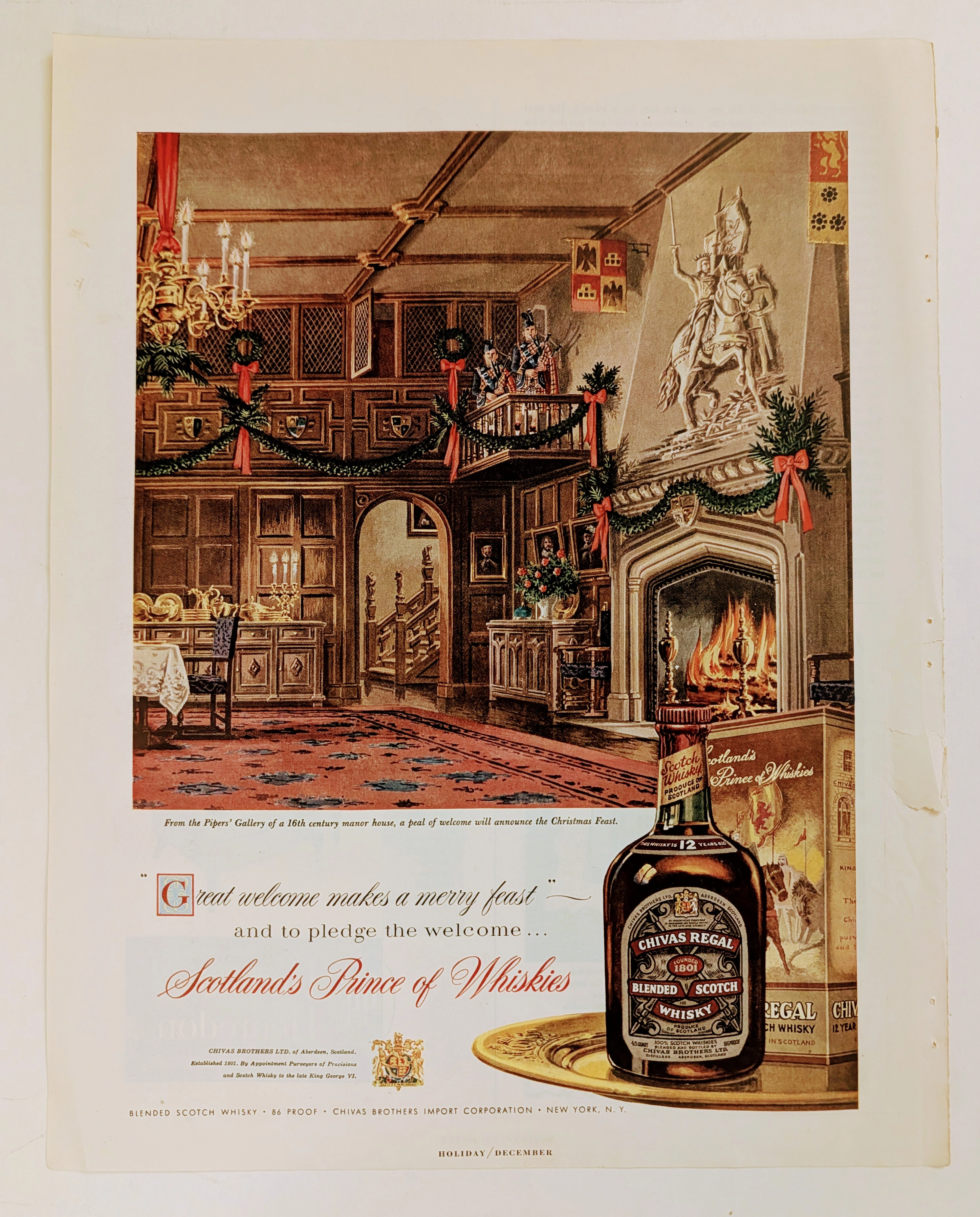
Chivas Regal
The Time Traveller's Dossier: The Architecture of Aristocracy – Chivas Regal "Prince of Whiskies" Advertisement (Circa Mid-1950s)
analysis is a meticulously preserved, single magazine tear sheet representing a pinnacle era of mid-20th-century commercial illustration and brand positioning. Far removed from the realm of disposable consumer advertising, this artifact operates as a sophisticated sociological document. It captures a precise historical epoch where the global spirits industry—specifically the Scotch whisky sector—transitioned from marketing regional agricultural products to curating internationally recognized symbols of aristocratic heritage and refined lineage. Operating with absolute curatorial precision, this dossier deconstructs a circa mid-1950s advertisement for Chivas Regal 12-Year-Old Blended Scotch Whisky. By analyzing the intersection of classical illustration, the strategic deployment of British royal iconography, and the meticulous visual forensics of the analog printing process, this document illuminates the foundational strategies of modern heritage branding. It demonstrates how a brand gracefully orchestrated a narrative of ancient nobility and warmth to captivate the post-war American consumer, establishing an enduring standard for the premium spirits market that remains profoundly influential today.
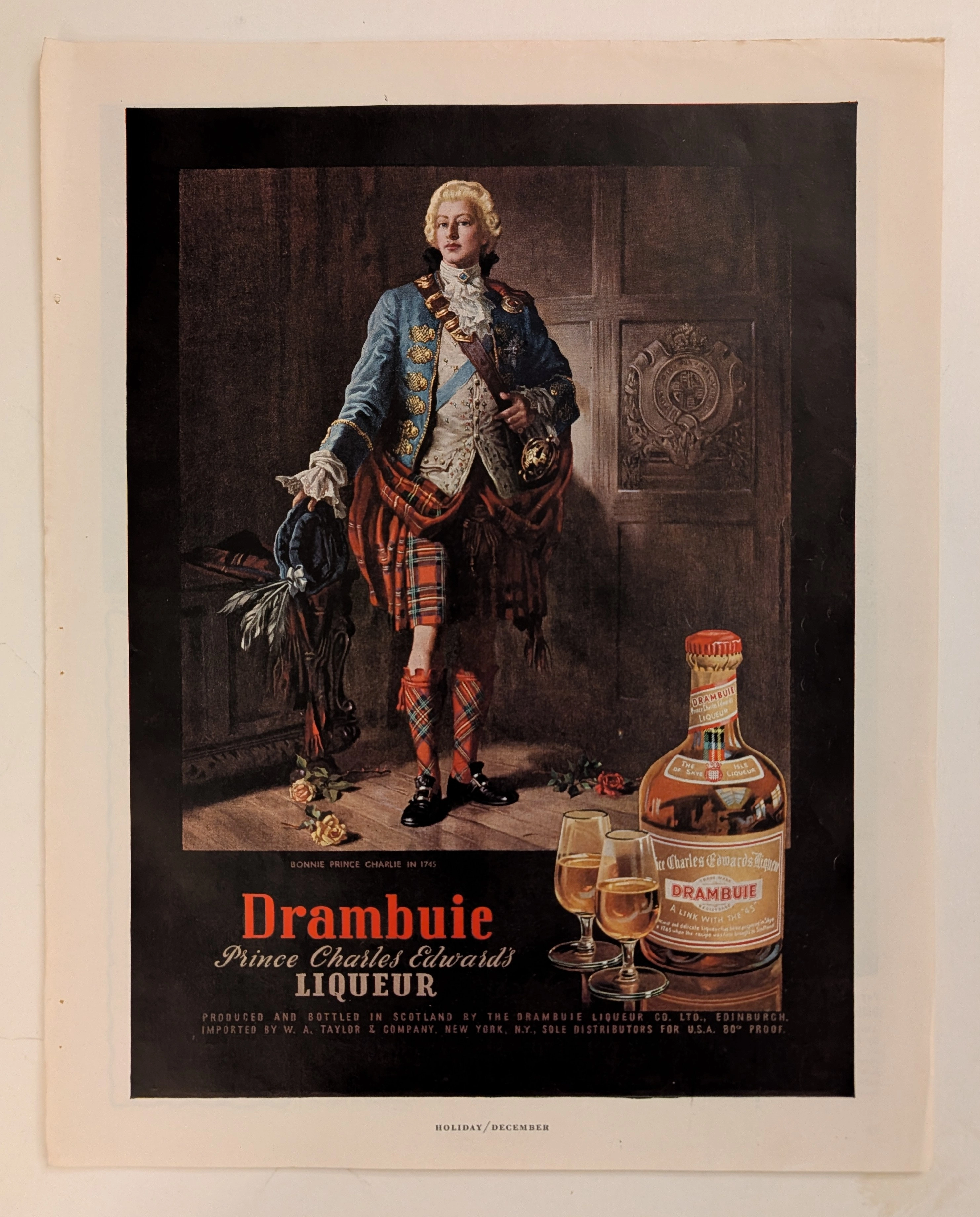
Drambuie
The Time Traveller's Dossier: The Alchemy of Royal Rebellion – Drambuie "Bonnie Prince Charlie" Advertisement (Circa Mid-20th Century)
History is rarely an objective chronicle of facts; it is a malleable narrative, continually rewritten, romanticized, and ultimately weaponized by those seeking to legitimize their power or, in the modern era, their products. Long before digital algorithms could synthesize artificial heritage, the supreme manifestation of corporate alchemy was executed through the calculated precision of the four-color offset press and the appropriation of historical iconography. The artifact presented before us is not merely a vintage magazine tear sheet selling a Scottish liqueur. It is a masterclass in the commodification of myth, a visual distillation of romantic rebellion, and a foundational blueprint for what is now known as "Heritage Branding." This museum-grade, academic archival dossier presents an exhaustive, microscopic deconstruction of a mid-20th-century print advertisement for Drambuie Liqueur. Operating on a profound binary structure, this document records a calculated paradigm shift within the global spirits industry. It captures the precise historical fracture where a highly specific, geographically isolated alcoholic beverage was conceptually transmuted into a literal draught of royal rebellion and aristocratic romance. Through the highly specialized lens of late-analog commercial artistry and stringent visual forensics, this document serves as a masterclass in psychological marketing. It established the foundational archetype for linking the consumption of a physical product with the ingestion of an epic, historical fantasy—an archetype that unconditionally dictates the visual and strategic totems of the modern luxury spirits industry today.
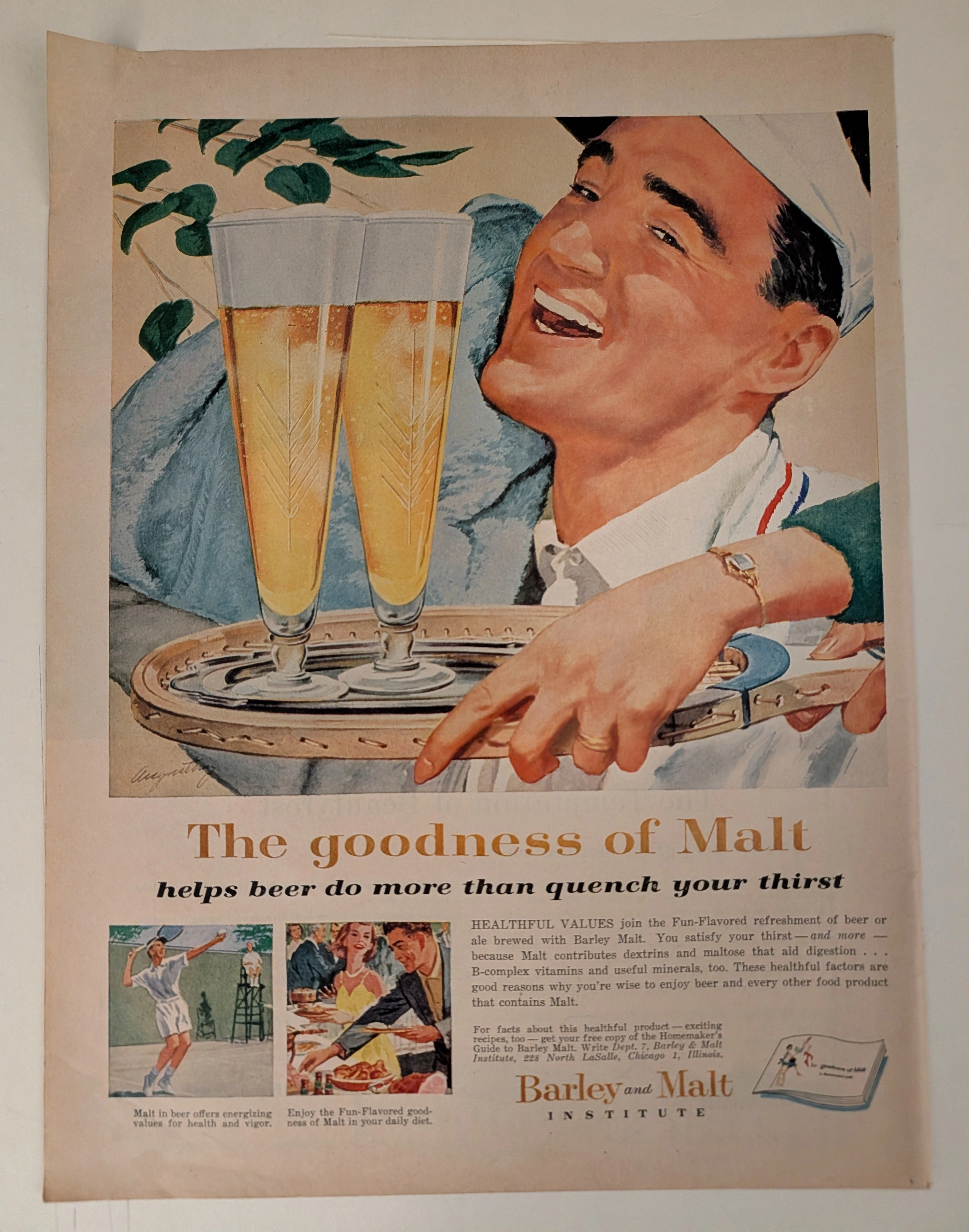
The Time Traveller's Dossier: How a 1959 Beer Ad Turned Alcohol into 'Health Food' – Barley and Malt Institute Advertisement
History is not written; it is printed. Before digital algorithms dictated human behavior, societal engineering was executed through the calculated geometry of the four-color offset press. The artifact before us is not merely an advertisement; it is a weaponized blueprint of middle-class aspiration. This museum-grade archival dossier presents an academic deconstruction of a 1959 print advertisement commissioned by the Barley and Malt Institute of Chicago. Operating on a profound binary structure, it documents a calculated paradigm shift within the American alcohol industry. It illustrates the precise historical fracture where beer was conceptually transitioned from a stigmatized working-class vice into a health-conscious staple of suburban domesticity. Through the lens of mid-century commercial artistry and precise visual forensics, this document serves as a masterclass in psychological marketing, establishing cultural tropes that unconditionally dominate modern pop culture and contemporary branding
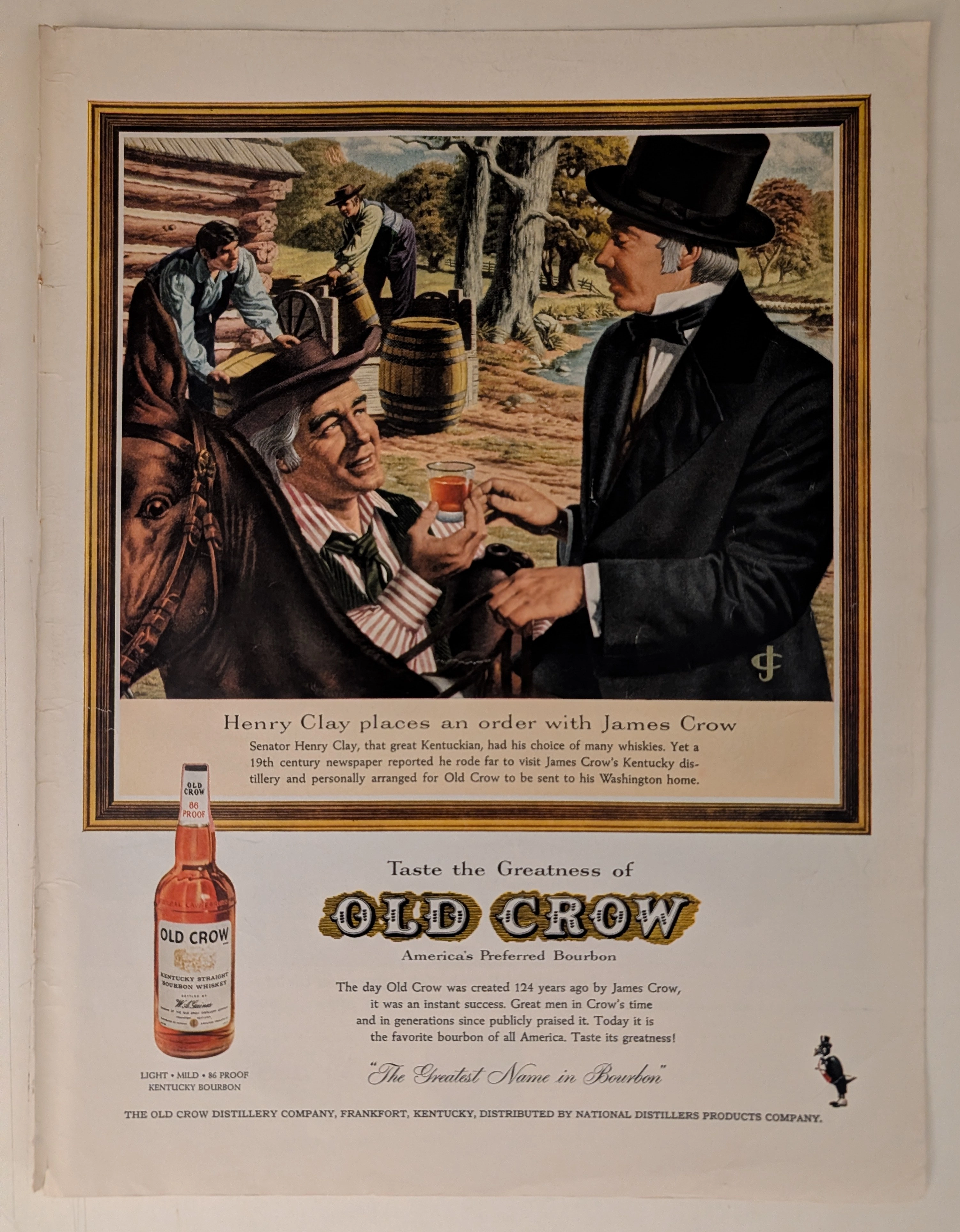
THE TIME TRAVELER'S DOSSIER: OLD CROW - THE MYTHOLOGY OF AMERICAN BOURBON
The artifact currently subjected to our uncompromising, museum-grade analysis is a profoundly preserved Historical Relic excavated from the golden age of American print media. This Primary Art Document is a full-page, magazine-sized advertisement for OLD CROW Kentucky Straight Bourbon Whiskey. Functioning as a "Forensic Blueprint of American Myth-Making," the document masterfully weaponizes political heritage and historical titans to validate the aristocratic taste and unparalleled quality of the bourbon. Its historical context is irrefutably anchored by the embossed text physically molded into the glass bottle itself—the most powerful and undeniable forensic evidence available in mid-century liquor advertising. Grounded by extreme macro details of the label, the microscopic golden monogram embroidered on the coat, and the breathtaking wabi-sabi chemical degradation of the highly acidic, magazine-sized paper, this artifact commands an irreplaceable status. It firmly cements its Rarity Class A designation as an absolute masterpiece of historical marketing engineering and analog preservation.
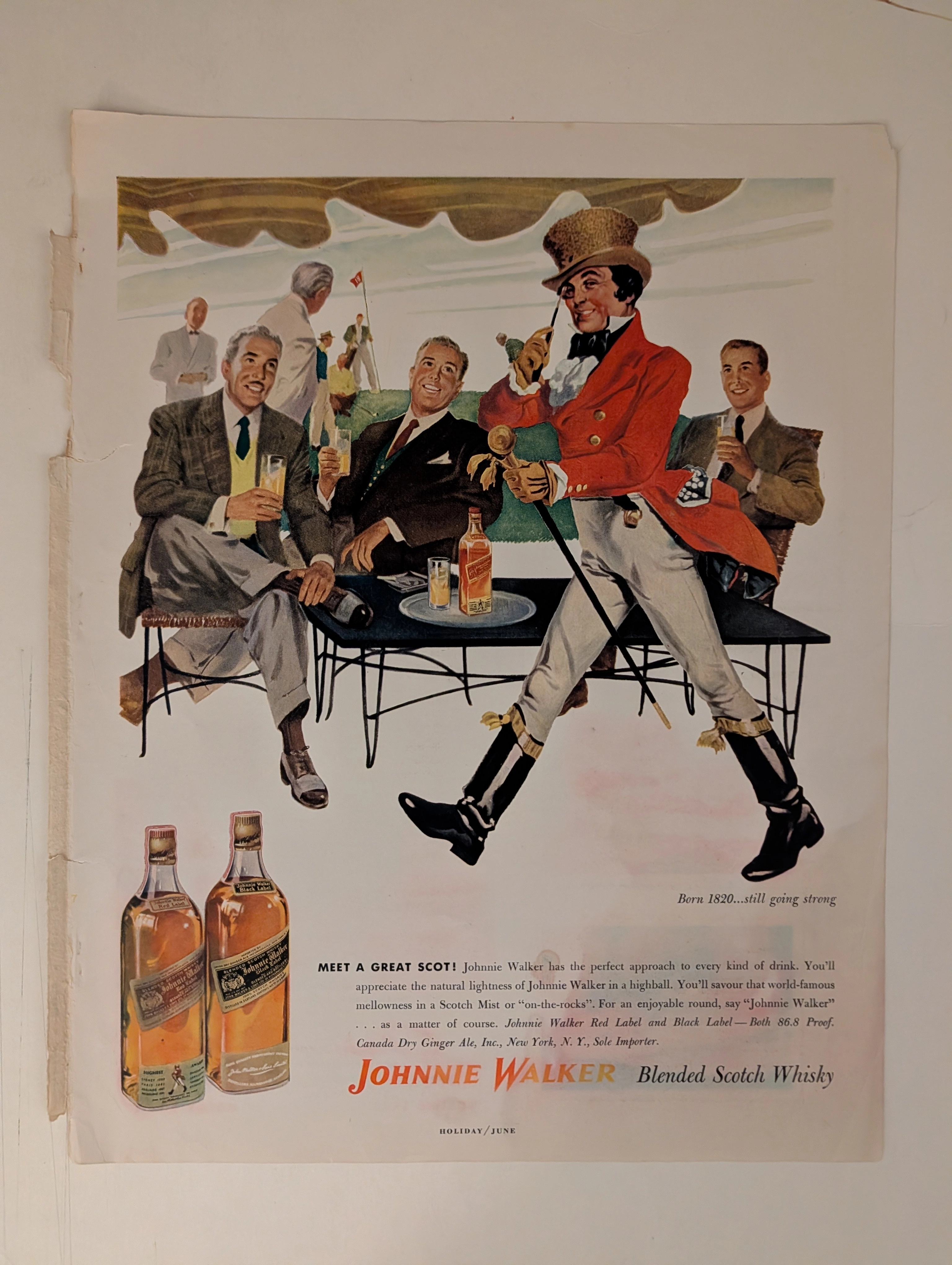
Johnnie walker
THE TIME TRAVELER'S DOSSIER :THE APPARITION OF HERITAGE — THE STRIDING MAN
The artifact currently subjected to our uncompromising, museum-grade analysis is a profoundly preserved Historical Relic excavated from the zenith of mid-century American prosperity. This Primary Art Document is a full-page magazine advertisement for Johnnie Walker Blended Scotch Whisky. Functioning as a "Forensic Blueprint of the Transatlantic Leisure Class," the document masterfully weaponizes British aristocratic heritage (embodied by the Striding Man) to validate the newly acquired wealth of post-war American consumers. Its historical context is irrefutably anchored by the microscopic fine print identifying the importer as "Canada Dry Ginger Ale, Inc., New York, N.Y.", a specific corporate era of distribution. Grounded by extreme macro details of analog halftone lithography and the breathtaking wabi-sabi chemical degradation highlighted by its violently torn binding edge, this artifact commands an irreplaceable status, cementing its Rarity Class A designation as a masterpiece of corporate sociological engineering.
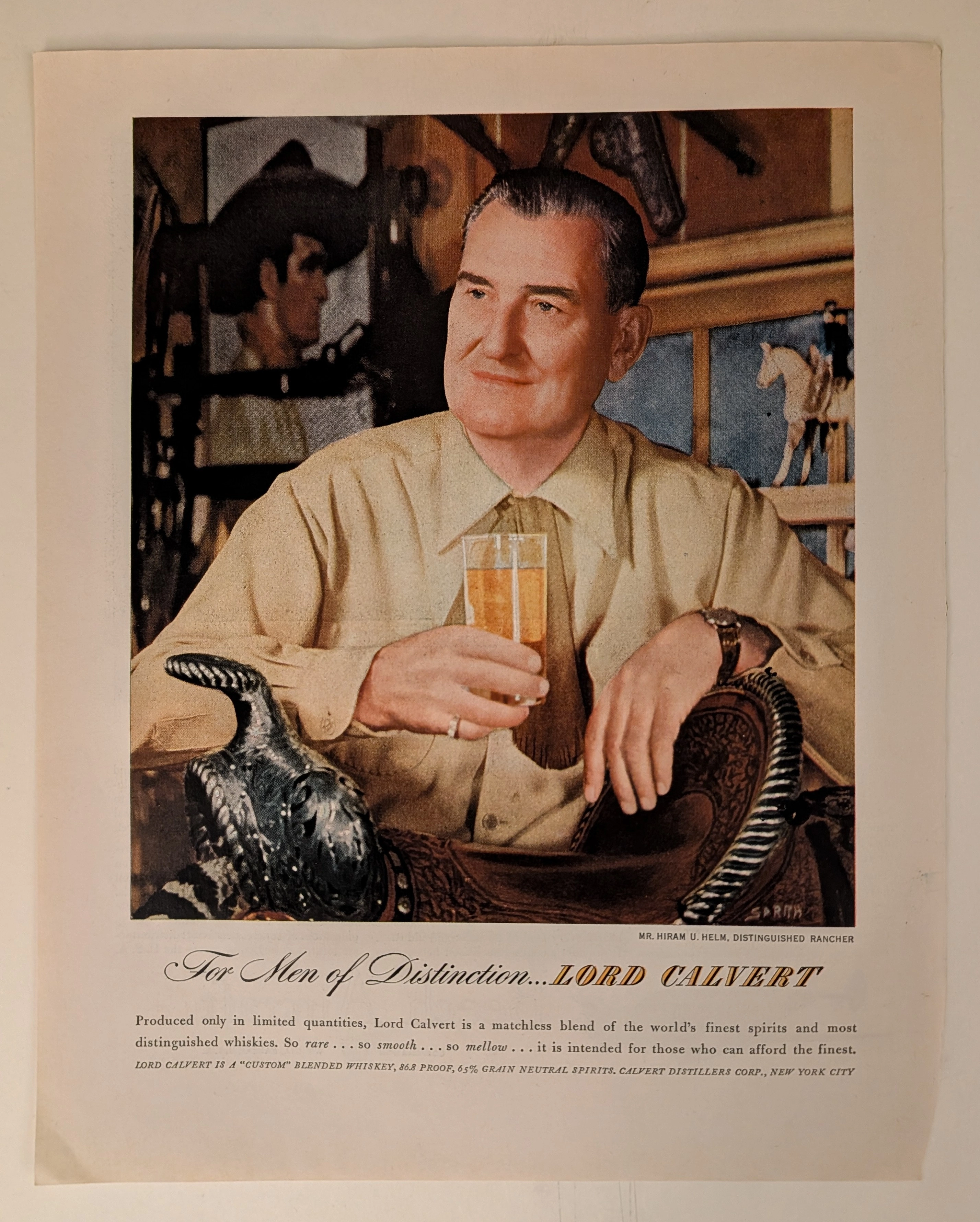
THE TIME TRAVELER'S DOSSIER: THE COMMODIFICATION OF STATUS AND THE ART OF THE ELEGANT ILLUSION
The artifact under exhaustive, uncompromising, and unprecedented museum-grade analysis is an exceptionally preserved Historical Relic originating from the absolute zenith of Madison Avenue's psychological marketing era (circa late 1940s to 1950s). This Primary Art Document is a monumental, full-page advertisement for LORD CALVERT, produced by the Calvert Distillers Corp., New York City. This piece represents the visual anchor for one of the most legendary, extensively studied, and phenomenally successful advertising campaigns in the history of American capitalism: "For Men of Distinction". It features a masterful, hyper-realistic portrait of Mr. Hiram U. Helm, Distinguished Rancher, deliberately painted/photographed to exude rugged sophistication, wealth, and aristocratic leisure. The artwork proudly bears the signature of SARRA (Valentino Sarra), a titan of mid-century commercial photography and illustration known for his cinematic lighting and profound character studies. This document is a profound "Sociological Blueprint of Aspirational Wealth." It masterfully utilized the psychology of exclusivity, marketing a blended whiskey composed of "65% Grain Neutral Spirits" as a "Custom" blend intended only "for those who can afford the finest". Rescued from the inevitable oblivion of disposable mass media, this mid-century analog artifact is a breathtaking embodiment of the Japanese aesthetic of wabi-sabi. Printed on inherently acidic wood-pulp paper, it exhibits a beautifully authentic, warm amber oxidation across its entire surface. This unstoppable molecular death transforms a piece of mass-produced corporate propaganda into an irreplaceable, ready-to-frame Primary Art Document of post-war sociological history.
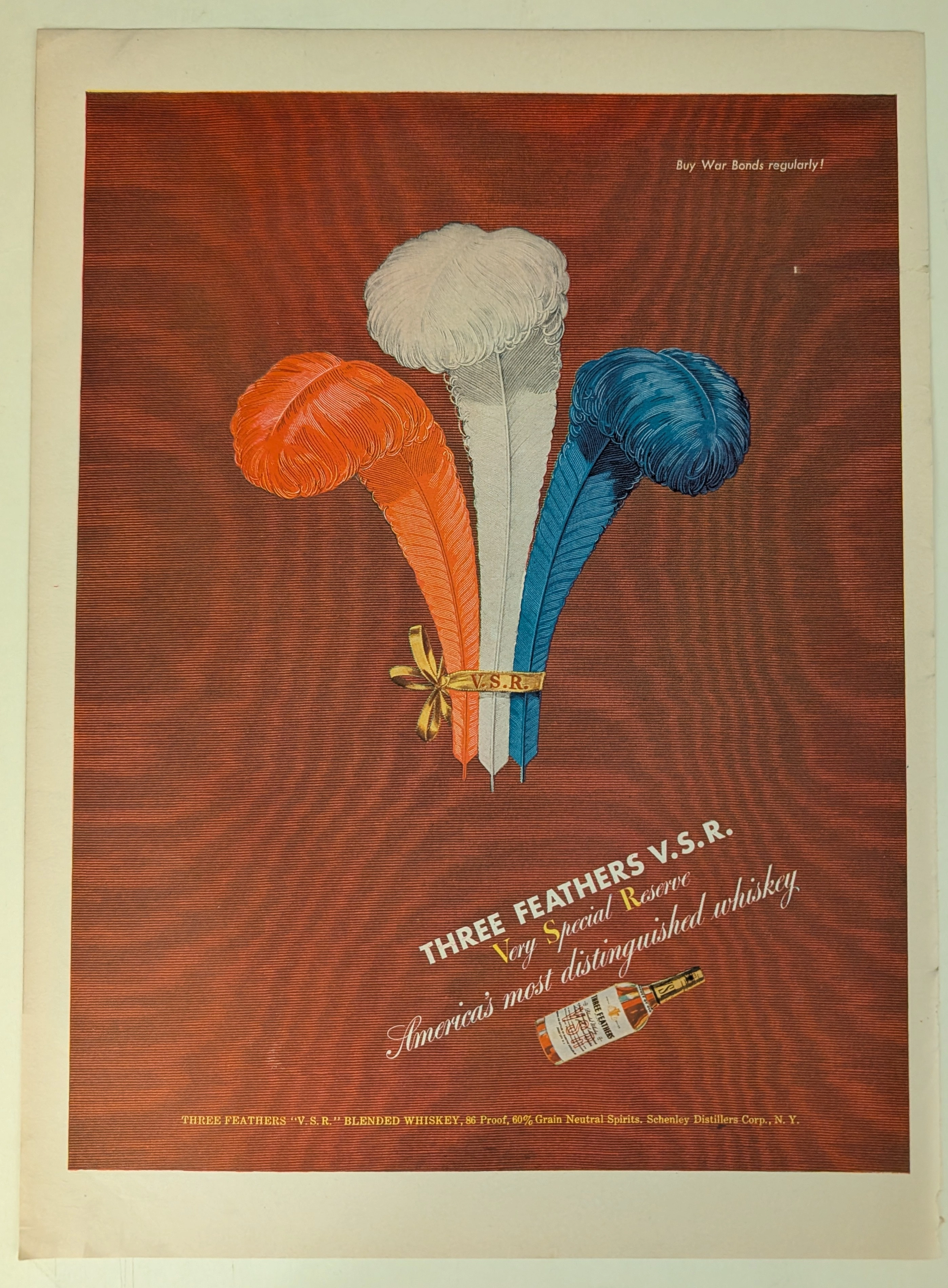
THE TIME TRAVELER'S DOSSIER: BLOOD CAPITALISM AND THE WEAPONIZATION OF WHISKEY
This impeccably preserved Historical Relic is a Primary Art Document from the brutal crucible of World War II, featuring a sweeping advertisement for THREE FEATHERS V.S.R. Blended Whiskey. It chronicles the ultimate mid-century psychological strategy of "Patriotic Capitalism." The artifact is forensically and definitively dated to the WWII era by the explicit, government-aligned directive in the upper right corner: "Buy War Bonds regularly!". Visually, the brand masterfully hijacked American nationalism by rendering its iconic three feathers in a vibrant Red, White, and Blue patriotic color scheme. Surviving the aggressive scrap paper drives of the 1940s, the acidic analog paper exhibits a profound integration of the deep crimson ink into its degrading fibers, perfectly encapsulating the analog aesthetic of wabi-sabi. This slow chemical death elevates this rescued wartime artifact to an irreplaceable Primary Art Document of Rarity Class A.
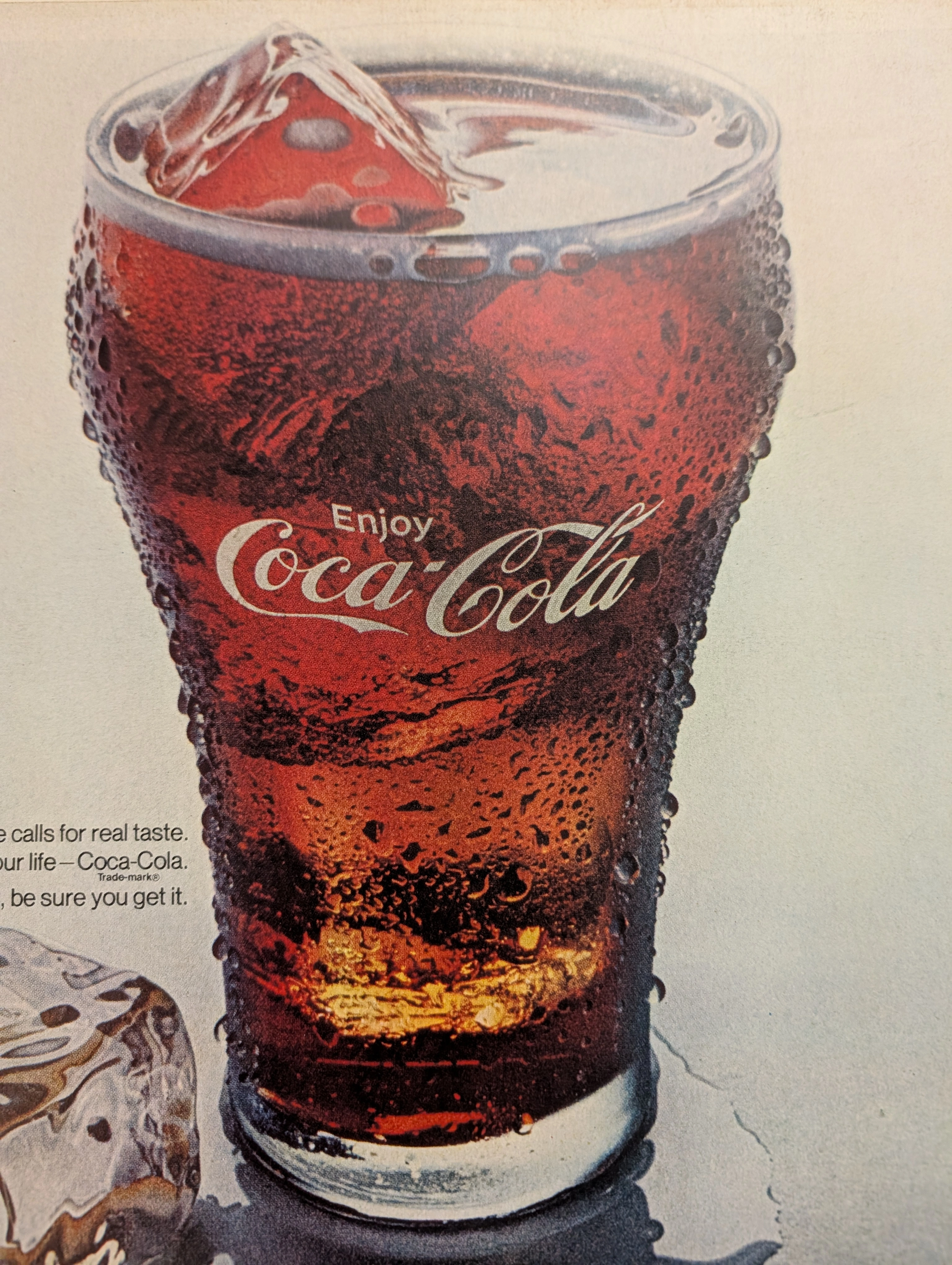
THE TIME TRAVELER'S DOSSIER: THE FLAVOR OF AUTHENTICITY AND THE PROPHET OF CAPITALISM
The artifact under uncompromising, museum-grade analysis is a flawlessly preserved Historical Relic originating from the cultural epicenter of 1970. This Primary Art Document is a monumental, full-page advertisement for Coca-Cola, officially copyrighted in 1970. It serves as the definitive visual anchor for one of the most legendary and heavily studied marketing campaigns in human history: "It's the real thing." This is not a mere beverage promotion; it is a profound sociological masterstroke. Emerging at the dawn of the 1970s—an era defined by counter-culture, political disillusionment, and a search for genuine meaning—Coca-Cola aggressively positioned its product as the ultimate, unassailable anchor of authenticity. The commanding copywriting, "Real life calls for real taste... When you ask for it, be sure you get it", is a psychological directive urging consumers to reject artificiality. Visually, the artifact is a triumph of mid-century hyper-realism. The towering glass, weeping with visceral, tactile condensation, and the monolithic block typography elevate a 15-cent soda to the status of an absolute cultural leviathan. Rescued from the inevitable oblivion of disposable mass media and preserved as a standalone Archival Artifact, the inherently acidic analog paper is undergoing a majestic chemical degradation. It exhibits a beautiful, warm patina, with natural biological oxidation softening the iconic red "Enjoy Coca-Cola" emblem. This unstoppable molecular death transforms a piece of mass-produced corporate propaganda into an irreplaceable, ready-to-frame Primary Art Document of American pop-art history.
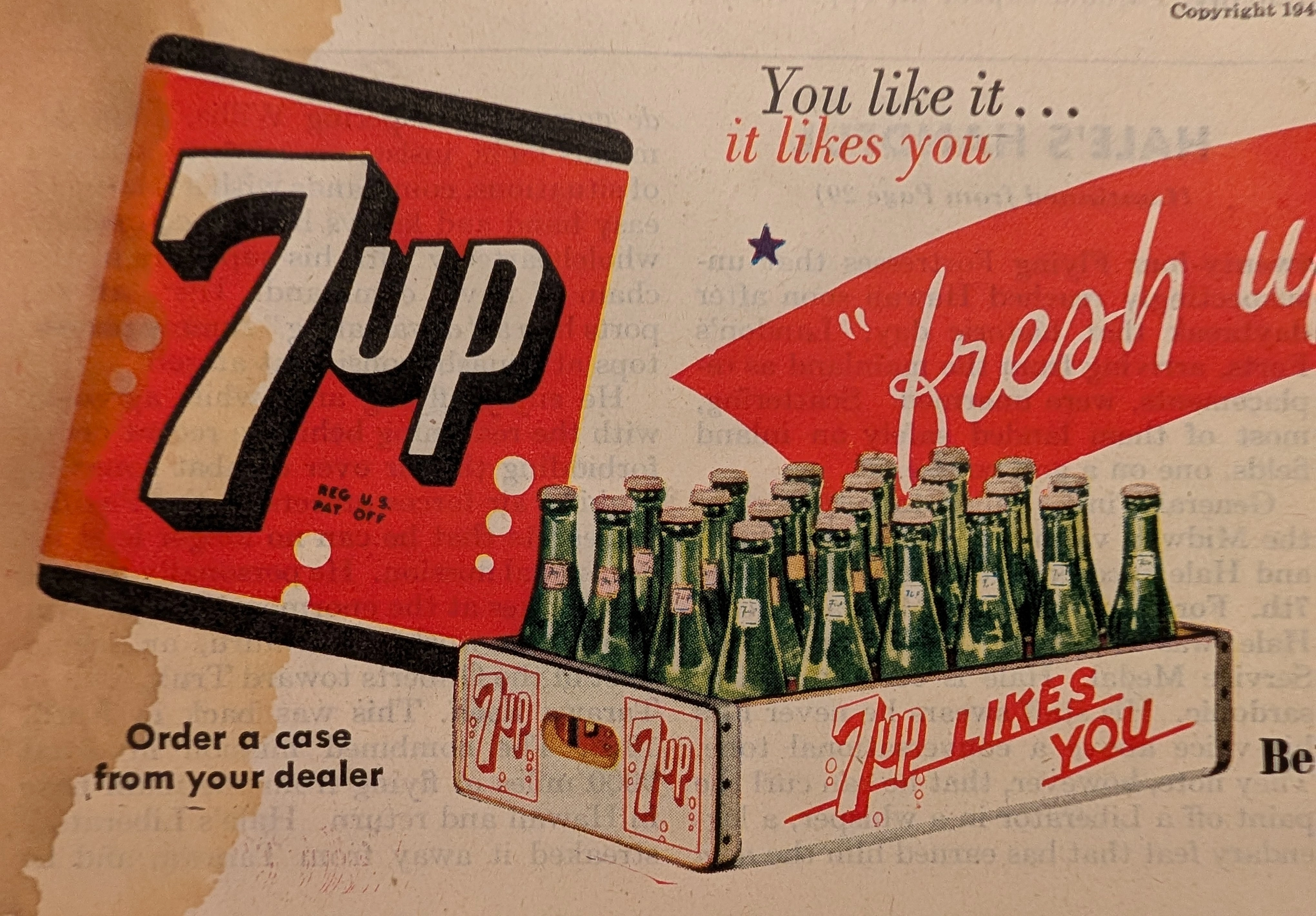
THE TIME TRAVELER'S DOSSIER: THE HOME FRONT SMILE AND THE 1944 PSYCHOLOGICAL WAR
This original 1944 7-Up advertisement cut page from The Saturday Evening Post is a vital piece of WWII Home Front ephemera. Beneath the wholesome mid-century illustrations lies a patriotic directive to support the war effort by adhering to rationing laws. The massive water stain and natural oxidation of the 80-year-old acidic paper highlight the beautiful aesthetic of decay, elevating this to a Class A primary art print.
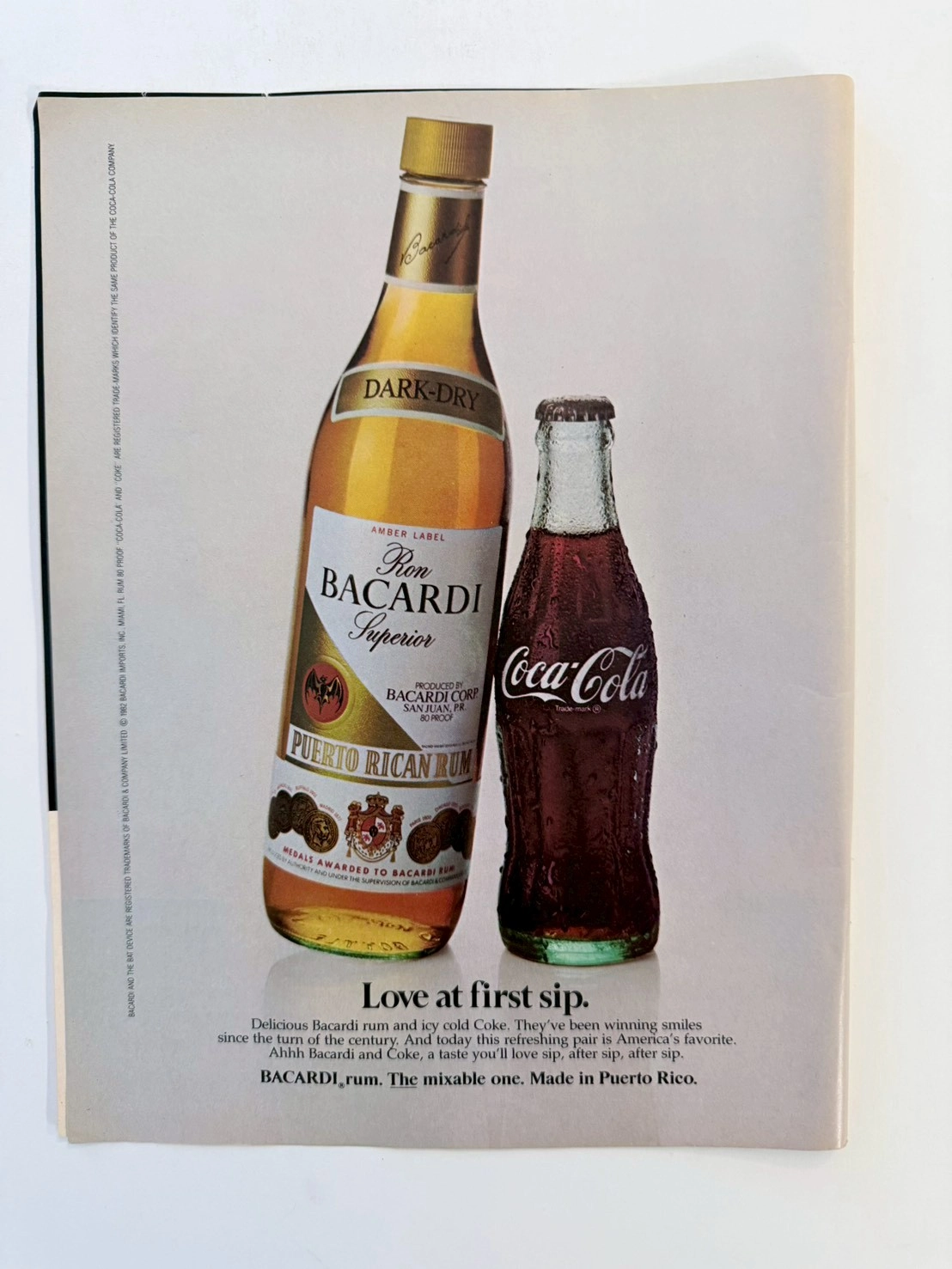
The Treaty of Two Empires: Deconstructing the 1982 Bacardi & Coca-Cola Vintage Ad (Class S)
Dive into the history of American consumerism with this museum-grade analysis of the iconic 1982 Bacardi and Coca-Cola co-branding advertisement. This Class S archival piece captures the definitive shift from the Golden Age of Illustration to 1980s commercial studio photography. Explore the geopolitical legacy of the "Cuba Libre" and the analog practical effects behind the immortal condensation on the Coca-Cola contour bottle.
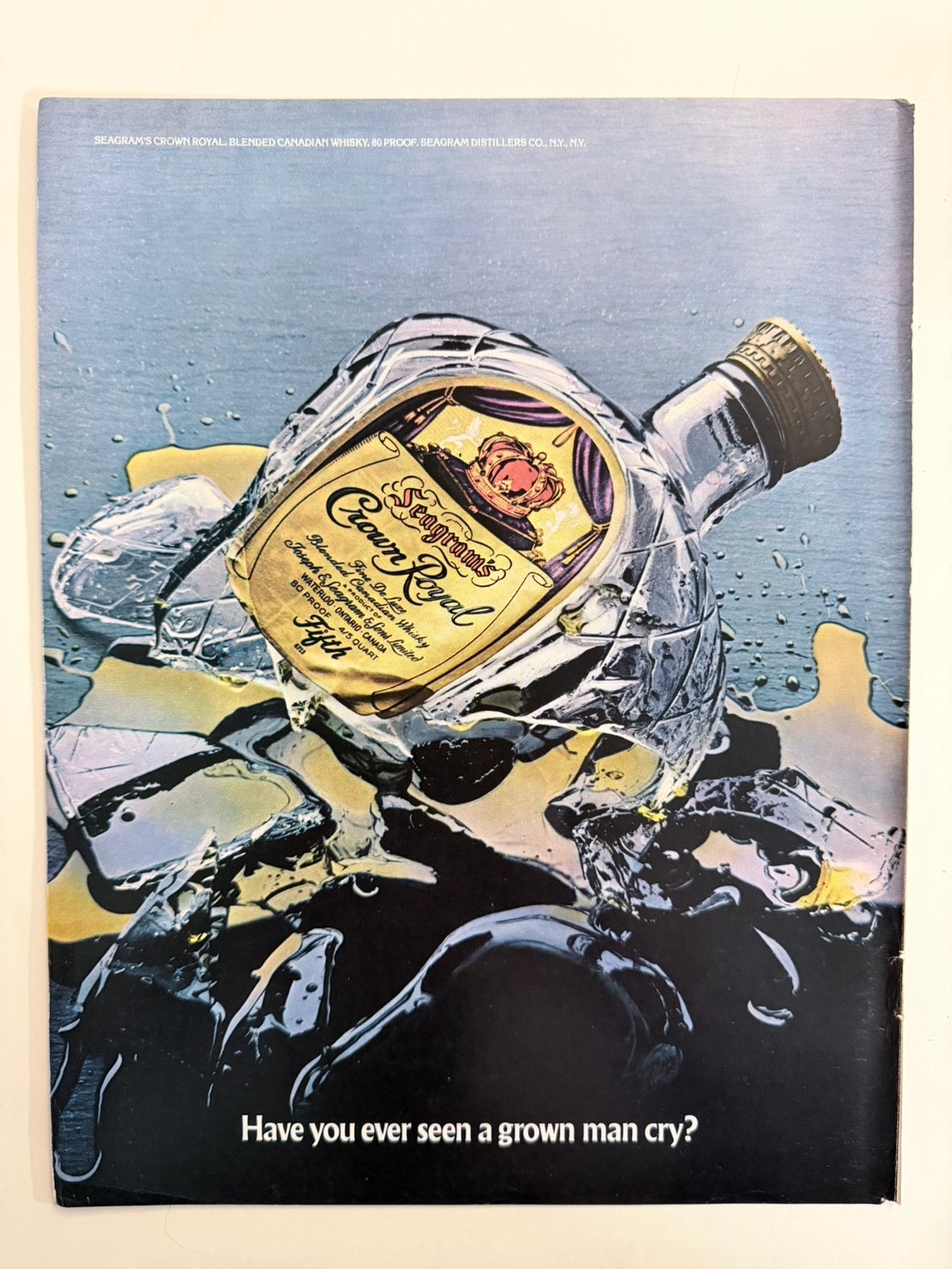
Vintage 70s Crown Royal Ad: Vanishing Analog Art | The Record
An in-depth look at the priceless 1970s Crown Royal "Have you ever seen a grown man cry?" advertisement. A masterpiece of authentic analog photography on degrading vintage paper, driving up the value of this original print as global supply inevitably shrinks.
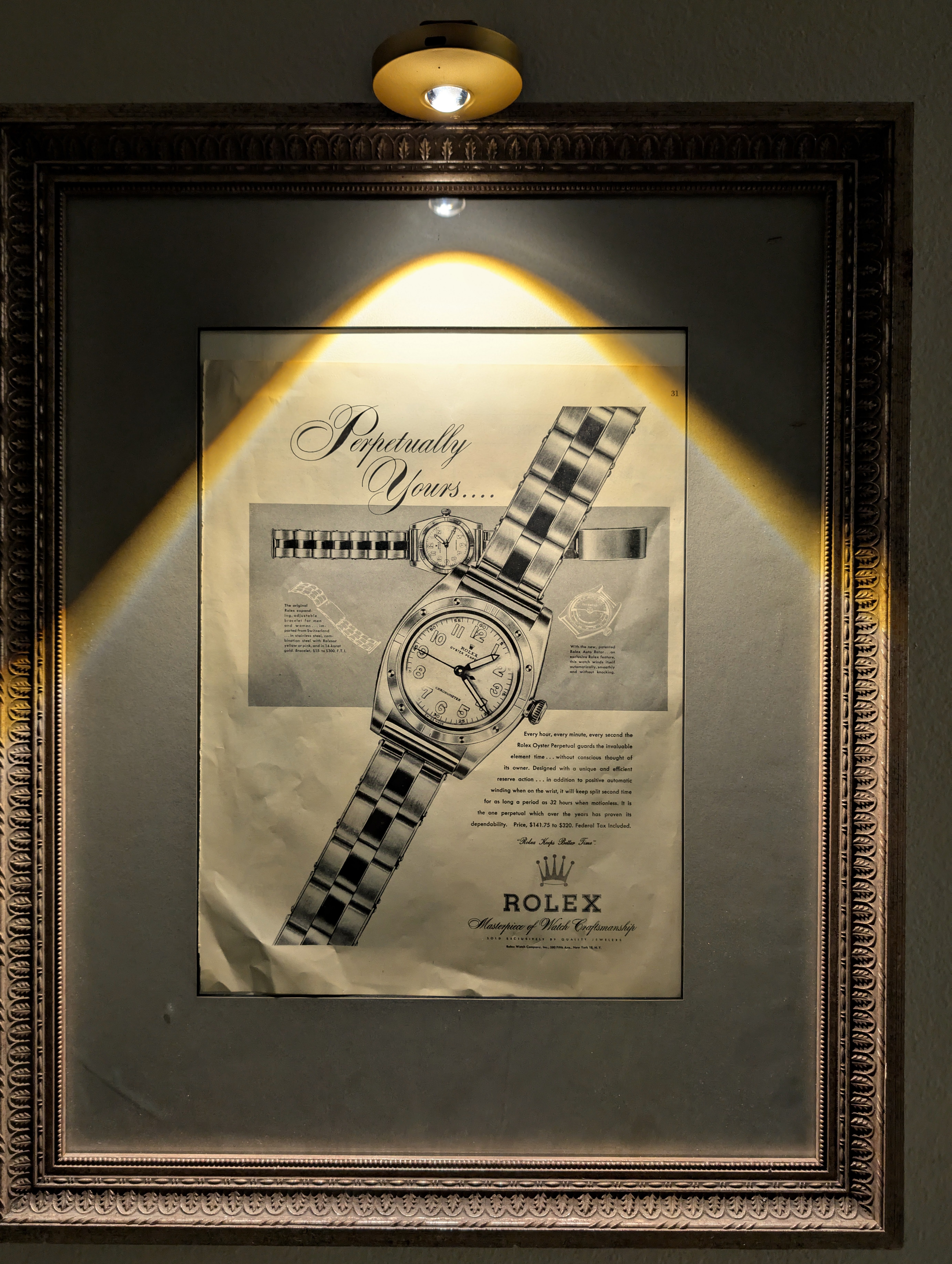
Rolex "Perpetually Yours"
This rare mid-century Rolex "Perpetually Yours" advertisement captures the genesis of the modern Rolex empire. Featuring the legendary Oyster Perpetual, it celebrates the historic union of the world's first waterproof 'Oyster' case (1926) and the revolutionary self-winding 'Perpetual' rotor (1931). A true museum-grade horological archive, this piece represents the ultimate mechanical blueprint that defined Rolex's eternal supremacy.