The Time Traveller's Dossier : 1968 Libbey - The Luxury Shift
The History
The artifact before us requires profound and exhaustive contextualization.
To comprehend this printed document, we must dissect the socio-economic anatomy of the world that necessitated it.
The year 1968 is a historical centrifuge.
The outside world is spinning into chaos.
The Tet Offensive shatters the illusion of a swift victory in Vietnam.
Protests paralyze universities from Berkeley to Paris.
Political leaders are assassinated.
The streets are loud, unpredictable, and violent.
In direct contrast to this external chaos stands the American suburban home.
It is engineered to be a sanctuary.
It is a controlled environment.
Inside the home, the hostess is the sovereign.
Entertaining is not just a pastime; it is a complex social ritual.
It is a display of stability.
It is a performance of prosperity.
But prosperity requires props.
For centuries prior, the hierarchy of glassware was rigid and exclusionary.
True fine dining required lead crystal.
Brands like Baccarat in France or Waterford in Ireland dominated the upper echelons.
These items were obscenely expensive.
They were fragile.
They were strictly inherited, carrying the weight of familial legacy.
The working class drank from simple, unadorned utility glass.
There was no middle ground.
You either owned history, or you owned utility.
Libbey Glassware, backed by the industrial titan Owens-Illinois, shattered this binary.
To understand the magnitude of this shift, we must look at the seal at the bottom of the artifact.
"1818 - 150th Anniversary - 1968".
This is not a marketing fabrication; it is an industrial bloodline.
The lineage traces back to the New England Glass Company in 1818.
In 1888, Edward Drummond Libbey moved the company to Toledo, Ohio, seeking cheaper natural gas.
In 1893, at the Chicago World's Fair, Libbey built a working glass furnace and spun a dress made of fiberglass for an actress.
They understood spectacle.
They understood desire.
But the true revolution occurred in 1903.
Michael Owens, backed by Libbey, invented the automatic bottle-blowing machine.
This machine eliminated child labor in glass factories.
It standardized production.
It reduced the cost of glass containers by an astronomical margin.
In 1929, the Owens Bottle Company merged with the Illinois Glass Company to form Owens-Illinois.
They became the titans of silica.
By 1968, Owens-Illinois had perfected the art of high-speed, flawless, automated glass production.
They could produce millions of perfectly identical tumblers in days.
But a plain glass tumbler is merely a commodity.
It sells for pennies.
The margin is in the aesthetic.
The margin is in the meaning.
This advertisement represents the apex of value-addition through applied design.
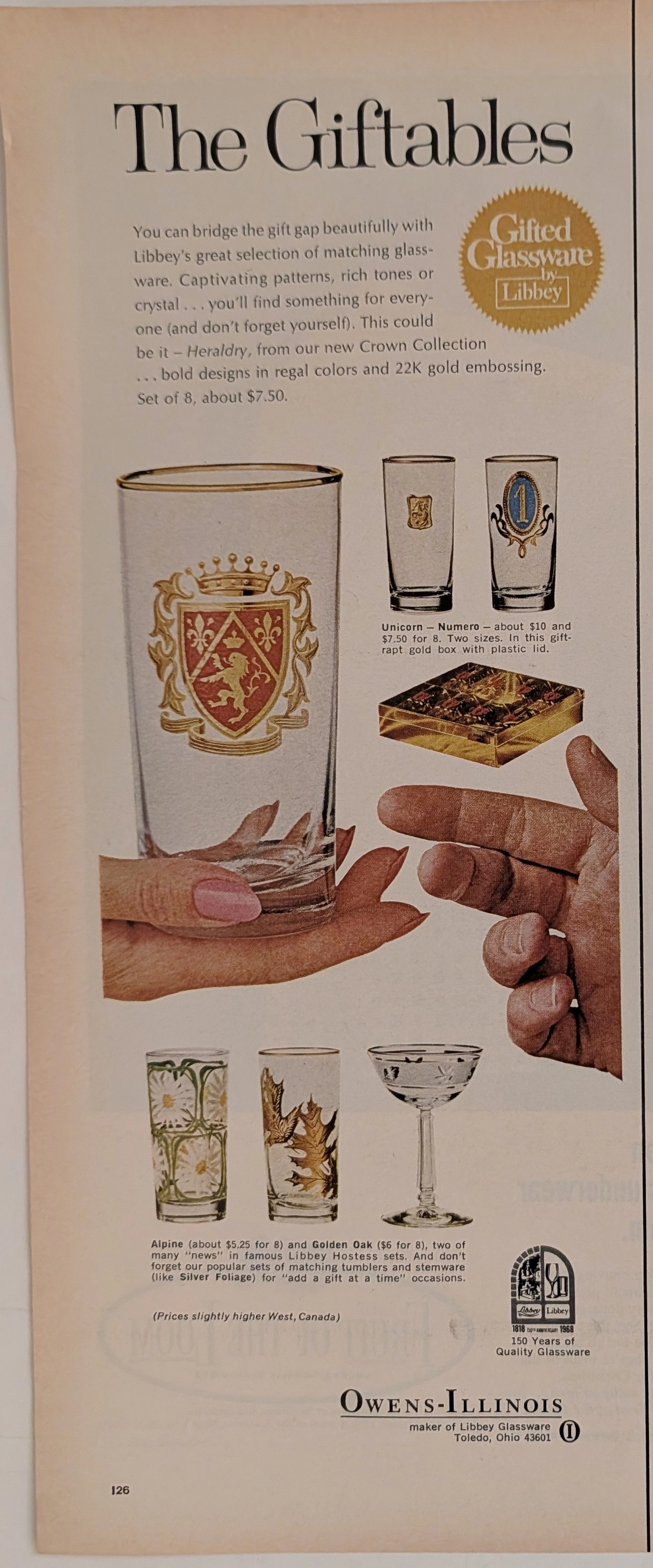
Look at the premier collection featured: "Heraldry, from our new Crown Collection."
"Bold designs in regal colors and 22K gold embossing."
This is a psychological masterstroke.
The post-war American middle class was highly mobile.
They had left their ancestral homes.
They had severed their roots to move to newly paved subdivisions.
They lacked old money, and they lacked inherited crests.
Libbey provided a synthetic aristocracy.
For about $7.50, a suburban housewife could serve iced tea in glasses emblazoned with lions, crowns, and fleurs-de-lis.
She could purchase an instant coat of arms.
It was the democratization of feudal aesthetics.
Consider the other patterns presented in the artifact.
"Unicorn" and "Numero".
The unicorn is a symbol of mythical purity and European folklore.
"Numero" utilizes a medallion design reminiscent of Roman antiquity.
Below them, we see "Alpine" and "Golden Oak".
These cater to a different aesthetic desire: the domestication of nature.
While the outside world was rapidly industrializing, the hostess could offer a beverage encased in delicate daisies or autumnal gold leaves.
It was a curated, sanitized version of the natural world, safely contained within a glass cylinder.
The text itself introduces a brilliant piece of manufactured anxiety: "The gift gap."
"You can bridge the gift gap beautifully with Libbey's great selection..."
What is the gift gap?
It is a purely invented social deficiency.
It is the space between the obligation to give a gift and the financial reality of the giver.
In 1968, social obligations were frequent.
Housewarmings, bridal showers, anniversaries, and casual dinner parties required tribute.
Libbey positioned its product as the ultimate social lubricant.
It was affordable enough not to ruin the giver's budget.
Yet, because of the 22K gold embossing and the elaborate "gift-rapt gold box with plastic lid," it appeared highly valuable.
It allowed the middle class to exchange manufactured luxury, satisfying the rituals of hospitality without the financial devastation of purchasing actual crystal.
This is a profound historical shift in consumer behavior.
It is the birth of "masstige"—mass prestige.
It paved the way for the modern home goods industry.
It taught consumers that elegance did not have to be earned through lineage; it could be purchased at a department store.
The artifact documents the exact moment when the aesthetic of the elite was successfully translated into the language of the assembly line.
Owens-Illinois did not just manufacture glass in Toledo, Ohio.
They manufactured social mobility.
They manufactured suburban royalty.
They took silica, ash, and limestone, melted it at thousands of degrees, and cooled it into the shape of the American Dream.
The Paper
The physical medium is a prime specimen of mid-century commercial offset lithography.
We are examining a magazine page from 1968.
The paper is a lightweight, coated text stock, formulated specifically for high-speed web presses.
The surface coating is critical; it prevents the ink from absorbing too deeply into the paper fibers.
This allows for the crisp reproduction of the photographic elements.
Under macro examination, the mechanical reality of the illusion is exposed.
The rich skin tones of the hands, the golden hues of the "Gifted Glassware" seal, and the deep reds of the Heraldry shield are all optical illusions.
They are constructed from overlapping matrices of Cyan, Magenta, Yellow, and Black (CMYK) halftone dots.
The "22K gold" embossing on the glass is not printed with metallic ink in this photograph.
It is simulated using precise combinations of yellow and magenta dots to mimic the reflection of light on metal.
The physical aging of the paper tells its own story.
The edges are yellowing, indicating the presence of lignin in the wood pulp.
As the lignin oxidizes over decades, it produces acids that slowly break down the cellulose.
The paper is effectively burning itself at an imperceptibly slow rate.
The background, meant to be a neutral, inviting warm white, has deepened into an antique cream.
This artifact is a temporal recording device.
It was designed to be glanced at for five seconds in 1968 and thrown away.
Its survival turns it into an accidental archive, capturing both the marketing psychology of its era and the chemical degradation of its own physical body.
The Rarity
Classification: Class B.
This advertisement was inserted into national publications with circulation numbers in the millions.
As an object, it was inherently common at the moment of its creation.
However, its current rarity is defined by its survival and its condition.
Most of these pages were incinerated, sent to landfills, or destroyed by moisture and time.
Its true value is not found in auction houses.
Its value is contextual and educational.
It is a pristine Rosetta Stone for understanding mid-century consumer psychology.
It is a flawless record of the corporatization of gift-giving and the mass production of status symbols.
Visual Impact
The visual composition is a masterclass in psychological manipulation.
The eye is immediately drawn to the large "Gifted Glassware by Libbey" seal, rendered to look like a gold foil sticker.
It establishes authority and premium quality before the viewer even reads a word.
Below the text, we see the primary visual anchor: disembodied hands holding the Heraldry glass.
This is not an accident of layout.
The hands are perfectly manicured.
They belong to an idealized, affluent woman.
She is holding the glass delicately, presenting it outward.
The image places the reader in the position of the receiver.
It simulates the act of being served, of being gifted.
It bypasses the intellect and appeals directly to the human desire to be cared for and respected.
The typography reinforces the dual nature of the product.
"The Giftables" is set in a refined, elegant serif typeface.
It communicates tradition, stability, and high culture.
Conversely, the "Owens-Illinois" logo at the bottom uses a stark, industrial serif.
It is the signature of the factory.
The layout bridges the gap between the mechanical reality of Toledo, Ohio, and the aristocratic fantasy of the Crown Collection.
The strategic use of warm colors—gold, reds, and the natural tones of the hands—creates an atmosphere of warmth, generosity, and hearth.
Exhibition Halls
Tags
The Archive Continues
Continue the Exploration

Firestone · Automotive
The Time Traveller's Dossier: The Firestone Margin of Safety
The symbiotic relationship between the extreme, high-stakes crucible of professional motorsport and the evolution of the daily-driven passenger automobile is one of the foundational narratives of twentieth-century industrial design. The historical artifact elegantly and securely positioned upon the analytical table of The Record Institute today is a majestic, large-format, two-page print advertisement for Firestone Tires, originating from the golden era of American automotive performance, circa 1967-1968. This document transcends the traditional boundaries of automotive consumable marketing. It operates as a highly sophisticated, multi-layered historical record, capturing the exact moment when the staggering horsepower outputs of the Detroit muscle car era necessitated a paradigm shift in tire technology. This comprehensive dossier conducts a meticulous, unyielding, and exceptionally deep examination of the artifact, operating under the absolute most rigorous parameters of historical, sociological, and material science evaluation. With an overwhelming eighty percent of our analytical focus dedicated to its historical gravity, we will decode the revolutionary introduction of the Firestone "Wide Oval" tire, analyze the critical importance of the vehicles depicted—including a Ford Mustang and a Dodge Coronet—and provide a profound biographical and mechanical analysis of the legendary racing driver Parnelli Jones and his revolutionary 1967 STP-Paxton Turbocar. Furthermore, as we venture into the chemical and physical foundations of this analog printed ephemera, we will reveal the precise mechanical fingerprints of the CMYK halftone rosettes and the graceful, natural oxidation of the paper substrate. This precise intersection of visual nostalgia, mid-century commercial artistry, and the immutable chemistry of time cultivates a serene wabi-sabi aesthetic—a natural, irreversible phenomenon that serves as the primary engine driving up its market value exponentially within the elite global spheres of Vintage Automotive Ephemera and Motorsport Memorabilia collecting.

General Motors · Automotive
The Time Traveller's Dossier: The Zenith of General Motors
The automobile in mid-twentieth-century America was never merely a mode of transportation; it was a colossal canvas projecting industrial pride, technological advancement, and shifting consumer identities. The historical artifact elegantly and securely positioned upon the analytical table of The Record Institute today is a magnificent, large-format, two-page print advertisement for General Motors (GM), originating from the late 1960s to early 1970s. This document completely transcends the traditional boundaries of automotive catalogs. It operates as a highly sophisticated, dual-narrative cultural mirror: the left page captures the visceral, visual desire of "Looks" intertwined with a radical new era of feminine empowerment, while the right page dissects the mechanical and electronic mastery of "And closer looks," showcasing the vast ecosystem of GM's specialized manufacturing divisions. This world-class, comprehensive dossier conducts a meticulous, unyielding, and exceptionally deep examination of the artifact, operating under the absolute most rigorous parameters of historical, sociological, and material science evaluation. We will decode the immense industrial weight of the "Mark of Excellence" campaign, analyze the profound sociological implications of the female model's tailored pantsuit as a symbol of women's liberation, and dissect the anatomy of the nine revolutionary automotive technologies that defined modern driving. Furthermore, as we venture deeply into the chemical and physical foundations of this analog printed ephemera, we will reveal the precise mechanical fingerprints of the CMYK halftone rosettes and the graceful, natural oxidation of the paper substrate. This precise intersection of visual nostalgia, mid-century commercial artistry, and the immutable chemistry of time cultivates a serene wabi-sabi aesthetic—a natural, irreversible phenomenon that serves as the primary engine driving up its market value exponentially within the elite global spheres of Vintage Automotive Ephemera and Industrial Design collecting.

ฺีBulova · Fashion
The Time Traveller's Dossier : Caravelle vs Timex - The Jeweled Shift
Time was once a luxury. Then, it became a commodity. Before this artifact, the consumer market accepted a bitter compromise: affordability meant fragility. The mid-20th century was dominated by the pin-lever escapement. It was a mechanism of planned obsolescence. It brought timekeeping to the masses, but at the cost of durability. The market leader, Timex, built an empire on this disposable architecture. Then came the shift. This advertisement is a tactical strike. It is not merely selling a watch; it is dismantling an empire’s foundation. By placing a children’s novelty item alongside a market leader, Bulova’s Caravelle executed a masterclass in comparative destruction. They solved the problem of the disposable watch by democratizing the jeweled movement. It changed the expectation of the working class. It declared that precision was no longer reserved for the elite. Affordability no longer required surrender.